Business RadioX ®

  • Home
  • Business RadioX ® Communities
    • Southeast
      • Alabama
        • Birmingham
      • Florida
        • Orlando
        • Pensacola
        • South Florida
        • Tampa
        • Tallahassee
      • Georgia
        • Atlanta
        • Cherokee
        • Forsyth
        • Greater Perimeter
        • Gwinnett
        • North Fulton
        • North Georgia
        • Northeast Georgia
        • Rome
        • Savannah
      • Louisiana
        • New Orleans
      • North Carolina
        • Charlotte
        • Raleigh
      • Tennessee
        • Chattanooga
        • Nashville
      • Virginia
        • Richmond
    • South Central
      • Arkansas
        • Northwest Arkansas
    • Midwest
      • Illinois
        • Chicago
      • Michigan
        • Detroit
      • Minnesota
        • Minneapolis St. Paul
      • Missouri
        • St. Louis
      • Ohio
        • Cleveland
        • Columbus
        • Dayton
    • Southwest
      • Arizona
        • Phoenix
        • Tucson
        • Valley
      • Texas
        • Austin
        • Dallas
        • Houston
    • West
      • California
        • Bay Area
        • LA
        • Pasadena
      • Colorado
        • Denver
      • Hawaii
        • Oahu
  • FAQs
  • About Us
    • Our Mission
    • Our Audience
    • Why It Works
    • What People Are Saying
    • BRX in the News
  • Resources
    • BRX Pro Tips
    • B2B Marketing: The 4Rs
    • High Velocity Selling Habits
    • Why Most B2B Media Strategies Fail
    • 9 Reasons To Sponsor A Business RadioX ® Show
  • Partner With Us
  • Veteran Business RadioX ®

BRX Pro Tip: Another Sales Tip from Bob Moesta

July 17, 2024 by angishields

BRXmic99
BRX Pro Tips
BRX Pro Tip: Another Sales Tip from Bob Moesta
Loading
00:00 /
RSS Feed
Share
Link
Embed

Download file

BRX-Banner

BRX Pro Tip: Another Sales Tip from Bob Moesta

Stone Payton: Welcome back to Business RadioX Pro Tips. Stone Payton, Lee Kantor here with you. Lee, I understand you’ve come across another sales tip from Bob Moesta.

Lee Kantor: Yeah, he’s one of my favorite salespeople and he has the book Demand-Side Sales. That’s kind of a go-to for me. And this is his success principle, number one. And I think it’s important to remember that people buy for their own reasons. It’s important to remember it’s more about helping your prospect make progress in the pursuit of solving their problem or achieving their goal than it is about your product or service or whatever it is you’re selling.

Lee Kantor: So, your job as a salesperson is to just help your prospect make progress on their own terms. It’s really not about what you’re selling. It’s definitely not about you making money. He says that approaching sales from this mindset will set you apart as a great salesperson. You’re going to sell more and feel less icky about it because all you’re focusing in on is helping someone get what they want.

Lee Kantor: And if it’s with you, great. If it’s not with you, that’s okay too. Ultimately, you want the person to get the outcome they desire and you want to help them do that, whether it’s through your product or service or if it’s with somebody else’s. Either way, this is going to be a good relationship for you to have, because if you focus in on the relationship part, the sales is going to happen. Maybe not today, but at some point, it will because they’re going to know you are an honest broker and a trusted partner with them.

Hawaii WBE Feature: iQ 360 & Communication Consulting

July 16, 2024 by angishields

WIM-IQ-360-Feature
Women in Motion
Hawaii WBE Feature: iQ 360 & Communication Consulting
Loading
00:00 /
RSS Feed
Share
Link
Embed

Download file

In this episode of Women in Motion, Lee Kantor interviews Lori Teranishi, founder of iQ 360. They discuss the critical role of having a clear mission and values in guiding business decisions and the challenges of maintaining a strong company culture as it grows. Lori highlights the importance of being part of a community of women entrepreneurs.

Lori-TeranishiLori Teranishi is the founder and CEO of iQ 360, a certified woman- and minority-owned communications consultancy that helps organizations manage major change initiatives, protect their reputations, and advance their sustainability agendas.

iQ 360 is comprised of a diverse group of consultants headquartered in Honolulu with teams in San Francisco, New York and Washington, DC. The firm has been recognized with a variety of national communications awards, including being named to the 2024 PRNEWS Agency Elite Top 100 list.

Lori provides strategic communications counsel to global corporations, nonprofits and government agencies. She combines her operating experience managing large-scale P&Ls with her track record of executing communications campaigns that advance her clients’ business goals. She is frequently called upon for strategic planning, positioning, stakeholder relations, crisis response, change management and risk mitigation.

Before establishing iQ 360, Lori was vice president of product development at Visa, managing the P&L for a $50 million business unit. She was also chief of staff to the chief operating officer, where she instituted an enterprise-wide business planning process and managed corporate strategy. iQ360-logo

Prior to these roles, she headed a variety of communications roles, which spanned product, technology and CEO communications. She holds bachelor’s degrees in mass communications and political science from the University of Utah and an MBA from the University of San Francisco.

She is the board chair of the Girl Scouts of Hawai‘i and a Trustee with the University of Hawai‘i Foundation. She was a delegate for the U.S. Japan Council’s 2023 Japanese American Leadership Delegation and was named a Ragan’s PR Daily Top Women in Communication in 2020.

Connect with Lori on LinkedIn.

Music Provided by M PATH MUSIC

Transcript-iconThis transcript is machine transcribed by Sonix
 

TRANSCRIPT

Intro: Broadcasting live from the Business RadioX Studios, it’s time for Women In Motion. Brought to you by WBEC-West. Join forces. Succeed together. Now, here’s your host.

Lee Kantor: Lee Kantor here, another episode of Women In Motion and this is going to be a good one. But before we get started, it’s important to recognize our sponsor, WBEC-West. Without them, we couldn’t be sharing these important stories. And this month we’re spotlighting WBEs from Hawaii, and we have Lori Teranishi with iQ 360. Welcome.

Lori Teranishi: Hi. Thanks for having me, Lee.

Lee Kantor: I am so excited to learn what you’re up to. Tell us about iQ 360.

Lori Teranishi: We are a sort of a unique entity in our field, where we like to think of ourselves as a mix of a business advisory firm and communications consulting, which is a little unusual in our industry. We’re not a traditional sort of PR firm. We have a number of consultants who have been chief communications officers in corporations, as well as a number of MBAs, attorneys, former product managers. And this is unusual in our field, but it also gives us the experience of track record to manage complex crises, litigation, mergers and acquisitions, labor issues, and large scale sort of organizational transformations. So we find ourselves often advising on strategy and operations as well as communications in these situations because the way we communicate to multiple stakeholders often involves making business decisions.

Lee Kantor: So what usually comes first?

Lori Teranishi: We always start with – we start with the company’s values actually in any situation, especially in a complex crisis, or if you’re embarking on a major change or if you’re getting a threat from an activist or, you know, someone who wants the company to pursue a certain policy. You know, it’s always important that a company have its purpose and values laid out so that that becomes its North Star and its guiding sort of force. And all business decisions sort of emanate from that. And then you can decide how you communicate. But you have to decide on what your actions are and then communicate as opposed to having the communications be the veneer or the window dressing.

Lee Kantor: Now, in the companies you work with, do you find that a lot of people might have a North Star on a mission statement or somewhere, but it isn’t maybe reality anymore? Maybe it was what they thought they should be when they started. And now over the years, they’ve kind of migrated to a different position in some of these kind of true north places.

Lori Teranishi: We – I see that quite a bit, actually. You know, in a prior life, I spent most of my career in communications, but I also spent time as chief of staff to Visa, where that was the company, the payment company I was working at. I was chief of staff to our chief operating officer and managed large parts of corporate strategy. And what we – first of all, strategy is very important. It’s something that needs to be revisited often. And we do see in our consulting practice today a lot of companies that create a mission statement or vision statement and it sits on a shelf. Same with a strategic plan, sits on a shelf.

Lori Teranishi: And, you know, because the world is changing so quickly, I think Accenture put out a report earlier this year that, you know, said the pace of change has accelerated by just orders of magnitude. So because things the world is changing, business is changing, it’s no longer enough to write a strategic plan and just keep it for, you know, five years and not change it or not revisit your mission or vision because companies have to be more adept, more flexible, more agile than they ever, ever have been.

Lori Teranishi: So we do see that. And I always encourage our clients to try to really look at their plans. I have a strategic plan for iQ. I look at it every quarter and we measure – you know, we measure where we are against our goals.

Lee Kantor: Now, is it possible for organizations, big or small, to have a one true north that is kind of like you said, their North Star, that this is how we make decisions, are all going to be based upon this? I remember reading many years ago about Southwest in the early days when somebody would come to them with an idea, they’d go, does this help us be the, you know, the low cost airline? And it was yes or no. If it did, then they would consider it. If they didn’t, they wouldn’t consider it like it was simple.

Lee Kantor: But do – is it possible nowadays, like you mentioned, with the advent of so much technological change, so much market change and all of the chaos that seems to be surrounding businesses of all sizes, is it possible to have that one North Star?

Lori Teranishi: I think it is. I think it’s more important than ever as the world has gotten more complex. I think we need, you know, more simple, more simple purpose or statement of vision. And I understand what you’re saying, Lee, because, you know, within one company there can be many divisions, sometimes with competing interests. But we have – you know, in addition to the complexity of the world, businesses have a complexity of stakeholders that they manage.

Lori Teranishi: It used to be that, for example, publicly traded companies really had an overwhelming focus on investors. But today, you cannot run a high-performing organization without considering employees, regulators, you know, your supply chain, your business partners, you know, even activists that oppose you, as well as investors and, you know, many other stakeholders.

Lori Teranishi: So in that kind of complex environment, where you’re you’re trying to sort of satisfy the needs – oh, I didn’t even mention customers. That’s a big one, too. If you’re trying to balance all of these needs and how do you do that, you have to have this North Star. So you have a litmus test, you know, especially when you’re being asked to do difficult – make difficult decisions where there are trade offs between those different stakeholders. And so company has to go back to what are its values and its purpose or mission to do that. And it seems it is difficult for companies to navigate that today. But if you don’t have that, then you can run the risk of getting pulled in many directions and not being able to have, you know, something that you stand for, that you can give a rationale for why you made that decision.

Lee Kantor: Now, is there any exercises or advice you can give an organization that maybe they can do right now, that maybe a listener to this show about either defining clearly what their North star is, or to get back on track towards it?

Lori Teranishi: Yeah. I mean, I think that it’s important to get all of, you know, get input from many people and including employees, maybe even some external people, your business partners, your customers. And if you feel as a company or organization that you’ve lost your way, you know, you have to start with defining what your mission is and then your values.

Lori Teranishi: And we actually help companies quite a bit do that. They’ll come to us and say, we have a problem. You know, we have a communications problem. People don’t understand what we’re doing in this area, or we’re getting a lot of lawsuits and we’re just, you know, for some reason this is happening and we go back to a lot of times while there are other presenting problems, the problem is that, you know, they don’t have the right strategy. You know, it’s a business problem, not just a communications problem, because the communication – you know, a lot of times people think it’s communications, but it’s a larger problem.

Lori Teranishi: So going back to your question, Lee, I think it is important to get a cross section of stakeholders to help identify and go back – sometimes go back to your roots. Why did you start the company and, you know, what’s changed, and try to determine if the mission or parts of the mission are still valid or not. And ask, you know – your values usually don’t change too much. But as you grow, you know, you might be servicing different parts of the marketplace and some of your values might even need to be adjusted or you become – you started in one region and you become global and your values have to resonate with a larger base of people. So, you know, there are always adjustments that have to be made, a regular.

Lee Kantor: I would imagine that if you poll your people at all levels of your organization and they’re having different definitions of what your purpose and your true north are, that’s probably a good time to call iQ 360 to get everybody on the same page.

Lori Teranishi: I mean, we would be happy to help. Sometimes it is good to have a third party because, you know, well, first of all, we do this kind of work a lot, but also having a third party that is sort of apart from the organization, you can get a more unbiased view of things and also people tend – this is why I see so many corporate strategies or this mission and vision work not being done because there’s – especially as a business owner, I understand every day you get pulled in so many different directions that it’s easy to just put this aside. So, sometimes when you hire an outside firm, right, you’re paying them so there’s a reason to try to prioritize the work and they can push it along.

Lee Kantor: Right. But I would think this is foundational work. Like, this is one of those things that aren’t a nice to have. This is a must have. You have to have everybody on the same page understanding what the mission is and how we do things and what the culture is. And if you don’t and you have, you know, slowly deteriorating different ways or different values get kind of shifted or adjusted based on the personality of that person that’s in charge, that’s where real problems can occur.

Lori Teranishi: You know, Lee, I couldn’t have said it better myself. I agree with you. And I think that this is something that many, many businesses don’t do regularly, or they have a mission, a vision and values, and they have a strategic plan. So it’s almost like the mentality is, well, check that box, it’s done. But if no one is using the strategic plan, if no one is embracing the values and living the values and it’s not front of mind and not being used to guide business decisions, then what good is it really? Right?

Lori Teranishi: So, this is not something that I believe leaders should just treat as a checkbox. I really believe if more leaders, you know, did the hard work – it’s also hard work. And people don’t like to do this because it’s also not numbers driven all the time. And it’s you have to sort of embrace your whole brain, your left brain and your right brain. And so, that exercise is uncomfortable to some people. It’s in a gray area. And not all business people like that. But, you know, it’s critically important if you want to drive your business forward and, you know, to grow your business and to make sure that you keep everyone focused on your goals.

Lori Teranishi: And also that you mentioned culturally that your culture is one that’s a happy, healthy, vibrant culture. If you are not, as a business leader, paying attention to your mission, vision and values and your culture, there’s no way you can be a high-performing company. So that is something that, although it’s hard work, if every business devoted time and energy to it, I think we would see, you know, better workplaces and better society in general.

Lee Kantor: Yeah, I agree 100%. I think this is one of those areas, especially in fast growing organizations, that they don’t prioritize, and it’s to their detriment in the long run because at first if you’re a small growing company and you know everybody and you know every hire, you know, the values and culture kind of gets communicated. But as you grow and especially like you were talking about multinational or global organizations, it gets so diluted that the people that are the boots on the ground sometimes don’t even know what the business really is about. You know, the culture didn’t kind of get disseminated all the way through to the bottom.

Lori Teranishi: Yeah. And it’s something that as business leaders we all have to reinforce every day. We have to train. You know, it’s one thing, as you said, Lee, when you start a company – I’m a founder, I’m the founder of iQ 360. And you’re right, when I first started the firm, I could talk to everyone in the company every day. But as you grow, you have to train your leaders to talk about the culture, to talk about the vision and values. And that’s another area where we see a lot of organizations could do better at.

Lori Teranishi: And even if you have this high-level vision and mission and you’re in a country that’s not, you know, in the headquarters country, you know, you as a leader it’s incumbent upon you to translate what all that means for your employees in that country. But then a lot of times, the companies don’t train the leaders to be able to do that. They have to have toolkits and they have to have direction and help to navigate that and to be good communicators and stewards of that vision and that culture.

Lori Teranishi: So, you know, it’s a lot to do. And I know everybody’s busy and they’re trying to make money and manage all these other risks. But really keeping your employees focused and really aligned with the culture is probably the most important thing you as a leader can do.

Lee Kantor: Yeah. And culture is one of those things where it’s going to happen whether you’re mindful or proactive about it or not so you might as well be mindful and proactive about it.

Lori Teranishi: I agree with you. It’s something that I think because of the change that we mentioned earlier, we talked about earlier, Lee, that I think culture and alignment on values and vision is going to become even more important because the world is going to be changing.

Lori Teranishi: I talk a lot about VUCA, the how we’ve shifted into a VUCA world. That’s not a new term. I think it was, you know, popularized, like, 20 years ago. But if you’re not familiar with the term, it stands for volatility, uncertainty, complexity and ambiguity. And in a VUCA world, everything’s happening faster with the greater sense of uncertainty.

Lori Teranishi: And so what I believe is required of leaders in this environment is, you know, as we shift from a world where the value of companies was determined by hard assets, like the number of factories you owned or the acres of land, in the digital world, human capital is the focus, and managing risk and reputation against multiple stakeholders is critically important. So that means as a leader, you have to think multi-dimensionally as I was mentioning across a number of stakeholder groups, and what these stakeholders perceive about you and your business is as critical as what they think about your products and services.

Lori Teranishi: So, you know, in that world, a stock price can plummet on a rumor. Your executive can be removed because he or she makes a careless remark. And in the younger generations, because of their changing values, you know what they expect from employers and brands are becoming as important as our sales growth or, you know, our products. So it’s just a different world. It’s really requiring so much more of leaders. But this is the world we live in. So we have to focus on culture and mission as leaders because we have to align everyone in this really confusing and complex world.

Lee Kantor: Yeah, especially in this competitive kind of search for talent. I mean, people quit bosses. They don’t quit companies. So everybody really has to be aligned.

Lori Teranishi: Yeah. I want to write a book with you, Lee, because everything you say, I just feel is right in my heart. And I think that – you know, you’re right. I mean, people, there are much higher expectations of brands and employers than ever before. And there’s more transparency. So you can’t just tell people what you’re doing, tell them you’re doing this or that. They’re watching your actions every day. And these are your employees, too. And they want to work for brands and companies that are authentic and that operate in the right ways. So there’s higher standards across the board for all leaders.

Lee Kantor: Now, why was it important for you and your firm to be part of WBEC-West?

Lori Teranishi: You know, as a woman-owned and minority-owned company, I feel that we need to try to, you know, be part of a community of Women Business Owners. And I’ve, you know, learned a lot from just interacting with the content. It’s nice to be part of a community of other women. It’s very lonely at times, being a founder and running a business. I had no idea how hard it would be to run a business. I mean, I do love it, but it’s not without its challenges. So having a community of other women entrepreneurs who are experiencing some of the same things is very comforting. And it’s an environment, an ecosystem in which, you know, I can learn from others. So it’s been a real benefit and a value to me.

Lee Kantor: Now, do you have an ideal customer? Is there a niche or a kind of a sweet spot for your firm?

Lori Teranishi: We tend to work with companies that allow us to interact with the highest levels of the organization. We are typically brought in by the C-suite or by boards to help them tackle big problems or big initiatives. So we tend to work with companies who really value communications performed at a strategic level. So in other words, we don’t, we’re not sort of developers of content or necessarily just launching new products. We come in where there are sort of bet the farm issues at stake, or a company wants to make a big transformation or transform their culture. We talked about that.

Lori Teranishi: So that those are the types of of companies we work for. They don’t have to be multinational companies. They can be smaller companies. But the reason why they hire us is we have a lot of people that have sat in their seats on the corporate side who managed large global corporate communications, functions or who are otherwise in situations in corporations so that we can advise at that level.

Lee Kantor: So what do you need more of? How can we help? Do you need more talent? Do you need more clients? What do you need?

Lori Teranishi: Both. I want to be greedy today. I think that we – you know, there’s – we are always looking for talent. We believe people are our greatest asset. And we – you know, I have this – the reason I started iQ 360 is I really believe communication is one of the most powerful tools that an organization has in its toolkit.

Lori Teranishi: And the way that we practice communications, I believe, is sort of game changing for companies. We’re not just there existing to help make the company look good. We are asking the kinds of questions that oftentimes help our clients to change the way they act and have changed policy. And so, you know, I really would like to continue on this journey and continue to advance my profession and make our profession a lot more integrated with the business.

Lee Kantor: So if somebody wants to learn more, have a more substantive conversation with you or somebody on the team, what’s the website?

Lori Teranishi: It’s www.iq360inc.com.

Lee Kantor: And that’s the letters I and Q; the numbers three, six, zero; and the letters I-N-C dot com.

Lori Teranishi: Correct.

Lee Kantor: That’s us. Well, Lori, thank you so much for sharing your story today. You’re doing such important work and we appreciate you.

Lori Teranishi: Thank you, Lee, for this opportunity. It was wonderful to talk to you.

Lee Kantor: All right. This is Lee Kantor. We’ll see you all next time on Women In Motion.


Tagged With: iQ 360

BRX Pro Tip: Bill Gates Recommends This Book

July 16, 2024 by angishields

BRXmic99
BRX Pro Tips
BRX Pro Tip: Bill Gates Recommends This Book
Loading
00:00 /
RSS Feed
Share
Link
Embed

Download file

BRX-Banner

BRX Pro Tip: Bill Gates Recommends This Book

Stone Payton: And we are back with Business RadioX Pro Tips. Lee Kantor, Stone Payton here with you. Lee, you’ve come across a book that is highly recommended by someone, some of us have heard of a guy by the name of Bill Gates.

Lee Kantor: Yeah, Bill Gates reads tons. And every year, maybe even every few months, he puts out a book list of highly recommended books. And this one was his must-read book of the summer. It’s from David Brooks, who is a New York Times columnist, and he wrote the book How to Know a Person: The Art of Seeing Others Deeply and Being Deeply Seen. Bill Gates says that this book is a blueprint for a more connected and humane way of living. So here are some of the takeaways.

Lee Kantor: You want to be an illuminator, and an illuminator is a good conversationalist because they are curious and ask questions. The opposite of an illuminator is a diminisher, and you don’t want to be a diminisher. You want to be an illuminator. You want to be curious.

Lee Kantor: Number two, showing empathy by being an active listener. You can do active listening obviously just through your ears, but you also do it through body language and sincere interest. And if you hit a point of disagreement, which a lot of people kind of shy away from, but the key is don’t get defensive when you hit a point of disagreement.

Lee Kantor: In today’s world, that’s so polarizing, it’s important to really just be open and listen. And one of the great kinds of tools to use when you’re talking to somebody who you disagree with is don’t get defensive about it but just ask this question, and this is the key takeaway of all of them for today is, what am I missing here? Just ask them, what am I missing?

Lee Kantor: Instead of trying to defend your position or dismiss their position, just ask what am I missing and have them try to articulate the point maybe a little differently. It’s a lot more effective from a communication standpoint than, you know, just trying to defend your position or arguing their position. Just be open and ask, what am I missing?

BRX Pro Tip: Build a Customer Database

July 15, 2024 by angishields

BRX Pro Tip: Cure for Lack of Motivation

July 12, 2024 by angishields

BRXmic99
BRX Pro Tips
BRX Pro Tip: Cure for Lack of Motivation
Loading
00:00 /
RSS Feed
Share
Link
Embed

Download file

BRX-Banner

BRX Pro Tip: Cure for Lack of Motivation

Stone Payton : Welcome back to Business RadioX Pro Tips. Stone Payton, Lee Kantor here with you. Lee, this may never happen to you. It doesn’t happen with me as much as it might for some, just because I get so much joy out of the work that we do. But, you know, sometimes I do find that I’m a little less motivated than others. What do you do, if anything, when you come across someone else or yourself feeling a little bit less motivated?

Lee Kantor: Yeah, a motivation, it kind of ebbs and flows, and sometimes, you know, you’re ready to run through walls, and other times you’re wanting to just sit on the couch all day. I find that when you’re going through one of those lulls or plateaus, it’s important to just start taking some kind of action. It doesn’t even matter how big or small the action is, just something, some action in the area that you’re working on.

Lee Kantor: And like right now, something you mentioned earlier today, you did 20 push-ups. So if somebody just stopped, started right now and did one push-up, you know, they just stopped what they’re doing, did one push-up, what would happen is they probably wouldn’t do just one push-up because they do one push-up then – and that might be good enough if every day you did that one push-up. But what ultimately would happen is you’d probably say, well, maybe I could do another push-up. And then over time, you would see how many push-ups can I do. But it’s doing that one push-up. The first one is the hardest one. And once you’re doing it, it’s a lot easier to do the second, third, fourth. And like, you, I think, did 20.

Lee Kantor: So it’s important to begin, take that first action. That’s going to be enough to get you started. And if you start doing that every single day, then you’re going to find out that you’re making progress. And then when you’re making progress and you’re growing and things are going your way.

Lee Kantor: So try this on your business. Try sending out one prospecting email, see what happens if you do that. And then when you get going with that, send the second one, third one. And then you’re going to see your business growing.

Lee Kantor: So, take that first action. You can do it. Start now.

Hawaii WBE Feature: Technology & Digital Literacy

July 11, 2024 by angishields

WIM-Wendy-Awai-Dakroub-Feature
Women in Motion
Hawaii WBE Feature: Technology & Digital Literacy
Loading
00:00 /
RSS Feed
Share
Link
Embed

Download file

In this episode of Women in Motion, Lee Kantor engages in a conversation with Wendy Awai-Dakroub. They discuss various topics, including Wendy’s professional journey, insights into her industry, and personal anecdotes that highlight her experiences. The episode offers listeners valuable advice and inspirational stories, providing a deeper understanding of Wendy’s expertise and the challenges she has overcome.

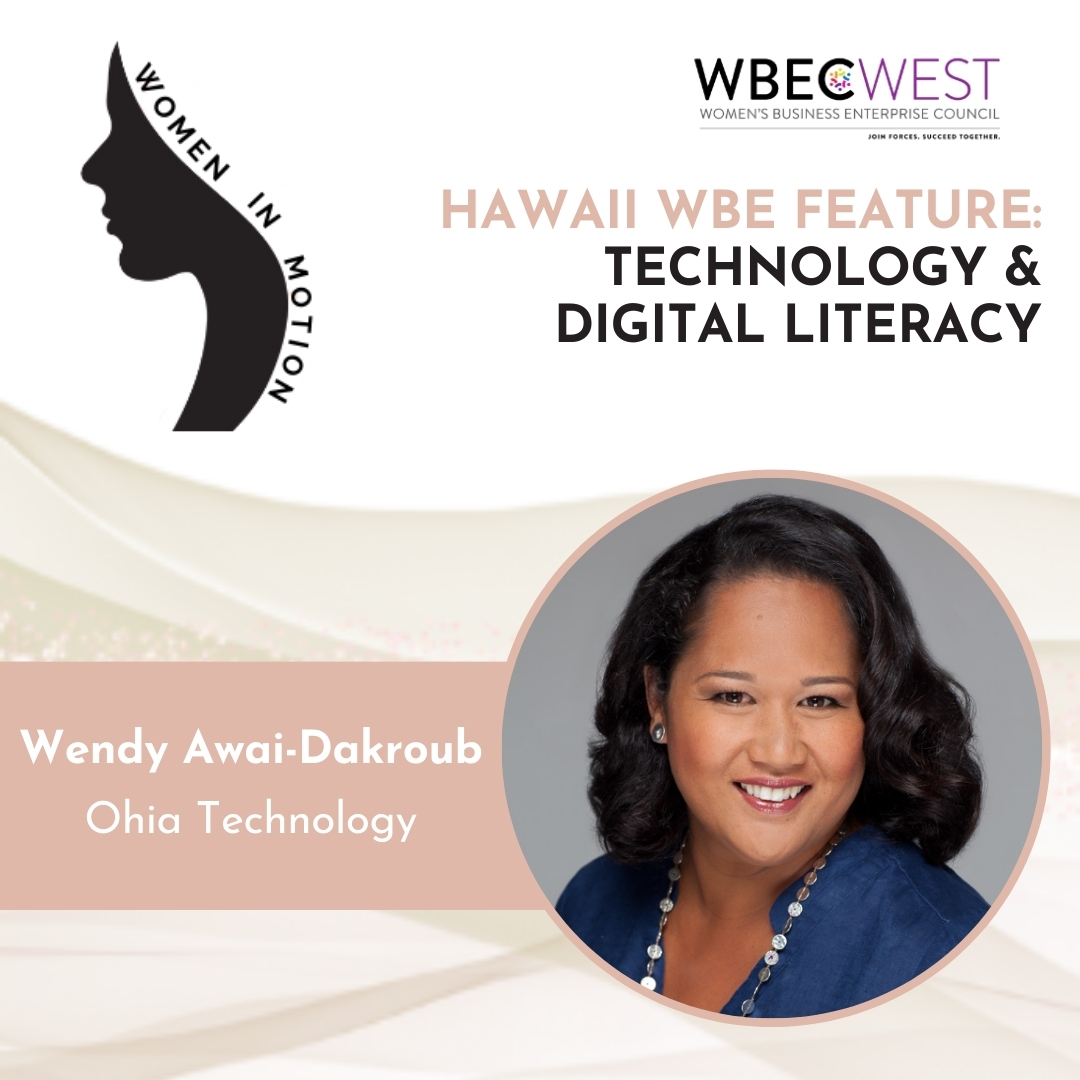
Wendy-Awai-DakroubWendy Awai-Dakroub is a seasoned marketing and business strategist dedicated to promoting the visibility of Native Hawaiians in the tech industry. Currently, she is the CEO at Ohia Technology, where she leverages her expertise to drive digital consulting initiatives across various sectors. Wendy is also the Co-Founder of Acton Digital Academy, a nonprofit focused on empowering local youth through technology education.

With a career spanning over 20+ years, Wendy has held significant roles, including Founder of Sumo Sushi & Bento, the largest Japanese restaurant chain in the UAE, and Marketing Communications Manager at Cisco Systems for the Middle East, North Africa, and Levant regions.

Wendy holds certifications from Harvard Business School Online in Leading with Finance and Sustainable Business Strategies and a Certificate in Marketing from The Chartered Institute of Marketing in the UK. Ohia-Technology-Group-logo

She has been recognized for her contributions and has received accolades such as the Marketing Communications Manager of the Year award from Cisco Systems in 2006. Wendy is committed to advancing digital literacy and business acumen, particularly among indigenous communities

Follow Ohia Technology on LinkedIn.

Music Provided by M PATH MUSIC

Transcript-iconThis transcript is machine transcribed by Sonix


TRANSCRIPT

Intro: Broadcasting live from the Business RadioX Studios, it’s time for Women In Motion. Brought to you by WBEC-West. Join forces. Succeed together. Now, here’s your host.

Lee Kantor: Lee Kantor here, another episode of Women In Motion and this is going to be a good one. But before we get started, it’s important to recognize our sponsor, WBEC-West. Without them, we couldn’t be sharing these important stories. Today on the show, we are spotlighting one of the WBEs from Hawaii, as we are all this month. And today, we have Wendy Awai-Dakroub with Ohia Technology. Welcome.

Wendy Awai-Dakroub: Thank you. Thanks for having me.

Lee Kantor: Well, I’m so excited to learn what you’re up to. Tell us about your company. How are you serving folks?

Wendy Awai-Dakroub: So, we are a new, I say three to four year, tech company opened in Hawaii recently. We focus on customized software development and mainly indigenous software customized development.

Lee Kantor: And then, when you’re saying mainly indigenous, is that to serve the indigenous consumer?

Wendy Awai-Dakroub: Yeah, exactly. Yeah. So, because I’m a native Hawaiian living in obviously Hawaii, when I first moved to home – because I just moved home. I lived abroad for many, many years – I didn’t realize how the language, Native Hawaiian language, was so much prevalent. It was becoming like a resurgence of our language. And as a Native Hawaiian woman, a lot of people started coming to me like, “Hey, can you help us develop customized software in our language?” And that was something new for me. I didn’t understand it, but now, three years later, I’m helping a lot of companies develop software that can do dual language.

Lee Kantor: So, how did that make you feel, like, being away and then seeing this resurgence?

Wendy Awai-Dakroub: It was difficult. I mean, so I left Hawaii in ’87 and I moved to Dubai in ’94, so I lived in the Middle East for 20 years. And I, at the time, I didn’t speak the language at all because back then when I was in high school, we just didn’t speak Hawaiian. So, coming back and then having children and realizing a lot of people spoke Hawaiian and I didn’t know any, it was a culture shock because I didn’t know my own language. We didn’t learn it in school.

Wendy Awai-Dakroub: So, what was exciting, I guess, was because I’m Native Hawaiian, people thought I spoke Hawaiian. And so, the more and more they would ask me questions about can you help us create even websites in our language or software learning management system with the language, I didn’t know how to do it, but I just hired the right people and I just got it done.

Lee Kantor: But you had the IT background.

Wendy Awai-Dakroub: Yes. Yeah. I worked for Cisco, and there, I was a regional marketing manager for 15 years.

Lee Kantor: So, you were kind of uniquely equipped to solve this problem?

Wendy Awai-Dakroub: Yeah, I think I was thrown into it, honestly. I mean, I started the tech company during COVID. I had to pivot. I was in the food and beverage industry. And because I knew a lot about how to order online, our business was already taking orders online when COVID happened in Hawaii, a lot of small businesses here didn’t have online access to ordering. So, I quickly helped them to figure out how to, you know, get their restaurants up online and that’s how the tech part started. I’m like, “Okay. Well, you know, I have the experience. I know how to get companies online.” And get them to quickly start pivoting and taking orders online, so that’s how my company started, it was really helping companies sell their restaurant items online, food items.

Lee Kantor: Now, did you find that in Hawaii there was a need for maybe this type of evangelizing for digital literacy, especially among young people, or was it something that was there?

Wendy Awai-Dakroub: You know, I would say Hawaii, honestly, really lagged behind the rest of the Mainland United States and the world in terms of adopting new technology. Our education still uses equipment like Dell computers that are so outdated and they’re just so far behind. So, when I came along and I obviously started working on small little IT projects right in the beginning of COVID, I really noticed the gap.

Wendy Awai-Dakroub: For instance, some of the middle schools and high schools that I was on the board during COVID didn’t have access to computers until six or eight months later. So, while everybody’s gone online and learning, a lot of our students and children in Hawaii were six to nine months behind just because they didn’t have access to laptops or WiFi.

Lee Kantor: So, when you saw this, what type of action were you able to take? I guess you have a network that was able to help in this area.

Wendy Awai-Dakroub: It was difficult. A lot of industry, IT industry professionals came together. A lot of people raised money to help schools and small projects here and there. But even at that point, we’re so far behind in terms of not being prepared. Nobody was prepared for a pandemic and having to go online. We just assumed everybody has a computer, everybody has WiFi, and that was just not the case in Hawaii. So, yeah, I had to pivot and work with a lot of organizations to get things moving.

Wendy Awai-Dakroub: In fact, for us, our company specifically, started having more and more business, meaning a lot of people started coming to me to help develop their external websites and online ordering. But I couldn’t find anyone to develop or create websites or software. So, that’s when I realized, like, “Wow. We don’t even have the talent here in Hawaii to do website development or basic coding.” So, all of these things, I mean, it wasn’t only my company we figured it out, it was a lot of IT companies here figured it out.

Lee Kantor: So then, where did you go to find the talent?

Wendy Awai-Dakroub: Well, that’s the whole new revolution here going on. So, I started reaching out to small organizations and schools. And there’s a program called Tech Savvy Teens, where we’re connecting teenagers, so ages 13 to 19, who are at-risk kids who just started getting computers and not learning the basics of IT. We’re connecting them with kupuna in their senior homes, because a lot of the kupuna started reaching out again to my company going, “Hey. Can you come to our senior home because the seniors don’t know how to use their laptops, they don’t know how to use their phones, they don’t know how to order telemedicine.” They don’t understand so many things.

Wendy Awai-Dakroub: And so, I worked with a nonprofit that does just that. They connect all these new teens, at-risk teens, get them into the senior homes. And you should see, I mean, it’s an amazing experience to watch.

Lee Kantor: And I think that we’re seeing that more and more where they are pairing some of the elders with some of the young folks to have them interact together so they can each help each other. I mean, it’s really a beautiful thing if it’s done right.

Wendy Awai-Dakroub: Right. And even then, so what we do at Ohia in sponsoring this nonprofit is that, after the teen finishes 30 hours of volunteer work, we offer them certification, like IT certification. Ohia is a Microsoft partner and a training center for Certiport, so we donate free certifications. And then, hopefully, by I think October, we should have our first cohort pass. And if they pass, I’m going to bring them on as interns. And that’s how we develop that cycle of workforce development in Hawaii.

Wendy Awai-Dakroub: But I’m one of the few that are doing it. I’m just proud that I’m part of something that can be bigger. You know, digital literacy is the whole gamut. It’s not just giving someone a computer and teaching them how to use it. It’s about connecting generations, connecting people, and then letting these kids have jobs, and in the process still give back to their community, and the ones who are least not looked at, which is our kupuna. We say kupuna when we say senior citizens.

Lee Kantor: Now, are you finding that young people are hungry for this type of knowledge?

Wendy Awai-Dakroub: Well, at first, it was tough to get students to sign up to help others. I think they’re like, “Well, what’s the benefit for me?” So, the nonprofit decided, “Well, we’re going to write grants.” And they wrote grants so that teens could have stipends. So, every time they would spend three hours at a senior home, they get $50. So, we had all kinds of teens now signing up. Summer is going to be busy because a lot of 13, 14, 15 year olds can’t get jobs. They’re not old enough. So, that was a huge motivating factor for these teens.

Wendy Awai-Dakroub: And with very little training, they’re able to go in and sit with the senior and help them with all kinds of things. I mean, some of the questions like, “Can you take my picture and put it on Facebook?” Just the random things that they ask is amazing. And when you see the seniors coming back every month asking for the same teen, it’s kind of nice. It’s a beautiful thing to watch.

Lee Kantor: Yeah, the impact is real, right? I mean, this is life changing for everybody involved.

Wendy Awai-Dakroub: Absolutely.

Lee Kantor: Is there a story you can share about some of those interactions? Obviously, don’t name their name, but maybe explain the transformation maybe you saw in a teen or an elderly person.

Wendy Awai-Dakroub: Well, I guess two stories stick out. We have one student. When she first signed up – I think her mother kind of forced her into it – wasn’t interested. She’ll just show up, help the senior, and then move on. And then, after, like, the third or fourth time she’s there, she’s asking for more time, she’s laughing. And then, she was the first one goes, “Hey, if I finish my 30 hours, can I have certification?” And it was someone who just didn’t speak, like she hardly spoke a word. And now four months later, she’s speaking. She wants to get involved more in the project. She’s helping us to launch an event at a mall. And that was a huge transformation, not knowing and then knowing this is her thing. We found her sweet spot, what she likes, which is helping others and technology.

Wendy Awai-Dakroub: And then, another story we just had, in fact, last week. We had a woman who, I guess, her older children bought her an Apple Watch and a new iPhone. And she sat down with one of them with teens, and she was like, “Okay. I need you to help me set this up.” And he’s like, “Auntie, I don’t even have a watch or I don’t have a Apple Watch or a phone. I don’t know how to work this.” But literally in half-an-hour, he managed to help her set all of it up.

Wendy Awai-Dakroub: And then, the husband came down with this huge donation. He just wrote a check for $1,000, he goes, “Can you buy an Apple Watch for this child?” And we were shocked, “Like what?” We told him thank you. We will donate it and we’ll help it out. We’ll purchase a watch and we can teach the kids. But, you know, they were so impressed with this child just not having any experience with an iPhone or iWatch and to set it up, that was kind of cool.

Lee Kantor: Yeah. It’s so neat to see the younger generation that are digitally native that they’re around technology since they were born. And then, the older folks who this is new to them, a lot of it, and then the ease in which that the younger person can figure stuff out, it must be really amazing to see.

Wendy Awai-Dakroub: Yeah, it really is amazing to see. And, again, we have the seniors, but now it becomes a party when we go to the senior centers. Like every single senior is there, they get banana bread, they get apples and eggplant. I mean, the things that the seniors give to these children, it’s amazing.

Lee Kantor: Right, because they want to reciprocate. They want to give something to them too.

Wendy Awai-Dakroub: And they spend more time. And we did a study that we spent 15 minutes on the problem and an hour talking, they talk story with the child.

Lee Kantor: That’s amazing. And it’s one of those things that the impact is so much more than even that you could have imagined it being, because it’s human to human interaction.

Wendy Awai-Dakroub: Yeah. And I think that was the goal, was generational. During COVID, we did see that, our kupuna were getting more and more isolated. And Tech Savvy Teens just started with a few teens helping kupuna who wanted to watch church online. So, they went to a church and they were helping from a church, and things exploded into a program they have, now Tech Savvy Teens.

Lee Kantor: Now, are you optimistic about the kind of next generation of maybe female and indigenous IT professionals? Are you seeing that there’s a desire and an opportunity for them to find opportunities?

Wendy Awai-Dakroub: I’m hopeful. You know, I would say I’m hopeful. I mean, a lot of the programs that are coming out in Hawaii for teenagers to get certified, there’s so many. It’s just reaching the right demographic. And there’s not a lot of Native Hawaiian here, non-Native Hawaiians in Hawaii now. It’s so expensive to stay here so many are leaving. Yet alone female native Hawaiians in the tech industry. So, I think that’s what I’m concerned about.

Wendy Awai-Dakroub: But I do have a handful of girls who are excited about the tech industry and they want to become developers, and stay in Hawaii and help create indigenous language platforms. Because Hawaiians, we learn differently. We’re not linear. We’ll jump from this subject to that subject and that subject. We have to move and jump and do so many things, so to create a platform that’s like that, it doesn’t exist. We would have to create it ourselves. So, I think having more and more Native, not only female, but all Native Hawaiians in IT would be the goal. But I’m hopeful. I won’t say we’re there yet.

Lee Kantor: Now, why was it important for you to become part of WBEC-West and be part of that community?

Wendy Awai-Dakroub: So, in the process of finding out how, I guess just we didn’t have a lot of money [inaudible]. It’s hard to find employees or people here that understand software development. I decided at an early point in my career that if I’m going to create opportunities or jobs for these students or these youth in Hawaii, then I would have to also create the contracts or the opportunities to win business.

Wendy Awai-Dakroub: And from what I know and through the YWCA program that I was in, they told me you should get certified and start doing government contracts. And then, as a female women-owned business, I could qualify for that. And so, I give credit to YWCA for providing me with the opportunity to get certified by WBEC. I didn’t know what it was, but it’s been amazing. Just having that logo on my business card and on my website, people take you more seriously, especially when I bid for local contracts, local state contracts.

Wendy Awai-Dakroub: So, the goal, obviously, is I’m going through my women-owned certification right now for WOSB, and I’m hoping to be an ADA soon so that I can win contracts and then give more jobs to people in Hawaii so they can stay here.

Lee Kantor: So, what is it that you need more of right now that we can help you?

Wendy Awai-Dakroub: You know, I had registered for a WBENC event, they had an event, an expo, I think, last year. But to go from Hawaii, it was so expensive. I mean, it was really hard. I mean, ideally what I would love to see is a local event. There’s a lot of women-owned businesses here that would love to be certified, but it costs us double the amount to travel to the Mainland and attend one of these events. I would love to see a local version of the WBENC event in the Pacific Islands, if I have to be honest.

Lee Kantor: Well, we’ll see what we can do about that. Now, if somebody wants to learn more about your firm, either your nonprofit or your for-profit IT company, what is the websites?

Wendy Awai-Dakroub: So, our website for my tech company Ohia Technology is ohiatechnology.com. And an information about Tech Savvy Teens, the nonprofit that we support certifications for is techsavvyteens.org.

Lee Kantor: And for your IT firm, it’s O-H-I-A-technology.com?

Wendy Awai-Dakroub: Yes. So, Ohia is the Hawaiian word for lehua, the flower. And it’s the first flower that comes through the lava. It’s a red flower. And, for us, it symbolizes strength to come through lava. The first plant.

Lee Kantor: Right. You got to be tough. You got to be resilient.

Wendy Awai-Dakroub: Resilient, yeah. So, that’s the name of our company.

Lee Kantor: Well, Wendy, thank you so much for sharing your story today. You’re doing such important work and we appreciate you.

Wendy Awai-Dakroub: You’re welcome, Lee. Thank you for having me. It was my first podcast, I enjoyed it.

Lee Kantor: All right. That’s good. And one more time, the website if somebody wants to learn more.

Wendy Awai-Dakroub: www.ohiatechnology.com.

Lee Kantor: All right. This is Lee Kantor. We’ll see you all next time on Women In Motion.

Tagged With: Ohia Technology

Jessica Green with Self-Made

July 11, 2024 by angishields

High Velocity Radio
High Velocity Radio
Jessica Green with Self-Made
Loading
00:00 /
RSS Feed
Share
Link
Embed

Download file

Self-Made-logo

Jessica-GreenJessica Green is a midwestern girl born & raised who’s always wanted & know she’s worth MORE!

She’s a little bit on the sassy but smart side, with a HUGE appetite for solving problems. Starting from running away and shaving her head at 13 to graduating college with honors & creating multiple multi million dollar businesses, Jessica will come up with a solution to just about anything, and where you won’t find me is STUCK IN THE MUCK! She’s a lover of life, travel, food and all the things that make life worth living to it’s fullest.

Jessica is an entrepreneur, educator, self-published author, wonder woman wife and Mom! Just ask the 4 boys she lives with or the two bonus daughters who she loves dearly! 5 kids you say? Wait no- two of those boys are furry, but not far from HOOOMANS too in this house!

# 1 thing she is grateful for? Her amazing God, with him absolutely anything is possible!

Connect with Jessica on LinkedIn, Facebook and Instagram.

What You’ll Learn in This Episode

  • Finding your super powers as it relates to entrepreneurship
  • About Jessica’s book SuperPower to Super Profit
  • Self-Made Hub- Jessica’s tech platform and mentorship membership

Transcript-iconThis transcript is machine transcribed by Sonix.


TRANSCRIPT

Intro: Broadcasting live from the Business RadioX studios in Atlanta, Georgia, it’s time for High Velocity Radio.

Stone Payton: Welcome to the High Velocity Radio show, where we celebrate top performers producing better results in less time. Stone Payton here with you this morning. Please join me in welcoming to the broadcast with Self-Made made Jessica Green. How are you?

Jessica Green: I am doing fantastic and thank you so much for inviting me on today. I always love to share with the world all of the things Self-Made and all of the things Jessica Green and how I can help more female online entrepreneurs.

Stone Payton: Well, we are delighted to have you on the broadcast. I got a ton of questions. I know we’re not going to get to them all, but I’d love to start if we could, with an overview. If you could paint a picture. Mission purpose. What are you and your team really out there trying to do for folks?

Jessica Green: Well, I’ve been on a journey for about 18 years in the business world, but the last ten mainly in the social marketing space, with working with female online entrepreneurs and network marketing, influencer marketing, affiliate marketing. And there’s one thing I found in common that there’s a lot of opportunity out there, but not necessarily a lot of skill set in the tech space. So being able to take a business and, uh, infuse tech into it so that they can build, scale and accelerate online. And so I dove into helping people, helping mainly female online entrepreneurs infuse tech so that they can accelerate and scale their business with a tech savvy mentor, someone who can help them along the way.

Stone Payton: So what did prompt for you, Jessica? The focus on serving the female constituency. Was it a cataclysmic event or did you kind of know all along this is the group I want to serve?

Jessica Green: No, I just was that group, right? I was that person. And I think that’s where a lot of really good coaches and mentors come from is struggling through the same exact problem that then they can turn around and go help other people with, grab all of the ones that are left behind and can kind of help them through and shortcut things. So I did, I had a number of businesses. I launched a few businesses a number of years ago and realized real quickly that in this online world and this online space, things were moving extremely fast, right? Just ten years ago, I had kind of fallen out of a brick and mortar business and into a network marketing business, and I found that most people didn’t have a business and marketing degree, just like I did, and have all these years of business experience and building business. And I found that I wanted to help, I wanted to I wanted to help as much as I could, but actually found myself stuck in a little bit of a space of having to pay people to build websites and pay people to infuse tech so that I could scale like the big dogs. I could compete out there in the space with everybody else, and not all females have the background.

Jessica Green: And I shouldn’t even just say females. Not all people going into the online space to build a social marketing type business or an online business have the skill set and don’t necessarily have the money to be paying big agencies big amounts of money to build them a website or do simple email marketing or SMS marketing. And now, in just the last 12 to 18 months, because of AI, this world is just changing every single second of every single day. And it’s it’s a lot to keep up with. So I decided, after struggling through some of that and pouring thousands and thousands, I should say wasting thousands and thousands of dollars and time and frustration and headache that when dollars got tight and I couldn’t spend to have someone else do it for me, I just needed to dig in. I was a pretty smart cookie. I could learn how to do most of this stuff myself, and if I could learn how to do it most myself. And it was pretty simple, I could turn around and teach people how to do it. So it was me going through it and knowing there’s a different way. There’s a better way. If you’re willing to learn a new skill set and partner up with somebody who can help walk you through the hard parts, you can really have a lot of control over your own business no matter what.

Jessica Green: Maybe someday. I do believe in the saying that if you’re working in your business and not on your business, you don’t necessarily have a business. You have another job. I don’t I don’t disagree with that saying once you’ve made it. But on the journey to making it, you need to learn some skill sets. So if things get tight or you have to fire somebody or someone walks away from your business, or a team member quits and all those things, you can always step back in and take over for a short time while you get somebody else back up and running. And I found that was the most freeing feeling. That is the most freeing feeling about what I do now is being able to jump into my business and work almost any part of it, especially in the tech spot, and get it back up and running, because most things now are running from tech behind the scenes, helping you scale things and automate things, and maybe not have so many employees because you can really put a lot of that into technology. So.

Stone Payton: So what are some of the more common mistakes or patterns that you can almost anticipate when you first begin working with someone? I know we’re probably going to see this, this and this. What are some of the most common mistakes patterns that kind of thing?

Jessica Green: Um, number one, not believing in yourself that you could actually do it, thinking that you have to have all this skill set and being scared of not being able to do it. Um, honestly, it’s not as scary as it, as it seems from the outside looking in. And if you have the right person that can walk you through and be there to guide you and just answer some questions. So it’s number one, just thinking that it’s too overwhelming when it’s really not. If you have the time and you’re willing to put that time in to learn the new skill set, you can absolutely do it yourself. You do not need to pay one of these big agencies out there to build all of these things for you. I believe that’s why it’s called self-made. That is the entire reason why it’s called self-made. Um, and then number I would say, um, number two is probably so believing in yourself. But number two is actually not having I don’t think that you need to have your whole brand figured out up front, but it is the one thing that I start with because most people don’t niche down far enough, and I almost hate that word, but I’ll use it. They don’t niche down far enough, but they think that they need to throw their product or service or opportunity out there to as many people as possible, because the online space is so big and vast, and they just want to grab as many people when it actually that does the opposite when your message is trying to hit everyone, it hits no one specifically. And I find that is one of the biggest, biggest things that most newer online entrepreneurs, network marketers, social marketers, just online business coaches, whatever solving problems, they’re trying to do it for way too many people.

Jessica Green: And so their messaging that comes out, their branding that comes out, doesn’t target the person who’s actually looking for them right now, today. So they end up doing a ton of push marketing, which is a lot harder to get the people that you want to say yes than the attraction and pull marketing that you can do if you’ve really picked. And it’s hard because I even had to go through that, like I want to help all online entrepreneurs, but that’s a very big space to Niching way down to I want to help very specifically female online entrepreneurs that are in the social marketing space, meaning network marketing in between the ages of 35 and 55 like that is my niche, and I have to get really specific about that because I want to help everybody. But I also know that the person that’s looking for me needs to hear exactly what I can solve for them, and what I can solve. For a 40 year old female wanting to build her social marketing business is not going to be the same things that a 50 year old male wants to hear about his his business, that he’s trying to create? They don’t aren’t going to listen to the same messaging. So you want people coming to you rather than trying to just word vomit and throw noodles at a wall and hope it sticks. And that’s the biggest problem I see out there.

Stone Payton: I am so glad that I asked, because I think you have articulated for me this gut feeling that I’ve had for some time, and my partner is a big proponent as well, of finding that group that really does want to hear your music. And then if someone else strolls in, great, you know, maybe they can enjoy it too. But finally, play to the ones that want to hear your your brand of music, right?

Jessica Green: Exactly. That’s a great way to put it.

Speaker4: All right, so let’s.

Stone Payton: Dive into the work a little bit. What does that look like? Someone comes into your circle. You begin serving them. Is it one on one instruction? Is it tapping into a platform? Walk us through the work, especially the early phases of of the work you’re doing with the clients?

Jessica Green: Yeah, absolutely. So I kind of started this journey of building out a business called Self-made to put a coaching program together to just really help female online entrepreneurs get their branding set and time management. And like all just all the things that you need as a new entrepreneur, like a lot of people jump into social marketing, network marketing, influencer marketing because they fall in love with the product, service or opportunity. Not because they woke up one day and said, I’m going to go out and create my own business. Some do, but a lot don’t. So don’t always have the background and what it actually takes to be an entrepreneur because they never saw themselves being one. So I started off with a program to help people through that, and then shortly realized that everyone was going to really need all of the tech pieces. And I had learned all of it, and I could turn around and go teach them those things along with it. So what I went and did is created my own, uh, boutique style agency, backed by a tech platform that’s already out there and made it my own. And so our membership is we take people in for a monthly membership that covers the cost of their complete and entire all in one tech platform so they can build all their websites, all their funnels, their email marketing, their SMS marketing, their calendar booking, their I mean, you name it, our platform does it, has it, integrates it, and you don’t need anything else out there.

Jessica Green: Because what we found is a lot of people are out there duct taping 17 systems together for their email and for their websites and funnels and all this stuff, and you actually don’t need that. There’s really great all in one tools out there that can combine everything and save you a lot of time, a lot of money and a lot of headaches. So we took that platform and paired it together with the business coaching and made it very inexpensive for people to be able to just belong to something and build along with some people that know what they’re doing and can direct them and guide them. So that’s really what we do. We go out there and we help those female online entrepreneurs that know they want to take the time, they want to spend a little bit of their energy, but not a ton of money going and building all the things that they need to scale their business and infuse that tech. So we start there, and then we have some other programs that we can offer along the way. If people are like, I need to dig in bigger, badder, better, faster, I need it all. I need it done quick. We have some like accelerator masterminds that will will invite people into that are pretty limited. But just because we like to spend time with our clients. But that’s it. It’s a it’s a monthly membership that gets you all of the tech that you need, plus the help to build it all.

Stone Payton: Well, it strikes me that if you can get the tech set up and in place, and particularly if it’s all available through one path as you’re describing, then you can really it seems like it would liberate you to lean into some of the things that you already bring to the table, like whatever. You’re already really good at the clarity of your own vision if you can. If you can get the tech figured out, speak to that a little bit about finding, you know, finding your superpower and really leveraging it.

Jessica Green: So I ended up writing a book through this journey because I did I what I have noticed out there in this industry, and I mean, especially since, you know, like everything changed with the world a few years ago. Right? And all of a sudden there was this like, oh, I could work from home. Oh, I could, I don’t want to go back to work now. I like this idea of working from home and kind of being my own boss. And so a lot of people with the online space decided they wanted to jump in and create their own businesses, but then they were like, oh, well, how what do I create? What do I go do? Do I go partner with a company and become an influencer marketer and have, you know, have a company that I just sell products for? Do I become a network marketer? Like, do I create my own coaching business? Like what could I do? And so I found myself counseling a lot of people and doing strategy calls with a lot of people. And so I decided to take all of that knowledge that I have of 18 years of business experience. My degrees, all of the businesses that I’ve had that have been successes and failures, I’ve learned way more from the failures and the successes and Then put that in a little bit of a book.

Jessica Green: Um, just a simple book called Super Power to Super Profits. Um, and it’s just me walking through. How do you find your own superpowers as it relates to entrepreneurship, and then utilizing those to create the business and empire of your dreams? So I always tell people when I start off coaching in that realm is if you if you create yourself just another job out there that you have to get up and go do every day, you’re not going to be excited about it. It’s just going to be like working that 9 to 5. But if we can create something that comes from passion, something that comes from what you get really excited to go work on, and you could jump out of bed every single morning and ready to walk across the hallway to that office home office of yours to work on your business. And you are so excited you’ve now created something that you will absolutely love, you will adore, and you will make a lot of money at. Because people know when you absolutely love and adore what you do every single day. And those are the people who are going to want to partner with you because they can see it and feel it, and it exudes from you.

Jessica Green: So my superpower to super profit is saying, hey, let’s go figure out what you’re really good at. What do your friends always ask you for advice on? What do you feel like you could do for hours and hours, and then look up at the clock and go, oh my gosh, I cannot believe I just spent five hours doing that. I could do that for five more hours and it wouldn’t even faze me. And no, I’m not talking about scrolling social media. That is not a career path. Um, because I think anybody can make time disappear like that. Um, so I’m very clear about not letting that happen. Um, but yeah, just I walk them through some questions and I walk through my own story. Um, as a young adult, actually a teenager to young adult. And some of the things that I went through, and it took me all the way until really my 40s to figure out what my superpower actually was. And so if I can, uh, speed that up for somebody who wants to get into the entrepreneurial journey, that’s what that book is meant to do. And then it walks them through some of the tech, how to start putting some things in place to build up your business online.

Stone Payton: So what was that experience like writing the the book? Did it come together pretty easily, or were were pieces of it harder than than others? I’d love to hear what that journey was like.

Jessica Green: If I could do it all over again, I would do it differently again. Another way I could speed up someone’s journey, I would point them in a different direction than what I took. I really wanted the book to just be a lead magnet, if I’m being quite honest with you. I had a lot to say. But it wasn’t the book that, like if Jessica Green was going to go write a book and it be like all of the things that I want to teach and share and show all of who I am, I wouldn’t. This isn’t the book. This is more of a lead magnet book, and I wish I would have done it the other way around. First of all. Second of all, I would really do my research on how you publish a book or self publish a book, or find the right company to work with. Through that process, I picked a company that I thought was a good idea. It came with some business coaching. Along with this book writing program. I would have gone to a company that was just a book writing program because I did need some help. I needed a mentor. I needed a coach. I’d never wrote a book before. I did know that I wanted to self-publish. I want because it was a lead magnet. I just wanted something simple. But the process was interesting. We’ll just we’ll just say that it was interesting. The book is written and it is out there. I can’t say that it’s like my masterpiece in any way, shape or form. So I’m looking to the second book that I write, but it’s a great book to just get people started in. Hey, I need to figure out what my superpowers are. I want to I want to start my own online business. I need someone to kind of walk me through those first few steps. And that’s what the book’s intended purpose was. So I’m okay with that. But the next book, stay tuned, it’ll be much better. All right.

Stone Payton: So you have another one in you. And I have to believe, while certainly it’s provided value to the people you’re trying to serve, I suspect it probably helped you crystallize your own thinking and equip you to even be that much better at what you were doing, just because you invested the energy to commit some of these ideas to paper, and really have to think them through and figure out a way to articulate them for others. I bet it helped you to be a better practitioner.

Jessica Green: Oh yeah. Absolutely. It’s like putting something in a really concise, organized format on how to teach. The one great thing is that I had already created a 12 week program that I was putting clients through, so I kind of took that 12 week program. That was my process of what I put clients through, and I kind of made that some of the chapters of the book pulled out like seven of the 12 different modules and made that into my book, with the exception of, like the first chapter, which tells my story and kind of how I uncovered what I’m really good at, which is problem solving, um, which is my superpower strategy and problem solving. But I take that was also really fun and cathartic. Maybe be the right word. Is telling a kind of embarrassing story about myself that I learned at 13 years old. Was was a like game changer for my life. Um, and telling that story out loud for anybody to pick up a book and read about that was interesting. Kind of cathartic, though.

Stone Payton: I would think the answer to this question probably changes over time as you evolve, as the work evolves. But I’ll ask you at this point now, you’ve been at it a while. What are you finding the most rewarding about the work? What’s the most fun about it for you these days?

Jessica Green: Oh, being a part of like so many different businesses. So we have a new client come in and we have a mastermind for our hub members every Wednesday morning. Um, and we have an accelerator program that’s like an 8 to 10 week program. We only take 12 people in at a time and so that we can spend time on their businesses, but it’s watching those businesses unfold. For example, I have, um, you know, we have some clients that maybe started with us eight, nine months ago, and you’re just now starting to see because they are really just doing it on their own. They didn’t join an accelerator. They’re just every week plugging away at building their business and watching some of that come to life. Now, having a just knowing, like when you see their business launch online and they start getting their clients and things start flourishing for them, and you start seeing their stuff on social media, you’re like, I had a little piece of that. If they if if we wouldn’t have gotten involved or connected, would they be where they’re at? Would their dreams be coming true? Would their empire be being built? Last week we got to walk through, um, a lady who’s in just a regular hub member of ours that shows up every Wednesday morning consistently and has been building out a math tutoring business, an online math tutoring business for, um, sixth grade to like through 12th grade, I think. Um, and she does it out of her home, but she really wanted to take this online and be able to do this for more people and do like, classes and watching all of her tech pieces finally get to completion so that she can launch everything and watching it unfold and seeing the website and seeing it’s just like, you know, that you just took somebody from working this like, boring 9 to 5 that they hate to actually making that dream of theirs become reality. That to me, there’s nothing like that.

Stone Payton: So are these people finding you because of the tech you have in place? Or I guess I’m interested in how the whole sales and marketing thing works for almost everyone I talked to. But in your case, like, are you out there shaking the trees? Or you’ve set things up so that they come shake the trees? Or how does that cause you have to, I guess you have to eat your own cooking to a large degree, right?

Jessica Green: Oh, yeah. Oh, yes. Yeah, absolutely. If I don’t show up online and have all the things in place online, how would anybody ever trust me? Or I heard me right and I will in no way, shape or form, uh, say that I’m perfect at those things. I just actually am super transparent to my coaching clients, too. So I had somebody call me the other day that just is one of our hub members that needed a little extra from me, and I try to always do that as much as I can. And, uh, she was asking me some questions about the front end of her business, like the getting of traffic. Right. And it’s just it’s not our specialty. We focus on the back end, like, we can tell you everything to plug in so that when you’re generating the traffic, everything goes on. Automation. Um, like, you go make a reel or a post or a TikTok and we we can help you set everything up on the back end so that everything is automated from there on out. So you could do one reel and everything sets on automation all the way to conversion, maybe 14 touch points later so that you can convert a viewer into a buyer. So we do the back end. We don’t teach people how to do social media. So when she called me and started asking me some questions, I’m like, listen, I got social media out there. I stay very present online. I have someone that helps me with some of that stuff, but I can’t coach you on that because I’m not good at it. It’s not my favorite part.

Jessica Green: I don’t do a whole lot of it, but we do have to do that for our business. So we work on it and we bring in coaches and mentors of our own for the front end of things, because that isn’t that isn’t what my business model is, and it is not our forte. Um, but I will say being super active out there on all the social platforms is one of the things that we do. But for ten, well, 14 years, myself and a business partner that I brought in, uh, we’ve been in the network marketing space wasn’t what I started off in. I fell into it in an economic downturn. I was the girl that ran from everybody. I’m no longer building in the space now, but I did for 14 years. And that grows you a very massive network of people. Um, that’s the one thing that I absolutely love about network marketing. And so because we were very successful in that top 1% in the industry, both her and I, in different businesses, um, we have a large network. And so it’s it’s a lot of hustle out there grinding, getting our own. You used a term and I don’t remember what what you said exactly was like, you know, just going out and getting our own clients. Then we do also do social media. We are just now getting into the ad space of getting some ads out there. Also not my forte. I don’t teach people how to do that. It is not my thing. But I can, you know, find some people that can help me with that because I’m very resourceful.

Speaker4: Well, that’s.

Stone Payton: Such an important point, is lean on what you’re good at and set up systems that will help you really just leverage that to the nth degree and go get best in class. Help in the areas that were in the holes you need to plug, right?

Jessica Green: Yeah, exactly, exactly. The other thing we do too is we because we both came from a lot of experience in network marketing. Um, while our company helps a lot of network marketers, we’re not a network marketing company, but we do have an affiliate program for our company. And because no network marketing so well, it was like super easy for us to deploy an affiliate marketing part of our business. So we have a lot of people that are our hub members, that are also affiliates for us, because they know they can go out and sell our service. They believe in us. They’re already hub members, and then they can also make some money with us too. So that’s another way that we drive traffic to us.

Stone Payton: Well, you clearly have the passion for your work. I can see it in your eyes. I know our listeners can hear it in your voice. But I did want to ask hobbies, interests, passions outside the scope of your work, like a lot of our listeners know that I like to hunt, fish and travel. Is there anything you nerd out about outside the scope of this work?

Jessica Green: So I, I love when this question comes up because I think I’m a little neurotic in my in my entrepreneurial journey, though, I know it’s not healthy at all times, but, you know, I’m not just working on my business. I’m working on so many other people’s dreams and empires that I find that is also a hobby. I say all the time, if you sit down with me for five minutes and we go have coffee, or we go to have a bite to eat, and we start talking in any way, shape or form that you could start a business or you like doing this. I’m trying to turn it into a business for you and show you how to monetize it, because I literally have fun doing that. So I spend a lot of time I don’t want to call it working because I really enjoy what I do. Um, but outside of that, um, I have three kiddos, uh, one son and two bonus daughters who are grown and have big girl jobs. We love to do stuff with our kids. We love to travel. Um, actually, as we speak, my husband is without me over in Europe, um, in Paris right now. And so we love to travel and we love to do things like that. We love to entertain at our house. And yeah, I mean, we’re pretty simple people, though.

Stone Payton: All right, before we wrap, let’s leave our listeners with a couple of actionable things. I’ll call them pro tips. Just a couple of, you know, start thinking about this or read this or don’t do this kind of thing. And look, gang, the number one pro tip is reach out to Jessica and her team, have a conversation with them, learn about what they’re doing. But let’s leave them with a couple of things to be noodling on between now and then.

Jessica Green: Yeah, I mean, my biggest piece of advice is, is just find them. Whatever you’re doing, go find someone who’s done it and has succeeded at it, but also maybe had some failures behind it because you learn more in those failures than you do the successes. It’s just the unfortunate piece about business. But, um, so when I, when I start coaching people, I actually tell them to go find a few people on social media that are doing what they want to do, but are only about 18 to 24 months ahead of them, and they’re successful. And the reason I say that is because, of course, I could go find the most successful person in my entire industry that’s been doing this for 10 or 15 years and model my behavior after them, but they’re at a different point in their journey. They’re so far beyond what I’m trying to accomplish right now. I’ll get there, but only modeling off of the activity and the things that they’re doing now kind of sets people back. So I try to have people look at somebody who’s more like 18 to 24 months ahead of them and looks like it’s becoming successful because the behaviors that you’re going to go and see or they’re breadcrumbs that they leave behind, um, are going to be what you need to do over the next 18 to 24 months, which is the most important right now.

Jessica Green: So find a mentor, find a coach. But maybe not someone who’s so far ahead of you that they’ve almost lost reality of. I always say it’s it’s almost the very same thing in network marketing. It’s like someone who first comes in and is just getting started versus the, you know, million dollar a year earner. That’s like been there, done that, spent in the industry for ten years and did all the things. They are not doing the same things every single day as the things that they want you doing when you first come in. Because the things you need to do when you first come in are quite different than what you do when you’ve been on your journey for 10 to 15 years. Believe in yourself and go find a good person to partner with. That’s like a mentor or a coach that can help walk you through some of the struggles and be there on the hard days. Best advice I could give?

Stone Payton: Well, I think it’s marvelous advice. Thank you for that. All right. What’s the best way for our listeners to connect with you? Tap into your work? I want to make sure they have access to the book that you described. Let’s leave them with some coordinates.

Jessica Green: Yeah, I think the easiest way and the easiest one to remember is my personal website, which is just green. I got the dot green, not a.com, just dot green is actually an ending to a website. So um, just dot green is how you can find my personal website. And from there you can get to our business website too which is self made hub. So yeah.

Stone Payton: Well Jessica, it has been an absolute delight having you on the broadcast. Thank you for your passion, your enthusiasm, your insight, your perspective. It’s uh, it’s been a marvelous way to invest a Tuesday morning and we sure appreciate you.

Jessica Green: Thank you so much for having me on. I really appreciate it. It’s been fun.

Stone Payton: My pleasure. All right, until next time. This is Stone Payton for our guest today, Jessica Green with Self Made and everyone here at the Business RadioX family saying, we’ll see you in the fast lane.


Tagged With: Self-Made

BRX Pro Tip: Do the Thing

July 11, 2024 by angishields

BRXmic99
BRX Pro Tips
BRX Pro Tip: Do the Thing
Loading
00:00 /
RSS Feed
Share
Link
Embed

Download file

BRX-Banner

BRX Pro Tip: Do the Thing

Stone Payton: Welcome back to Business RadioX Pro Tips. Lee Kantor, Stone Payton here with you. Lee, I think you’ve run across and maybe even re-read a piece of work that really had an impact on you and it’s about just do the thing.

Lee Kantor: Yeah, this is something I discovered a while ago. It’s a newsletter I subscribed to. It’s called strangestloop.io. You can go to strangestloop.io, and then you can read all this person’s work. They have a ton of essays and thought leadership.

Lee Kantor: But they wrote this essay and I quote it now, regularly when I talk to any aspiring entrepreneur, any aspiring artist, anybody who would like to do something that they’re not doing it right now, and I think that everybody here would benefit from hearing it. So I’m going to read you the entire essay. It’s not that long, but, this is a great piece of advice. So this is what they say about doing the thing.

Lee Kantor: “Preparing to do the thing isn’t doing the thing. Scheduling time to do the thing isn’t doing the thing. Making a to-do list for the thing isn’t doing the thing. Telling people you’re going to do the thing isn’t doing the thing. Messaging friends who may or may not be doing the thing isn’t doing the thing. Writing a banger tweet about how you’re going to do the thing isn’t doing the thing. Hating on yourself for not doing the thing isn’t doing the thing. Hating on other people who have done the thing isn’t doing the thing. Hating on the obstacles in the way of doing the thing isn’t doing the thing. Fantasizing about all the adoration you’ll receive once you do the thing isn’t doing the thing. Reading about how to do the thing isn’t doing the thing. Reading about how other people did the thing isn’t doing the thing. Reading this essay isn’t doing the thing. The only thing that is doing the thing is doing the thing.”

Lee Kantor: So I think that’s super important that a lot of people are trying to do everything but the thing. And I think the only way you’re going to move forward is by doing the thing. And you can go to strangestloop.io for more from this person. But please, today, start doing the thing.

BRX Pro Tip: Fully Leveraging Your Podcast Appearance

July 10, 2024 by angishields

BRXmic99
BRX Pro Tips
BRX Pro Tip: Fully Leveraging Your Podcast Appearance
Loading
00:00 /
RSS Feed
Share
Link
Embed

Download file

BRX-Banner

BRX Pro Tip: Fully Leveraging Your Podcast Appearance

Stone Payton: And we are back with Business RadioX Pro Tips. Stone Payton, Lee Kantor here with you. Lee, what are your thoughts? What’s your experience, recommendations on fully leveraging the fact that you have been on a radio show or a podcast?

Lee Kantor: Yeah. This is something that I am a big believer in and I think this is – people are leaving money and time on the table by not doing this. But if you’re ever a guest on anything, radio show, podcast, if they wrote an article about you in a blog, or whatever the content you got in media, I recommend you take that content and put immediately – once it’s published, go to your calendar and then mark on your calendar over the next 12 months, 4 to 6 times that you’re going to mention this thing again to your people in your database.

Lee Kantor: So when you get the interview, put a calendar reminder to repost that interview on your socials every two to three months. You don’t have to always post new content. You can repurpose existing content. You probably have already done a ton of interviews and things in the past. Go back to that and then save yourself some time and headaches and just repurpose some of that existing content that you’ve already done.

Lee Kantor: I guarantee you there is a pile of content that you did already in the past that you can go back to and repurpose it, and it’s going to be new to the people on your socials. Because number one, all the people in your socials don’t see every single thing that you post. So there’s no harm in repurposing existing content. And if you did that, you would actually get more people to pay attention to your stuff because you’d be posting more often, and then you would just be able to build your following by just posting things that you’ve already done that’s new to the person that is reading it. So repurpose old stuff.

  • « Previous Page
  • 1
  • …
  • 120
  • 121
  • 122
  • 123
  • 124
  • …
  • 1329
  • Next Page »

Business RadioX ® Network


Our Most Recent Episode

CONNECT WITH US

  • Email
  • Facebook
  • LinkedIn
  • Twitter
  • YouTube

Our Mission

We help local business leaders get the word out about the important work they’re doing to serve their market, their community, and their profession.

We support and celebrate business by sharing positive business stories that traditional media ignores. Some media leans left. Some media leans right. We lean business.

Sponsor a Show

Build Relationships and Grow Your Business. Click here for more details.

Partner With Us

Discover More Here

Terms and Conditions
Privacy Policy

Connect with us

Want to keep up with the latest in pro-business news across the network? Follow us on social media for the latest stories!
  • Email
  • Facebook
  • Google+
  • LinkedIn
  • Twitter
  • YouTube

Business RadioX® Headquarters
1000 Abernathy Rd. NE
Building 400, Suite L-10
Sandy Springs, GA 30328

© 2026 Business RadioX ® · Rainmaker Platform

BRXStudioCoversLA

Wait! Don’t Miss an Episode of LA Business Radio

BRXStudioCoversDENVER

Wait! Don’t Miss an Episode of Denver Business Radio

BRXStudioCoversPENSACOLA

Wait! Don’t Miss an Episode of Pensacola Business Radio

BRXStudioCoversBIRMINGHAM

Wait! Don’t Miss an Episode of Birmingham Business Radio

BRXStudioCoversTALLAHASSEE

Wait! Don’t Miss an Episode of Tallahassee Business Radio

BRXStudioCoversRALEIGH

Wait! Don’t Miss an Episode of Raleigh Business Radio

BRXStudioCoversRICHMONDNoWhite

Wait! Don’t Miss an Episode of Richmond Business Radio

BRXStudioCoversNASHVILLENoWhite

Wait! Don’t Miss an Episode of Nashville Business Radio

BRXStudioCoversDETROIT

Wait! Don’t Miss an Episode of Detroit Business Radio

BRXStudioCoversSTLOUIS

Wait! Don’t Miss an Episode of St. Louis Business Radio

BRXStudioCoversCOLUMBUS-small

Wait! Don’t Miss an Episode of Columbus Business Radio

Coachthecoach-08-08

Wait! Don’t Miss an Episode of Coach the Coach

BRXStudioCoversBAYAREA

Wait! Don’t Miss an Episode of Bay Area Business Radio

BRXStudioCoversCHICAGO

Wait! Don’t Miss an Episode of Chicago Business Radio

Wait! Don’t Miss an Episode of Atlanta Business Radio