Laughter and Lessons: Balancing Business and the Desire to Help Others

/
RSS Feed
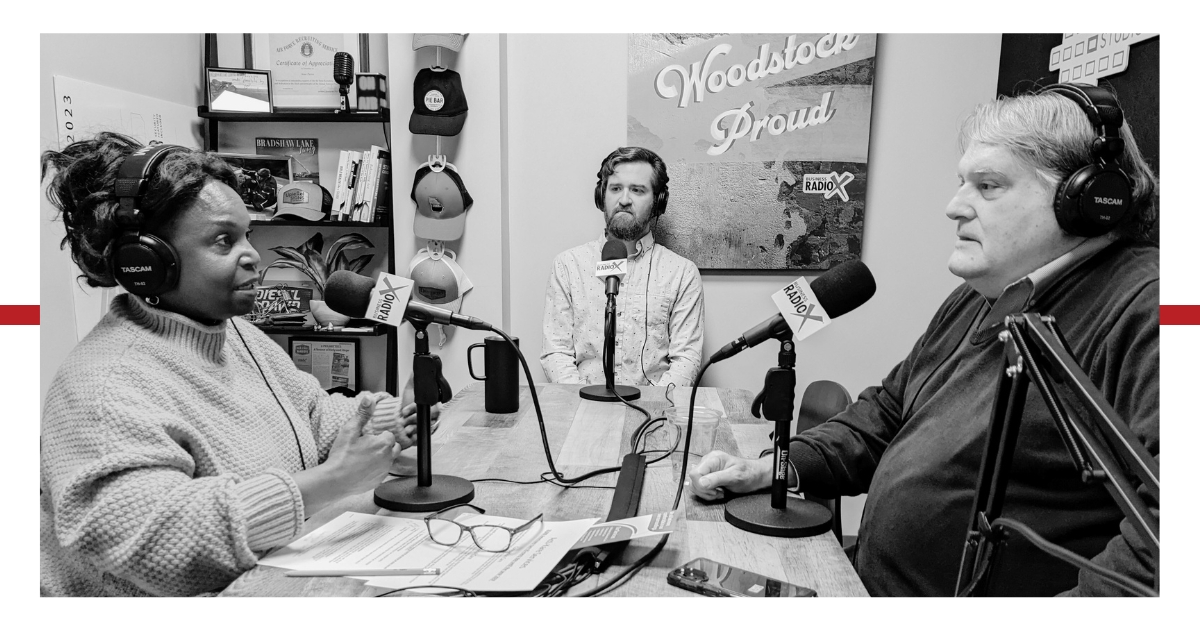
Brought to you by Diesel David and Main Street Warriors

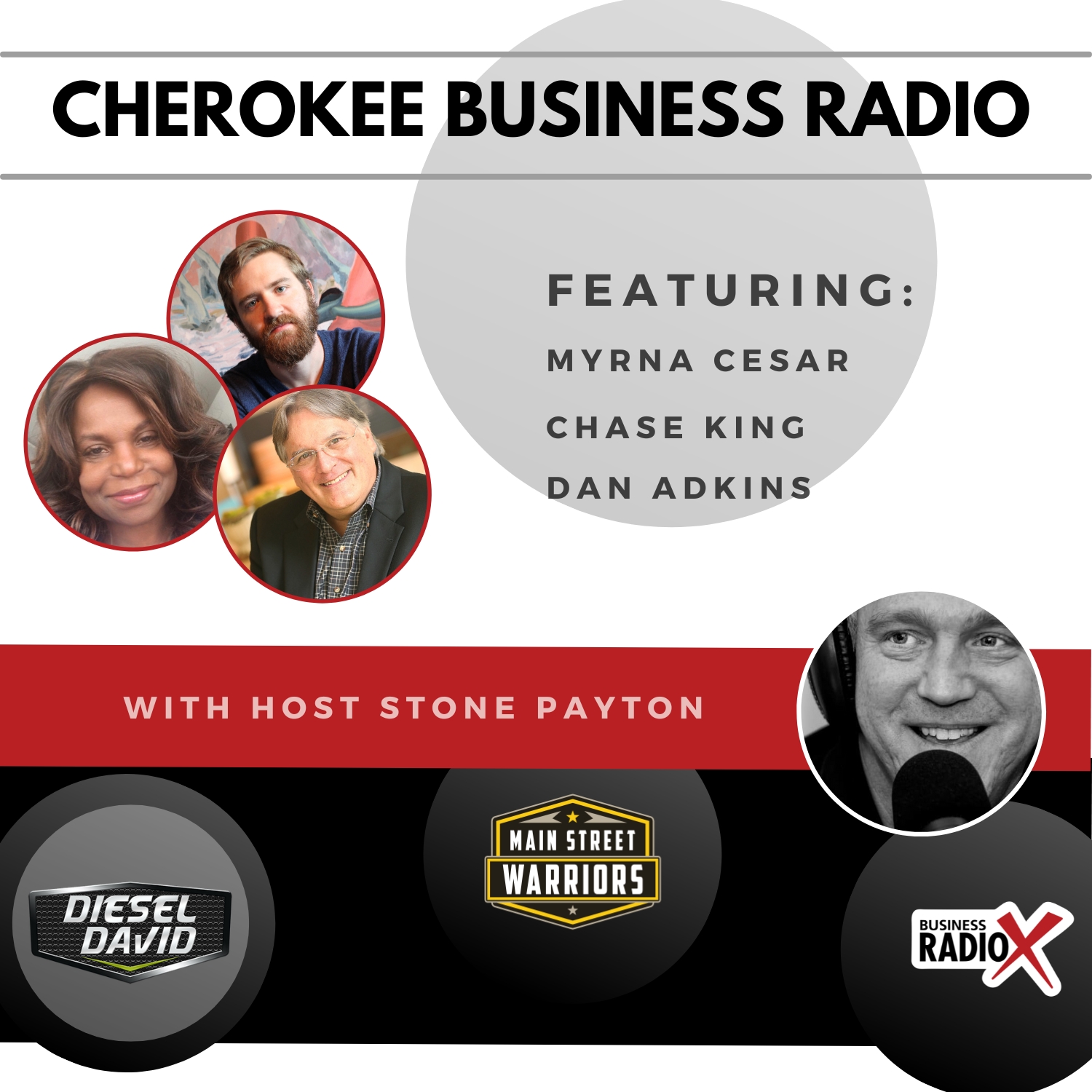
In this episode of Cherokee Business Radio, host Stone Payton is joined by Myrna Cesar, Chase King, and Dan Adkins. Myrna shares her expertise in elderly care, emphasizing respect for their independence and the importance of marketing in this sector. She also talks about her role in founding Senior Chronicle magazine.
Chase discusses the business of being an artist, and how it’s not to be taken lightly. He also talks about doing live paintings at events and being a two-entrepreneur family.
Dan shares effective tactics for fundraising and the need to monetize services for sustainability. He introduces his innovative “chatter boxing” method for business expansion and reflects on his book, “Gifts from My Father,” drawing parallels between his father’s dementia and broader life and business lessons.
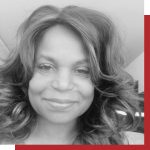 Myrna Cesar, Director of Acti-Kare, is a graduate of University of Massachusetts with a Bachelor of Science in Clinical Psychology/Marketing. She worked and graduated from Harvard School of Public Health with a with a Master of Public Health (MPH) – an additional Master in Healthcare Informatics from Capella University.
Myrna has a well-rounded background, with many years of experience in multi-media marketing, Artificial Intelligence (AI), project management, and customer relations. After working in the corporate world, Myrna decided to start a business that would have a meaningful impact on the community by providing seniors, families, and those needing in-home care services with a full continuum of care.
Myrna and her team are compassionate and tenacious in providing high quality in-home care that makes it possible for people to age in place gracefully. She knows how important it is for our clients and their families to have reliable, trusted, and affordable in-home care to help the lives of aging adults and their families.
Myrna and her team look forward to helping you and your family!
Follow Actikare on Facebook.

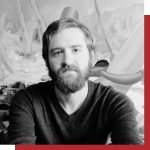 Chase King, a Woodstock, Georgia native, is 33 years old and received a Bachelors of Fine Arts with a concentration in Painting and Drawing from Kennesaw State University in 2017.
Currently, Chase uses traditional media in his art, oil paint being his primary medium. He has been exhibiting his work regionally and nationally since the age of 17.
Chase is a full time artist based in Woodstock with his wife Madeline, their daughters Lucy and Della , as well as their chiweenies Lando and Yoda. Visit www.chasekingart.com for more artwork and information.

 Dan Adkins, Innovative Coach with Strategystix, devoted many years working on Saturday Night Live, over 40 feature films (Malcolm X, As Good As It Gets), plays, and television, but was eventually led back to the business world.
After a brief stint, his father was diagnosed with dementia and he authored “Gifts From My Father.” Simultaneously, Dan was consulting with non-profit organizations, small businesses and large corporations across industry. Dan has maintained a resilient sense of humor and gleaned valuable lessons from each success and setback. He found that his true passion lies in empowering individuals, non-profits, and businesses to succeed.
Toward this end, he has been an adjunct professor at Belmont University’s Massey School of Business, a guest lecturer at Indiana University’s Ernie Pyle School of Journalism and a consultant and the Kelley School of Business at Indiana University. Dan has coached a wide variety corporate executives and Methodist ministers and has spoken on Leadership, Teamwork and FUNdraising.
Dan holds a BMUSE from the University of Florida and earned his MBA from the Owen Graduate School of Management at Vanderbilt University. In 2000, for reasons known best to him, Dan embarked on the London Marathon to support the Leukemia/Lymphoma Society. To this day, his legs and lungs are in recovery mode!
Whether you seek coaching or a compelling speaker for your company or organization, don’t hesitate to reach out to Dan at dan@strategystix.com to explore potential synergies.
Connect with Dan on LinkedIn.
 This transcript is machine transcribed by Sonix
TRANSCRIPT
Intro: [00:00:07] Broadcasting live from the Business RadioX studios in Woodstock, Georgia. It’s time for Cherokee Business Radio. Now, here’s your host.
Stone Payton: [00:00:24] Welcome to another exciting and informative edition of Cherokee Business Radio. Stone Payton here with you this morning, and today’s episode is brought to you in part by our Community Partner program, the Business RadioX Main Street Warriors Defending Capitalism, promoting small business and supporting our local community. For more information, go to Main Street warriors.org and a special note of thanks to our title sponsor for the Cherokee chapter of Main Street Warriors Diesel David Inc. Please go check them out at diesel.david.com. You guys are in for a real treat this morning. We’ve got a studio full. Please join me in welcoming to the broadcast, first up on today’s episode director with Acti-Kare Marietta, Cherokee and North Fulton. Ms. Myrna Cesar. How are you?
Myrna Cesar: [00:01:19] I am doing awesome. So glad to be here.
Stone Payton: [00:01:22] It’s a delight to have you in studio. We’re neighbors here at a co-working spot, uh, called the Innovation Spot.
Myrna Cesar: [00:01:28] Yes we are.
Stone Payton: [00:01:29] We’ve had lots of conversations. This has been in the planning for some time. I’ve got a ton of questions. I know we’re not going to get to them all, but I think a great place to start might be if you could paint for me and our listeners a bit of a picture of mission purpose. What you and your team are, are really out there trying to do for folks.
Myrna Cesar: [00:01:49] Well, um, Acti-Kare of Marietta is basically our focus is to, um, keep client as active as possible in their home. Um, the the age range varies depending on their needs. So our main focus is keeping a client at home safe and providing awesome service.
Stone Payton: [00:02:15] Well, it sounds like noble work and fun work, if you can get it. What, uh, what’s the backstory? How did you find yourself doing this?
Myrna Cesar: [00:02:22] Um, I, my aunt, uh, who lives in Florida. Um, we went to visit my mom and I. So I have to say, it was my mom who dragged me in this space.
Stone Payton: [00:02:35] Way to go, Mom.
Myrna Cesar: [00:02:36] I know, so, um, we went to visit her in Florida. Um, she has at the time, a slight case of Alzheimer’s dementia. Mm. Um, I didn’t like the service that, um, the agency that was providing the service, the way they talked to her, the way they were engaging with her. So, um, I let them go, and then I stayed a couple of months, and at the time, I was working in corporate, um, so I can pretty much work anywhere in the US. So I set space for about three months, um, and trying to, um, get engaged, engage with her and see, um, the best service and agency that can provide care once we leave. So I had a slew of them that came through, and an active care was one of them. So I like the way, uh, they engaged us from start to finish and how they incorporate her into the decision making, um, care plans and all of that. So, um, my mom was sitting next to me. She said, oh, you can. She has a very French accent. Oh, you can do this. This is you. I said, no, mommy, I have a I have a nice little cushy job in corporate America. I don’t want to do this. She’s like, oh, you can do this. Um, so a few months went by and she came back again. She’s like, have you decided what to do? Because you want to leave corporate because you want to do your own stuff? I’m like, no, I don’t, I’m okay. So finally I did, um, and and I did all my research and, and so active care it didn’t break the bank, so I didn’t have to sell my first born child to buy into a franchise. And and I’m glad I did.
Stone Payton: [00:04:36] And you made the decision to join a formal franchise. Did you ever consider, hey, I’m going to do this, but I’m just going to be, you know, CSR chair.
Myrna Cesar: [00:04:46] No, because I didn’t know the the ins and out of the business. And I needed to be part of a of a family that’s been around for a while. Um, and so I needed that structure and that knowledge before I could have, but it would have taken me a while to get, you know, dirt under the fingernails type of. Yeah. So. Yeah. Right.
Stone Payton: [00:05:16] And there’s, uh, I’m operating under the impression there’s some brand equity, if that’s the right phrase, there’s some recognition, there’s some procedures back into the house. All that.
Myrna Cesar: [00:05:25] Exactly, exactly. It, um, they educate you to a point where it makes the process dealing with the red tapes. Um, from, you know, state to state, way better. So now, if I wanted to, you know, consult with someone who wants to do it on their own, I can definitely help them, because now I know the, uh, all the nitty gritty of what to do, how to do it. Yeah.
Stone Payton: [00:05:51] So now that you’ve been at it a while, what’s the what’s the most rewarding? What’s the most fun about it for you?
Myrna Cesar: [00:05:57] For me, it’s, um, uh, working with not just my team, but learning from, uh, the seniors and their life, uh, uh, understanding what makes them tick. And they’re funny as heck. So to me, it’s the, the relationship, um, with a client and also their family, because we’re not only providing care to them, but also making sure that their family feels comfortable and they know that, you know, their loved ones safe. So because one of the, uh, slogan of active care, when you can’t be with the one, your loved one, we can. And so so we’re kind of like an extension of, of their family.
Stone Payton: [00:06:44] Well, that’s an excellent point. Um, we’re not there yet for me, but my parents, they now live two minutes away. They were down in Florida. I grew up in Pensacola, Florida, and they’re not there yet. But when they are, yeah, I guess I’m going to be a client too, right? I’m the client, too. Not just not just Mom and dad.
Myrna Cesar: [00:07:03] Exactly, exactly, exactly. So what we do and what I. What I’ve been doing is really educating the public on if you have, um, an aging parent, um, what to do, um, how to engage them, because we seem to think a lot of people think and even I’m I’m definitely guilty of that, that now that my mom is, uh, is older now, I’m taking, you know, rein of this now she’s my child that I’m taking care of, and I can tell what to do. But no, they’re not. They’re grown adults. They raised she raised me. So I have to follow a certain line that she needs help. And I’m there to provide help. But she’s also an independent person, so you have to respect those boundaries as children of an older parent.
Stone Payton: [00:08:00] So you talked about educating. How does the whole sales and marketing thing work for a business like yours? Is that a big part of the the strategy, the way that you meet your market is by educating people and maybe ideally early rather than late.
Myrna Cesar: [00:08:17] That that’s definitely one aspect. Uh, the other aspect is really, um, you know, door to door going down, meeting, going to senior facilities and, and talking, reaching out to them, providing free service. Um, I do a lot of bingos and a lot of facilities. Um, uh, so I’m in the community and, and they just they see me as the brand of active care of Marietta. So that’s one aspect of this. Then I also have leads, um, that we received, um, another.
Stone Payton: [00:08:55] Benefit of being part of this formal franchise. Okay.
Myrna Cesar: [00:08:57] Exactly, exactly. So and then we have, you know, um, a bootstrap marketing, um, I have, you know, a couple of sales, uh, ladies that goes out and sell our services, uh, facilities, um, doctor’s office. We have all our marketing material all over the place beside myself, you know, doing the show and dance.
Stone Payton: [00:09:23] Well, no, it’s a good lesson and a good conversation for, uh, budding entrepreneurs. Aspiring entrepreneurs. I don’t care how great the franchise is or how cool the idea is. You know, you’re not going to build it, and they come. You gotta have some kind of approach to go to.
Myrna Cesar: [00:09:39] That is a that’s exactly what I tell people. Don’t, don’t, um, put in your head that, um, I provide all these services and people will just going to be knocking at my door. That doesn’t happen. You have to you have to be out there promoting it and sometimes giving free services, uh, going to expos wherever I said wherever a senior is, Myrna is there with the banner of active care. This is who we are, what we do and how we do it. All right.
Stone Payton: [00:10:10] So let’s talk about who you are, where you are, how you do it. Uh, the work itself. And if we if you want, you can use me as a case study. Although maybe I’m too early in the. But I would like to know. Let’s talk more about the work itself.
Myrna Cesar: [00:10:23] So normally, um, a client will, um, uh, son or daughter will call me and said, I have mom. She lives alone. Um, we want to respect her space and have provide service at home, which is awesome because that’s where you want them to be. Yeah. Facilities. Um, you know, sometime, you know, uh, family can help, but put someone in a facility. But there are, you know, 1 or 2 caregivers, and they’re taking care of 24 people. So that one on one, that connection is not there. Um, the level of care is not there. So when someone calls me and said, okay, mom is 80 years old and, um, you know, she has no major, um, no major health concern, but we want to have someone that comes and provide companionship that makes sure that she’s eating the right food, um, making sure that she’s dressed, she’s showering. Uh, she can do that. All those things by herself. And sometimes she’s afraid that, you know, she may, you know, she may slip and fall in the shower. Right? So, um, I will go and I will do an assessment, um, to make sure that there’s no, uh, no rugs around, that she can easily fall. There’s some grab bars in the bathrooms. Um, things are easily accessible to her in the kitchen. Um, so I will look at all of that and.
Stone Payton: [00:12:01] See that never even was on my radar. None of what you just said was on my radar. I mean, the idea of a companion and someone there. Yes, but not the. I need to check their house for rugs when I go later today.
Myrna Cesar: [00:12:13] Well, we we we have a we have a checklist that I can share with you. Uh, so there’s a checklist that I go through the house and I make sure that things are okay. Yeah. Um, so once that happens, then I kind of get a feel for how many days of the week that you want this? Um, we don’t impose, um, you know, that you have to have 40 hours. You have to have someone here because they may not need someone 24 hours a day. They just need someone three hours a week, 2 or 3 times a week. So we’ll go and we’ll kind of fine tune that. Um, and then talk to mom. My engagement is really to, uh, mom or a dad, uh, just to get into their head, um, if they’re okay with this. Now, I’ve talked to son. Now I’m talking to. How are you okay with this? Um, what are some of your concerns? Because sometimes I’m like, I don’t need anybody. And then now my job is to really say, okay, we’re not going to intrude. We’re just here for some help. We’ll help you. If you need, uh, help with the laundry, we’ll do that for you. If you need, uh, a good cook meal instead of going to Wendy’s, we’ll do that. Um, a little vacuuming. He’s like, oh, yeah. Yeah, yeah. And. Usually I put it in such a way that this is really to help your daughter, because your daughter is at work in the office, so she doesn’t have to worry that you’re going slip and fall. She doesn’t have to worry that you’re not eating the right stuff, but it clicks for them automatically.
Stone Payton: [00:13:54] That’s a great way to frame it. Yeah, because that would be meaningful. That would be far more meaningful to my parents that it’s helping me. Yeah, I love it.
Myrna Cesar: [00:14:02] Yes. So kind of take that burden off of you. Um, and then so once that happens and like, oh yeah, we yeah, we’re going to do it. They make the decision. Yeah. We want you. Let’s do it. Before they sign any any, um, uh, agreements. So I go back to my office, called the nurse, and have the nurse do an assessment that is a requirement by the state of Georgia that if you are licensed by the state of Georgia, you are required to do a nurse supposed to come and do an assessment. So we scheduled the nurse to do the assessment. They signed the agreement. The agreement. Is this a list out all the, you know, three days a week, the time we’re going to be here from ten to 10 to 12, and we’re going to provide X services. Um, and then um, and then you sign. Now you can try it out for whenever, whenever you decide to say, you know what, mom is okay, we don’t need the services anymore. So you’re not locked into a two year contract. It’s as needed basis. Um, so once that happens, and then I also, um, try to connect, uh, the personality of the client with the caregiver.
Stone Payton: [00:15:19] Oh, I bet that chemistry would be important.
Myrna Cesar: [00:15:21] Exactly.
Stone Payton: [00:15:22] Dans over here, nodding his head. And we’re going to visit with Dan in a little bit, but he’s he’s living through very much a lot of what you’re describing.
Myrna Cesar: [00:15:29] Awesome. Because even for even for Dan because he’s providing care to for your mom. Right. So even respite care, we do provide that service to caregiver home caregivers, um, so they can go to their doctor’s appointment or do the kind of thing or go have a lunch with a friend. Uh, so we also that’s all underneath that umbrella and all.
Stone Payton: [00:15:53] Of this, uh, I’m under the impression that we may start with program A, and it’s outlined like this. But as we get further and further in, we kind of we can dial it in and fine tune it, right? The needs evolve or we’re now we’re a lot smarter a month or two in. But what we really need and want.
Myrna Cesar: [00:16:10] Exactly, exactly. And and at times it, sometimes it, it just grew from three days to five, seven days, uh, depending on the level of care that the client needs.
Stone Payton: [00:16:26] And this didn’t have anything at all to do with your corporate job.
Myrna Cesar: [00:16:31] No. No. Actually, I have to say, my mom reminded me the other day, she’s like, well, you know, you when you were in, uh, when you were in high school, you work in a nursing home. I was like, oh, yeah, your major was a pre-med major. I’m like, oh, yeah. Um, you’re you’re it’s like your degree is in clinical clinical psych. You work with autistic kids and da da da. And now that you, you know, you you have forgotten. That’s what you remind me. So you have forgotten the gifts that was planted in your heart. I’m like, okay, I’m done.
Stone Payton: [00:17:07] I feel like you’ve described a lot of the elements and I’m connecting the dots, but in short form. How would you articulate the difference in in active care and what you guys do and the way you approach it versus maybe the rest of what we might find in the general market?
Myrna Cesar: [00:17:24] I think the way we approach, um, uh, dealing with, um, our care partners, that’s what we call them, our care partners is that, um, that one on one is always there. They have my number at any time they can call me. Not a not a whole lot of agency. You can call the owner.
Stone Payton: [00:17:49] Yeah, I bet.
Myrna Cesar: [00:17:50] You can call me. Um, the type of care plan that we provide, we, we create for our client. Um, they, they are part of not just the client, but also the family. When we create the care plan, we incorporate them into that so they know exactly when a caregiver walk into their home, what they what they’re supposed to do. In addition, uh, we leave a communication log in every home. That communication log has my direct number. It has, uh, our liability insurance. Um, so you know that if something happens to a caregiver in your home, you’re not going to be burdened with the costs of making health care. Yes. So we incorporate all of that in that communication log. So if I’m a daughter and I live in Texas, which I do have clients, and we’re taking care of their family, they live in Texas. If they walk in two weeks from now, they can tell exactly what happened, what mom ate, when when we do laundry for her, when we took her to a appointments, doctor’s appointment, all of that. In that communication lock and it goes back. So that’s a requirement of mine. So I know so I know as a daughter who has an aging parent that that’s what I would like to have to see when I walk in I want to see, okay, mom did this. She did that. Oh, she ate this this morning. Oh, okay. Okay. We did this exercise. So we incorporate all of that in that communication log.
Stone Payton: [00:19:32] All right I’m going to switch gears on you okay. For a moment before we before we wrap your segment, I don’t know when you’d find the time because it sounds to me like you got a lot going on. Uh, but passions, pursuits, interests, hobbies outside the scope of your of your work, anything you have a tendency to. My listeners know I like to hunt, fish and travel. Okay, but is there something like that that you nerd out about?
Myrna Cesar: [00:19:52] I am, um, I come from a technical world, and I’m still in there, and I’m a creative person, so, um, uh, last year I created this magazine called Senior Chronicle, which we’ll talk about. Um, it was a way for me to highlight all these, um, uh, aging seniors that have so much to, to offer. And they’re just sitting at home, um, looking at the shiny object we call television. So. But I wanted to put them up front in terms of who they are, as fabulous as they are on a magazine cover, so they can have something to talk about. So, um, so that is the creative piece of me in terms of what I do on a daily basis. I’m a big, uh, hot yoga fan. Um, I, I also play pickleball.
Stone Payton: [00:20:55] We were chatting about that before we came on here. The whole studio, everybody but Stone plays pickleball. I’m gonna have to look into this.
Myrna Cesar: [00:21:01] Yes. So, um, there’s a wonderful indoor pickleball place, uh, in Roswell that I go to, uh, some friends of mine. So. Yeah. So I’m learning pickleball. Uh, it’s awesome.
Stone Payton: [00:21:13] All right, let’s leave our listeners with a couple of actionable tips. Maybe they’re in my situation where it’s early, but, you know, the parents are getting a little bit older, and they need a little help. I thought, like, just like what you mentioned earlier about just around the home. Well, a couple of of tips so that we could practical, actionable tips to help them just be better at communicating with and working with, uh, aging family members.
Myrna Cesar: [00:21:38] Yeah. One tip I would like to leave, and I think I, I, I alluded to that earlier, um, that your parents or your parents, um, and, uh, rather than coming and take over. Um. They need more guidance than for you to take over their lives. You will get a lot of pushback, so I would suggest not to do that. I’ve, I created actually a, um, a presentation on how to talk to an aging parent on receiving services from agencies. Mm. Uh, it’s, um, and I usually send that out, uh, to potential leads or people that have called me. I send that out. Um, in addition to how to select the best care agency that fits your fam for your family. Um, there are certain things that the certain questions you need to ask because they’re coming into your space, they’re coming into your parents space. You need to know, um, the the questions to ask, like, you know, what kind of, uh, training does your caregivers have? What how do you, uh, make sure that the caregiver is who they say they are? I know I act a care. Uh, although we run them through the, the database and the state of Georgia. But I do a statewide check because you can be beautiful in Georgia and not so beautiful in North Carolina. Yeah, yeah. So you have to know, and I know for some it’s, uh, it’s new territory and they get really, uh, you know, trying to figure it out. Mhm. Call actor care will help you figure that out.
Stone Payton: [00:23:36] I love it. And when you come back and you are coming back we’re going to dive in more on this magazine I could see like a periodic uh, installment, almost like an audio column of what’s going on with Senior Chronicle.
Myrna Cesar: [00:23:47] Senior Chronicle. Yeah.
Stone Payton: [00:23:49] Right. So we’re going to have you back and we’re going to dive into that. But for now, let’s make sure that our listeners know how they can tap into your work, where they can get their hands on some of this educational material, have a more substantive conversation with you or somebody on your team, whether it’s a website, whatever. Uh, coordinates make sense?
Myrna Cesar: [00:24:06] Um, the the the number is, um, (678) 559-5887. Uh, you can send me an email. It’s mce sa at acti k a r e. Acti-Kare. Kare with a k, not a c where you can go to, um, to our website www.actikare.com slash marietta.
Stone Payton: [00:24:32] What a pleasure to have you in studio and visiting with us.
Myrna Cesar: [00:24:37] It was awesome. Thank you.
Stone Payton: [00:24:38] Well thank you for joining us. Really appreciate you sharing your insight, your perspective. And uh, I’m quite sincere. We’re going to have you back in here and we’ll, uh, we’ll explore that later. We’re neighbors anyway, so we’ll grab some coffee and and talk it through. How about hanging out with us while we visit with our other guest?
Myrna Cesar: [00:24:53] I would love to because you have some really cool people here.
Stone Payton: [00:24:56] I do. All right. Next up on Cherokee Business Radio this morning, please join me in welcoming to the show with Chase King Art the man himself, Mr. Chase King. Good morning sir.
Chase King: [00:25:07] Good morning.
Stone Payton: [00:25:08] Hey, did you learn anything in that last segment?
Chase King: [00:25:12] I did. You have, uh, you offer some personalized care for seniors, and that’s a great thing.
Speaker4: [00:25:16] Thank you. Yeah.
Chase King: [00:25:16] We’ve got an aging population, and they need it.
Stone Payton: [00:25:19] Some of the folks in this room are a little longer in the tooth than Chase, but let’s not get too personal. Tell us about Chase King Art man.
Chase King: [00:25:29] Well, it started, uh, started when I was about 15 years old. I was, um. I had a great art teacher in high school. Um, we he took me under his wing. And at the time I needed a little bit of guidance. I just lost my mother to, uh, to cancer, to a brain tumor. It’s kind of like a. It happened pretty fast about, I guess, six, eight months. It just kind of swept over and took over. But it was a kind of a traumatic event. But I had my grandparents with me and they raised me and they took me, took me under and helped me out. But I needed a little bit of guidance. And at the time I was skateboarding and I loved skateboarding. I had some good friends in the all the way up through high school, but we, uh, I needed some something to do, and painting became that. And it was a good outlet for me to express my emotions and angst at the time and just kind of figure out life. And from there, it hasn’t stopped.
Stone Payton: [00:26:28] So have you landed on a niche, a style, a type of painting? A I don’t even know the right questions to ask. I’m just asking questions like the like, do you paint oils or watercolor?
Chase King: [00:26:40] Yeah, I do just about all of that. Uh, my primary my primary medium would be oil painting. Uh, but I do work in a lot of graphite watercolors, pastels. I like to draw a lot, so I just kind of bring that into the fold as I do my drawing. And then the oil painting is like the, like the pinnacle of my ideas. Whenever I get to a point where I’m going to do something major, I’ll do it in oil.
Stone Payton: [00:27:04] And your painting people, landscapes, uh, you know, hot rod cars. Yeah.
Chase King: [00:27:09] Pretty horses. Um, I like I’m a, I’m an observer. And my life, I just like to watch things and look and see. And I’ll just pull from just about any resource that I can, if it’s interesting enough to me, or if it’s not interesting, and I want to figure out a little bit more about it, I’ll paint it and see what I can.
Stone Payton: [00:27:25] Make it interesting. Yeah, right.
Chase King: [00:27:27] So, uh, just about anything, but I have a I have a very expressionistic style, and I use a lot of color, and I take a lot of liberties with form. So it may not look like as realistic as, as it could, but it’s identifiable and it gets your attention.
Stone Payton: [00:27:44] Now you do something that seems very unique to me. At least I haven’t come across it. Where you’ll paint. Is it live painting? You paint like at events? Yeah. And you capture what’s going on at the event. Mhm.
Chase King: [00:27:56] Yeah. So I’ll, um I’ll. I’ll either be on the fringes of the of the audience, or I’ll be slap dab in the middle. It just depends on what? All events are so different. So I just have to coordinate with with who’s organizing the event. But yeah, I take in the entire audience. Um, everything that’s going on and I’m either working from my sketchbook or I’m working from scene and I’m just painting. And people love watching stuff evolve in front of them. It’s like you could watch a tree grow, but it’s a painting instead. It’s just super fast and it’s, you know, some events can be an hour or two hours or less. So it happens fast. And I’ve been doing this for about half my life, so I’ve been able to develop speed. And it was kind of a natural way for me to to showcase what I do to the public.
Stone Payton: [00:28:50] Well, I’m so enamored with the idea. I mean, even in my world where we in studio like this or like a Thursday, we’re going on site to do what we call a remote broadcast. Yeah. You know, we’ll be broadcasting live. It’s a big technology summit kind of thing. I just how cool would it be if you were kind of off to the side painting the action? Maybe at the whole event, but even just the Business RadioX action, I’m really I’m intrigued with this. Yeah. You get it’s.
Chase King: [00:29:15] A great opportunity for me to meet people. It’s also a great opportunity for other peoples to be around creativity in a way that you wouldn’t expect. It’s kind of surprising, and I like that about it, and I think other people do too. And I’m just trying to grow a business model around that. And it’s been exciting. It’s been really fun and it makes me tick. It really does.
Stone Payton: [00:29:35] So that’s the other side of all this. You’re an artist. Marvelous. I’m sure you’ll continue to get better and better and and enjoy all that, but oh, by the way, you got to run a business. Yeah. What are you learning about the business of being an artist?
Chase King: [00:29:50] Yeah, I’ve spent again half my life just developing my craft. I haven’t, I mean, I’ve sold paintings here and there, not consistently, but I’ve taken a leap as of 2 or 3 months ago now to do this full time. So I’ve been I’m in the midst of it. Oh, wow. Things as I’m going. Running a business is not, um, it’s not anything to take lightly, especially if you’ve got people who are depending on you to provide. So there’s there’s aspects involved that I have to learn and. Figure out. So I’ve been able to do I’ve had a I have a a business. My wife is a business owner. Madeline was on here a few weeks ago. Oh, she did.
Stone Payton: [00:30:31] A marvelous job. So you gotta have a high bar to clear here. Chase.
Chase King: [00:30:34] She’s a really great, uh. She’s so inspirational. So I have heard of in my corner to help me with figuring things out as the business goes on. Um, but, yeah, there’s, uh, lots to learn, but I’m getting it, all right?
Stone Payton: [00:30:50] So as a potential customer, I could come to you and say, hey, we’re doing this remote broadcast, or I’d love to have you come in this studio. We’re throwing a block party. So this live painting thing, I, uh, I can what a great, uh, accent to a party, huh? Darn right. Yeah. Very cool.
Myrna Cesar: [00:31:04] I think one of my questions for you is when you do these type of event, that energy must be, like, blinding. And because you’re you’re absorbing it, you’re absorbing it as you’re doing it. So that must be really hyped.
Chase King: [00:31:21] Yeah. No it is. And and there’s a lot of nerves involved. But as I get started it’s just those kind of simmer down and I get to get focused. And also I get healthy distractions from the audience members and they get to talk. And it just kind of takes my mind off of the nerves a little bit, too. It’s just a really cool, immersive experience for everybody.
Stone Payton: [00:31:42] I gotta agree, man. I don’t think I’ll throw another party without maybe reaching out to. I did a.
Chase King: [00:31:47] I did an event at a deer park, uh, Christmas around Christmas time. They had Santa Claus there, and they set me right up next to the fireplace where the kids were lining up, and I just was painting the Christmas tree in front of me. It was a big, grand Christmas tree they had decorated, and I just was painting that as the kids were lining up and I would let them paint on it and I would just kind of work it in a little bit. So it’s not didn’t turn into a mess. Not all of them. I mean, it just it was an experiment to say the least. We just made it made it something and it was pretty cool. And then we raffled it off. So there’s just so many different possibilities to get involved. Uh, get the community involved with painting too. So that was a that was kind of the first event that made me realize, like, this is something I really need to be doing.
Stone Payton: [00:32:32] Very cool. So how were you finding the Cherokee area business climate? Do you find that other business owners are trying to find ways to help, or ways to get you incorporated into things? Or if you need an accountant or a lawyer, are you finding them in the community, embracing you on this?
Chase King: [00:32:51] They’re, uh, they’re there for a lot of there’s there for support and friendship. And I’ve been I’ve been able to do business with quite a few of them, especially, um, the Woodstock arts organization. Oh, yeah. They were the ones who pretty much kick started my live painting suite idea, because they asked me to do it during 2020, right before I was getting shut down.
Chase King: [00:33:13] Just got back from, uh, from Mardi Gras. I was, I was riding high, you know, it was I saw a lot of theatrics out there. It was cool. So I got up on stage and it was 400 people behind me, so.
Stone Payton: [00:33:24] Wow.
Chase King: [00:33:24] I was like, that was nerve wracking. That was the first time I’d ever done that. And I was crazy. But the nerves went away after I just got locked in. Awesome. But, um, yeah, Woodstock Arts has been a great supporter of mine as far as getting my, uh. Career going. Honestly, I’ve taught there to painting live for their galas. Um, it’s been it’s been good. And then, I mean, there’s a number of other ones. I’m trying to think Capital Mortgage Solutions helped me out with that Adair Park event. And then, um. Uh, collaborative co-working space at Adair Park. They had, uh, hosted an event a couple two weeks ago, I believe so, yeah, they’re it’s all coming. They’re all coming together and seeing what’s going on, and and any way that they can help, they do. And I try to do the same.
Stone Payton: [00:34:08] And then what I’m viewing as the more traditional artists work, like can someone come to you and is commission, is that the right word? Like, yeah, hire you to paint a specific thing.
Chase King: [00:34:18] Um, the more traditional, uh, route of my business is commissions or custom art, and I sell my original work too, and I do a lot of that, and I have a lot of that.
Stone Payton: [00:34:28] So you give yourself plenty of latitude to sit down and do what Chase wants to do and then take that to market. But then you’ve got these other avenues.
Chase King: [00:34:36] Yep, yep. That’s the that’s the idea. I want to be able to hopefully just sell my artwork and do commissions and live paint. I love it.
Stone Payton: [00:34:46] Yeah.
Stone Payton: [00:34:48] So how about you? Outside of painting you enjoy other stuff or that really is your thing? That’s my.
Chase King: [00:34:52] Thing. But I love, uh, I have a growing family. We, uh, like I mentioned, my wife. Yeah. And we have, uh, very two little girls, two and a half and one.
Stone Payton: [00:35:02] Oh, my. Oh, you can’t have a hobby for 15 years.
Speaker4: [00:35:05] There’s a little bit of.
Stone Payton: [00:35:06] Right, Dan?
Dan Adkins: [00:35:08] I think it’s all about the girls at home, huh? I say, and then the hobby is all about keeping the girls intact. After 14 or 15 years, they keep us busy.
Chase King: [00:35:18] They’re so much fun, though. I mean, we it’s so up and down and chaotic, though. It’s. You just can’t predict any kind of behaviors. It’s just whatever you get. So we can be feeding them dinner one night and they love it the next night. They hate it. It’s the same food just drives us up the walls. But then we have moments where it’s just watching them play together and they’re so sweet.
Stone Payton: [00:35:38] So I do know your wife and I think the world of her. Uh, Madeline, it’s a two entrepreneur family. Have you have you have you come across begun to build some? I don’t know what you call them. Disciplines or, like, here’s how we’re going to conduct our, our lives. Because have have you is it too early or have you kind of you’re figuring your way on that. Yeah.
Chase King: [00:35:59] I mean we we’re we’re getting some things in order. We we started doing that a little while ago. We got life insurance policies and stuff that we’ve been investing in. And just like trying to keep our house somewhat ordered as far as, like getting necessary things we need, like food and paying our bills and our mortgage and all that, just making sure that all that’s taken care of as far as like the growing business, it’s it’s a crapshoot. Sometimes it’s just whatever works works. We try to capitalize on what doesn’t or what works, and then kind of put things to the side that don’t work and try to refine things. So it is a learning curve for both of us to entrepreneurial spirits in the house. One’s pretty fresh off the block too. So right. Madeline’s got an upper upper hand I think. And I’m I’m learning a lot from her.
Stone Payton: [00:36:47] I’ll bet you are. So, uh, like Myrna are are you out there shaking the trees and networking and talking to people? And I mean, you you got to do that, right? In addition to all the art.
Chase King: [00:36:59] Yeah, yeah, I learned that you have to do that. And there’s so many ways to do that. But, um, I’m a pretty shy, reserved, shy person, naturally. But I’ve been able to go to some networking events and just listen to people and talk with people and tell them what I do. It’s got me out of my shell a little bit good, and doing this is a pretty big deal for me too, because I don’t know. But doing the live painting thing that was like, I didn’t think I would be able to do that. But then again, I’m internally, though, I’m a pretty shy person.
Stone Payton: [00:37:29] But you.
Chase King: [00:37:30] Mentioned try to get it out though.
Stone Payton: [00:37:32] But you mentioned listening, and I think all of us who have been at it a while as entrepreneurs have learned that while being able to articulate ideas and frame up and all that, that’s that’s certainly helpful. But I think the most powerful tool you can utilize in a, in a sales and marketing capacity, and I think I see the other two nodding their head, is just being good at listening. Yeah. Um, so it’s good to hear.
Chase King: [00:37:57] It’s reaffirming. Yeah.
Stone Payton: [00:37:59] And you’ll, you’ll, uh, profit from the law of contrast because not every. Yeah. A lot of folks who may be think they’re listening are actually waiting. They’re just waiting till you’re done talking. Then they want to. They’re not actually listening. Yeah.
Chase King: [00:38:14] Yeah that’s a good, good point.
Myrna Cesar: [00:38:16] I think for me as a as a business owner in this space. Yeah. Um, and I don’t know if you, if you come across this because I want to help so much and sometimes I’m like, okay, um, uh, I’ll do it for free. Do you find that? And and then I have my staff will stop me and said, well, no, well, we’ll do it for free today. And then because I have this, this, this yearning to help, I want to save everybody. Do you find that? And not so it’s the humanness of it. And then. But you have to. Balance the business side of it, and that’s what I’m learning. Um, uh, now that I have to do the I have to do the balancing act, it’s.
Dan Adkins: [00:39:04] Pretty typical of entrepreneurs. Yeah, I don’t know how to price themselves. And they they want to give it away. It’s a dart game. It is.
Myrna Cesar: [00:39:12] Yeah. Yeah, yeah.
Dan Adkins: [00:39:13] And a lot of that is because they’re they do want to serve as people. That’s why they do what they do.
Myrna Cesar: [00:39:18] Yeah. And it’s not even the pricing. It’s just oh I feel so bad right. Yeah. Well we’ll do it for free.
Chase King: [00:39:27] And I just tried to take what I do and, and educate people on the value of it. I’m not trying to boast or anything, but what what people do for their livelihood is important. And you got to try to exercise that and and display that to people and present it in a way that they’re going to understand how valuable it is. Yeah. Otherwise they’re going to want to deal. Yeah. And if you keep giving them deals, they’re going to keep expecting that. And that word spreads.
Dan Adkins: [00:39:53] Well. And and also you have to explain how valuable it is to them because it’s wiifm. What’s in it for me is so often the case. Yeah. And um, and you’re selling the value not not anything else. Yeah.
Chase King: [00:40:10] Sometimes you’re even selling yourself, right?
Myrna Cesar: [00:40:12] Yes.
Dan Adkins: [00:40:12] That’s usually what you’re selling in the value. But, um, people sometimes ask me, why am I different? It’s because I’m me and nobody else is. And that’s what one of the things I offer. It’s not the key thing necessarily. But if somebody doesn’t buy into me, they don’t buy into what I do. Sure.
Myrna Cesar: [00:40:33] Well, I like that.
Stone Payton: [00:40:34] Sounds to me like.
Dan Adkins: [00:40:36] Well, I’m sorry. Go ahead.
Stone Payton: [00:40:37] I was just going to say, it sounds to me like Chase has accumulated or already came to the table with a great deal more wisdom than I would have thought. For someone who is very early in their entrepreneurial journey, I think he’s got a good handle on it.
Myrna Cesar: [00:40:50] Yes, yes.
Dan Adkins: [00:40:51] And you, you had a phrase that I really liked when you said, and I’ve forgotten the first word, which was the crucial word, but you were talking about distractions and healthy distractions, healthy distractions. That is such a great term. Um, because, uh, it’s getting ahead.
Chase King: [00:41:07] A lot, and you just have to let things come to you.
Dan Adkins: [00:41:10] And as opposed to trying to fight them off, which doesn’t work very well, or, uh, you know, get away from them. And that also doesn’t work very well when you’re doing things in the public eye. Yeah.
Chase King: [00:41:25] I’m a pretty firm believer of the law of attraction. I think if you can. Believe something and think something. Um, you’re going to keep attracting that to you, whether good or bad. So if someone comes up to you and is interested in what you’re doing, it’s because you’re thinking about something that you’re doing that’s interesting and the people want to know. So embrace it, right? Right. Or if you’re doing something wrong, you’re going to get something to come at you that’s going to teach you a lesson. So accept it.
Stone Payton: [00:41:52] Well, I can tell you I turned 60 in August, and I do have a lot of anecdotal evidence that there is something to this law of attraction, or whatever you call it.
Chase King: [00:42:02] God or what? Something something’s in the works that is facilitating all this.
Stone Payton: [00:42:09] Well, I think the universe is conspiring to help you. Uh, and I think the universe should conspire to help you. Chase, I was inspired on this pricing and doing work for money and not getting caught in the free trap. Uh, by something that happened last night. Uh, my wife Holly, we’re always looking for a new series to binge. And so we binge watched a series called tracker. And this guy, and it’s a network show, but we can watch it on Paramount+ without the commercials. And he calls himself a rewards. But, you know, like, if your kid goes missing or whatever and you offer a $20,000 reward, he goes and finds them, you know, or somebody stole your, you know, 1967 Mustang. Yeah. He goes and finds it. And every episode I thought to myself, okay, on this one, he’s not going to charge him. He’s going to say, here, you keep this and get, you know, get your life back or whatever, buddy, on every one and every one of them. I had like that draw to not charge them or and every one of them, buddy, he took the check. He put in his backpack. I was so inspired by that. So. But it’s it’s hard to help people if you don’t make money. Yeah.
Chase King: [00:43:17] You get sometimes you have to be less personal about it and just sort of, you know, but you’re in the business of being personal, right? So am I.
Chase King: [00:43:25] So are you, I’m sure.So there’s a balance like you mentioned. And that is so special. I’m learning that too as I go.
Stone Payton: [00:43:33] Sounds to me like you’re off to a marvelous, marvelous start. All right. What’s the best way for folks to connect with you?
Chase King: [00:43:39] You can find me at Chase King Art.com and you from there you can find my Instagram is linked to my website. You can also find me on Facebook at Chase King Art.
Dan Adkins: [00:43:52] Can we can we see your art in those places?
Chase King: [00:43:55] Yeah, yeah.
Dan Adkins: [00:43:55] Wonderful.
Chase King: [00:43:56] If you want to see more of my process and you can see everything on my website because my Instagram is linked. But if you want to see my process in more, in greater detail, follow me on Instagram because I’m sharing my process and how I’m creating. It’s not just finished products. Instagram. I’m kind of like behind the behind the scenes and what I’m doing, and that that can be interesting for some folks.
Myrna Cesar: [00:44:20] I like Chase.
Stone Payton: [00:44:21] I do too, and I like what he’s doing, and he’s got plenty of ideas for you. Uh, or if you come to him with a general idea, he can probably help you make it a reality. Yeah?
Stone Payton: [00:44:31] I mean, why not? All right, one more time. Those coordinates.
Chase King: [00:44:34] Chase King art. Com.
Stone Payton: [00:44:36] Fantastic. Are you gonna hang out with us while we talk with our next guest? Well, thank you, man, this has been fun. All right, y’all ready for the headliner?
Myrna Cesar: [00:44:46] Well, you know, I was going to clap for Chase.
Stone Payton: [00:44:48] All right, we can do that.
Stone Payton: [00:44:49] I think we clap for Chase. There we go. I’m all for it.
Myrna Cesar: [00:44:52] And people can’t see him. He’s cute.
Chase King: [00:44:56] Yeah. They can.
Stone Payton: [00:44:57] That might be a first clap for Chase. You know, that could be a whole movement. Clap for Chase. That’s a new meme. Clap for chase.
Myrna Cesar: [00:45:04] Clap for Chase.
Stone Payton: [00:45:06] No. Our headliner, he’s he’s been very patient. He’s been nodding his head. He’s been very, uh, supportive. Uh, please join me in welcoming to the show innovative coach with Strategystix, LLC, Mr. Dan Adkins. How are you Man?
Dan Adkins: [00:45:22] I am great. I’m happy to be here. I didn’t know what to expect. I’m here with two wonderful people and yourself, which makes three. And, uh, I just feel, uh, blessed to be here, particularly at this hour of of the day. I had to get up a little earlier than my normal waking hour, but, uh, but I was happy to do it, and I. It’s like discovering a new world, so.
Stone Payton: [00:45:47] Well, I’ve been doing this for right at 20 years, Dan and I didn’t know what to expect this morning either. So if that brings you any comfort. And that’s.
Dan Adkins: [00:45:54] What I think is great about it.
Dan Adkins: [00:45:57] Excuse me. It must be morning. Um, yeah. It’s I when I was working in the film business, and I would have to get up at 4 or 430 in the morning to be on set by six. And I would think, what was I thinking? You know, I mean, that’s just not my hour of the day. And yet getting up was terrible. But I loved being up once I was there. It just took a while for me to appreciate that. So, um.
Stone Payton: [00:46:26] So, tell us about Strategystix. What you out there doing, man?
Dan Adkins: [00:46:28] Well, it’s pronounced Strategystix, but everybody. But everybody seems to want to pronounce his strategy stick. Okay, so one day I’m going to go out and buy about 6000 drum sticks and put little strategies for strategies on him and hand them out. But, um, but, uh, a Strategystix is a, uh, we’re kind of a strange company in that we focus on strategies, but on a lot of different things. Uh, for the most part, I’m focusing on nonprofits right now, helping them with leadership, helping them with fundraising, which actually overlap. If you have good leadership, you’ll have successful fundraising if your leaders are not quite where they need to be or you’re not developing leaders, your fundraising will suffer. So, uh, as you were saying, you know, people people hire are they hire you because a lot of it is about you. That’s the same thing with people giving money to nonprofits. They they give people. They give money to people, not necessarily to cause sometimes to causes. But a lot of times it’s to people if they don’t trust the people, that cause goes down, down the tubes. So I work with them on that. I work with them on developing plans, strategic plans and on key investors or potential investors into their, uh, organization, people who will lead the parade, both with their leadership and also with their pocketbook because they can’t survive without having, uh, people contribute. But there’s a tiring effort for many executive directors because they are constantly asking for money, and they’re going back to the same people over and over and over and over again. And, uh, it it is, you know, almost a daily or weekly challenge for them because they’ve got to find money for this, that or the other.
Dan Adkins: [00:48:31] So what I try to do is I have a system that will lead them toward a, uh, a five year capital campaign or a capital campaign that will fund them for five years for their programs. Uh, a lot of nonprofits don’t realize that they can do that. They think that a capital campaign means I need to build a building, or I’m. I have to buy some extension on this building. Uh, it doesn’t it means that you have a secure five year budget, and you can apply that to your programs, if that’s what you’ve told the people who are investing in it. And, uh, and I believe it’s not donors that you want. You want investors. They want to invest their money. They want to you want them to invest their energy, their time, their brainpower, their contacts and and all of those things. And so that’s that’s what I go through. Um, it’s not magic. I was a professional fundraiser for a number of years and, um, fortunately had some successes. I also, unfortunately, had some failures, but the failures taught me how the successes worked and why the failures did not. And it usually stems from leadership and from an understanding of how to conduct a proper campaign or even proper asks. So, uh, that’s what I focus on. And, um, I have a new course that I’ve just developed to help, uh, nonprofits and to help executive directors who might want to enhance their leadership, want to enhance their teamwork effort, want to grow leaders within their organization, and, uh, and extend their financial situation by focusing on key, uh, potential investors and not just random, uh, investors into the Or donors, depending on how you word it.
Stone Payton: [00:50:32] So when you approached this five year frame initially, uh, do you often get some pushback or are people like, hey, that’s novel? That makes a lot of sense. Let’s dive in or.
Dan Adkins: [00:50:43] Well, it’s a combination because there are people who understand a capital campaign and, uh, they just don’t necessarily understand that it would apply to their budget for five years. It would. So it’s not so much pushback as as it is their, um. Reticent about a campaign because they don’t really know how to conduct it or how it works. Right, necessarily. And if that’s what they’re striving for, a lot of times they’re not in a position to do it, and you have to kind of prepare your way, which is not an overnight preparation. You have to get the right people involved. You have to get the right people that are supporting your organization from a non-financial standpoint, as well as a financial standpoint, and very difficult to just walk in and go, okay, I’m going to do a five year campaign and I want to raise all this money. Well, that’s great, but you also have to do a feasibility study to see how much money is reasonable to to actually raise. And by that you you go to your community and ask them. And so you go through that, then you have to actually ask them to contribute. Uh, but it’s, it’s not something you just, you know, grab a figure out of the air. Some do. And they said, well, we want to raise $5 million. And it’s like, well, good luck with that because your community says you’re going to max out at a million or or a little, you know, maybe a little more than that. And there’s just no way on the planet that you’re going to reach that dollar figure in, in, in a campaign. But you have to even prepare that. I mean, that has to be and a lot of nonprofits don’t do that.
Dan Adkins: [00:52:34] Um, and it’s painful. It’s painful to do a campaign. It’s all all hands on deck. Everybody’s involved. And it usually takes, uh, eight months to a year. So it’s not something that a lot of people want to do. And particularly when you have a board that is predominantly business people and they’ve got their own lives, they’ve got their own businesses, and suddenly you’re going, well, I want you to put a lot of time in this. And and also you’re asking them to call perhaps their friends to, uh, be as generous as they should be in terms of the campaign. And a lot of boards think that, yeah, you hire a professional fundraiser and go raise money. In the case that that I found myself in, I was going to cities that I’d never been to small, smaller towns and smaller cities. In the southeast, where I’d never been, and people would say, okay, go raise money. Most did not because they they understood it by that point, but. If they do that. Nobody in that town knows me. There’s no reason for them to give me a penny. Right? But if their best friend walks in and says, you know, I’m on the board of this organization. I’m thinking I’m going to contribute. Maybe they’ll say a dollar figure, maybe not. But I’m going to contribute to this effort. And I’d like you to listen to Dan so that he can tell you what it’s all about. I’ll carry it from there. So I’ll tell them what the story is. I’ll tell them what the strategies are. I’ll tell them what the idea is behind it, why it’s important to them, why it’s important to their community. And then I’ll shut up and I’ll say, how’s.
Stone Payton: [00:54:29] That for a pro tip on selling? I’ll say it and shut up.
Dan Adkins: [00:54:33] I’ll ask them for a dollar figure. But then I’m quiet and just sit and wait and listen. He who talks first loses the argument. Um, so so someone will then respond often. You know, I have to check with my board. I have to check with my wife. I have to check with, you know, my dog, whatever. And then sometimes I’ll respond and say, yeah, I’m in. But a lot of times, um, they’ll, they’ll have to check with somebody. I’ll do all the follow up. The person who introduced me is now. Pretty much out of it, unless I’m just getting nothing from that person and I may call them and say, hey, can you just give them a little prompt to make a decision? It can be yes, no, whatever the decision is, but could you prompt them so that if they’re not going to participate, I don’t have to keep bothering them? And if they’re going to participate, let’s get it rolling.
Stone Payton: [00:55:31] So I have a tendency to see a lot of things through a sales lens. I came from the training consulting world, but I kind of gravitated to the sales side of that world. And it occurs to me that you are constantly selling. You got to sell the work to get the gig, then you got to sell them on doing it this way, and then you’re going to go out there and help them sell to get you do a lot of selling, don’t you?
Dan Adkins: [00:55:54] Well, actually, it’s not that much because they understand if they decide, well, if I’m going to do a capital campaign, which frankly, I’m not interested in doing, I’m interested in doing the prep, okay. But if I’m going to do a capital campaign, they understand the need. They’re happy to have me there to do it. So I don’t have to sell them on that. Mm. Um. The main thing I have to sell them on is participating at a hot, uh, a fairly high level.
Stone Payton: [00:56:23] You got to get me to reach out to Chase and say, hey, Chase, you know, and I’d like you to listen to Dan for a while. I think you ought to get involved with. Let’s just. Whatever.
Dan Adkins: [00:56:31] Let’s get together for 30 minutes and give him a shot. That’s it. And, um, a lot of people are reticent to do that to their friends, and they’re also reticent to do it to people who aren’t their friends because they know it’s money and they they really don’t want to get into that. I don’t mind asking for money. I’ll ask anybody for money and I’ll ask him for a lot. So if it’s determined that that that’s what we do. But there are strategies for different people because those people who know them may say, well, you know, they’ve had a rough year this year. And we really I think what we’re asking is too high or they listen, they’re making money hand over fist. They can afford to jump in on this. And and I know that they have an affinity for this organization. So you you have to figure out how to approach them in the best way. And um, and that’s, that’s why you have a friend help you. Right? Right. They just point me in the right direction. Then I can be the dog after me.
Chase King: [00:57:38] So this is fascinating.
Stone Payton: [00:57:40] It is, isn’t it?
Stone Payton: [00:57:41] How do you get the business in the first place? Have you just been at it long enough that you’ve helped one organization and they’re also on the board of another one, and they go, oh, we ought to talk to Dan. Kind of.
Dan Adkins: [00:57:51] Well. Um. No.
Dan Adkins: [00:57:54] Uh, there is some of that, but it’s very limited in my case. Uh, but I do a thing that, uh, I call chatter boxing, and that’s I call people cold and just say, hey, you know, I have some questions for you. Uh, I’m doing this, this and this, and I’m wondering if I’m headed in the right direction, if your organization would think this was a good idea. And I have 6 or 8 questions. I never make it past the third question because people say, well, what do you what are you doing exactly? I’ll say, well, I just developed a course mainly for executive directors to understand, uh, better leadership and how that influences their fundraising. And I’m going to start the course at a certain time, and I’m just trying to make sure that I’m focused properly on the right things. And, uh. Is that something you’d have any interest in? And, you know, people tell me. Yes. No or indifferent. Um, I had one fella say, no, I don’t want to take your course, but I want you to coach me. And I’m like, okay, that’d be fine. I’m happy to do that. Um, and others have said, yeah, that sounds like something we need. So that’s that’s how I develop that is. And the same with my coaching. It just. I just talked to people and I’ll talk to, you know, the guy in the grocery store. I’ll talk to, uh, I’ll talk to a tree, you know? So, um, it’s it’s mainly that. Yes, ma’am.
Myrna Cesar: [00:59:26] Yes. Um, it. Is there a the company? Does it have to be worth a certain amount of money for you to work? Let’s say I don’t work with a company that’s less than.
Dan Adkins: [00:59:37] I would never negate any any organization. However, the key with nonprofit is they do have to have the money to pay me. If they don’t have the money to pay me, then obviously that’s not going to work out very well because I am not one who gives. I give some services away, but it’s limited and because this is my income. And so, uh, and the course in, in terms of. This type of offer and coaching. I’m I’m in the inexpensive level of that. However, that’s not necessarily inexpensive for nonprofits depending on their budget, and they don’t often budget for things of this nature. So I have to get them to either re funnel some of their budgeting or, uh, find the money. Some of them, you know, there are a number of nonprofits and it’s fairly significant that do have money like that, but there are a lot who don’t. So that’s the only qualification is they have to pay me. I’m happy to have him aboard. Awesome. In fact, I’d like to work with a lot of beginning nonprofits, uh, because I think I could help them a great deal.
Myrna Cesar: [01:00:55] So your the focus is mostly with nonprofits? Not necessarily, you know, uh, small business. Yeah. Um hum.
Dan Adkins: [01:01:05] Yeah, I do small businesses as well. I’ve just been focusing on nonprofits because I developed this course. Uh, my plan is to develop a course for small businesses as well, particularly startups. But even beyond startups.
Myrna Cesar: [01:01:17] Well, let us.
Dan Adkins: [01:01:18] Know. Okay. I have no fear. Okay. Um, and of course, the other thing is, is my book that I recently launched, and I want to say that Arktocara sounds like a fabulous service. My book is called gifts from My Father. It’s about my dad’s, uh, journey in dementia and the things that we had to accommodate, but it’s also walking away from it. With positive things, and I applied some of those to business and some of those to life. I have ten business gifts and 11 business lines. Uh, 11 life gifts. I’m sorry. And, you know, listening to you, um, describe your services is is fantastic. Uh, I have, uh, a, uh, a bonus within the book. Uh, you can also get it outside of the book, but it’s called 39 Questions to ask when you are looking to put, uh, a loved one in a facility. And, um, and it’s questions for the person or the family to answer. And then they’re also the majority of questions are about the facility. And you brought some up about, you know, are whose are you? Do you have trained personnel. Are they are they nurses? Do you have a nurse on staff? Am I able to call people at all hours? What happens? And and all of those things and.
Myrna Cesar: [01:02:52] And how you communicating to the family? Yes. Um, to make sure that, um, they know, uh, mom or dad that they’ve been they taken care of, um, facilities. I tried to, um, uh, as I do consult because I do consultant work with, um, children. So I, uh, when they asked me my opinion, I, I my preference is to keep a loved one at home. It’s a familiar. It’s a familiar place. Um, they’re more comfortable, and they’re able to live longer. Um, uh, when, uh, when they, when they stay it within the confines of, of their home and they can still provide, you know, you can still provide in the exercise the, um, you know, outings and all of that. Sure. Um, but they’re at home and they feel more comfortable there. So, um, so, yeah, uh, facilities for me are just kind of, uh.
Dan Adkins: [01:03:58] Well, I think you certainly have to make sure that you have a facility that is structured in the way that you were talking about your company being structured, um, and, and, uh, there are good ones and there are some that are not as wonderful, but, uh, it’s so important and I believe that they should stay at home as long as possible. In our case, my mother was my dad’s caregiver. Well, my mother was no young spring chicken and he was wearing her out. She just couldn’t do that. And so we eventually decided to put dad in a memory care facility where he had people there who theoretically were trained and were there 24 hours a day, and they were in eight hour shifts, not 24 hour shifts, like my mom, because she was just worn out. And my dad was, uh, in his early 90s and my mom was, uh, 90 as well. So, you know, she was just getting hammered. Um, now, in the case of my mom, now, I do take care of her, uh, for part of the time. We do have a companion that comes in, but I take care of her on certain days, all day, and, um. But she’s ambulatory, and she has mental capacity. She’s very sharp, even though she’s a hundred years old. She’s amazing.
Stone Payton: [01:05:24] Wow.
Dan Adkins: [01:05:25] And, uh, so she gets around, she visits, she goes and socializes, and, um.
Myrna Cesar: [01:05:31] I love that.
Dan Adkins: [01:05:33] Yeah. I’m really blessed. Uh huh. And so it’s it’s a little different than, uh, someone who is not capable of doing those things. Um, so. And my mom has to have a walker, but.
Myrna Cesar: [01:05:47] Which is fine. Which is fine.
Dan Adkins: [01:05:49] She gets on that walker, and she. She moves out.
Dan Adkins: [01:05:52] I have trouble keeping up with her.
Myrna Cesar: [01:05:54] Our focus is is is dementia. My focus is is dementia Alzheimer’s and dementia. Sure. Yeah. And we train our caregiver on that.
Dan Adkins: [01:06:02] That’s my book. I wrote my book because I ran into so many people who had parents who had dementia. And they would get so angry with them and they’d say, oh man, my mom was pulling my chain today. And I’d say, well, what do you mean? Oh? She kept saying, you know, you were a blond when you were a kid, and this, that and the other. I’ve never been a blond. And my I would say, well, who cares? What difference does it make? And if you’re not living in their reality, then you’re not living in a reality because their reality is the only one around when you’re with them. And and so I was very frustrated by some of that. And I’d say that’s the disease. Your mom’s not trying to pull your chain. She’s she has a disease. And I ended up I didn’t plan to write the book. I just ended up writing it. And and it was mainly because of people not understanding. And, um, and also because of the stages that happen. Uh, I include a lot of that in the book so that people are not shocked by the fact that my dad, who as a, for instance, who was well educated, he was an engineer, he was a brilliant musician. And, you know, toward the end, he didn’t know what a knife and a fork and a spoon. And, you know, as sad as that is, and it is tragically sad when it’s someone you love, the the point is that you have to help them through that in some form or fashion. And that’s that’s where he lives. So you just have to be aware and and not abuse him about it or anything.
Myrna Cesar: [01:07:51] Yes. I’m sorry. What did you learn? Um, as you were, um, uh, birthing all the book.
Stone Payton: [01:08:00] That’s a good word for it. I wrote a book a hundred years ago. To birthing is a great word for that.
Myrna Cesar: [01:08:05] What did you learn?
Dan Adkins: [01:08:07] Well, I kind of learned what I had learned.
Dan Adkins: [01:08:10] Uh, in other words, you know, my, uh, an example is, um, my dad, uh, when he was at home with my mom, and he would say, uh, isn’t it about dinnertime, honey? What’s for dinner? And my mom would say, spaghetti, and my dad would say, uh, spaghetti. As if he had it was.
Myrna Cesar: [01:08:30] Never heard it before.
Dan Adkins: [01:08:31] And and it was gold.
Dan Adkins: [01:08:33] And and I, I thought, you know, we lose touch with simple what we consider to be simple things. You go around the world and see how many people get spaghetti, you know, or or other things that we have here in this country, as, for instance. And they may not have that, but we have it. That’s just like a staple. And you go, oh yeah, spaghetti. Okay, fine. But dad would go, oh, he’d just be so amazed and ready to go. Yeah. Um, I learned that when he was, uh. Are you familiar with Sundowning? I’m sure you are.
Dan Adkins: [01:09:09] There are, uh, to kind of explain, um, to someone who may be listening. Sundowning is when a person with dementia will. A lot of times they revert to something that happened earlier in life and they have they have a need to get somewhere or find someone or do something. So in my dad’s case, he had to get to the place where they were doing the thing.
Dan Adkins: [01:09:39] And I said, what thing are they doing? Well, you know, they’re doing the thing. Uh, who’s doing it, dad? Well, the guy’s there doing it.
Myrna Cesar: [01:09:45] And where’s my keys? You gotta drive to that place to go to that thing.
Dan Adkins: [01:09:49] That’s right.
Myrna Cesar: [01:09:50] Yes.
Dan Adkins: [01:09:50] And so, um. What I would find is that we would go round and round in this circular conversation for 2 or 3 hours and, you know, I would want to take a gun and shoot both of us just to get out of the misery. Um, and I finally found a way, an understanding that my job was not to solve the problem of the guys doing the thing down at the place. My job was to give him comfort. And so what I started doing, I would go through one iteration of it, and then the second time it would come about, which was, you know, two minutes later, I’d say, hey, dad, do you trust me? And he’d look at me and he’d go, well, of course I trust you, son. So well, why don’t you let me take care of this for you? I can take care of it. And he’d say, you would do that? I’d say, yep, yep. Well, okay. And I’d leave. I’d go back in my room for five minutes. I’d come back out. My dad was fine. What I learned was that I really had to listen to him. It was so, so specific and pick up on a word to to utilize in my part of the conversation. And I thought, am I doing that with my clients? Am I listening to them well enough? When I ask a guy to give me $250,000, am I really listening to what he’s telling me? Or am I just going on my path and thinking, well, he’s he’s just making up an excuse or something of that nature? And it really caused me to refocus in my work and start really being in the moment with that person.
Myrna Cesar: [01:11:38] So yeah, that we call in our world redirecting. Yeah. Listening to him and then while he’s in his head, it’s all fire and kind of redirect him and bring him back into the present moment. Awesome.
Dan Adkins: [01:11:53] And a lot of these things sound simple. Um, but with my dad as a, for instance, going to the place to where the guys were doing the thing, this was almost a matter of life and death. He would he would feel like he had failed, that he was a failure. And, I mean, it was so traumatic for him that the intensity of it draws you in and and it’s just it’s amazing you’d be worn out.
Myrna Cesar: [01:12:25] And so it’s basically it’s the same story for a lot of people with dementia. They go through that sundown effect and it’s just it’s every evening. Yes. It’s from between 4:00, four and 6:00. It’s every day. So it’s different story, but it’s the same thing, same thing. So it’s all about redirecting redirecting them and kind of and in a lot of time we use uh music to, to, to do to, to help them kind of bring it down and then so we can kind of, you know, put them back into the present moment.
Dan Adkins: [01:13:00] Yeah. It’s it, it is an amazing thing. And I used music with my dad a lot because he and I, I grew up playing music with my dad. That’s how I got to know him. Uh, I’m a musician. I studied it in college, I taught it, I’m still songwriting and compose every now and then. And, um, you know, his. I could if I played something that he and I had played together. 40 years ago or whenever, you know, he could, uh, he would he would stop pretty much everything and focus on that. But in the midst of what we were doing, I couldn’t just get up and go play the piano. Um, so I, I would try and find other ways to get him just to, to refocus or not only refocus, which is what he would be doing, of course, but so he would relax and not worry about the problem that he had built into this incredible mountain.
Myrna Cesar: [01:14:01] Mhm. Yeah.
Dan Adkins: [01:14:02] So anyway that that’s the I thank you for that. Didn’t mean to get off on that but.
Myrna Cesar: [01:14:06] Thank you for that.
Dan Adkins: [01:14:07] I love what you were saying and I would, I would hire you guys in a heartbeat.
Myrna Cesar: [01:14:10] Well thank you.
Stone Payton: [01:14:11] So did the did the book come together easy or was it hard to get what was going on in your head committed to paper? What was the process of writing a book like? That’s a.
Dan Adkins: [01:14:20] Good question. Um, it it came together fairly easily, but over a period of years, because I didn’t start out to write a book, I just started writing and it became somewhat, uh, cathartic and therapeutic. And so I thought, well, you know, what about this? Well, I’ll write about that, and I’d write about that. It’s a it’s a series of essays. So they’re not necessarily connected. They’re not necessarily in order. And it came over a period of years. So I actually have a disclaimer at the beginning of the book saying, I don’t know what’s going to happen in the future by the time I finish this book, but I’m not changing the I’m not following the chronology. I’m following what what happened. And you can, you know, take it from there. But, uh, and I also make another disclaimer, which is this is not a scientific or medical book. I do have some studies that are quoted in there, but it is more the the soft skills of dealing with, you know, how dementia happens. There are a lot of people who can tell you that better than I, uh, what what the issue is in the brain. There are people who are disagreeing with some of it at this point. Um, that’s up to them, I don’t care. I just know that my dad was having a problem and I needed to solve these problems. And in the in the course of that, he taught me. And so it became something that was, uh, meaningful for my life and that I try and think about and continue to invest in those gifts.
Stone Payton: [01:15:57] What a gift for so many of us to have access to the book. I’m looking forward to reading it. But I was, uh, intrigued and inspired by the idea that it was also a gift to yourself. And it even you found parallels to your work life lessons that you drew from really diving into this.
Dan Adkins: [01:16:16] Well and and it it. Uh, it’s where I felt a lot of people that I knew who had parents with dementia particularly, were were missing the boat. They they weren’t drawing from it. They were. It would just upset them. And it would either upset them because it would anger them, or it would be so sad that they would be upset. And I understand that. I miss my dad tremendously. We were very close, but at the same time, he would have wanted me to, to learn and and to, uh, be able to feasibly help others. In in the course of that. So why not give him that legacy? And I will say that I gave a speech. Um, a couple months after my dad died. And it was a speech on teamwork, um, that I have, and it’s called everything I learned about teamwork, I learned in prison. And, um.
Stone Payton: [01:17:22] Nice title.
Dan Adkins: [01:17:24] Yeah. Well, it’s it’s, uh, it makes another.
Chase King: [01:17:26] Podcast, I think. Yeah, I think so.
Stone Payton: [01:17:28] Obviously we’re having you back as well.
Dan Adkins: [01:17:30] Um, I’d be happy to come back. Uh, so anyway, I was giving that, and toward the end of it, it’s about my dad. And I was giving this to a bunch of medical professionals, and, uh, I started talking about my dad, and I started crying, and I got almost hysterically crying and couldn’t stop. And I was still trying to finish this speech, and I thought, well, okay, this is not going to work out well. And, and I finally finished it and moved on. But I, you know, I’ll never forget that because it just crept up on me suddenly that and and part of what I was telling them was about the, you know, some of the gifts that my dad had imparted and, and the next thing I knew, I was a mess. So, uh, I don’t think I’ll do that again. Um, not the not the imparted part, but the crying part.
Myrna Cesar: [01:18:26] That’s okay.
Myrna Cesar: [01:18:27] It’s it’s okay. It’s okay to cry.
Dan Adkins: [01:18:29] It is okay to cry. But you don’t want that to dominate your speech. Um, well.
Myrna Cesar: [01:18:34] At the time, you may have needed to do that.
Dan Adkins: [01:18:36] Well, apparently my body felt that way. Yes, my brain was going. What are you doing, fool? Uh, so.
Stone Payton: [01:18:43] All right, where can we get our hands on this book? And where can people connect with you on on your work?
Dan Adkins: [01:18:48] I will, uh, tell you that the book is available on Amazon.com. Gifts from My Father by Dan Adkins. Adkins. Um. And it’s available in an e-book as well that you can download, uh, as well as the paperback and I am available at my email is Dan at strategists or strategists.com. And I will spell that because it is strategy s t r a t e g y s t I x.com. And uh, my my, um, uh, you can go to strategists, uh, strategists.com and that’s my website as well.
Stone Payton: [01:19:38] Fantastic. Dan, I am so glad that you joined us this morning.
Dan Adkins: [01:19:41] I appreciate your allowing me and and with such a good crew here as well. I, I’m just so happy to meet you all and a pleasure to listen to you.
Chase King: [01:19:53] Let’s clap for Dan.
Stone Payton: [01:19:54] Hey clap, clap for Dan. All right.
Dan Adkins: [01:19:58] Thank you much.
Stone Payton: [01:19:59] Well on that note, until next time. This is Stone Payton for our guest today. And everyone here at the Business Radio X family saying we’ll see you again on Cherokee Business Radio.
BRX Pro Tip: You’re Not Asking People to Buy From You Enough

/
RSS Feed

BRX Pro Tip: You’re Not Asking People to Buy From You Enough
Stone Payton: [00:00:00] And we are back with Business RadioX Pro Tips. Stone Payton and Lee Kantor here with you. Lee, I know sometimes I just forget or I’m a little bit shy about asking people for the business. What’s your take on that?
Lee Kantor: [00:00:17] Yeah. I think this is a mistake that a lot of folks make, especially when you get to a level where you’re pretty comfortable of where things are. But I think that you should be asking people to buy something from you quite a bit, and not only doing it in a similar manner.
Lee Kantor: [00:00:34] Like in our case, we have studios and stuff, and obviously you want to be asking people to buy things when they’re in the studios, if that’s appropriate. But you also want to be letting them know that you have different offerings. You should be doing that on your website. You should be sending out email blasts. You should be doing some content marketing. But you should be using a variety of channels to communicate with your prospects and your clients to let them know that you have different things that they could be buying from you.
Lee Kantor: [00:01:04] And I think that using some sort of an omnichannel approach to engage with your prospects works best, ultimately, and I would recommend that you just try this for a week. You know, try to kind of bombard your database in a variety of ways with some sort of an offer, with some sort of an opportunity to buy something from you. And if you do this for a week in a variety of channels, I think you’re going to be pleasantly surprised with the amount of new sales you’ll get.
BRX Pro Tip: Achieving Word of Mouth Momentum
/
RSS Feed
BRX Pro Tip: Achieving Word of Mouth Momentum
Stone Payton: [00:00:00] And we are back with BRX Pro Tips. Lee Kantor and Stone Payton here with you. Lee, most of us in the professional services arena have come to really appreciate, and even wear as a badge of honor, this method of getting new clients called word of mouth. But to really get meaningful word of mouth momentum, have we cracked the code on that? What’s the best way to get that done?
Lee Kantor: [00:00:31] Well, I think you have to do it intentionally. I mean, if you really believe that word of mouth is critical to your success, then you better build into your service something that makes it easy for your clients to share what you’re doing for them. And you have to give them the tools to tell people about you. If you don’t have anything for your clients to be sharing or to let other people know how they’re benefiting, then you really should invest some time into coming up for something that makes it easy for them to do that. Because if you don’t have that kind of memorable piece of content or some sort of collateral or something that makes it easy for your client to share the work that they’re doing with you, then how can you get any word of mouth? There’s nothing to share. You’re not doing anything that’s shareable.
Lee Kantor: [00:01:23] So, if you’re not intentionally kind of building out some word of mouth tools for your clients and for your prospects to share, then you’re just hoping that people will discover you. And their hope is not the strategy. So, I think that you don’t want to be the best kept secret if you don’t have to be. So, make it easy for your clients to share some of the the work that you’re doing so that you can benefit and truly benefit from word of mouth.
Celebrating 125 Years: How the NCRA Serves the Public
/
RSS Feed
In this episode of Association Leadership Radio, Lee Kantor is joined by Kristin Anderson, President of the National Court Reporters Association (NCRA), which is celebrating its 125th anniversary. Kristin discusses the NCRA’s mission to support its 12,000 members in achieving professional excellence in capturing and converting spoken word to text. She explains the importance of court reporters in legal settings, their role in providing access to the deaf and hard of hearing community, and the rigorous certification process for stenographers.
Kristin also shares her personal journey into the profession, inspired by her father, and emphasizes the value of shadowing professionals to explore career options. The conversation also covers the NCRA’s efforts to attract new talent through the A to Z program and the significance of maintaining the human element in legal proceedings.
 Kristin Anderson is the official court reporter for the 481st Judicial District Court, Denton County, Texas. She graduated Magna Cum Laude with a Bachelor of Arts degree in Management and Human Relations in 2012 and with her Master of Arts degree in Organizational Leadership in 2022.
Anderson is a Certified Shorthand Reporter (CSR) in Illinois and Texas and holds the nationally recognized professional certification of Registered Professional Reporter (RPR) and her Federal Certified Realtime Reporter (FCRR) designation with the U.S. Court Reporters Association (USCRA).
Ms. Anderson has been a stenographer for 24 years. Previously, she worked as a freelance reporter in Kansas and Missouri and as an official court reporter for the states of Illinois and Kansas as well as for Bexar County, in San Antonio.
She is a past chair and vice chair of the National Congress of State Associations (NCSA), under NCRA, and served on that committee in various capacities from 2006-2014. She has also served on several other committees and task forces during her 19 years of volunteer service for the profession at both the national and state level, including two terms as president of the Kansas Court Reporters Association.
During her NCRA board service, Anderson has chaired the Board Policy & Procedures Committee as the Association’s Vice President and the Finance and Audit committees during her two years as the Secretary-Treasurer. Prior to becoming President, Anderson served as NCRA’s President-Elect.
From 2015-2016, she also served on the convention and ethics committees for the Texas Court Reporters Association (TCRA). In addition to TCRA and USCRA, Anderson also holds membership in the Texas Deposition Reporters Association (TexDRA).
Connect with Kristin on LinkedIn and follow NCRA on Facebook, X and Instagram.
What You’ll Learn in This Episode
- The importance of the stenographer as the guardian of the court record
- Quality captioning for equal access to communication
- Job opportunities
- Making every connection matter
This transcript is machine transcribed by Sonix
TRANSCRIPT
Intro: [00:00:02] Broadcasting live from the Business RadioX studios in Atlanta, Georgia, it’s time for Association Leadership Radio. Now, here’s your host.
Lee Kantor: [00:00:20] Lee Kantor. Here another episode of Association Leadership Radio. And this is going to be a good one. Today we have Kristin Anderson with National Court Reporter’s Association,she’s the President, on today. Welcome, Kristin.
Kristin Anderson: [00:00:34] Thank you Lee. Happy to be here.
Lee Kantor: [00:00:36] I am so excited to learn about your association. Tell us a little bit about National Court Reporter Association. How you serving folks?
Kristin Anderson: [00:00:45] Well, actually it’s exciting. Our association is celebrating its 125th year this year. So it’s been it’s a very special year. So we’ve been in existence for 125 years. And hopefully we’re going to be around for 125 more. So we’re an association of approximately 12,000 members. And the mission statement of Ncra is to and Ncra stands for National Court Reporters Association promotes excellence among those who capture and convert the spoken word to text, and is committed to supporting every member in achieving the highest level of professional expertise. So we a lot of things we do, we serve the public in the court setting, and also we represent Captioners who do a broadcast captioning and, um, access real time cart captioning is access real time for those that are in the deaf and hard of hearing community. So we represent the interests of those people. We offer certifications. That’s probably where we are backbone of the association. That’s where a lot of people come. They want to get their certifications. We have several certifications and I can talk about those, but, um, they’ve evolved through a time. So we have speed requirements to be a court reporter. If everybody knows what a court reporter is, a stenographer, we have a little machine that has 24 keys on it. And it’s it looks everybody remembers it back in the day when you type on it, mine is out in the courtroom. I should have brought it in here to. I could have shown, but it’s, uh, we take down everything phonetically. And so it’s a service we provide for the public in capturing the record. And so it’s an important instrument and kind of a timeless profession, I would say that we’ve been doing for all the ages. There were pen readers and then there’s been machine riders for a long time now, really about 100 years.
Lee Kantor: [00:02:38] So. So what’s your backstory? How did you get involved in this line of work?
Kristin Anderson: [00:02:43] Um, how did I get. That’s a great question. Um, well, I mean, when I was going into college, I, I loved to organization being doing legal work and stuff, and my dad was a tax accountant, um, every year. So he told me, well, why don’t you look into this profession? They seem to do quite well. And so I went on a shadowing experience. And I would always encourage any young people that are out in the world not knowing what they want to do. You go shadow something for one day, and you might know if you think you have a knack for the profession you want to go into, and I. I loved it from the minute, um, I went in shadowed with somebody that was a mutual student, probably about ten years before I, um, when I got a school, she had been working. And so I went and shadowed. And then, um, fast forward a few years, I was a coworker of hers. That was the first place I worked. So is my dad. Kind of inspired me because it’s like the greatest profession that you’ve never heard about. People were just like that quiet little person in the courtroom, um, trying to take down all the proceedings, um, very quickly, all the time. It seems faster and faster. But we also, when I mentioned the certifications, we do real time. And so that’s very vital, um, in a huge asset that we provide from just making the record that we take down with our steno, our computer, um, aided transcription software translates that and so into English text. And then we also can provide that by streaming real time for our judges or attorneys in the courtroom. And actually, um, it can be done there and in the deposition setting. And then, as I mentioned, the cart cart captioning access for those that, um, have deaf or hard of hearing or late deafened adults.
Lee Kantor: [00:04:33] Now, I mean, this is just fascinating because everybody in any movie that has a courtroom, there’s a person there that is, you know, you write or people like you in it and you wonder, like, how do you kind of they always kind of have this straight face, this neutral, um, demeanor about them. Is that a hard part of this when you’re hearing testimony or is that you kind of. Tune it out. But you’re listening. But you’re not trying to get emotionally involved.
Kristin Anderson: [00:05:04] Yeah, I would, that’s a good observation. I would say a lot of those things just because, um, our job is difficult and we take it very seriously because, uh, we are taking down the most intimate affairs of people’s lives, and you want to be attuned to what’s going on. And, um, you know, if people get emotional and they talk over each other, you can, um, step in and say, can you repeat that and stuff? That’s why, um, it’s so essential to have that human element when you’re making the records. So yeah, we, we do or like some, some refer to us as solemn soldiers in there, but we, um, we know our job is and we take it very seriously because we’re there to as a neutral party. Most importantly, we don’t have any interest in the outcomes of those cases and just providing the service of the record for an appeal purposes so that everybody can go through the process of the justice system.
Lee Kantor: [00:06:04] Yeah, it’s one of those things I had a chance when I was younger to be part of a grand jury. And, um, and I don’t think that a lay person who has never been on a jury or a grand jury or in the courtroom, like, you see, probably, you know, almost every day, but people take this very seriously. This isn’t like fun and games and people, you know, kind of being dismissive. I think by and large, people’s heart is in the right place when they walk into that courtroom, they’re trying to do. Right. Um, is that what you experienced? Oh, you.
Kristin Anderson: [00:06:36] Mean like in the jury or just.
Lee Kantor: [00:06:37] Just the the everybody involved in this, it seems like they’re trying to get they’re trying to be fair and right, and they’re not being they’re not taking it lightly. The responsibility.
Kristin Anderson: [00:06:49] No. Yeah. Like I mentioned, we are taking down the most serious things in life. And, um, it can be very emotional. I mean, family law cases are very emotional because they often involve marriage and divorce and custody of children. And then, um, there’s crimes against children, there’s crimes, um, in general. So there’s victims and there’s, um, people involved. So but everybody has a job in the courtroom, and an attorney is to advocate for their client and for reporters to make the record and judges to, you know, run the proceedings and, um, give everybody a fair hearing. So, yeah, everybody has it takes a whole team to make, um, make it all work. But I think it all comes together, uh, really? Well, um.
Lee Kantor: [00:07:41] Now, um, do you find that, uh, is it difficult to get new people to take this job? I mean, I’m sure this isn’t on the radar of most people when they’re thinking about career.
Kristin Anderson: [00:07:52] Well, um, we we’ve been a lot better about that the last few years. We have, um, something called the Ncra A to Z program. And what that is, it’s, um, ncra is about promoting and protecting our profession, but that’s about promoting it. And so it’s a free course that you can take through our web if you go to our website and, um, you can put in A to Z and it’ll, it’ll take you to the correct area, but it’s um, or it’s at discover org and it’s about a six week program. It’s six weeks and you learn all the letters, as I said, A to Z on your machine and learn how to write little phrases. Everything we take down is phonetically, uh, down in strokes, as opposed to every single letter like you would on a quirky keyboard, however. So yeah, people can, um, check it out. And I can tell you when I used to, um, work in my previous jurisdiction down in Bexar County in San Antonio, Texas, uh, there’s a group we had our judge that would swear in the panel of jurors, and there would be several hundred people there would tell everybody. We’re always looking for more court reporters. There’s this free program. So what better place? And a jury, um, pool downstairs where they’re all meeting to see where they’re going to go to all these practically 50 courts. And so, um, whether they’re interested or somebody in their family is interested, it’s a great way to kind of tip your, uh, stick your toe in the water and see if you’re cut out for it. Um, and if you really want to invest, go into school and learning the theory and, and going forward. So it’s just an introduction to steno program that we’ve offered and it’s had great success.
Lee Kantor: [00:09:31] Now do you have to have kind of legal background or legal education or certifications?
Kristin Anderson: [00:09:38] No. You um, those are great things. When you’re in school, you, um, you’ll take legal terminology. You’ll take medical terminology because there can be med mal cases that are those are very difficult. And, um, so you don’t really I would say you need a good command of the English language. That’s very important. Now, however, the spoken language doesn’t always sound as eloquent as a book, and it doesn’t come out that way. But we’re there to get what is actually said. So being able to punctuate and having a good command of that is very important. And um, being very, um, you need to be self-assertive in a sense of knowing, um, you have people after you’re in court, they’ll order transcripts and you have to work on your get your transcripts finalized. And being very organized, I think, is what I’m saying is a good skill set of being a court reporter.
Lee Kantor: [00:10:30] So now does every court reporter have to be certified through the National Court Reporters Association?
Kristin Anderson: [00:10:37] Um, not everyone. Um, ours is a we do offer a national um, certification called the PR, the registered professional reporter, and a lot of states adopt that as their state legislation. So but some states are different. So for example, in Texas they do not offer reciprocity for that. I had to take the Texas test to be certified here. Um, however, I used to live in Kansas years ago and they honored my PR certification. Um, so it just kind of depends on the state, but a lot of them utilize the test so they don’t have to set up their own board and go through the whole process of offering testing. They’ll they’ll honor the national test a lot of places.
Lee Kantor: [00:11:21] Now, what um, what was the reason that you got so involved with the association that you’re now the president, like.
Kristin Anderson: [00:11:29] Oh, I, um, you know, uh, actually, I went to to, um, school, got out and started working in my home state and then moved to Kansas. And I, um, when I right after I moved there, when my father passed away and he was very involved, um, giving back on church council, he was on the township supervisor and always giving back in some way. And I had a friend of mine said, oh, you know, you should um, after a year went by, she goes, you should, um, give back and get involved and make a difference. And, um, having a, you know, a voice heard on a state level for what’s going on and things that are affecting our profession. So I did and I’ve done secretary, treasurer, um, vice president, all that stuff. I did that all in Kansas. And, um, I’ve worked in several courts, um, from Illinois to Kansas to Texas through the years. I’ve been working 24 years now. And so I got involved. And the thing is, is you get more than you give. I think a lot of times in leadership. So, um, you start giving back. And you meet a lot of great people and we have a lot in common. And so we have common interests. And I got involved with that, just trying to mostly not only promote the profession as we’ve discussed, but protecting it. And, um, meaning that making sure that the integrity of the record is seen all the way through, through the ears and making sure that human element is there. When you have a stenographer who always has care, custody and control of your record and just trying to be involved and, um, make sure we offer services that are valuable to our membership.
Kristin Anderson: [00:13:17] We recently were up in Washington, D.C. on the, um, we had boot camp and we were on the hill and we had a bill, um, we were working on about, um, asking for a task force for research and oversight of potential AI in the Courts Act of 2024. So we were working on that because we think that our, like our lawmakers, need to put guardrails in place about, um, making sure, um, AI isn’t just put in and there’s no people have access to all that information. We talked about how people come in. They have they talk about very private things in their lives, medical conditions, social security numbers, children’s names, um, credit card numbers, bank accounts sometimes. So you want to make sure you always know who’s going to have access to that information. And as a licensed professional who’s accountable, um, to, um, my licensing board, actually, here in Texas, for example, you don’t want to you don’t want to compromise that. So you’re paid, you’re a professional and you keep all that information confidential. So those are important. But that’s how I’ve gotten involved with leadership was just, um, going through the ranks of that and just, um, making a difference. And I guess I’m kind of going into leadership. It was always making sure the members are heard about what matters to them. And I think that is a big component of leadership is a lot of times. I became president of Ncra back in August of 2023, and I my term will be up in, oh no, it was July.
Kristin Anderson: [00:14:58] It was a little before um, August and it’ll my term will be up on August 1st. And so it’s been a journey. It’s been very busy. Um, I’m in a very busy court, but, uh, you just want to make sure everybody’s interests are heard, um, in a way that, um, can make a difference. Uh, a lot of times people think, um, you know, people complain about stuff and they think, oh, why isn’t Ncra or something doing this? And I really think a lot of it is, is people just want to be heard. And so it kind of goes back to Covey’s, um, book about, um, seek first to understand, then to be understood. So those are just some that’s just a highlight of some things in leadership that I think are important. And people want to know that they’re being heard and their concerns are being addressed. And a big thing that the board of the NCC board of directors brought, um, before this year was a members matter meeting, and there was some things that need some addressing that they kind of resurfaced through the years and through different presidents, and we wanted to address them. And so now we have a page on our website available to our members that it’s so we don’t have to always revisit issues because that’s always a concern sometimes of revisiting issues. You can’t be up looking at the 30,000 foot level of the future of the association and the profession. Um, sometimes when you’re dealing with, um, some issues that have come up time and time again, sometimes, if that makes sense.
Lee Kantor: [00:16:29] Yeah. I think you, um, mentioned a very important part. Like if you’re not serving your members and your membership isn’t growing, that’s a major problem. I mean, that that’s something that you really should be rethinking, because the reason you’re in an association is to be of service to the members. I mean, the members are the heart of the association. Without them, there would be no association.
Kristin Anderson: [00:16:53] Exactly, exactly. I agree with that.
Lee Kantor: [00:16:57] Now, are there opportunities within the association to help the member get, you know, opportunities or to network with, uh, amongst themselves and, you know, get kind of maybe more learning or collaboration?
Kristin Anderson: [00:17:12] Yeah, we have a lot of, um, um, a learning center that people can go in and get, um, continuing education points for, um, their certifications. But, um, a few years back during Covid, actually, we even provide a lot of services. Free May is mental Health awareness month. And so, um, we offer free webinars on that for our membership. Because not only for yourself, you might have families that are going through things. Um, working in the legal field can be a stressful job, so it’s just good to have, um, that kind of outlet available to you. So we have those kind of resources as well. We also, um, we have a foundation and we have relief for any kind of world disaster. Um, well, world national disaster here. Floods, tornadoes, hurricanes and things that happen. They can reach out for support from their association and a lot of member benefits, um, that we offer there. So it’s just trying to offer them a lot of tools that they can use for themselves, um, to make them to make life easier, life better and a better professional, um, type of things. So, yeah.
Lee Kantor: [00:18:26] So what do you need more of? How can we help you?
Kristin Anderson: [00:18:30] Well, we always need more people, uh, going into the profession, um, because this is a great job that, like I mentioned in the beginning that you’ve never heard of. And so there there’s really you’re going to find a job somewhere when you get done. It’s not that. Oh, I went to college and got a degree. It’s a usually a two year. It’s a, it’s usually associate degree program. And in a community college and some people can get done in two years. Some people take a little longer. Just depends on how long you can speed, how quickly you can build your speed to be a stenographer. And so, um, getting the word out about this is a great job. If you’re wanting to get out into the workplace and, um, make a very comfortable living. Um, I court reporters usually do very well. Um, you have to work very hard, but it’s, um, it’s very worth it, I think. So, um, I’ve been single all my years and been able to support myself in my Labradors, so it’s it’s gone well for me.
Lee Kantor: [00:19:26] So now, is it something that, um, like you mentioned, like, if I, I go through the program, I get my speed up. Um, I, is there going to be an opportunity near me, or is it something that I might have to travel and go, oh, you know what? Like, like you mentioned, you lived in a variety of states like, oh, I’m going to have to go to another state in order for the opportunity.
Kristin Anderson: [00:19:50] Um, well, there’s opportunities everywhere. Um, you can. There’s not as much as there used to be during Covid. There’s remote depositions, so you can work remotely, but sometimes there’s notary, um, requirements in areas. So that can make it a challenge. So you can do that. I mentioned cart captioning that can either sometimes be on location or that a lot of that is remote. People caption the weather while they’re sitting in Iowa for Canada or on the west coast somewhere. So that can be done. Captioning is usually done from somebody remotely from somebody’s home. And even in states there’s official ship openings. There’s a lot of opportunity for deposition work, which is pretrial discovery. Depositions are also done by freelance court reporters. And so there’s opportunity there. So if you wanted to move to Chicago or, uh, Tucson, Arizona, you’re going to find opportunities.
Lee Kantor: [00:20:48] I think so, yeah. So most kind of even mid to large cities there’s going to be a lot of opportunity.
Kristin Anderson: [00:20:55] Yeah I think so. I mean they there’s some remote areas that have a hard time filling official positions. And but they have a hard time filling out a lot of sometimes a lot of positions. I think, um, society kind of just gravitates towards larger cities right nowadays than they did 50, 60 years ago or more.
Lee Kantor: [00:21:14] So if somebody wants to learn more about National Court Reporters Association, what’s a website again?
Kristin Anderson: [00:21:20] It’s. Uh ncra.
Lee Kantor: [00:21:22] Org Ncaa.org. Well, Kristen, thank you so much for sharing your story today. You’re doing such important work and we appreciate you.
Kristin Anderson: [00:21:31] Oh, thank you. Thank you for having me, Lee.
Lee Kantor: [00:21:33] All right. This is Lee Kantor. We’ll see you all next time on Association leadership Radio.
BRX Pro Tip: Why a Business Coach Should be a BRX Studio Partner
/
RSS Feed
BRX Pro Tip: Why a Business Coach Should be a BRX Studio Partner
Stone Payton: [00:00:00] Welcome back to Business RadioX Pro Tips. Stone Payton and Lee Kantor here with you. Lee, you know me, I have a tendency to feel like Business RadioX is going to solve world peace. But I do think there are so many people in some very specific categories who should really seriously consider teaming up with us to serve people. Let’s talk a little bit about, very specifically today, though, why should business coaches become Business RadioX ambassadors, correspondents, studio partners? Why should business coaches team up with us?
Lee Kantor: [00:00:45] Well, I think one of the great things that we’re offering business coaches nowadays is this no cost, no risk way of partnering with us through the Ambassador Program. And the Ambassador Program allows them to invite whoever they want to come on our show. And when they have that ability, they’re going to be amazed at how many doors that opens and how easy it is to now start a conversation and build a relationship with the people who matter most to them. And we recommend that the only people they should ask are the people important to them. Whatever niche they serve in terms of coaching, that’s who they should invite on.
Lee Kantor: [00:01:25] I’d invite on existing clients. I’d invite on prospective clients. Anybody that’s important to me in my business coaching business wherever I’m located, that’s who I recommend you invite on. And there’s no fee to do that. They can be doing this through LinkedIn. They can be doing it through just their normal networking. You know, one day when networking is in person again, they can start doing that. Inviting interesting folks in their ecosystem to a Business RadioX show is the easiest and most effective way to start a relationship with someone.
Stone Payton: [00:02:04] Well, and I guess if you think about it, an ambassador, even in a new developing market for us, they’re getting a lot of the same benefits that our paying clients get, the ones who write us checks in our more developed markets, because they really are getting a chance to strengthen existing relationships, open some doors with, in some cases, folks that, you know, may not have given them the time of day before that.
Stone Payton: [00:02:33] And I will say this, you also mentioned, you know, focus on people who it’s going to be good for you, meaning the ambassador. And, you know, that came up the other day with one of our newer ambassadors. Bless his heart, he was trying to help us because he really appreciated the opportunity we were giving him. And he was focusing even more to make sure it was really a good fit for the Business RadioX Network. And, of course, we appreciate that. But, you know, I kind of helped him understand, “Look, just reach out and start connecting with people who will be good for you, and the rest of it will fall into place,” right?
Lee Kantor: [00:03:11] Yeah. We’re business to business, so anybody a business coach is coaching is somebody that’s involved in business, that has a business of some sort. And that’s a perfectly appropriate guest for Business Radiox. So, it’s a no brainer. Business coaches should be inviting their prospective clients and their existing clients to shows, and we can help them do that in an easy, elegant, effective way through the Ambassador Program.
Stone Payton: [00:03:37] And some of them who do that Ambassador Program for a while, I mean, we’ve learned they’re going to want to talk about being a correspondent and even taking it up a notch. So, yeah, well, there you have it. That’s why if you’re a business coach, I mean, at least have a conversation with us about it.
Customers Want Follow Up
Women in Construction: Milestones to Millions Part 2

/
RSS Feed
In Episode Two of “Milestones to Millions,” our Women in Construction series, Dr. Giovanna Brasfield and Cynthia Lamecker share captivating narratives about their remarkable journeys within the different areas of the construction industry. Both of these inspiring women initially navigated the corporate world before seizing the opportunity to establish their own companies. The episode features comprehensive discussions around answering calls to action, spotlighting their ability to adapt, perform, and deliver results in challenging situations. Further, Dr. Giovanna and Cynthia articulate the significance of dreaming big and setting ambitious goals as Women Business Owners.
They provide invaluable insights into the art of learning and growing within their fields, emphasizing the continuous pursuit of knowledge as a cornerstone of their success. Moreover, they generously share their wisdom on becoming experts in their respective lines of work, offering practical advice that serves as a beacon for aspiring women entrepreneurs in the construction and non-traditional construction industries. Episode Two is a testament to resilience, ambition, and the transformative power of strategic goal-setting in the dynamic world of construction.
 Giovanna Brasfield (Dr. G), CEO of Brasfield & Associates, LLC, is a renowned advocate for diversity, equity, inclusion, and accessibility (DEIA) in the construction industry.
With over 19 years of expertise, Dr. G focuses on leadership, DEI program development, and education. She champions actionable steps for culturally diverse, equitable, and inclusive workplaces.
Dr. G has garnered numerous accolades, including the 2023 Comerica Bank’s Women Business Award and the 2023 AGC of California – Associate of the Year. Holding dual doctorate degrees from the University of La Verne, she is an Executive Certified Master Compliance Administrator.
Dr. G actively contributes to various boards, serving in leadership roles for AGC of California, RAND Foundation’s Center to Advance Racial Equity Policy, and West Angeles Community Development Corporation.
Connect with Dr. G on LinkedIn.
 Cynthia Lamecker has been a resident of Las Vegas since 1997 and an alumna of UNLV.
Coming from a construction background that began in project management then grew into operations management, she was involved in many high profile company transactions which included the sale of one of DuPont’s company assets to Koch Industries in 2005.
In 2007, she founded Stage House with Tony Lamecker and grew the company from a small startup to a business with 10% annual growth and over 40 employees.
Cynthia is a long time supporter of Candlelighters of Southern Nevada and a multiple Trifecta holder in Spartan obstacle course racing.
Follow Stage House on LinkedIn, Facebook and Instagram.

About Our Co-Host
 Dr. Pamela Williamson, President & CEO of WBEC-West, is an exemplary, dedicated individual, and has extensive experience as a senior leader for over twenty years.
She has served as the CEO of SABA 7 a consulting firm, overseen quality control at a Psychiatric urgent care facility of a National Behavioral Health Care Organization where she served as Vice President and Deputy Director,and has served as the CEO of WBEC-West, since 2008.
Her extensive experience in developing and implementing innovative alliances with key stakeholders has enabled the organizations to reach new levels of growth and stability. Her ability to lead and empower staff members creates a strong team environment which filters throughout the entire organization.
She takes an active role in facilitating connections between corporations and women business enterprises and sees a promising future for WBENC Certified women-owned businesses.
Dr. Williamson holds a Doctorate in Healthcare Administration, a Master’s degrees in Business Administration, and bachelor degrees in both Psychology and Sociology.
Connect with Dr. Williamson on LinkedIn.
Music Provided by M PATH MUSIC
This transcript is machine transcribed by Sonix
TRANSCRIPT
Intro: [00:00:07] Broadcasting live from the Business RadioX studios. It’s time for Women in Motion. Brought to you by Wbec West. Join forces. Succeed together. Now here’s your host.
Lee Kantor: [00:00:27] Lee Kantor here with Dr. Pamela Williamson. Another episode of Women in Motion brought to you by WBEC West. So excited to be talking about what we’re talking about this month, celebrating Construction Month and really getting into these Milestones to Millions series. So welcome, Dr. Pamela.
Dr. Pamela Williamson: [00:00:46] Hi. Thanks, Lee. It is good to be with you again. I am so excited for today’s show. We have two dynamic women, um, that have quite a few things in common, actually. And so we have Dr. Giovanna Brasfield and we also have Cynthia Lamecker. I hope I got that right this time. And what’s interesting about both of them is that one, they have truly taken the journey from milestones to millions, but also they both started working for corporations. And so I’m excited to have them share their journey. Um, I’m going to start with Cynthia. Do you want to talk to us a little bit about how you started in the field of construction, which we all know is a very male dominated industry. How you started and built your way to the successful business owner that you are today?
Cynthia Lamecker: [00:01:41] Sure. Thank you very much again for having me. Yes, my my career did start off in construction. I’ve been in Las Vegas since 1997, and I worked for DuPont, and they had a series of flooring companies on the West Coast. So did that for about eight years. And then in 2005, Las Vegas started taking a downturn in our real estate market. I was involved with the acquisition of our company they had sold to another another entity, to be honest, didn’t love the corporate environment strictly after being through something that, you know, we experienced a lot of layoffs and then we moved, moved over to a different entity. I decided that I wanted to do something to where I had more control as to how we treated our people, our employees. At the time, my husband was building scenery. So what that means is the sets. So when you see any shows or any events and you see all the the facades, he’s been in that for quite some time. And he also worked for a large corporation. And at the time I said, you know, I think we could do this ourselves and do it much better. And, you know, we could get into this with our own set of ethics and, you know, really make a great business for ourselves. So we did that, and we started in 2007, was told no by about 30 banks when we were going to them ask for for SBA startup funding and then just ended up putting everything on the line.
Cynthia Lamecker: [00:03:15] Finally was able to obtain a smaller SBA loan. And then we were off and running. So we started our our shop in 2007, the July 4th. Actually, he and I probably spent every waking moment here, you know, setting up our shop. I mean, I even remember it’s the heat of the summer here in Vegas, which is feels like it’s 118, but it feels like 150. And we’re out in the warehouse putting down flooring and and all of all of that. But, um, it’s been quite a ride since then. I think I’ve learned. I’ve learned everything from how to laminate something to how to stand up to the big boys when when the times are getting tough. So, um, that’s the beginning of our, our journey here. Um, we’ve had a really great run. We were able to weather the economic downturn that Las Vegas then, you know, saw shortly after we started, 0809 uh, survived that and, um, have just kept thriving. 2020 was also another another pain point for us. Um, but we’ve done a lot of work. We learned a lot of lessons from the earlier, uh, down downturn that we experienced in 0809. And I felt going into 2020, I felt bulletproof, but I wasn’t quite well, I wasn’t quite grasping how long we were going to need to to remain bulletproof.
Cynthia Lamecker: [00:04:43] But, um, we made it and we’re still we’re still surviving. And I feel that a lot of that has to do with the people that we’ve surrounded ourselves from the very beginning. Um, I’ve had a, you know, if I ask someone to work for me, I don’t take that lightly. Like, that was one thing that I didn’t appreciate in corporate life was just the expendability of people. You know, they’re just a number, or this person is older, reaching retirement, so on and so forth. Um, for for me, it’s always been very important that if you give to me your life to work here and you put your, your family’s faith and everything in me, it’s my duty to make sure you’ve got a job. Um, so I’ve been very proud of the fact that since day one, we’ve been able to maintain that 2020. Unfortunately, I did have to lay off some people, but not everybody. I kept my crew, um, my main crew. But, um, I really feel like that’s that’s been one of the reasons why we’ve been so successful is we’ve always valued our employees. We valued, um, what that means to go get up every day and work for somebody and put their faith in your decisions that you’re making every day. So in a nutshell, I hope that wasn’t too long of an explanation, but that’s kind of a nutshell as to where we are now.
Dr. Pamela Williamson: [00:06:02] No, it was great. Thank you. I’m going to ask Doctor Giovanni the same question. If you’d like to just share with us how you started, where you’re at today, and then we can get into some discussion questions.
Giovanna Brasfield: [00:06:19] Thank you so much Dr. Pamela forinviting me to be a part of today’s conversation, especially when it comes to just women and advancement of women in this space of construction. So my circle is it’s quite interesting. It’s kind of full circle. I started off as a consultant helping the Small Business Development Center when it came to this initiative to help businesses get certified as a DBS. From there, um, I had a chance to work with some of the large major construction companies, from civil to commercial, and really helping them strategically include small businesses, workforce, youth engagement, charitable giving. And it has been such a journey working on many different amazing projects. Um, when we’re talking about large infrastructure, um, from hospitals, hotels, military facilities, civil, uh, roadway work. And my favorite one was the automated people mover project at the Los Angeles World Airport. But it was at a point where our country, as you know, and in 2021 was 2020, uh, was faced with such hardship. There was, uh, employees, there was organizations looking for more ways that they can be inclusive. It was height of social injustice. And I got many calls from large executives across the country asking about, is Dei real? Do we have to do anything? Do we have to say anything? How does this go away? You know, how do we engage our employees? I mean, the questions went on and on and it was quite eye opening, just eye opening in the need for more inclusive practices and more, uh, opportunity for me to really help multiple organizations. So at that time, I had a chance to jump mind and heart in, which was absolutely scary. And at that time, you know, I had a chance of serving as as Webbank board chair.
Giovanna Brasfield: [00:08:13] And it was a hard, um, decision to leave and now become a WB, which was amazing to see the resources and support that Webbank West provides our women certified businesses. So now in this space, as a certified small Business WB, I have a chance to really work in helping multiple organizations pivot. Think about strategy, think about their employee resource groups engagement for retention of industry. But it’s been a journey. Um, and the beautiful part is that I’m still learning and growing as a consultant. So from, you know, RFP strategy, sitting down with the team and looking at geographic areas of organizations, maybe it could be hardship of the workforce in that area to figure out how they can have them on their projects, or even how to maximize various different scopes of work or NAICs codes for these large mega projects. And my new favorite initiative, where I’ve been asked by clients is to help them when it comes to their employee resource group. And so I’ve been focusing on women in the industry. So one of my clients, I’ve been helping them with strategic planning for their ERG, uh, where I’ve gone to Boston to talk to their executives. I’ve also helped them with allyship. And then this year, for, um, Women in Construction Week, we’re focusing on mentorship. So it’s been just a a great opportunity for me in this space by just raising my hand, which I never, ever imagined, raising my hand and answering the call to action when it came to an industry that just needs more inclusive practice and inclusive collaboration to really, um, engage more and build pathways for others into, um, overall opportunities.
Lee Kantor: [00:10:05] Now, I’d like to ask each of you, but I’ll start with you, Doctor Giovanna. When you first started out and this is now your business, it’s Brasfield and Associates. Put the shingle up and now you’re ready to begin. How? Um. How did you kind of come up with the positioning and niche that you were going to serve so that you, you know, could get, uh, you know, get some momentum quickly and get some wins early, like, or did did you were you ended up today kind of evolve over time or did you have a pretty good handle of, okay, here’s an opportunity, here’s my superpowers. This is where I’ll be able to really kind of quickly get going.
Giovanna Brasfield: [00:10:46] Wow, Lee, thank you so much for that question. I think that’s I mean. It’s interesting journey. So literally when I was packing up my office, I left. I was serving as vice president for this large mega civil construction company overseeing the western states. And when I packed up my office, I was in the car ride home like questioning did I do the right thing? I answered the call to action. I jumped out there heart and mind, and now I gotta figure out how to sink. I mean, how to swim, not sink. And so I remember calling one of the people that I knew in the industry and I was saying, hey, you know what? My email address is going to change. I’m going to have a new one. And then at that moment, um, he responded and he says, doctor G, you’re free. And I said, yeah. And, uh, he says, we have this executive leadership training program that we need a Dei consultant to help us actually develop the training for executives across the country. We’re launching this new program. We haven’t fleshed out this one scope of work. We would love for you to lead the training. And we want you to participate in this leadership program. And now that’s, you know, Project Engage, which is a major, um, uh, any industry training for leaders across the country. So that was my first contact. And then from there I got another one to help another civil construction company.
Giovanna Brasfield: [00:12:06] And the ball just kept rolling. And it’s been truly, truly amazing. So Brasfield and Associates has turned into now this premier diversity, equity and inclusion and accessibility consulting firm that focuses on inclusion for the small businesses and also workforce development and helping when it comes to social impact with charitable giving and contributions. And now I have a team. You know, first it started off with just me, but now I have operations, I have a communications, I have outreach, um, person, that coordinator who helps me going out to events. And my team truly excels in delivering customized solutions when it comes to strategy, trainings, employee resource groups. And then also, I’ve been a keynote speaker, which was something that I didn’t anticipate in my space as a small business, but I’m able to speak like I spoke at, uh, new Formas World Conference, which was streamed, uh, it was hosted in the US, but it was streamed throughout their different partners across the world, or even another organization where I had a chance to have my presentation, um, streamed to the United Kingdom in Scotland. And in May I will be going to Lean Construction Institute, Finland to do a keynote presentation in Finland. So it’s been one of these journeys where there’s such a need, where I’m focusing on Dei, but that particular one is going to be lean in to Dei, where it’s looking at lean practices. But the Dei lens, and again, it was just answering the call to action where this ball has been been truly, truly rolling.
Giovanna Brasfield: [00:13:38] And the stuff that the interesting part is as a when I was corporate, I used to have all these, uh, recommendations to removing barriers for small businesses and what they should do, but it’s a whole different. Perspective when you’re in the driver’s seat of the car. The things that I used to say, be patient with your invoice processing means something so different now. I’m like, oh, so my takeaway in this space now is a stronger strategy for these large organizations, because now I get to feel that same thing and impact that I used to coach people through not knowing the other side of the heel of the mountain. And now I live it. So, you know, I’m more of an advocate. I’m a stronger advocate because I’m speaking from a point of experience, lived experience, whether it be good or those hardships that we have to overcome as small business owners. And I remember talking to one of them, for example, and saying, hey, you go through this all the time. This is one of the hardest things I’ve ever had to do in my life. I thought my doctorate was hard. This is really hard because it’s your baby. You wanted to grow. You want it to be successful. You wanted to change people’s lives. And the answer they gave me back was yes, doctor G. This is what we go through now.
Lee Kantor: [00:14:57] Cynthia, thank you.
Giovanna Brasfield: [00:14:58] For that question.
Lee Kantor: [00:15:00] Cynthia, can you share, um, the beginnings and, um, how you found that niche and, and how it’s evolved over time?
Cynthia Lamecker: [00:15:08] Yes, absolutely. Um, we actually had a lot of relationships with the, um, the technical directors for, um, the properties on the strip, um, most importantly, Bellagio. Um, everybody over there was a really big champion for for what we were about to embark on. And, um, they gave us a chance. They they gave us a chance. And, uh, you know, we we spent a lot of time just getting our name out there. Um, Las Vegas is it’s big and it’s small. The especially the industry that that we’re in, it’s very small. Um, nationally, I feel like we all know each other. We all know who’s who’s doing what. Um, but but for us, you know, getting our, our start in, in the ballrooms of Bellagio was definitely where, where it kicked off. And then, you know, as people moved around city center opened up about two years later. Um, so that spawned Aria, which was another, uh, another big, big fan of our, our company. They brought us along with them. And then, you know, through time, we’ve, we’ve grown with, with the technical directors as they’ve moved around. Um, we learned a lot of lessons in the beginning as far as not placing all of our, our eggs in the basket of Las Vegas. Um, we know what we’re really good at. And, um, we decided to start branching out, um, into the West Coast. So it started off, we got into esports pretty quickly. Again, this is a small industry and you start meeting people. People start moving around. So with all the work we were doing down on the strip, it started, um, attracting a lot of our esports clients. So we started off with, uh, Sony PlayStation.
Cynthia Lamecker: [00:16:56] We did E3 for them for several years. We recreated the Sweet Tooth truck, which was a fun and interesting, uh, uh, project that we had for a while. You know, still to this day get tagged in memes where people are like, do you remember this truck? And I’m like, oh, that’s great. We built that. And the little the guns, they don’t even know. Those are your Yoplait yogurt lids. Like it’s. So it’s fun to kind of see like where things have gone today. Um, but and in the meantime, you know, again, just from word of mouth, we, we started talking to, uh, the, the tank people. I don’t know if you remember the show tank, the fishing, uh, fish tank guys. Um, so we filmed a few seasons here, and it’s just all of this work just started pushing us in the direction to where we are now. Um, we just recently finished our most high profile, uh, project to date, which was the CBS stage that was out in the Bellagio fountains for the week leading up to the Super Bowl. And, uh, and again, it was fitting that it was in it was in the Bellagio because that’s where we got our start. So it’s been a nice feather in our cap. Um, you know, we’re rounding up year 17 in business, and it’s been the wildest, craziest, scariest, best ride of my entire life. Um, so that’s that’s where we’re going now this year, it’s, you know, bigger goals and, um, focusing on company development. We’re pushing about 40 employees right now. Um, so we’re just getting ready for the next our next move.
Lee Kantor: [00:18:30] Now, Cynthia, can you share maybe some advice for women that are getting into a male dominated industry like construction? Is there some do’s and don’ts that you’ve learned over the years?
Cynthia Lamecker: [00:18:41] Yes, I can and I hope I hope these sound okay. But you know, when I first started in construction, I was 21 years old and I was very lucky to have. Women mentors that were very frank with me. You know, I worked with superintendents and, um, they’re not the nicest at times, and especially if you’re a woman, at least in the early days, um, you really had to prove that you knew what you were, that you knew what you were talking about. But the biggest thing that, um, that I was, I was taught and that I lived by was just trying to keep my emotions in check. You know, whenever somebody was angry or they were trying to direct a problem at me, that wasn’t necessarily my problem. I just always kept my composure, kept cool, um, and didn’t didn’t back down. You know, like, I like to use the phrase telephone tough guys, you know, like, I would get superintendents screaming at me on the phone and cussing me up and down. And I’d say, you know, I’m going to go out. I’m gonna drive out there, I’m going to meet this guy. I’m going to meet him face to face so he can put a face to the phone that he’s screaming at. And I just felt like that. That helped me for for the rest of my journey, because now I’m not scared when times are tough. Um, I assess the situation, and I, we just deal with it. Um, as far as dealing with, with, um, a male dominated industry, I and even right now, you know, it’s a little bit like that in, in our world. But I just feel like if you keep your cool, keep your composure and deal with the facts, you can you can get through anything. And and I just try to never let never let anything hurt my feelings. You know, I always say I leave my feelings at home every day when I. When I leave the house.
Lee Kantor: [00:20:33] Doctor G.
Giovanna Brasfield: [00:20:37] I would say, um, I guess I have two things that people have sold into my life that really kind of helped me. When it’s coming to the future leaders of industry and talking with women. I would say always perform, always deliver, which was from Rick Moore from Swinerton. Um, and then the other one is Big John Herrera of Second Call, who talks about always being in shark mode. And so what that means is when you’re in shark mode, you think about a shark, you’re fierce, you’re you’re swimming, you’re at the top of your game, you’re always hunting, you’re looking to take on, you’re free, but you’re also empowered. So I think about those two things that really have helped me in my career, meaning removing barriers. So because I don’t have a traditional background in construction, I fell in love with construction. It was almost like seeing the matrix. You know, you go into a room, you see these amazing renderings, these designs that are on paper, whether it be a hospital, hotel or even a elevated guideway project. And from there I’m like, wow, this has to become something. This has to engage local community members. This has to help certify small businesses, build impact and capacity, and I get to be involved in the process. So from that journey, truly, I think about shark mode, whereas I had to go in the room and be on top of my game regardless because again, I don’t didn’t have that traditional background in construction. So what I did was I lined myself with others with those two, um, kind of quotes in my head that mentors shared with me.
Giovanna Brasfield: [00:22:21] I would align myself with others who were the experts in that space. So, for example, if I wanted to know about a construction schedule, I’m tapping into the superintendent, the project, or the area superintendent because they’re the ones are in charge. They know what’s going on. They know how to run their crews. They have the different scopes of work that they’re having. And, you know, in the next pipeline, they know what’s union trades. Crews are coming on when the work is finished. And to me, that was so helpful and understanding the overall progress made in order for me to really help the overall team with engaging the small business, with engaging the workforce and understanding those field dynamics at the ground root rather than just the office perspective. So I’ll put my boots on and I would go out there and visit him. Shark mode. People were like, well, I didn’t know you knew that. And I’m like, because I take the time to really develop again. It’s always perform that Rick Moore quote and being in shark mode, staying ahead because most people funny enough, I don’t know if you know this. I mean, Cynthia, I don’t know if this from your experience, but most people don’t read the details in the contract. So when you go into the room. Absolutely. Yeah. Right. It’s I is shocking. I’m getting believe it. So all I would do is just read the contract and know the details and the policies and they’re like, wow, you’re so like. And I’m like, hey, I’ll be shark mode, right? Always for.
Dr. Pamela Williamson: [00:23:48] And she.
Cynthia Lamecker: [00:23:50] Yeah, you’re you’re correct on that. You know, as long as as you’re performing that that’s that’s the ticket. You know, I think that um, many times, you know, and let’s be frank, we run across a lot of people that they they think they know what’s going on and they don’t. And it’s really easy to to pinpoint that right away. And I feel like those, those that know you kind of stick together and, um, and exact, like you’re saying, with contracts, sometimes I feel like I could probably like, squeeze something in there, and I know they’re not going to see it. I know they’re not going to see it, but, uh. Yeah. No, I, I agree, you just you’ve got to perform. And once, once you’re a proven performer, then a lot of the other things, they don’t happen as often. Um, and and again, just not shying away. You know, I like to think we, we do all the scary stuff. We do all the heavy lifting, you know, like when, when I tell people what we do, they’re like, oh, like trade shows. I’m like, no. Have you seen, like, a 40 foot long whale hanging above your head when you went to CES? That was us.
Cynthia Lamecker: [00:24:54] Like, we’re we’re never afraid to say no, but but it’s the same thing. Like we’ve had to we’ve had to gain our clients trust by proving that we know what we’re talking about, proving that, you know, safety comes number one. When we do anything we engineer, we over engineer some things. Um, and we’re just we’re all about the details. We, when we perform bids, our bids, they spell out exactly what you’re getting, exactly what your finishes are and how much. You know, that’s another thing too, that that we see happens is sometimes somebody will say, oh, this is going to cost X. And then the projects finish. And it was the project was blown to to pieces. The budget was, um, we, we do our best to not do that. So we’re always into the details. Um, and just delivering, you know, if we say we’re going to be there at 3:00, we’re going to be there at 245 waiting for you, you know, and we’ve and we train everybody from the top down that way.
Giovanna Brasfield: [00:25:52] You raised a good point, Cynthia. You talked about not being afraid to say no, right. And looking at the details of the contract. And I think about, I mean, so I’m on the earlier part of my journey and you have all this years of experience, which is awesome. And I think about even as a new person coming into business, this one client was was having a conversation with me and I’m like, okay, I’m going to submit my proposal for scope of work. And, you know, I’ll price it accordingly based on the the details of the RFP. And so she’s her response to me was, well, we usually don’t pay our, our small businesses for work up front on the pre proposal stages. And I paused and I just was like unfortunately I didn’t go into business to to operate in such fashion. And I said I’m not sure I can’t speak for other businesses. And I think this is where the experience, like you said, like you do all this major work and it’s just having that ground to stand and say, you know what, if something’s not right, no, it’s okay. Right. And I told her at that time I’m like, well, I can’t speak for other firms, but I can speak for my firm and this is how I operate. So I love to hear, you know, just especially with your your years of experience in doing these large projects and how you said you can’t be afraid to say no and looking at all of those details because they make a difference, you know, when you the contracts can talk about insurance and people don’t know, they might get excited about this value and not see all these heavy risks that eat into the value that they would have made off of the project because of the carrying the insurance a certain level, rather than negotiating those terms.
Cynthia Lamecker: [00:27:27] Right, right, right. You’re absolutely right. You know, I, I think there’s an art to saying no, because, you know, it’s the exact opposite of what you ever wanted. When you’re starting a business, you want to say yes, yes, yes. But if it’s going to cause the the product to suffer, your mental health to suffer, um, your employees to suffer, you’ve got to be able to find a delicate way to tell a client. No, you know, we just experienced that in the last two months. You know, this the Super Bowl is is going to be you know, we’re not going to see that in Vegas for a while. And, you know, we’ve seen so much activity that we cannot forget about the clients that brought us here. You know. And while there’s a lot of new work out there, you know, it was difficult kind of navigating because we didn’t just do Super Bowl. We also still had New Year’s Eve, we had CES. And literally 24 hours after Super Bowl ended, Chinese New Year and all of these, all of these events are very, very important to the to our end clients, you know, so we did have to say no a bit, but it’s never no, you know, it’s no. And here’s why or no, we we always try to offer solutions. And, and honestly that has helped us for future work. You know we’ve had clients come back and say you said no to this project three months ago. And we appreciate that you were honest and didn’t take it on and completely, you know, kill this event. We have another one, you know, and I think people appreciate honesty, especially now, you know, I, I see it all the time where we all rely on our vendors, especially if you’re in construction, you know, you, you, you rely on those suppliers.
Cynthia Lamecker: [00:29:13] And if they can’t deliver, you’ve got a big problem, you know, and I think that being able to just be transparent with clients and especially with money, that’s another one a lot of people don’t like to take a lot like to talk about money. I tell people all the time, if you’re going to go into business, you better get real comfortable talking about money because there is nobody else. There is no one ahead of you to call. There’s no well, let me check my boss. You’re it. You’re it. Like I actually have a picture of Jesse James’s hand where it says pay up, suck on his hand in my office. So when people come here and I meet them for the first time and they’re like, well, what do you do here? I’m like, I do a lot, but that I collect money, you know, and I make sure that my business is is healthy. You know, we we do custom fabrication. So when we get people and to be honest, we don’t get it a lot anymore. Like in the early days, people would hem and haw because we always require a deposit, especially on anything that we’re, we’re building because a lot of these items are one and done. You know, once I cut that piece of wood, it’s it. So, you know, in the beginning a lot of people were like, well, you know, 60%.
Cynthia Lamecker: [00:30:19] You’re like, well, it’s custom and it’s it’s our policy period. You know, there doesn’t need to be an explanation. It’s what you need to to run your business. And then same thing for us. You know, we don’t have an opportunity to lean anything like in a traditional construction sense. So once our last semi leaves, that’s it. You know, if I haven’t collected. There’s a chance I may not be able to. And I don’t take that chance. You know, there’s too much at stake. And, you know, like you’re saying a lot of people just don’t understand in business, especially with. Construction. You’ve got to have the heaviest of insurance policies and they’re not cheap. You know, I’ve got to have I’ve got 70,000ft², got seven welders running right now. I hope you can’t hear them, but I’ve got seven welders on the other side of my wall, you know. So it’s like this stuff costs money and payrolls every Friday. So I just think, you know, like I was trying to say earlier, just, you know, not being scared of of the important parts of business and money is one of them, you know, it is money is one. And and being able to service your clients to the best of your abilities, which even means the times that you won’t be able to service them. You just need to be able to be up front, let them know, and they’re way more appreciative when you do that rather than taking it on and it just being a disaster.
Lee Kantor: [00:31:38] Now let’s talk a little bit about goals and aiming higher. A lot of folks that get into business when they’re first starting out, I find that they don’t dream big enough. How important is it, um, to have kind of those big dreams and aim may be higher than the expectations of people around you a lot of times. Uh, does, uh, Cynthia, you want to take a stab at this? Uh, uh, because you’re you’re coming off that big, uh, milestone achievement of the Super Bowl.
Speaker6: [00:32:08] So, yes, it’s everything.
Cynthia Lamecker: [00:32:11] It’s everything. I tell people that all the time. You know, when when we first started up, I can’t tell you how many people were like, you’re crazy. This is going to happen. That’s going to happen. I was like, well, that’s fine. I want to find out for myself. And those things that they warned us about didn’t happen. You know, and I think that it people don’t dream big anymore. And that’s and that’s sad to me because if you’re not pushing for the next, the next big thing, then, then what are you doing? You know, like in the beginning it was, oh, I can’t wait till we do $1 million in revenue. And when we hit that, it was like, okay, now I can’t wait for, you know, we would we would start looking at clients or shows or events that were, you know, I’m calling it my bucket list. Um, you know, you had to put a target on some of those and some of the backs of those things, or else you’ll lose sight of what you’re doing. You know, I, I always say the Super Bowl was won when we first started. I was like, I know that we’ve made it when we did something big for Super Bowl and we just did that.
Cynthia Lamecker: [00:33:14] So I have my eyes set on something else, the last one, but it’s like you have to do that if you don’t set goals. What are you doing? You’ve got to do that. And there is no such thing as too big. I feel like, you know, again, in the beginning, everybody was like, oh, that’s cute. You know, you have a little shop and so on and so forth. No, we’re now in, you know, of course it’s my opinion, but I feel like I could justify it. Or one of the biggest scenery companies in Las Vegas, you know, I we’ve touched everything that exists on the strip, pretty much, um, done a lot of shows, met a lot of great people. And, you know, I feel like we’re just hitting our stride, you know, again, we’re 17 years in. My big thing now is I’m trying to get get the people that have worked for us. I’ve got a lot of people that have been with us more than ten years. I want them to start working on their retirement plan with us. I want them to start taking the torch. I’m ready to start passing that on, which is very scary as a business owner. But it’s it’s paramount, you know, again, it’s a goal.
Cynthia Lamecker: [00:34:20] I had goals as to how long I wanted to do this. I had goals as to revenue numbers, um, metrics. You know, we’re talking really about giving back to the community. And I’ve lived. I’m a military kid, so Las Vegas is the closest to home that I’ve ever had. I’ve never lived anywhere in my whole life as long as I have here. And so it means everything to me to be able to do things in our community. Um, and we’ve we’ve been very, very blessed the last few years. You know, even coming out of the pandemic, everybody was like, oh, are you guys okay? Is this. I’m like, oh yeah, we’re innovative. But you know, chips are down, but we’re going to figure it out. And we did. We built a studio. Um, we talked about dreaming big during the pandemic. I spent a lot of time in my home office thinking, all right, what are we going to do? We went and got contractor licenses. We went and turned one of our suites into a studio, and all of a sudden everything started taking off. So there’s nothing wrong with having big goals, is what I’m saying. You put your heart into them and something’s going to stick.
Giovanna Brasfield: [00:35:23] Thank you. Raised such a good point. I mean, think about there’s that saying that big man used to say, you know, if you shoot for the star, you know, shoot for the stars, shoot for the moon, then you’re amongst the stars if you miss. So those kind of like strategies are so needed just to think big as a small. I mean, as a growing business, I won’t even say. And I’m like hearing your story 17 years and I’m like, whoa. As I look ahead in my road, I’m like super excited because I feel so empowered and motivated by your own story. And you’re right. Every year. Thank you. Yeah, you’re doing some amazing things. And then Super Bowl super excited. But um, yeah, every year so far I have set my goals big, big big. Just thinking outside the box every annual goals and five years out. What does that look like. Look at percent ratios. I look at revenue. I look at, um, industries and just things that I want to accomplish for the me and the team as I continue to grow and even structure like changing structure, what does that look like? Um, for new locations, placement, there’s a conversation I’m having upcoming with Denver and there’s one with Vegas. So it’s like, okay, scary goals, but goals nonetheless, because you have to think big in order to grow and take the risk. Like you said, you took this risk to change your your one of your facilities out and voila, now it’s return on investment. Beautiful. So I’m super excited to have that experience. Hopefully soon.
Cynthia Lamecker: [00:36:51] Yes. And I and I and I’m sure that I’m sure that you will. And you said something like scary goals. I know it sounds a little cliche, but I always say if it doesn’t scare you, it’s not worth it. Like you’ve got to be scared and excited at the same time. You know, I feel like, you know, I say this all the time that I if I were to die tomorrow, I’d be okay with that because I accomplished a lot of the scary stuff. And then it trickles over into your personal life too. You know, I done a lot of things that pushed me so far out of my comfort zone, but they helped me grow. And those, you know, my my hobbies have also helped me as a leader, you know, especially, um, I know I keep not trying to bring up negative times, but I think it’s important for people to share, you know, how you do get through negative times. I think that you’ve got employees, they look to you, you know, you’re the one when I say like, oh, yeah, I got to call somebody else. You’re the one that’s at that top. So you’ve got to be able to show that. That you got this. Yes. It’s scary. And yes, they’re on this boat with you and there’s a hole in the bottom, and something fell out the back. And the waters are doing this, but you’re at the head of that boat and you’re telling them this is where we’re going.
Cynthia Lamecker: [00:38:03] Buckle in, but we’re going to be okay. And, uh, and, you know, sometimes in the back of your mind, you’re like, God, I hope we’re going to be okay. I’m going to sell myself on it. But you’ve got to you’ve got to be able to you got to be able to sell your scary to your employees as well. You know, again, I’m going to use the Super Bowl. I think I was probably asked four times over the course of that project, because we built that in eight weeks over the holidays. I had welders out there day before they went filming live. The whole time the guys were like, is this really worth it? And I’m like, yeah, it absolutely is worth it. You’re building a stage that the whole world is going to see, and not for a five minute halftime show. We’re out there all week. Drew Barrymore’s coming tomorrow, so let’s get this done. You know. So again, you know when when you do have a scary goal like that, you really got to sell yourself on it because you’re going to get questioned. People riding with you are going to say, are you sure about this? You’ve got to be able to say, yeah, I am. I know it’s scary, but yeah, I’m sure about this.
Giovanna Brasfield: [00:39:06] Okay. I think that confidence makes a difference when you’re all in and you’re like, we’re gonna do it and we’re gonna be successful at it. The team seems to be like the momentum. You can see the momentum and the excitement that they’re a part of the change, the impact. And then once you continue as a leader to continue to rally and support. I mean, I mean, I’ve had those moments, like you talked about those moments where I’m like, man, am I going the right way? Am I doing the right stuff? This is hard every day. Like what I have to when I kill, I eat kind of thing, right? Yeah. New contracts are great.
Cynthia Lamecker: [00:39:37] Absolutely. Our hunter. You’re your own hunter. Every day I tell like I. We have a painting in our conference room that is that it’s a bunch of people wearing, like, you know, professional suits, but they all have, like, war paint on them, and one’s got like, a a, you know, deer on his back and they’re all looking at a city and it’s like, that’s that’s life. You know, it’s either we eat or someone else eats, right? You know, and. Right. And I think that, um, especially like I’m going to keep referring to this projects, it was tough. You know, it’s hard to keep people motivated over the holidays, you know, and um, especially with construction, like my type of construction is a little bit different. I always tell people we work when no one else wants to, you know, like New Year’s Eve holidays. And, um, one of my departments worked 31 days straight. The last day they had off was New Year’s Day. And, um, I thought it was really important. At the end of this, we all went down to the to the structure on the strip. I pulled them all in front and I said, look at what you guys just did. And to see like a bunch of grown men, ironworkers that are all still dirty because they’ve been working that morning, kind of take their hats off and look up. And they went, wow, this is amazing. I never thought I could do this, you know? So then once you start showing the people around you that they can do hard things too, you know, they they start buying the Kool-Aid, you know, they’re drinking the Kool-Aid. They’re like, yeah, this is great. I love doing hard things. So, you know, I always think it’s it’s it’s the the best motto is just keep it, push and get these big, big scary goals. Because once you accomplish them, you do feel like you’re on top of the world and you’re like, yeah, what’s next? That’s exactly what I was asked before. Here. They’re like, what’s next? It’s like, well, we’re coming up with it.
Giovanna Brasfield: [00:41:31] Right? Right. And I remember talking to this other consultant where she still has the job and she does consulting on the side. And so we were talking about she’s like, you do this 100% of your time. And I just kind of looked and I was like, yeah. And she’s like, I’m always scared to do that, to give up the the corporate job to do that 100%. She was I said, well, to me, I had to believe in myself enough to jump 100% in so I can know I gave it 100% try. Good effort. I brought people in that could help me with my weaker areas to really think about things strategically, long terme, or even operationally right when it comes to billing and finance and putting together packages. So she’s like, I just can’t believe, you know, she’s like, I’ve always thought about it, but I haven’t. And I get more proud because I’m like, wow, these lights are on because I had a contract.
Cynthia Lamecker: [00:42:22] That’s right, that’s right. But but you’re all.
Speaker6: [00:42:25] In a contract.
Cynthia Lamecker: [00:42:27] But you’re all in, you know, and that’s like you said, you jumped in with both feet. That’s the only way. You know, you’ve really got to work your dream every day. And it’s it’s rewarding. As difficult as some of the hardest days are, like you just said, it’s rewarding when you look around and you’re like, I did this, I did this, I put all these people to work. Or like you’re saying, the lights are on because of me, the internet’s because of me, you know? So but it’s fun. Like, I would not trade this life for anything. You know, the hard, like I said, the hard days. That’s just part of the package. You know, it’s growth. Hard, hard things make you grow. They, you know.
Speaker6: [00:43:07] So indeed, it’s a.
Giovanna Brasfield: [00:43:09] Stretch, right? The stretch.
Speaker6: [00:43:11] The stretch I love it I love it.
Lee Kantor: [00:43:14] Now, Cynthia, who’s your ideal client? Uh, who out there is that perfect fit client for you and your firm?
Cynthia Lamecker: [00:43:22] That I don’t already have.
Lee Kantor: [00:43:24] Okay.
Cynthia Lamecker: [00:43:25] Ah, well.
Speaker6: [00:43:27] You know, dream big.
Lee Kantor: [00:43:28] Aim high.
Cynthia Lamecker: [00:43:31] Um hmm. That’s a great question. I feel like we’ve got we’ve got an incredible Rolodex right now. So I, I don’t know, I feel like we’re we’re working with all the, the industry leaders that we’ve wanted to work with. Um, you know, right now, I think. As far as, um, is there.
Lee Kantor: [00:43:52] A type of client? Is there like a, you know, is there an industry type that you would like to get into or that you haven’t already, or it’s just a matter of in order to grow, you just need more work from each of your existing clients.
Cynthia Lamecker: [00:44:06] Um, yes. I think in order to grow, we we have to. We’re trying to pick which industry or I’m sorry, which facet of our industry we like best. Um, you know, our heart will always be with the, um, you know, Las Vegas and the shows that we have here. But as far as, as clientele, we actually do have, um, a lot of great clients that spend a lot of time, um, with, um. Working on inclusion and working with small businesses, diverse businesses, women owned businesses. And those have been great. You know, we’ve got, um, a couple, I call them corporate corporate clients, you know, bringing me back to the corporate world. And they’re they’re great to work with. You know, they’re they’re understanding about things. Their deadlines are are great. Um, and they’re realistic. So I feel like at this point of the game that’s, that’s kind of where we want to go, you know, the, the big crazy things you see on TV, those are fun, but they’re bloodbaths to get through, you know, the, the, the, the, like keynote speeches that come through here. We do a lot of what we call corporate industrial. So if we’ve got like a drug, a drug company coming out and they’re, um, launching something new, we’ll do the set for that. And those type of clients have always been fun to work with.
Lee Kantor: [00:45:30] So if somebody wants to get Ahold of you, what’s the website? What’s the best way to connect?
Cynthia Lamecker: [00:45:34] It’s steakhouse LV. Like Las Vegas. Com and our Instagram page is is pretty active. We we do our best to put up the work that we’re, that we’re creating. Um, unfortunately we signed a lot of NDAs. So some stuff we can’t put up. We do a lot of auto dealership or, I’m sorry, auto manufacturers. So we get to see all the cool new stuff where it comes out. So but our website does does cover all of the big ones and it covers what we do now.
Lee Kantor: [00:46:04] Doctor G, who’s your ideal client? And, uh. What? Who would that be? What? Is there a niche that you want to get into? Is there an area that you’d like more business in?
Speaker6: [00:46:16] I’m all, you know.
Giovanna Brasfield: [00:46:18] So initially when I started, it was only construction. Now I have some, um, architecture firms reaching out for inclusion efforts. And then it’s been telecommunications. It’s been technology, it’s been education. So it’s been an evolution of industries. When I again when I started, I was so narrow minded, I was thinking I would be in one space. And now I see that the conversation practices and kind of policy, I mean, assessments are across industry. And he’s taken that core foundation and applying it to each organization. Kind of like customized because each one is so uniquely different where they are in the overall Dia journey. Some are a little further along. I remember one client asked me, hey, we we we know you work with this other company and we want you to do a training just like that here. And I paused and I and they said, we only have like a week and a half for you to pull this training together. Our leaders are involved and engaged. And I said, let’s stop. Leaders are involved and engage a week and a half to prep a whole training. That would be a two and a half day training, really. How involved are your leaders and how supported are your leaders? And so she paused and thought and I said, plus the other organization you were referring to that I worked with because I gave her a client list. The other organization that you’re referring to, they have ten years celebrating their employee resource group to support women in industry.
Giovanna Brasfield: [00:47:37] You are launching your program to support women in industry. There are two different spectrums of the effort for inclusion. So it’s not a cookie cutter type model that needs to be applied. It needs to be customized based on where you are in your journey. And so that same question to answer that lead would be all industries, because each organization is as such at a different point in where they are in the Dei journey, whether they want to help me look externally when it comes to project pursuits or deliverables, or even serving as serving as the owner’s representative, making sure that the contractor and is meeting requirements, that’s one role, or even internally when it comes to employee retention. You know, our industry as a whole has a huge, huge shortage at some capacity across the country. And it’s really looking at how do organizations retain workforce so that they can build some of these amazing projects and whatever dollar value. And so it’s helping those companies think, um, for the education they have EEO policies I’m helping. I have a couple of conversations right now. Oh, and I’m also speaking on this upcoming, uh, the California Community College Foundation has a women’s caucus. I’ll be speaking in March 8th for that event. Again, it’s just these different industries for me to really strategically look at, of how to help everyone elevate.
Lee Kantor: [00:49:00] And is there a website they can go to to connect with you.
Speaker6: [00:49:04] Or learn more?
Giovanna Brasfield: [00:49:04] First and last name your great question, Lee. It’s my first and last name. So it’s not doctor. So that’s Doctor Giovanna Brasfield. So com so Doctor Giovanna Brasfield com or of course my favorite is LinkedIn. I get many different messages on LinkedIn. If they can’t remember Giovanna Brasfield, they’ll search me out there and give me a quick message. Um, from there. And then we’ll connect about opportunities or even just to to know what’s going on in industry or research that they might be looking for.
Lee Kantor: [00:49:38] Good stuff, Doctor Pamela. What a show.
Dr. Pamela Williamson: [00:49:43] You know what? It was a fantastic. I want to just emphasize just a couple of things that were shared, because both doctor G and Cynthia dropped some major nuggets, and I want to make sure our listeners walk away with them after listening to the show. Um, I think my favorite one was have clarity in your yeses, but also have clarity in your nose. And so I think that is such great advice, because you definitely need to know why you’re saying no and be able to discuss that no with your client. I think another one that is one that we hear a lot, but I just also want to kind of bold it and highlight it is, you know, dream big, have stretch goals, be able to measure your success. And Cynthia, I think one of the things that you said, which I love, which which was around your story about bringing your your team together to see what they accomplished. You know, I think it’s so important to celebrate those accomplishments, um, not just internally, but also let the world know about your accomplishments, um, by sharing what you guys do each and every day, it just helps to build the confidence and the others that are watching you, especially for newer entrepreneurs and even for people who are just thinking about starting a business. Um, just seeing and hearing about your success just helps them build their confidence and make that decision to step out on their own. More valuable and more realistic. So thank you guys. Thank you guys for being here. Thank you for sharing your story so openly, Lee, and thank you for being such a fantastic host.
Lee Kantor: [00:51:29] Well, this was a great show and it was so important to hear from all of you. You’re all doing such important work and we appreciate you. Thank you for being part of this.
Cynthia Lamecker: [00:51:39] Thank you very much. I appreciate the opportunity.
Speaker6: [00:51:41] Thank you. All right.
Lee Kantor: [00:51:43] This is Lee Kantor for Doctor Pamela Williamson. We’ll see you all next time on Women in Motion. No.
BRX Pro Tip: Promise Deliver Check
/
RSS Feed
BRX Pro Tip: Promise Deliver Check
Stone Payton: Welcome back to BRX Pro Tips. Lee Kantor, Stone Payton here with you. Lee, we have consistently suggested that to be successful in this business, and I suspect it applies to most businesses, you make promises and then, you keep them. But there’s another component to this. We may think that we’re delivering on the promise, but the best way to make sure is to check with the client, to make sure that we are delivering on the promise in the way that they feel like we should be delivering. Can you talk to that a little bit?
Lee Kantor: Sure. This is one of the big points of differentiation between our media platform and traditional media. We don’t just kind of put out—our clients don’t put out an ad and then, just hope that it’s effective. Our responsibility as a studio partner or as a consultant, with consulting with our clients and holding them accountable in terms of the result that they desire. They’re holding us accountable and we’re holding them accountable. It has to work together.
Lee Kantor: So, we have to check in with the clients to make sure that they are getting what we promised them that they should be getting. And then, these check-ins, you have to be professionally confrontive with them in order to hold them accountable, to make sure that they’re getting the guests that they’re supposed to be getting in order for them to be successful. Because if they don’t have the right guests, they’re not going to be successful, they’re not going to get clients.
Lee Kantor: And it’s going to be an exercise that’s fun to do, but it’s not going to be an exercise that’s delivering like Stone says, that green dollar ROI. So, we have to hold them accountable to the guests that are coming in there. And if they’re struggling to get the guests, we have to help them get the guests if we can. So, we have to manage their expectations that this isn’t some magic formula. You know, they say they’re hosting a show and all of a sudden—or they’re sponsoring a show and all of sudden, money appears.
Lee Kantor: We’ve got to manage expectations. This requires work. You have to be proactive. You have to ask people that you don’t know to be a guest. This way, you can nip some of these problems in the bud before they become real problems when it’s time to renew. And if they’re not getting those inbound guests request yet, you might want to help them either go through your Facebook or your LinkedIn and make some introductions for them.
Lee Kantor: You might have to buy some Facebook ads or some ads to help promote the show on their behalf and use some of the budget that they’re spending with you to help them get the word out and to help them get more inbound guest leads. It’s critically important. If they do not have the right people in the room with them, they are not going to get the results that you promised them. And then, I think as a platform, we have to take some responsibility in helping them achieve the goals that you promised that they would achieve.
Stone Payton: So, another little side note from Stone here. You know I’m fond of saying that this thing of ours, it works. It always works. It never doesn’t work. And that really is the case if you aim it in the right fashion and you’re clear about what you’re trying to accomplish with the platform. But the other thing to watch out for is you are going to deliver on the promise, particularly if you follow some of these guidelines. And sometimes, your clients will forget or not truly recognize that you’re the reason the promise got delivered.
Stone Payton: Sometimes, they think it’s their charm and their intellect. And I’m not saying that doesn’t play a role, but come on, guys, we accomplished so much through our platform. And you don’t have to, you know, get in their face about it. But sometimes, your clients have to be reminded that, look, the reason you have these relationships, the reason you have this access, the reason you’re generating this green dollar ROI is because you have a Business RadioX show.