Business RadioX ®

  • Home
  • Business RadioX ® Communities
    • Southeast
      • Alabama
        • Birmingham
      • Florida
        • Orlando
        • Pensacola
        • South Florida
        • Tampa
        • Tallahassee
      • Georgia
        • Atlanta
        • Cherokee
        • Forsyth
        • Greater Perimeter
        • Gwinnett
        • North Fulton
        • North Georgia
        • Northeast Georgia
        • Rome
        • Savannah
      • Louisiana
        • New Orleans
      • North Carolina
        • Charlotte
        • Raleigh
      • Tennessee
        • Chattanooga
        • Nashville
      • Virginia
        • Richmond
    • South Central
      • Arkansas
        • Northwest Arkansas
    • Midwest
      • Illinois
        • Chicago
      • Michigan
        • Detroit
      • Minnesota
        • Minneapolis St. Paul
      • Missouri
        • St. Louis
      • Ohio
        • Cleveland
        • Columbus
        • Dayton
    • Southwest
      • Arizona
        • Phoenix
        • Tucson
        • Valley
      • Texas
        • Austin
        • Dallas
        • Houston
    • West
      • California
        • Bay Area
        • LA
        • Pasadena
      • Colorado
        • Denver
      • Hawaii
        • Oahu
  • FAQs
  • About Us
    • Our Mission
    • Our Audience
    • Why It Works
    • What People Are Saying
    • BRX in the News
  • Resources
    • BRX Pro Tips
    • B2B Marketing: The 4Rs
    • High Velocity Selling Habits
    • Why Most B2B Media Strategies Fail
    • 9 Reasons To Sponsor A Business RadioX ® Show
  • Partner With Us
  • Veteran Business RadioX ®

Workplace MVP LIVE from SHRM 2022: Jess Miller-Merrell, Workology

July 20, 2022 by John Ray

Workology
Minneapolis St. Paul Studio
Workplace MVP LIVE from SHRM 2022: Jess Miller-Merrell, Workology
Loading
00:00 /
RSS Feed
Share
Link
Embed

Download file

Workology

Workplace MVP LIVE from SHRM 2022: Jess Miller-Merrell, Workology

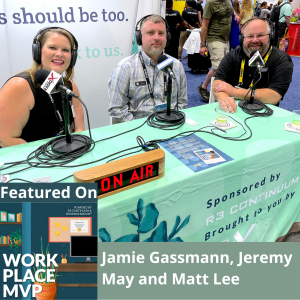
Jess Miller-Merrell, Founder of Workology, joined host Jamie Gassmann in the R3 Continuum booth at SHRM 2022, offering findings from her latest research. Jess discussed how she’s looking at data around HR titles, the eleven different priorities HR leaders are focused on, the challenge of managing the top priorities, how Workology serves these professionals with training and development, and much more. Workology continues to collect data on HR trends from leaders. Jess encouraged anyone interested to take the survey which is available here.

Workplace MVP is underwritten and presented by R3 Continuum and produced by the Minneapolis-St.Paul Studio of Business RadioX®.

This show was originally broadcast live from the 2022 SHRM Annual Conference held at the New Orleans Convention Center in New Orleans, Louisiana.

Jess Miller-Merrell, SHRM-SCP, SPHR, Founder, Workology

Jess Miller-Merrell, SHRM-SCP, SPHR, Founder, Workology

Jessica is a former executive HR leader turned thought leader and entrepreneur focused on sharing resources and stories to help elevate the workplace, employees, and business leaders. Jessica has spoken at global events including SHRM’s Annual Conference, SXSW, Working Mother Magazine’s Conference, and HR Tech Fest. She’s recognized by Forbes Magazine as a top 50 social media influencer and featured by The Economist in their C-Suite series for HR. Jessica’s newest book available in Fall 2022 is Digitizing Talent: Creative Strategies for the Digital Recruiting Age published by SHRM.

Jessica is also a Master certified trainer in Neuro-Linguistic Programming (NLP), a psychological approach that involves analyzing strategies used by successful individuals and applying them to reach a personal goal.

Jessica Miller-Merrell is the founder of Workology, a digital resource that reaches more than a half million HR and workplace leaders each month. Jessica lives in Austin, TX, with her husband, daughter, and an assortment of furry family members. She is the co-owner of Duo Works, an Austin-based co-working and shared office space

LinkedIn | Twitter

Workology

The team at Workology have made it their mission to elevate HR and workplace leaders everywhere with more training, support, and resources to help them do their jobs better. They reach nearly 1 MILLION leaders monthly. The team of wordsmiths, course creators, HR experts, and marketers offer training and learning to the HR community AND we help their HR tech and service provider clients with content creation, demand generation, market insights, and support.

Company website | LinkedIn | Instagram | Twitter| YouTube

About Workplace MVP

Every day, around the world, organizations of all sizes face disruptive events and situations. Within those workplaces are everyday heroes in human resources, risk management, security, business continuity, and the C-suite. They don’t call themselves heroes though. On the contrary, they simply show up every day, laboring for the well-being of employees in their care, readying the workplace for and planning responses to disruption. This show, Workplace MVP, confers on these heroes the designation they deserve, Workplace MVP (Most Valuable Professionals), and gives them the forum to tell their story. As you hear their experiences, you will learn first-hand, real-life approaches to readying the workplace, responses to crisis situations, and overcoming challenges of disruption. Visit our show archive here.

Workplace MVP Host Jamie Gassmann
Jamie Gassmann, Host, “Workplace MVP”

In addition to serving as the host to the Workplace MVP podcast, Jamie Gassmann is the Director of Marketing at R3 Continuum (R3c). Collectively, she has more than fourteen years of marketing experience. Across her tenure, she has experience working in and with various industries including banking, real estate, retail, crisis management, insurance, business continuity, and more. She holds a Bachelor of Science Degree in Mass Communications with special interest in Advertising and Public Relations and a Master of Business Administration from Paseka School of Business, Minnesota State University.

R3 Continuum

R3 Continuum is a global leader in workplace behavioral health and security solutions. R3c helps ensure the psychological and physical safety of organizations and their people in today’s ever-changing and often unpredictable world. Through their continuum of tailored solutions, including evaluations, crisis response, executive optimization, protective services, and more, they help organizations maintain and cultivate a workplace of wellbeing so that their people can thrive. Learn more about R3c at www.r3c.com.

Company website | LinkedIn | Facebook | Twitter

TRANSCRIPT

Intro: [00:00:02] Broadcasting live from SHRM 2022 at the New Orleans Convention Center, it’s time for Workplace MVP. Brought to you by R3 Continuum, a global leader in helping workplaces thrive during disruptive times. Now, here’s your host.

Jamie Gassmann: [00:00:19] Hi, everyone. Your host, Jamie Gassmann here with – goodness sakes. It’s been a long day already – at SHRM 2022’s Expo Hall. And I am here at our sponsor, R3 Continuum’s booth. And with me is Jess Miller-Merrell. Welcome to the show.

Jess Miller-Merrell: [00:00:36] I’m so excited to be back. We’re like conference besties now.

Jamie Gassmann: [00:00:39] Yes, we are. And LinkedIn besties. We’ve known each other for a while socially on social media.

Jess Miller-Merrell: [00:00:44] Agreed. Agreed.

Jamie Gassmann: [00:00:46] So, just remind us a little bit of your background just for any listeners that might be listening to this first hand, because I know you run Workology, so share what that is and kind of talk to us a little bit.

Jess Miller-Merrell: [00:00:55] So, Workology is a training and learning destination for, really, the entire human resources industry. We help HR professionals be their best selves with a lot of digital resources and training. And we also help HR technology companies and vendors, people who are in the industry that aren’t necessarily practitioners, learn and understand about the HR space. Because – shocking news – it’s incredibly complex what we do and it only has gotten more complex in, you know, this thing called the COVID.

Jamie Gassmann: [00:01:30] Yes. And I know what we want to talk about today that I think is really exciting because any time you’ve got research and data that can help business leaders, especially an HR leader, to make some decisions or kind of know what might be coming is always exciting and really useful. So, you’ve done some research. Tell us a little bit about that.

Jess Miller-Merrell: [00:01:49] I have. So, I’m such a nerd about just our industry. I absolutely love this space. I’ve had a podcast for now eight years, but in 2020, when we were all buckled down in our homes, I started interviewing heads of HR on the podcast for a series called the CHRO Podcast Series over with Workology. And so, what I decided was, like, I needed more information than just anecdotal interviews with CHROs, which we have now 50 of these interviews.

Jess Miller-Merrell: [00:02:23] So, I launched a survey, and so it’s called HR Benchmark Survey. And if you’re like, “Wow. This is cool. What the heck is this?” hrbenchmarksurvey.com is where to go. And there are 30 questions. It is geared towards heads of HR and senior HR leaders for them to let the community know about what is happening in their world as an HR leader. I think we see each other at events, but I want to know, not one on one, but with many different responses, as many as possible, what are the trends? What are we seeing in HR? And how is our job, our responsibilities transforming? Because it really, really is.

Jess Miller-Merrell: [00:03:03] We’re leading executive meetings because of COVID and all the changes that have happened. And I want to make sure that we keep being a part of these conversations. Because you and I know working in the HR space, it’s incredibly important what we do. It’s not always understood fully the impact we have. So, that’s what the survey and the research I’ve done is all about.

Jamie Gassmann: [00:03:25] Yeah, I love that. I always kind of say you’re kind of secretly the heroes in the workplace that nobody knew was the hero. You’re helping with so many different things. I know I consider my HR team definitely my heroes because they help me do a better job as a leader.

Jamie Gassmann: [00:03:40] So, in looking at COVID, I think would you agree, and maybe your research has told you this, that more organizations due to the ways they had to shift and pivot with the changes with COVID, in response to it but then also now kind of coming into this endemic they’re talking about, the changes to the work environment, do you think that HR is being seen in a different light in terms of value than ever before?

Jess Miller-Merrell: [00:04:07] Anecdotally, yes. We are, like I said, leading conversations. And I do think all the economic changes and the shifts, and then the Omicron coming in have really made us have to be incredibly nimble and flexible. And businesses with teams of people and leaders aren’t always those things. But, now in this current environment, for whatever is coming next, we have to continue that. And my hope is that we learn from the mistakes, the failures. Those are all moments of opportunity for us to grow.

Jess Miller-Merrell: [00:04:43] And as an entrepreneur, as a business owner, I think about that for myself. Like, when something doesn’t go right, it’s an opportunity to learn for next time, for the next time we launch a new product or a new conversation that I have, like in a podcast interview. Like, I wasn’t always great at podcast interviews. My first one over eight years ago on my podcast, the Workology podcast, not great. So, it takes time and you have to learn from each lesson, there’s a lesson there. And I think that’s what we have learned from this is we have to be prepared for the unexpected.

Jamie Gassmann: [00:05:16] Yeah. Like the silver lining in it. So, let’s dive into the research a little bit. So, I know you’ve got some results, you know, what were some of the findings you gathered from that research?

Jess Miller-Merrell: [00:05:26] So, for the nerdy HR geek in me, I really just wanted to know what is important to HR leaders. And so, we asked a lot of different questions. I had 30 different questions on there. But I asked about their teams, their organizations, how big they were, what their job title was. Which, for me, I really wanted to understand why are there two different job titles. For a senior HR person, there’s typically a chief people officer or a VP of HR – well, there’s a third – or the chief HR officer. What does that mean exactly? And is this a new position? Is this a new title? What’s changing?

Jess Miller-Merrell: [00:06:04] So, the majority of our respondents, which we had 457, identified as a VP of human resources, primarily. We had a number of chief people, officers. Of course, we had some chief HR officers. But those are really the majority of the titles. There was also like a VP of talent and management, which I thought was kind of interesting from the survey results. But I think that’s what makes it challenging for selling in our industry, number one, because everybody has a different job title. And then, connecting with the right person who is actually the head of human resources.

Jess Miller-Merrell: [00:06:42] I was also really interested in the HR to employee ratio. I’m still working on that data because I want to be able to see, are there differences in verticals or segments or company sizes. So, the nerd in me is like, “Yes. The more responses I get, the better.”

Jess Miller-Merrell: [00:06:59] One of the really interesting parts of the research was initiatives, and I’m interested in seeing how this changes over time. But we found, the HR responses in the survey said that they have 11 different initiatives or priorities for HR. And if I think about my day and what I try to do as an HR leader, 11 sounds like a lot. How do you manage all those things? So, when I am communicating this information to the CEO and I’m interested to see how this evolves over time, but there are 11 priorities that the average HR leader is focused on.

Jess Miller-Merrell: [00:07:36] So, if you’re focusing on 25, compared to this information that we have here, you have a lot more three times, almost, the priorities, but they’re very vast. We have talent. We have recruiting. We have retention. We have upskilling. We have payroll processing. All these different things, and that’s really one of the biggest challenges of the HR role is it is so diverse, you have to be an expert in so many different areas. In fact, 11.

Jamie Gassmann: [00:08:04] Yeah. That’s crazy. And not to mention like the day job, right? Eleven sounds like it’s just the projects that they’re working through, goodness sakes.

Jess Miller-Merrell: [00:08:12] Yeah. Because then you have the individualized thing. So, maybe one of your top priorities is retention, but within retention you might have three or four different projects that you’re focused on. Maybe you’re launching some pulse surveys, maybe you’re doing some skip level interviews, or some different programs. How do we manage and balance all those things?

Jess Miller-Merrell: [00:08:31] I really think that HR leaders are really super secret project managers because you really have to be able to organize yourself, your team, and then all the other members who are involved in the organization who are part of these programs. Because it’s not just HR who’s doing the things, it is the frontline managers who are really executing the plans and the programs that we are putting together.

Jamie Gassmann: [00:08:55] Yeah. That’s amazing. So, now, this is the first time you’ve done the research, are you looking to do this kind of on an annual basis so that people can see trending reports?

Jess Miller-Merrell: [00:09:04] So, I want to do quarterly. Because I feel like if COVID has taught me anything, it’s that we have to be flexible. So, this is done quarterly. My goal is for us to have as many responses that we can receive, which is one of the reasons why I was excited to be on the podcast, because I need your help. I need everybody’s help to help contribute, because the more people we have to complete the survey, the more information I have to share, and the better our data and results will be. So, we’ll be doing it quarterly.

Jess Miller-Merrell: [00:09:35] I want to just go back for just a second. I talked about the 11 initiative, so there’s four primary, this is right now. I’m so excited to see how this changes next quarter for us. The number one initiative is onboarding, which is not surprising because we’re hiring all these people. We’ve had a lot of turnover, the Great Resignation. The next one is culture and employee engagement. Also, not surprising. But then, number three is recruiting. And then, our fourth one is employee experience.

Jess Miller-Merrell: [00:10:09] So, I feel like HR really has, in the top four anyway, there’s a foot in a different area. Like, we’re on the culture retention side, but then, “Oh. We have to hire all these people.” So, how do we do all these things? And then, upskilling is also very high on the list, too. So, it’s very retention and recruiting focused for us right now.

Jamie Gassmann: [00:10:30] And it’s so interesting and I love hearing the whole employee experience, because I’ve heard a lot about that lately. You know, just creating those work environments that makes it hard for an employee to leave. And so, your data seems reflecting very similar to that kind of thinking of I need to recruit these people, but I also need to make sure I create a great experience where I can retain them at the same time.

Jess Miller-Merrell: [00:10:56] I call it The Leaky Bucket Syndrome, really, because we are filling up a bucket with water and there is always a hole, and that’s the turnover that we’re having in our organization. So, with the Great Resignation, our hole was very, very big, and it still might be. I think a lot of people are going to jobs, and then six months in saying, “Oh. This wasn’t the right place for me.”

Jess Miller-Merrell: [00:11:20] And I have a number of friends who are returning back to their original organization, so they are boomerang employees. Or they have made some choices and they’ve said, “Okay. My priorities have shifted even more. These are the kind of things I do want in an employer. I’m going to go over here to this other place now.”

Jess Miller-Merrell: [00:11:38] And HR people are switching jobs too. A number of our survey respondents, a very high number, are less than a year in the role. And, frankly, based on my LinkedIn right now, I think that so many people have changed jobs and they are less than six months in. I don’t even know the number of congratulations I send out every day for new people in the space who are in these chief HR officer roles is so many.

Jess Miller-Merrell: [00:12:08] And I feel like if you’re having turnover in that head of HR role, there is really something serious with your organization that you need to take some reflection. Because if you can’t retain the person who’s supposed to be in charge of onboarding, retention, employee experience, et cetera, et cetera, how are you going to be able to retain any of your workforce?

Jamie Gassmann: [00:12:28] Yeah. You can’t. I mean, your HR leader kind of helps to set the tone of that culture in a way. I mean, it starts at the top. I mean, it’s all executive leadership. But your HR people drive a lot of that.

Jess Miller-Merrell: [00:12:39] And we’re the ones who are having those conversations with the executive team and reminding them about these things. Yes, I think every leader should be responsible for turnover and culture. But we are the keepers of those metrics and information in those programs, really.

Jamie Gassmann: [00:12:56] So, in looking at your research, if somebody wanted to get access to the research or to get access to Workology, how do they do that?

Jess Miller-Merrell: [00:13:06] Well, just Workology in general is really easy, it’s workology.com. And I have over 8,000 published resources there on the website. I’ve been doing this a little while. We really shine for online training in the area of HR certification and HR personal development. So, you can go to workology.com for that information. If you’re like, “Wow. This is great. I want to know more information about the survey,” the best place to go is hrbenchmarksurvey.com.

Jess Miller-Merrell: [00:13:39] One of the interesting things that I’m seeing HR leaders who take the surveys – you have to complete the survey and then we’re sending you a copy of the results. So, complete that and then we’ll get you the information – a lot of our HR pros who have access to report and the preliminary data have been using this to have conversations with their executive team about, “Here’s how my HR department needs to be set up or here’s what my peers are doing on their HR teams.”

Jess Miller-Merrell: [00:14:05] It’s really important for me to make sure that we are still leading these conversations long after COVID is in the rearview mirror. So, this data is designed for us to help make that happen, because I don’t want to hear more about HR trying to get a seat at the table. We are at the table and I want us to be able to stay there.

Jamie Gassmann: [00:14:23] At the table and now have the data to help backup what you’ve been saying and doing.

Jess Miller-Merrell: [00:14:27] Absolutely. Absolutely.

Jamie Gassmann: [00:14:29] Fantastic. Amazing. Well, you heard it here, check out workology.com and definitely get that HR Benchmark Survey. Thank you so much for stopping by, Jess. It’s always a pleasure to see you.

Jess Miller-Merrell: [00:14:41] It is. I love this conference. I love that you all do the podcast here at the conference. I think it’s fantastic and it’s such a great way to get to know you and the Continuum team better.

Jamie Gassmann: [00:14:51] Yeah. Thank you so much. Appreciate it.

Outro: [00:14:56] Thank you for joining us on Workplace MVP. R3 Continuum is a proud sponsor of this show, and is delighted to celebrate most valuable professionals who work diligently to secure safe workplaces where employees can thrive.


Tagged With: Chief People Officer, HR Benchmark Survey, Jess Miller-Merrell, R3 Continuum, SHRM 2022, Vice President of HR, Workology, Workplace MVP

Dr. Everette Bannister, Family Tree Animal Clinic

July 20, 2022 by John Ray

Dr. Everette Bannister, Family Tree Animal Clinic
North Fulton Business Radio
Dr. Everette Bannister, Family Tree Animal Clinic
Loading
00:00 /
RSS Feed
Share
Link
Embed

Download file

Dr. Everette Bannister

Dr. Everette Bannister, Family Tree Animal Clinic (North Fulton Business Radio, Episode 476)

Veterinarian Dr. Everette Bannister, Owner of Family Tree Animal Clinic, was host John Ray’s guest on this episode of North Fulton Business Radio. After several years of experience at two different veterinary clinics, Dr. Bannister opened his own practice several years ago and specifically chose Milton. He shared his journey in veterinary medicine, his experience, his approach to high-touch client care, what sets Family Tree apart, tips for both dog and cat owners, and much more.

North Fulton Business Radio is broadcast from the North Fulton studio of Business RadioX® inside Renasant Bank in Alpharetta.

Family Tree Animal Clinic

Family Tree Animal Clinic is a small animal clinic in Milton, GA.

Our mission is to strengthen the human-animal bond by consistently providing unmatched care to all pet companions and their families in the communities in which they serve while upholding the Gold Standard of veterinary medicine. “Together on the Journey of Care”

Company website | Facebook | Twitter

Dr. Everette Bannister, Owner & Veterinarian, Family Tree Animal Clinic

Dr. Everette Bannister, Owner & Veterinarian, Family Tree Animal Clinic

Dr. Everette Bannister is proud to be a part of the FTAC family since its inception. After finishing his clinical year at the University of Georgia and graduating from Ross University in 2007, Dr. Bannister has dedicated his career to strengthening the human-animal bond by focusing his passion on educating companion owners on preventative care, practicing internal medicine, and performing advanced dental and surgical procedures.

During his free time, he enjoys relaxing with his wife, daughter, their pet Ocean, playing the bass guitar, reading, and community outreach events.

LinkedIn

Questions and Topics in this Interview:

  • Tell me about yourself
  • What’s your vet journey? How long have you been in business?
  • Why Milton?
  • Why is Family Tree Animal Clinic different?
  • What do you do best?
  • What does the future hold for Family Tree Animal Clinic?

North Fulton Business Radio is hosted by John Ray and broadcast and produced from the North Fulton studio of Business RadioX® inside Renasant Bank in Alpharetta. You can find the full archive of shows by following this link. The show is available on all the major podcast apps, including Apple Podcasts, Spotify, Google, Amazon, iHeart Radio, Stitcher, TuneIn, and others.

RenasantBank


Renasant Bank has humble roots, starting in 1904 as a $100,000 bank in a Lee County, Mississippi, bakery. Since then, Renasant has grown to become one of the Southeast’s strongest financial institutions with over $13 billion in assets and more than 190 banking, lending, wealth management and financial services offices in Mississippi, Alabama, Tennessee, Georgia and Florida. All of Renasant’s success stems from each of their banker’s commitment to investing in their communities as a way of better understanding the people they serve. At Renasant Bank, they understand you because they work and live alongside you every day.


Special thanks to A&S Culinary Concepts for their support of this edition of North Fulton Business Radio. A&S Culinary Concepts, based in Johns Creek, is an award-winning culinary studio, celebrated for corporate catering, corporate team building, Big Green Egg Boot Camps, and private group events. They also provide oven-ready, cooked from scratch meals to go they call “Let Us Cook for You.” To see their menus and events, go to their website or call 678-336-9196.

Tagged With: A&S Culinary Concepts, Dr. Everette Bannister, Family Tree Animal Clinic, Milton, North Fulton Business Radio, renasant bank, Small animal veterinarian, veterinarian

Ed Foye, Discount Waste, Inc., and All Children, Inc.

July 19, 2022 by John Ray

Discount Waste
Business Beat
Ed Foye, Discount Waste, Inc., and All Children, Inc.
Loading
00:00 /
RSS Feed
Share
Link
Embed

Download file

Discount Waste

Frazier & Deeter’s Business Beat: Ed Foye, Discount Waste, Inc., and All Children, Inc.

The founder of Discount Waste, Inc., Ed Foye, was Roger Lusby’s guest on Business Beat. He founded the company from nothing in 1999 and has grown it into a nationwide company. In addition, he is heavily involved in work with All Children, Inc., the non-profit he founded to help the poorest disabled children in orphanages in the poorest countries. Ed talked about the construction industry, the ways Discount Waste retains its talent, the life event that turned his heart towards giving back, his foundation, the ways other companies can get involved, and much more.

Business Beat is presented by Alpharetta CPA firm Frazier & Deeter and is produced by the North Fulton studio of Business RadioX®

Discount Waste, Inc.

Discount Waste, Inc. manages solid waste removal and recycling for customers nationwide.

Their customers rely on them to help define the best possible solutions. They take pride in being able to help customers identify their specific needs and work hard to implement services tailored to each and every situation.

Discount Waste has provided open top dumpsters for small one-night projects as well as services for customers with hundreds of locations. No job is too small or too large when it comes to satisfying the needs of our customers.

Their customer base continues to grow and their business has seen significant year-over-year growth.

Discount Waste’s growth is directly attributed to the hard work and dedication of each employee to provide the best possible services to each customer.

For information on how Discount Waste, Inc. can service your needs, please contact them or fill out a request a quote form. They keep adding services for you to make your project smoother and more cost-effective. They will be glad to assist you.

Discount Waste believes companies have a responsibility to address social issues such as poverty, poor health, lack of education and more. They practice Corporate Social Responsibility (CSR) and choose to make a difference in the lives of less fortunate children.

Their model for corporate social investment is AC3. All Children deserve a voice. All Communities deserve a future. All Companies need a mission to serve. This straightforward model points the way for like-minded companies to give back to those in need.

Their actions incorporate the company’s values of Compassion, Integrity, Service, and Responsibility. These values are reflected in their daily actions, interactions with customers, and those that they seek to help.

Discount Waste supports issues impacting children’s lives in less developed countries with limited welfare services. This year Discount Waste along with All Children, Inc. have supported more than 2,100 children with:

  • Medical Care – Children die needlessly when aid and vaccinations are so easily available but not provided
  • Nutrition – Without proper nourishment, the body and mind cannot grow and prosper
  • Education – The cycle of despair will continue without this opportunity to achieve new heights
  • Shelter – Children abandoned on the streets have no voice and no future

Discount Waste proudly supports allchildren.org. Change will happen when companies, individuals, and nonprofits collaborate to create long-lasting results.

Company website | LinkedIn | Facebook

All Children, Inc.

All Children, Inc. is the vision of founder Ed Foye, CEO of Discount Waste, Inc. As a teenager he survived a life threatening car accident. He had to learn how to walk, talk and complete everyday tasks all over again. With the support of his family and friends, he made a full recovery and went on to graduate from college. He knows that he was given the gift of life a second time.

As a successful entrepreneur and businessman, he has always embraced opportunities to give back to the community. In 2012 he and his wife Amy created a family foundation named International Children’s Foundation of Atlanta to fund special projects serving disabled children in third world countries.

In 2016 he founded All Children, Inc. to provide an opportunity for other like-minded companies and individuals to support children living in some of the poorest countries. So many children with disabilities have tremendous potential, but with no resources they are never given a chance.

All Children began with two projects aiding orphans in Kenya and the Philippines. By the end of the first year they were able to help fund five additional projects that included feeding hundreds of starving children, tuition for children too poor to go school, education for deaf children and medical assistance. All Children currently supports nine projects in four countries.

Currently more than 2,100 children from some of the poorest countries are receiving a second chance in life through All Children’s support. All children have value and through medical assistance, nutrition, education and shelter they will experience a better quality of life. Many of these children have the potential to be future leaders and will someday have their own stories to share.

YouTube | Instagram | LinkedIn | Facebook

Ed Foye, Founder and CEO, Discount Waste, Inc., and Founder of All Children, Inc.

Ed Foye, Founder and CEO, Discount Waste, Inc.

Former waste executive, Ed Foye, founded Discount Waste, Inc. in 1999. With over 20 years of experience in the waste industry, Mr. Foye has built a solid reputation as a national provider of solid waste removal and recycling services.

As a teenager, Ed Foye, CEO of Discount Waste, survived a life-threatening car accident. He had to learn how to walk, talk and complete basic everyday tasks again. With the support of his family and friends, he made a full recovery. Armed with a new perspective in life, Ed wants to help abandoned children in third-world countries have a better quality of life.

Frazier & Deeter

The Alpharetta office of Frazier & Deeter is home to a thriving CPA tax practice, a growing advisory practice and an Employee Benefit Plan Services group. CPAs and advisors in the Frazier & Deeter Alpharetta office serve clients across North Georgia and around the country with services such as personal tax planning, estate planning, business tax planning, business tax compliance, state and local tax planning, financial statement reviews, financial statement audits, employee benefit plan audits, internal audit outsourcing, cyber security, data privacy, SOX and other regulatory compliance, mergers and acquisitions and more. Alpharetta CPAs serve clients ranging from business owners and executives to large corporations.

Roger Lusby, Partner in Charge of Alpharetta office, Frazier & Deeter
Roger Lusby, Partner in Charge of the Alpharetta office of Frazier & Deeter

Roger Lusby, host of Frazier & Deeter’s Business Beat, is an Alpharetta CPA and Alpharetta Office Managing Partner for Frazier & Deeter. He is also a member of the Tax Department in charge of coordinating tax and accounting services for our clientele. His responsibilities include a review of a variety of tax returns with an emphasis in the individual, estate, and corporate areas. Client assistance is also provided in the areas of financial planning, executive compensation and stock option planning, estate and succession planning, international planning (FBAR, SFOP), health care, real estate, manufacturing, technology, and service companies.

You can find Frazier & Deeter on social media:

LinkedIn | Facebook | Twitter

An episode archive of Frazier & Deeter’s Business Beat can be found here.


Tagged With: All Children, allchildren.org, Business Beat, construction waste disposal, Discount Waste, Ed Foye, Frazier and Deeter, orphanages, Roger Lusby

Nicole Comis, Nicole Comis Coaching

July 19, 2022 by John Ray

Nicole Comis
North Fulton Business Radio
Nicole Comis, Nicole Comis Coaching
Loading
00:00 /
RSS Feed
Share
Link
Embed

Download file

Nicole Comis

Nicole Comis, Nicole Comis Coaching (North Fulton Business Radio, Episode 475)

Professional Certified Coach Nicole Comis joined host John Ray this edition of North Fulton Business Radio. Nicole shared what led her into coaching from a career in mortgage lending, why she emphasizes the power of mindset in her work with driven professionals, her coaching training that includes NLP, how she engages with clients, and much more.

North Fulton Business Radio is broadcast from the North Fulton studio of Business RadioX® inside Renasant Bank in Alpharetta.

Nicole Comis, Professional Certified Coach, Nicole Comis Coaching

Nicole Comis, Professional Certified Coach, Nicole Comis Coaching

Nicole Comis works with driven professionals to achieve their BIG personal and professional goals. She works with her clients to gain clarity on what they want their future to look like, identify obstacles holding them back, face their fears, and create a plan to help them achieve goals that are outside of their comfort zone.

Her coaching practice incorporates her client’s whole life, not just their career, leading to a more balanced, productive, healthy, and fulfilling life.

Nicole is a graduate and certified coach from the Accomplishment Coaching Coaches Training Program and is accredited by the International Coach Federation (ICF) as a Professional Certified Coach (PCC). In addition, she’s a Certified Neuro-Linguistics Programming (NLP) Master Coach and a Master Practitioner of NLP, Time Line Therapy®, and Hypnotherapy.

Nicole’s high-energy, judgment-free, fun, no-BS approach helps men and women live a more balanced life with a career they love, fulfilling relationships, healthy well-being, and killer confidence!

Website | LinkedIn | Facebook | Twitter

Questions and Topics in this Interview:

  • Tell us a little more about coaching.
  • What’s the difference between coaching, consulting, and therapy?
  • What led you to become a coach?
  • Can you tell us a little about your training and certifications?
  • Who are you passionate about working with?
  • What is a common myth about coaching?
  • What is the most important lesson you’ve learned over your career?
  • What are some of the most meaningful goals that your clients have achieved?

North Fulton Business Radio is hosted by John Ray and broadcast and produced from the North Fulton studio of Business RadioX® inside Renasant Bank in Alpharetta. You can find the full archive of shows by following this link. The show is available on all the major podcast apps, including Apple Podcasts, Spotify, Google, Amazon, iHeart Radio, Stitcher, TuneIn, and others.

RenasantBank


Renasant Bank has humble roots, starting in 1904 as a $100,000 bank in a Lee County, Mississippi, bakery. Since then, Renasant has grown to become one of the Southeast’s strongest financial institutions with over $13 billion in assets and more than 190 banking, lending, wealth management and financial services offices in Mississippi, Alabama, Tennessee, Georgia and Florida. All of Renasant’s success stems from each of their banker’s commitment to investing in their communities as a way of better understanding the people they serve. At Renasant Bank, they understand you because they work and live alongside you every day.


Special thanks to A&S Culinary Concepts for their support of this edition of North Fulton Business Radio. A&S Culinary Concepts, based in Johns Creek, is an award-winning culinary studio, celebrated for corporate catering, corporate team building, Big Green Egg Boot Camps, and private group events. They also provide oven-ready, cooked from scratch meals to go they call “Let Us Cook for You.” To see their menus and events, go to their website or call 678-336-9196.

Tagged With: A&S Culinary Concepts, business coaching, Coaching, hypnotherapy, ICF, mindset, Neuro-Linguistic Programming, Nicole Comis, NLP, North Fulton Business Radio, Personal coaching, renasant bank

Workplace MVP: John Baldino, Humareso

July 19, 2022 by John Ray

John Baldino
Minneapolis St. Paul Studio
Workplace MVP: John Baldino, Humareso
Loading
00:00 /
RSS Feed
Share
Link
Embed

Download file

John Baldino

Workplace MVP: John Baldino, Humareso

John Baldino, President of Humareso, joined the show again after his December 2021 appearance to review his predictions for 2022.  He and host Jamie Gassmann noted how he was right on the mark about trends such as meeting the holistic needs of employees, supporting their well-being, the shift towards more flexibility, companies rethinking their approach to disruption, the wave of resignations and layoffs, and many other timely topics.

Workplace MVP is underwritten and presented by R3 Continuum and produced by the Minneapolis-St.Paul Studio of Business RadioX®.

Humareso

Humareso is able to strategize with your company and develop plans to manage talent, recruit for skill gaps based on employee inventories, assess markets for growth, develop long-range succession plans and influence a culture of enthusiastic buy-in. Humareso handles all facets of employee engagement and business development. Humareso provides HR solutions and administration for small businesses trying to manage budget and growth.

Humareso sits strategically to support an organization’s vital talent needs. Talent is what they believe in cultivating. They look to drive organizational health through true employee engagement, strategic workforce planning, and invested management training. Having a culture that values people, policy, and performance in the right measures is the differential needed to stand apart from other organizations. Whether your organization has 10 or 100,000 employees, dynamic human resources will build corporate strength and recognize talent contribution.

Company website | LinkedIn

John Baldino, MSHRD SPHR SHRM-SCP, Founder and President, Humareso

John Baldino, MSHRD SPHR SHRM-SCP, Founder and President, Humareso

With 30 years of human resources experience, John’s passion of setting contributors and companies up for success is still going strong.  John is a keynote for US and International Conferences where he shares content and thoughts on leadership, collaboration, and innovation, employee success, organizational design and development as well as inclusion and diversity.

He is the winner of the 2020 Greater Philadelphia HR Consultant of the Year award. John is currently the President of Humareso, a global human resources consulting firm, and the proud dad of 3 amazing young adults.

LinkedIn | Twitter

About Workplace MVP

Every day, around the world, organizations of all sizes face disruptive events and situations. Within those workplaces are everyday heroes in human resources, risk management, security, business continuity, and the C-suite. They don’t call themselves heroes though. On the contrary, they simply show up every day, laboring for the well-being of employees in their care, readying the workplace for and planning responses to disruption. This show, Workplace MVP, confers on these heroes the designation they deserve, Workplace MVP (Most Valuable Professionals), and gives them the forum to tell their story. As you hear their experiences, you will learn first-hand, real-life approaches to readying the workplace, responses to crisis situations, and overcoming challenges of disruption. Visit our show archive here.

Workplace MVP Host Jamie Gassmann

Jamie Gassmann, Host, “Workplace MVP”

In addition to serving as the host to the Workplace MVP podcast, Jamie Gassmann is the Director of Marketing at R3 Continuum (R3c). Collectively, she has more than fourteen years of marketing experience. Across her tenure, she has experience working in and with various industries including banking, real estate, retail, crisis management, insurance, business continuity, and more. She holds a Bachelor of Science Degree in Mass Communications with special interest in Advertising and Public Relations and a Master of Business Administration from Paseka School of Business, Minnesota State University.

R3 Continuum

R3 Continuum is a global leader in workplace behavioral health and security solutions. R3c helps ensure the psychological and physical safety of organizations and their people in today’s ever-changing and often unpredictable world. Through their continuum of tailored solutions, including evaluations, crisis response, executive optimization, protective services, and more, they help organizations maintain and cultivate a workplace of wellbeing so that their people can thrive. Learn more about R3c at www.r3c.com.

Company website | LinkedIn | Facebook | Twitter

TRANSCRIPT

Intro: [00:00:04] Broadcasting from the Business RadioX Studios, it’s time for Workplace MVP. Workplace MVP is brought to you by R3 Continuum, a global leader in workplace behavioral health and security solutions. Now, here’s your host, Jamie Gassmann.

Jamie Gassmann: [00:00:25] Hey, everyone. Your host, Jamie Gassmann here, and welcome to this episode of Workplace MVP. So, last December 2021, I had the pleasure of interviewing John Baldino, President of Humareso, on our show, and we did a year-end review talking about what challenges or nuances HR and other business leaders navigated over the last year.

Jamie Gassmann: [00:00:48] And during that interview, I asked John what his 2022 predictions were for what would be the areas of challenge or need for change in the workplace this year. So, today, a little over halfway through 2022, we are following up with John to get his update if his predictions came true, and what other challenges is he seeing that we didn’t predict, but that we want to talk about today. So, help me in welcoming Workplace MVP John Baldino, President of Humareso. Welcome to the show, John.

John Baldino: [00:01:23] Thanks, Jamie. Great to be back.

Jamie Gassmann: [00:01:25] Yes, it’s always such a pleasure to have you on the show.

John Baldino: [00:01:28] I appreciate that.

Jamie Gassmann: [00:01:29] So, I did want to start out for any new listeners that might be catching this episode that didn’t have an opportunity to listen in in December, tell us a little bit about your background and your career journey in growing your business.

John Baldino: [00:01:43] Sure. So, I am, you know, 30 years still in human resources and in the veins of leadership development, and organizational development and structure, and all the employee lifecycle components. And so, I started Humareso, it will actually be ten years in a few weeks for Humareso and so that’s really fun. And Humareso is a full-service HR consulting firm. And we just have a great time working with companies across the country at various sizes from startup to enterprise level clients. I’ve got a great staff that’s across the country and just doing some phenomenal work. And it’s really, really been a good time.

John Baldino: [00:02:34] And I’ll just mention, though, my journey, as you said, I started in personnel. Before there was human resources, it was personnel. And I say that because I don’t know that we’ve really kind of given enough props to the fact that in this discipline of human resources, we have had opportunity to evolve out of completely transactional work and mixing it now a bit with some transformational work. Like, helping to look at organizations more holistically.

John Baldino: [00:03:10] And so, those who are practicing HR in various organizations across the country, my colleagues in the profession, there’s been a lot of movement over the last 30 years that I’ve been involved, and probably more movement from a pace standpoint over the last three than any of the 27 before in many ways.

Jamie Gassmann: [00:03:32] Well, they spent so many changes, especially over the last couple of years. And even before then, I think, there were changes especially in that HR arena. So, wow, you’ve definitely come through a lot of that. And congratulations on your upcoming anniversary. That’s exciting.

John Baldino: [00:03:49] It is. It is very exciting. Thank you for that.

Jamie Gassmann: [00:03:52] Absolutely. So, now the moment I’m sure our listeners are looking for. How did you fare in your predictions for this this last year? So, I’m going to start with the first one, overall health of your employees, including religion, emotional, mental, and physical. We kind of talked about how employers need to really be looking at that whole person, as opposed to just the one component, like physical, which a lot of them probably maybe have focused more on over the years. So, tell me a little bit about what are you seeing? Has that come true?

John Baldino: [00:04:29] It has. There’s going to be a theme, I think.

Jamie Gassmann: [00:04:34] You’re like, “I was right.”

John Baldino: [00:04:39] I would say that for sure we certainly not arrived. But I think that what we see over the last six months is a continued deepening of organizations looking at the overall person that works for them, not merely, “How do I keep them healthy? So, I keep my health insurance premiums lower.” Which, that’s unfortunately kind of what some of the attention had been previously. And certainly we’re not going to, like, talk down about the fact that we want our staff to be physically healthy. Of course, if we can provide opportunities for that, please continue to do so.

John Baldino: [00:05:18] But I think that what you and I spoke about, really, was the holistic view, that there is an emotional component to what people are bringing into the workplace. If we didn’t learn anything from COVID and from that pandemic and, honestly, what we’re still going through in certain parts of the country, for sure, it took an emotional toll on people. It was really difficult.

John Baldino: [00:05:42] Like, it was really difficult to stay in your house under mandates from cities and/or state. It was difficult for people to say you cannot come into the office and see these people you’ve worked with for the last four, five, six, seven, ten years. Stay away from each other.

John Baldino: [00:06:05] People are really dealing with some emotional and mental health challenges as a result of that. And I think that the wiser companies today are looking at that saying we’re seeing the residue of that and we’re really needing to be wise about how we provide an outlet for care, for communication, and consideration.

John Baldino: [00:06:30] And so, we’re watching organizations do things that they weren’t doing before, even things like open chat channels on platforms, like Slack or Teams or whatever you might be using, to say we want to work in a spirit of transparency a little differently than we were previously. It wasn’t that we weren’t transparent at all before, perhaps, but now we’ve got to do it with a bit more intention. And we’re going to be proactive in our approach to those things.

John Baldino: [00:07:03] Because if you’re struggling today, we need to know. We’re not going to judge you. We’re really going to help provide some areas of support. And if, for nothing else, just so that people on your team can say, we’re with you, we want to take a minute and not just look at what our production numbers are like for today. It matters, I get it. But we’re also going to take a couple minutes and say, let’s just do a pulse check. How’s everybody feeling today? Green for great, yellow for I’m not so sure, red for I’m really struggling. You know, there’s organizations that are kind of doing that stoplight poster, and that’s great.

John Baldino: [00:07:39] You know, you don’t have to have everybody tell you every bit of their deep, dark secrets or what they’re really struggling with because there is some protection there as well that needs to be understood. But is there an outlet for people to say, I’m going to talk to HR and I’m going to talk to whatever support structures we have within the organization.

John Baldino: [00:08:00] And it needs to be – what we’re also seeing very deliberately – is it’s got to be more than just your immediate manager. It doesn’t mean that it has to exclude the immediate manager, but it has to be more than just that. Because it might be uncomfortable for me to go to my direct supervisor and say, “I’m not feeling great today. My body physically is fine, but I feel just overwhelmed and maybe even depressed. I’m not really sure, but I’m feeling it today.” Because bias is real, that may affect the way a manager could look at that employee.

John Baldino: [00:08:37] So, companies are being wiser about if you’re feeling that way, here’s some other places to go to talk about that, to report that, to ask for resources and support. And so, we’re seeing that happen more and more. So, that’s exciting, I would say, even though it doesn’t sound like the reason for it is exciting, and I appreciate that. But it’s wonderful that we’re being much more deliberate about giving these kinds of resources and outlets.

Jamie Gassmann: [00:09:02] Yeah. Just more mindful of that whole person at work. And they might just need something, you know, that person, an outlet to talk to. And I would agree, sometimes the manager is not going to be the right person they want to have that conversation with. But I think a leader being able to show their own vulnerability and transparency to how they’re feeling can make a huge difference in how that employee shows up too.

John Baldino: [00:09:29] For sure. And, you know, I like to have data and some statistics behind some of what I share because I just want to make sure people know this isn’t Baldino just waxing philosophical because he’s bored. There’s real numbers behind a lot of these things.

John Baldino: [00:09:43] And so, even I would say since the start of the pandemic, and many of you who are listening may remember, maybe the first 6 to 12 months of what we went through, organizations were doing happy hours, “Let’s just get together on Zoom or Teams,” or what have you, and everybody just let’s have a happy hour together. And what we’re seeing statistically is that, there’s been – it depends on the survey – 60 to 65 percent drop off in the happy hour offering at organizations. And that is predominantly pushed because of a healthier outlet.

John Baldino: [00:10:21] What we found is that individuals at organizations who are struggling with emotional or mental health issues to then push them towards happy hour, towards alcohol, became a bit uncomfortable for some organizations. And they thought that’s probably not a great outlet to offer to someone. The intention is great, we get it. The intention is great. Let’s change the dynamic of it a little bit. Let’s not push alcohol as the release in that, but rather the relational communication, rather the let me feel like I belong with some people. That’s the better way to push things.

Jamie Gassmann: [00:11:01] Yeah. Definitely. And kind of hanging out in that overall health, same vein, something that I’m hearing and I heard in some of the interviews I was doing at SHRM recently, where we ran into each other again, was part of your DE&I structure is looking at that whole person and looking at kind of how do you support maybe that religion that that person wants to have shown up at work, and how do you make them feel welcome as that whole individual when you’re looking at it spiritually.

Jamie Gassmann: [00:11:35] I mean, mental health, absolutely. Stigma is reducing everywhere. It’s very exciting to see. Physical, we’ve kind of got that one down. But looking at that religion component, what are you seeing with some of the changes? And what are you hearing within work environments in how they’re starting to embrace different religions that individuals are coming to work with?

John Baldino: [00:11:56] Yeah. That’s a great question. And I would say, out of all of the areas of consideration for individuals that are coming to work, the spiritual vein is probably the one that’s still the weakest in terms of comfort because most business owners, senior leaders, managers don’t know what to do with it. They’re nervous that they may have some sort of compliance infraction by having a conversation with someone or being open to having a conversation with someone.

John Baldino: [00:12:29] And I think that the ones that are doing it really well, what we’re seeing is that, they are just providing a forum for communication and conversation around it. So, for instance, there are some organizations that are being more thoughtful around spiritual and/or religious diversity. I know that there are people who wear, for instance, particular pieces of clothing that represent some of the spirituality that they’re starting to pursue more. Also, for those individuals, who maybe during the remote time of the pandemic, who are now coming back to work, are coming back different as far as an expression of faith is concerned.

John Baldino: [00:13:12] And so, people don’t know how to manage that relationship. “Oh, my goodness. You’re wearing something or your routine is very changed now, and I don’t know if I can say certain things to you. Am I allowed to curse in front of you anymore? Could I split my ham sandwich with you anymore? I don’t know what to do anymore.” And I think that the ones that are doing it really well are creating a place for there to be safe conversation.

John Baldino: [00:13:43] Not everyone is an expert in every area of spirituality. There has to be a place to be able to say, “I’m so sorry. I’m predominantly ignorant about this vein of spirituality that you’re talking about. Can you enlighten me? Can you tell me what it’s been like for you? I don’t have a frame of reference, but I’m really interested in understanding.”

John Baldino: [00:14:03] I think that if you can provide that place for it to be safe, it doesn’t mean it’s the responsibility of the employer to have people pursue spirituality. That is not what we’re saying. But rather when there is an outlet – remember, religious accommodation is still a very real federal allowance within the law – it should be comfortably discussed as anything else where there’s an accommodation or a consideration at play.

John Baldino: [00:14:33] We’re seeing, again, not as high of a percentage as in the other veins of support, but it’s starting to make a way. We actually even know a couple of organizations that have before work, there are some employees who are getting together to pray or to meditate. And they may meditate towards or with a frame of reference towards their own spirituality, but they’re doing it collectively in quiet in a room with others. There are some organizations that we know that actually have a Bible study going on before work.

John Baldino: [00:15:04] Whatever your people are bringing up to say that it might be helpful for them if they can start their day or end their day in a certain way, be open to that. It doesn’t mean that you’re giving acceptance to everything, but just be open to that dialogue.

Jamie Gassmann: [00:15:17] Yeah. Absolutely. It sounds very familiar too. I did another interview with a gal by the name of Soumaya Khalifa, and she talked about even just, you know, being curious or wanting to know more is refreshing. And being able to say have a blessed Ramadan, where normally you wouldn’t hear that, but even just being aware of the fact that she’s celebrating that and that she’s fasting, and maybe asking questions about what that looks like can go a long way with an employee.

John Baldino: [00:15:50] Absolutely. And wouldn’t it be nice to be able to have a conversation with an employee that you know to understand rather than being scared and telling someone, “We’ll just Google it.” Should we really be Googling how to understand everybody else’s spiritual? I’d be terrified to do that. Like, talk to somebody else and just ask them. “I see that you’re taking some extra time during the day, how exciting. What’s that like for you? It seems like you’re much more centered. I’m jealous of that, even. I love the fact that you do.” Have an honest conversation. Be safe in that.

Jamie Gassmann: [00:16:23] Absolutely. Great advice. Love that. So, looking at your second prediction, creative health options. So, that need to think creatively and kind of a little bit out of the box on how you might accommodate somebody’s overall health. So, kind of expanding out of some of the traditional modes, like an EAP, obviously, all employers usually have an EAP for the most part. You know, and that’s always usually a standard kind of offering. But looking at what are some other ways that you can help those employees to promote self-care and taking care of themselves. So, talk to me a little bit about what some of the things that you’re seeing with that.

John Baldino: [00:17:01] Yeah. And, again, I’m so excited to say this has gone in the right direction coming into this year.

Jamie Gassmann: [00:17:07] You were right again is what you’re saying.

John Baldino: [00:17:08] I mean, thank you for saying that. First of all, just to make sure everybody has a frame of reference, so, the EAP, the Employee Assistance Program, those of you that are involved with a smaller business, say, under 100 employees, there’s a good chance that your current medical benefit offering does not include an EAP. So, your frame of reference may be very left of center in that, and that’s okay. Please don’t think that you’ve done something wrong or that your employer is not providing at a level that you need them to. Quite frankly, it’s a product of the volume that goes behind the way health insurance is put together, and that’s why the EAP isn’t thrown in.

John Baldino: [00:17:59] But there are things, so one of the areas that I’ve seen an uptick is at the state level. And for most states, there is an opportunity to connect, you can pick up the phone and dial 211. Just like you can dial 911 for an emergency, 211 can get you to a variety of support resources that, for some things, mimic what an EAP would offer. So, there’s opportunities for counseling, for issues around physical health, all of that health veins that we just spoke about and beyond.

John Baldino: [00:18:37] And so, what we’re seeing is that there’s more organizations pushing out that 211 as part of sort of their resource list within their organizations to say, “Don’t be ashamed, please use this.” Even if we have an EAP, there’s more stuff at the county level that, quite honestly, your taxes are paying for. So, tap into those things. Look for that help there.

John Baldino: [00:19:02] But one of the things that’s become, I think, a growing consideration coming into this year is a step back and looking at the ways in which, from a creative standpoint, wellbeing – not wellness but wellbeing – is looked at. And so, we’re seeing products and service out there now that are marketing to businesses to say, “How’s that health savings account going for you that you were so keen on five years ago? Are people using that?” “There’s money left over at the end of every year. They never use all the benefit that they have that they’re entitled to.” Or December 20th, everybody’s running to CVS to buy Q-tips and cotton balls and contact lens solution, even when they don’t wear contact lenses, just because they want to spend this HSA money that they have.

John Baldino: [00:19:59] And is that really the goal? Like, the goal is not let me stock my medicine cabinet with this stuff that’s not really, really helping me. And so, this wellbeing offering is really, I think, more on a vein that we’re going to see more and more of. We’re already seeing a consideration in a different way to this where employers are saying, “I want to split what I’ve been giving to this HSA between, yeah, I’m going to keep money in a health savings account for you, totally. But I’m not going to put as much. And instead I’m going to put some of that money over to a wellbeing app cafeteria consideration.”

John Baldino: [00:20:39] Again, I’m using cafeteria in a broader sense, meaning pick what works for you. Maybe you want to do things that are physically related for you. Great. You want to take yoga classes, you want to get some equipment to use, whatever, but this wellbeing is also going to give you opportunities for your soul, for your spirit, for your mental health.

John Baldino: [00:21:02] TherapyNotes does a great job with journals covering all kinds of mental health considerations that now an employee can use employer funded components to buy these notebooks and start a journey of moving through anxiety or depression, and keep themselves accountable in a comfortable way. Not to say that it can’t be counseling as well, but this is sort of the upkeep in between visits.

John Baldino: [00:21:29] So, to have these resources where, well, my employer is not going to get involved with my therapy directly because I want to keep that boundary there. But my employer is providing me an opportunity for wellbeing to continue my therapy journey every day. And they don’t even realize it because they’re just providing me with some funds that can be used towards these kinds of resources. Maybe I care a lot about my environment, social issues that affects my wellbeing. Here, I can use some of these set aside funds for this.

John Baldino: [00:22:01] So, we’re seeing creativity in probably the broadest way that I’ve ever seen in the marketplace right now. And those companies that are trying to do things to be thoughtful about their current staff, but also to attract new staff from a talent acquisition standpoint, they’re bragging about having this accessibility for their teams, and that is drawing potential candidates to their organizations who are looking to make a change. And that’s a set apart that, honestly, organizations need today to capture talent.

Jamie Gassmann: [00:22:35] Yeah. Being a little innovative, kind of looking outside of the box, not the standard. That’s great. And I know the next one was more flexibility, which I think has an absolute key in today’s working environment for employers to be looking at. So, talk to me a little bit about what are you seeing from the flexibility side of it in terms of how long the working day should look like. What are those hours look like? Where are you working? You know, tell me a little bit about some of the things you’re seeing that didn’t go away after COVID. And in fact, if not anything, it increased.

John Baldino: [00:23:09] Totally. Isn’t that amazing? Like, it didn’t go away. And, you know, you had some people, some I’m going to say well-meaning, but you may be missing it a little bit, who were saying it’s all going to go back to normal. No. No. And so, part of that is not because the workforce has become lazy. They just don’t want to get on a subway and travel into New York City. They don’t want to get in a car and fight LA traffic. Well, first of all, who does? Let’s be honest.

John Baldino: [00:23:43] But the other part of it is, “Oh, my goodness. People have been as productive at home or even on a hybrid schedule as they were when they were in five days a week, maybe even more productive. Oh, no. Now, what do we do? This is terrible.”

John Baldino: [00:23:59] And I think that we’ve got to be able to say, somebody else’s predictions may have been wrong – not mine – about how that was going to change back. And I think that what we’re seeing today is there are a lot more candidates in the first, I’ll say, phone screen or consideration of a new role, this is one of their first questions, and sometimes even more than how much does the roll pay, “Can I work from home? Can I work from home part time and come into an office? What does hybrid look like? Does remote work mean I have to be at my house all the time? Or can I take my laptop anywhere I want to go to do the work?”

John Baldino: [00:24:48] Now, look, that’s an IT thing. I know there’s some security protocols for some organizations. If you’re looking to get a job in finance, they’re not going to love that you want to be on a cruise, you know, nine months of the year with picking up WiFi signals from all different countries, that’s going to cause an IT professional to have some issues. I get that.

John Baldino: [00:25:08] But by and large, individuals are looking for that kind of flexibility. And I think the smarter companies have said yes. Yeah, it can. It does not mean that you can’t, though, still ask for some level of balance, if you’re an organization that does need to have people come in, if you’re an organization that exclusively has to have people come in. You and I spoke last time about making pizzas. You can’t do that remotely. You’re going to have to come in somewhere, right? So, depending on the industry, don’t apologize for it. Continue.

John Baldino: [00:25:50] And what we’re seeing is organizations that are unapologetic – and I don’t mean obnoxious – but sure of who they are, what kind of work they do, and not having to apologize for it. If you work for a manufacturing company and you build things, you make things, that’s really hard to do remotely, you’re going to have to be together. Engineers will have to get together. Those that are working the manufacturing line have to be there to facilitate that production. Don’t apologize for that.

John Baldino: [00:26:19] And we’re seeing more companies be braver in that, which is healthy. You and I talked last time, we were starting to see a little bit of a caste system, where there was, like, it’s better to have a remote role and terrible if you have to come into work. No. We’re seeing that come back to, I’d say, center. But it doesn’t mean that we’re no longer offering remote work or hybrid work. Smarter companies that are looking to provide that kind of flexibility are doing so, I would say, with some flexibility of hours when possible. They are doing it with some longer gaps in between for some companies.

John Baldino: [00:26:58] So, someone who is still a caretaker for, say, parents or having some child care concerns that they have to take care of, that person saying, “I’m going to need two hours. From 2:00 to 4:00 p.m., I can’t work because I’ve got to go do these things. But I’m going to come back and stay on until 7:00 p.m. to do my eight hour day,” or whatever it might be. You’re seeing some companies saying, “I’m okay with that. I wouldn’t have been two years ago.”

John Baldino: [00:27:27] But we’re so much better now. And as long as your productivity is not hampered, as long as your performance continues to be at the level we need it to be – and this third part is a smart question for organizations to always ask of each individual – as long as your team is aware of what that schedule is and can work with it, not around it, but work with it, I think it’s respectful all the way around.

John Baldino: [00:27:57] Because we have seen some companies not do this well and create friction amongst teammates because there’s the impression that a few people feel like they are covering for this person constantly. It isn’t true necessarily, but it feels like it because for two hours of the day they’re not around, I’m here working, but they’re not. Have that conversation. We’re seeing the smarter companies talking through that with their teams.

Jamie Gassmann: [00:28:22] Yeah. And I know there’s a question I have that I want to dive into is some of the cultural divides that are happening. And I want to cover that here in just a little bit so I can get through showing off your smart predictions here and how they came through. But, yeah, no, there’s that internal perceptions that are happening that I’m excited to dive into a little bit with you to see what you are seeing.

John Baldino: [00:28:49] But changes in sick time was the last one that you predicted in terms of that more workers being okay in coming into the office sick is not okay anymore. If you’re sick, stay home. And if you’re sick, go home. But if you you really can’t work, be sick. And so, I think you said in your interview, if you’re sick, go home and be sick. Don’t bring it here. Just stay where you need to be to get yourself back on track. I think that the super hero in all of us that says, “I’m good, I can make it,” we have to rethink that now in terms of what we might have been doing before COVID. So, tell me a little bit about what you’re seeing with that one.

John Baldino: [00:29:31] Absolutely. I think that what we’re seeing is that there are more organizations championing that sentiment. That they are not going to be able to be okay with people just showing up being sick and putting other people at risk. Even if, look, we get colds. I understand that that they still exist. But why cause tension? Why cause nervousness? Why cause there to be some stress between people for unnecessary reasons? It’s just silly.

John Baldino: [00:30:14] Plus, we have people who have to be really thoughtful about how sickness affects their own wellbeing. To continue to push through those things does create, statistically, resentment with an organization. Even if the organization is not directly asking you to plow through, they’re telling you to be sick, but you keep showing up, you can still develop resentment towards that organization. And so, that residue is unnecessary. You are creating a self-fulfilling prophecy of this company doesn’t appreciate me. That’s a bad thing. You don’t want that.

John Baldino: [00:30:54] And I think that organizations, what we’re seeing in terms of the sick time is, we’d rather you take the extra time. And, yes, you have so many hours. But we’ve seen so much flexibility the past couple of years whether it’s COVID sickness or not, but there’s an accommodation consideration to this that I think there’s wisdom in. And we’re seeing more companies say, “I don’t want to penny pinch about the hours. I really want to be thoughtful.”

John Baldino: [00:31:22] Now, there’s always the exception. Yes, I already see people shaking their heads while I’m saying this. Yes, I know there are people that take advantage. I know. I get to talk to them and say, why are you taking advantage of the company? I get it. But they are the exception. Believe me when I tell you, they are the exception, not the rule. And we have to stop legislating to the exception and start being considerate of those that are the majority.

Jamie Gassmann: [00:31:48] Very great advice. And a job well done on your predictions.

John Baldino: [00:31:53] Thank you so much. I appreciate that.

Jamie Gassmann: [00:31:56] Great job. So, we’re going to dive into a quick commercial from our sponsor, and then we’re going to look into what we’re seeing in 2022 that we didn’t talk about in that prediction show.

Jamie Gassmann: [00:32:07] Workplace MVP is sponsored by R3 Continuum. R3 Continuum is a leading expert in providing behavioral health support to people and organizations facing disruption and critical incidents. Through our evidence-based interventions, specialized evaluations, and tailored behavioral health programs, we promote individual and collective psychological safety and thriving to learn how we can help your workplace make tomorrow better than today by helping your people thrive. Visit r3c.com today.

John Baldino: [00:32:40] So, now looking at what we’re seeing in workplaces today, you know, kind of looking at that cultural divide, so we kind of stay in the same vein of some of the things we’ve been talking about, some of the things I’m hearing from HR leaders in the conversations that I’ve been having is that, even though they might have made that hybrid work environment or the remote work versus working in the office options for the entire team, when you start actually getting kind of settled into that, some people are remote, some are in the office, some are kind of a combination of, they’re seeing that resentment you mentioned and they’re seeing conflict. And, basically, culture breaking down between these employees because of the choices that each person made, even though they were both given that option. What are you seeing and what is some advice that you’ve been giving to leaders in terms of how they can navigate that unexpected kind of challenge?

John Baldino: [00:33:43] Yeah. I think, first of all, it’s a conversation. You’ve got to kind of bring the parties that are involved in this into a room and chat. And a room means like Zoom. Just look at one another. I think that if you’re only doing these things via email, you’re missing it. And, certainly, we foster levels of resentment – to come back to that word – or stress, because we’re letting people fill in the blanks with our tone. And we’ve got to stop, whether that is email, whether it’s a Slack channel, Teams channel, stop just typing everything. Talk to someone.

John Baldino: [00:34:34] I know that sounds silly. And for some people they might think it’s old fashioned. “John, it’s not efficient.” I’m going to tell you something, it is more efficient. Here’s why. Because now I don’t have to run back and have two more conversations to sort of fix an implied tone that someone heard, as opposed to just having the initial conversation. And, yes, yes, that conversation may take ten minutes longer than the chat that I did on Teams. But that chat on Teams now led to 20 more minutes of conversation that I wound up having to have. I’m still net better ten minutes if I had done the communicative right way in the beginning.

John Baldino: [00:35:15] So, when people hear tone and they hear me say, “I’m so sorry that you have not been feeling well. Is there anything that we can do?” There’s a big difference than me just saying what they hear, “I’m sorry you’ve not been feeling well. What can we do?” That sounds cold. You don’t really care. I could mean it with all my heart, but they’re not hearing my tone. They’re not picking up on those things. So, I would say that, honestly, is the basic that should be done by organizations.

John Baldino: [00:35:49] I have to tell you, I challenge even my own team often about getting on the phone or being in a video chat with people. And that’s not even because we’re having tension with anyone. But just to remind them of the familiarity that talking to someone, even virtually, face to face, what that does, what that means, how it affects the dynamic of the conversation. To do that intentionally is, honestly, a very smart strategy. It does not mean that you still can’t use Slack or whatever you’re using. Just mix it up.

John Baldino: [00:36:28] And I think you’re going to watch that issue, for instance, that you just were mentioning, dissipate. Even if someone thinks for a minute, maybe there’s tension here, maybe I should feel a certain sort of way. Because of the deposits you’ve made into the rapport development, they’re going to tip the scales towards giving you the benefit of the doubt, the measure of grace, as opposed to there’s nothing in that bank. I’m just going to think the worst right away.

Jamie Gassmann: [00:36:55] And talking in person is so much more powerful, I’m with you. I mean, email can’t capture it.

John Baldino: [00:37:04] And how many emojis can you do, right? Like, how many punctuation marks? Stop. That start to becomes silly, right?

Jamie Gassmann: [00:37:11] Or then you use the wrong one and you’re like, “Oops, that didn’t send the right message.”

John Baldino: [00:37:14] Oh, my gosh. Or you’re my mom who just sends random things emoji-wise to my kids. And they’re always like, “Should we understand something here that my mom is trying to tell us?” No. No. They were at the beach, she thought she sent them a crab. She sent them a scorpion. My son’s like, “Do you want me dead? Like, what does this mean?” And we can laugh, because if my mom listens, I’m in big trouble. But the idea of I can laugh about that with my kids and my mom because we have more in our relationship bank than just text messages. It matters.

Jamie Gassmann: [00:37:51] It does. Yeah. That’s a great analogy to use in kind of comparison where you’re not going to take it the wrong way because you understand the person behind it, where with a coworker you’re going to only know them as far as you’ve allowed that relationship to build with them. So, it does kind of change that.

Jamie Gassmann: [00:38:09] And then, kind of looking at this and this is something, too, that we’re seeing quite frequently – you know, not really quite frequently, but really a common challenge that primarily in health care space they’re experiencing, but I would say this is in probably a lot of other areas as well, the systemic disruption that workplaces are facing. Discontinued large scale events happening within the country. The pandemic started and then the waves of the pandemic where, “Nope, the cases are down.” “Nope, they’re back up.” And there’s a surge.

Jamie Gassmann: [00:38:42] And then, it’s racial tensions, civil unrest, political divide. We continue to see these things happening within the world that is tipping into the work environments. And what it’s creating is a lot of stress, some burnout. So, what are some of the things that you’re hearing from customers? And when you have a customer experience this, where are you navigating them to get support for that?

John Baldino: [00:39:10] Yeah. I mean, it’s a really great question. And I think that, typically, what we do is take a step back with some clients to say, “Let’s just talk about a general category to start with.” And that general category is disruption. What is it that you would like to be known for when it comes to disruption? It’s an interesting question to ask an organization because it’s like, “Well, John, we want to be a leading disruption. We’re innovative. We’re creative, we want to be at the forefront of disruption in a healthy way to bring our technology forward or process forward or product forward,” whatever it might be.

John Baldino: [00:39:54] And so, I’ll say, “Okay, I believe you. I don’t have a reason to not believe you. I’ll believe you that that’s your intention around disruption.” So, when disruption comes to you, why do you revert back to a non-innovative response? Where does that come from and why is that the default trigger? What that tells me is that there’s some behavioral modification that has to occur. We want to get to good old fashioned psychology and say, “I mean for X to be my response, but I keep defaulting to Y.” Where is that coming from? Stop and take stock of that.

John Baldino: [00:40:41] What we have found some organizations realizing is, “Darn it. We say we’re innovative. But we’re kind of scared of innovation.” Or, “We say we’re really creative, but if I really sit and think about it, I don’t know when we’ve had a really robust creative idea.” We found maybe another product or piece of software that helped us do things better, but is that creativity or is that efficiency? “Oh, man. We’ve overlapped those words and we shouldn’t have.” Efficiency is something different.

John Baldino: [00:41:16] And so, what we try to do is help organizations to say, let’s talk about disruption itself. Don’t worry about it being a social issue, a pandemic, or something else. First, talk about disruption. Now, let’s align your response or what you desire your response to be in disruption to your value system. What is the organization about? Why do you say it’s about that? What does that mean to you and for you? And as a result, how might it impact the way in which disruption is then perceived?

John Baldino: [00:41:55] Because you may think that I’m doing it this way, but your value system is running counter to some of your approach. And people don’t know what to do with it. They don’t know how to perceive what it is that they see. How do we help that? I’m just giving you a couple of steps to start with. Certainly, there’s a lot more to it.

John Baldino: [00:42:14] But working with organizations to say, “let’s just take it in pieces,” because what we’re seeing – and I’ll be very practical – in sort of a recent social disruption is in the Supreme Court change for Roe v. Wade. And whatever side that you fall on, that’s not what I’m getting at. But it is certainly a disruption. It has certainly changed for 50 years what people had grown accustomed to.

John Baldino: [00:42:44] And so, if you chose as an organization to say, “Down with the Supreme Court. We are now going to support every individual in our organization up to $4,000 each time that they seek a procedure like this if they work and live in a state that no longer supports it, because the federal mandate is gone.” That’s fine. If that’s what you’re response is from a disruption standpoint. But are you looking at it just for today or are you looking at it long term?

John Baldino: [00:43:21] One of the things – again, this is practical and philosophical where the roads meet – I have said to people, do you know what kind of utilization those services have been leaned on for your employee population to date? Do you have any sense of that? “No, I don’t.”

John Baldino: [00:43:43] You may. Your finance person is in a corner with a box of tissues sobbing because they’re worried that in your 400,000 person organization, there could be 10,000 people who use this benefit even just once this year. That’s a hit to the budget that was not planned for. And it isn’t only about the social issue, it is also about the financial impact. Be thoughtful about that. There’s no magic in $4,000 and there has to be consideration for that.

John Baldino: [00:44:17] I’m saying those social issues are worthy of your consideration, but approach it the way that you would approach disruption as a whole. How do we put all of our options in front of us? How do we talk through it? How do we collaborate on it with our teams? How do we get there? Because what that would tell us is, not everybody is going to get their way. Someone might want $10,000 a year. Someone might say don’t give them a nickel because of how they might feel about the issue.

John Baldino: [00:44:45] That isn’t the way you make a decision. It can’t just be how people feel. That’s a piece, but it’s not all. How do you approach disruption and then apply it to social issues? Apply it to doing “the right thing” based on your value system of your organization? Don’t lose sight of those things.

Jamie Gassmann: [00:45:02] Yeah. That’s great advice too. And I think that’s important is looking at the value system. Because at the end of the day, when you go off, especially public, on some of those things, it can affect your brand, so, it’s being mindful. And then, ultimately, it can affect those employees too. So, great advice.

John Baldino: [00:45:26] Absolutely. And listen, I want to make sure I say this, companies that are giving $4,000, great. That’s not the issue, at all the issue. But what happens in two years when the issue isn’t as much of a hot button? Let’s say, you decide to kind of wind down that benefit a bit, take it from $4,000 to 2,000 or and take it away completely because the budget is struggling. That may actually be a harder conversation now to have with your people because you were not thoughtful about it in all the ways you should be to start with. And I don’t want to make it just about the money, but for the sake of our conversation, that’s just an easy example to give.

Jamie Gassmann: [00:46:03] Yeah. Absolutely. And it’s in either direction that you lean. Absolutely. So, the other thing that we’re kind of seeing, and from what I’ve heard and what we see, and, obviously we see a lot of it in the media as well, staffing shortages and mass exodus out of certain industries.

Jamie Gassmann: [00:46:20] You know, I have a sister who’s a teacher and she’s like, “Teachers are leaving left and right.” You know, you hear it in health care, nurses, doctors leaving left and right. But then, on top of that, we’ve also got staffing shortages across the board. So, what are some of the things you’re seeing? And how are you helping leaders to navigate that?

John Baldino: [00:46:40] Well, and the other piece that is much more rampant in some ways, in some industries is layoff. We are seeing the layoffs that we’ve talked about that were going to come, and whether that’s because of compensation reasons that they have to sort of right size what we’ve been paying people. And so, organizations are now like, “Oh, my gosh. We can’t afford this long term.” Or the amount of startups that are laying off people, just do a little research alone on tech startups, you’re talking thousands of Americans have been laid off this year so far from tech startup companies or series E, series B funded companies that it’s like, “Oh. We raised 30 million. We’ll be fine.”

John Baldino: [00:47:32] I’m going to tell you something which is scary for me to say out loud, that goes quickly. You hire a whole lot of people, it’ll go quickly. So, you have companies laying off that might not sound like a lot, so-and-so laid off 400 people. Well, when they had 700 people, when they lay off 400, it’s more than 50 percent of their workforce. Don’t be fooled to think it’s only 400. Think about it as a percentage of the organization. That’s a huge impact. Let alone the huge organizations, like Wells Fargo, that are laying off a ton of people in mortgage lending and other divisions of lending as a whole because of the interest rate increase.

John Baldino: [00:48:13] So, now you have people still wanting to find the job that they really want to work in. They’re looking for something better than where they’re currently working. They don’t believe in the organization that they’re a part of anymore, if they ever did quite honestly. Or they are still entertaining and being wooed by some really high paying possible roles. But these same people now are sort of looking at the news and seeing, “Oh, my gosh. Such and such just laid off 2,800 people and so-and-so just laid off 4,000 people. And Netflix is laying off people.” And some of these companies are like, “Oh, shoot. I watch Netflix all day long. How can they not have enough business? What’s happening?”

John Baldino: [00:48:59] Now, you have people taking a moment – which I’m so grateful for – they’re taking a breath to say, “Do I want to self-select out of the company I’m a part of for what I perceive to be the grasping, greener, knowing that there may not be a guarantee I might be on the chopping block in three months of these layoff swing continues across the country?” It’s happening. We talked about a lesson. The Verizon were laying people off. Amazon is laying off people. It’s happening. So, they have to be thoughtful about that.

John Baldino: [00:49:31] Now, that does not mean that the business owner or the manager now can be a jerk once again and say, “Yeah. Go ahead. See if you can find something.” No, no, no. No. No. That’s the wrong response. The answer is, “Why, employee, are you looking elsewhere?” Let’s talk about this a little bit more, because it really may not be about the money at this point, because now there may be nervousness. The right sizing may be happening with some industries to bring down some salary ranges. What else is inspiring you to want to leave?

John Baldino: [00:50:07] And to hear from somebody to say, “It’s a thankless job. No one shows appreciation in this place. You get an offhanded thank you. Or the only way we show thank you is we have pizza the last Friday of every month for lunch. It’s just not enough anymore. It’s just not enough. And by the way, I’m on Atkins. I can’t eat the pizza. Like, nobody knows. Ask people.” But there are so many people who are like, “I don’t eat the pizza. I don’t eat the tacos. I don’t drink the alcohol. But nobody asks me. They assume I should be an assimilate like everybody else. And I live individually. I don’t live corporately. Nobody’s asking me.” That is still where we’re finding organizations struggling.

Jamie Gassmann: [00:51:01] Yeah. And that can make a big difference in an employee, just even that if somebody needs something different than what we’re going to serve today. “Can I get you a salad?”

John Baldino: [00:51:13] Right. And listen, it’s not about taking everybody’s order. I understand that. But if you just have one way to show appreciation, and I’m picking on the pizza thing. Pizza Friday is the last Friday of the month, if that’s it, that is not going to meet everyone. It’s just not. Even the people who like pizza, they want something different or they want to hear appreciation differently.

John Baldino: [00:51:38] And I want to make sure I say this, because I think this is another dynamic that’s really interesting because of what’s been happening in the economy. This year alone, 1.7 million people who retired in the past year are returning to the workforce.

Jamie Gassmann: [00:51:54] Interesting. Wow. The early retirement didn’t stick.

John Baldino: [00:52:01] It did not stick. Because you look at your stocks, you look at your 401K, and you’re like, “Oh, no.” I mean, you see the hit that the 401Ks have taken the past 6 to 12 months. Those that retired last year are saying, “No. I’m not going to make it. What I thought I was going to draw from has shrunk quite a bit.” And they’re coming back. Now, it doesn’t mean that they’re coming back to the same exact role or even full time, but it does mean that they’re coming back into the workforce.

John Baldino: [00:52:38] Now, I sound like an old man, the young upstarts that are like, “Whoever’s got the best offer for me, that’s who I’ll talk to.” And you have retirees saying, “I don’t need the best offer. This is all I really need to make. And I only want to work 25 hours a week. So, if you could give me that for the 25 hours a week, I’ll get the same work done. For some roles, I can get almost fulltime work done in that 25 hours.” And so, then the person who’s thinking, “Make me an offer, you might hear from the employer. I don’t have an offer to make you. We’re covered.”

Jamie Gassmann: [00:53:09] And you get that retiree that’s got how many years of experience that they can bring to the table. That’s fantastic. So, it sounds like there’s some pendulum shifting there, swinging going on in that, which is probably refreshing to hear for some employers who maybe have been experiencing challenges in that area.

Jamie Gassmann: [00:53:31] So, if you could give any advice – just wrapping up our show today – to our listeners of what they should be focused on and what you would advise them to to kind of do in the next five months we have left of the year, what would you leave them with?

John Baldino: [00:53:52] I mean, there’s so many things you could say. But if I’m going to just come down to really, really one core piece, it’s talk to your teams, talk to them. Not talk at them. Not just listen to them. But communicate. Converse with them. And I don’t need it to be some formalized system where you’re like, “Well, I conducted 17 stand up meetings with people this week.” Take a minute. I’m not asking for it to be so categorized. Just make sure that there’s a regular cadence of communication and real conversation. I think you’re going to do really well as you run towards the end of the year. I think you’ll do really, really well.

Jamie Gassmann: [00:54:44] Yeah. Absolutely. And, you know, as normal of any conversation I have with you, we take up that full hour because it’s such a great conversation, great insights and information. So, if our listeners want to get a hold of you, learn more about your organization or just get more advice from you, how can they get a hold of you?

John Baldino: [00:55:03] Thank you. I mean, certainly feel free to go to our website, humareso.com. I am super active on LinkedIn and Twitter, so look me up on both. On Twitter, I’m jbalive. Please feel free to follow, lots of resources and information that gets pushed out there as well, so happy to connect.
Jamie Gassmann: [00:55:25] Wonderful. And thank you so much again for being on our show, John, and sharing your great wisdom, your predictions, your expertise, and kind of filling us in on how leaders can help navigate the current world that we’re in with staffing and employees and other things. So, thank you so much. It’s been an absolute pleasure.

John Baldino: [00:55:45] Always awesome to be with you, Jamie. Thank you.

Jamie Gassmann: [00:55:47] Yes. And we also want to thank our show sponsor, R3 Continuum, for supporting the Workplace MVP podcast. And to our listeners, thank you for tuning in. If you have not already done so, make sure to subscribe so you get our most recent episodes and other resources. You can also follow our show on LinkedIn, Facebook, and Twitter at Workplace MVP. And if you are a workplace MVP or know someone who is, we want to know or hear from you, so email us at info@workplace-mvp.com. Thank you all for joining us and have a great rest of your day.



Tagged With: Business Development, Employee Engagement, HR Solutions, Human Resources, Humareso, Jamie Gassmann, John Baldino, layoffs, R3 Continuum, systemic disruption, Workplace MVP

Patricia Leonard, Speaker & Coach, Author of Hello, Self…

July 19, 2022 by John Ray

Patricia Leonard
Nashville Business Radio
Patricia Leonard, Speaker & Coach, Author of Hello, Self...
Loading
00:00 /
RSS Feed
Share
Link
Embed

Download file

Patricia Leonard

Patricia Leonard, Speaker & Coach, Author of Hello, Self…(Nashville Business Radio, Episode 45)

Speaker and Coach Patricia Leonard talked with host John Ray about her unique approach to coaching and her new book, Hello, Self. She shared with John her belief that we are all more powerful than we realize to change our circumstances, and how she coaches her clients to find their true passion and pursue it. She talked also about how this theme plays out in Hello, Self…, remarkable stories of transformation from her coaching clients, and much more.

 Nashville Business Radio is produced virtually from the Nashville studio of Business RadioX®.

Patricia Leonard & Associates

Patricia Leonard & Associates has a mission of expanding visions, building runways to success, and encouraging celebration. As a dream builder, Patricia is personally committed to helping you live your personal and professional life fully by identifying your passions, defining your talents, exploring possibilities, and awakening hope and inspiration within.

Patricia Leonard & Associates offers a full-service CAREER AND LIFE MANAGEMENT program beginning with process approaches for finding your authentic self, defining your vision and developing plans for implementation. Getting to your innermost dreams, desires and goals require knowing your WHY, WHAT and HOW!

Her company works with individuals, corporate and small business leaders, conference organizers, non-profit organizations, focus groups, academic and personal growth planners to craft a one-of-a-kind participatory experience focused on the client audience and their expected outcomes.

RUNWAY TO SUCCESS is an achievement-based organization focused on supporting groups and individuals who want to explore personal, professional, and organizational possibilities. They strive to motivate, encourage, and empower our clients. Patricia’s style is to build capability; not create dependency. Napoleon Hill said: Whatever the mind of man can conceive and believe, it can achieve. This is a key operating philosophy of Patricia Leonard & Associates.

Company website | Runway To Success

Patricia Leonard, President, Patricia Leonard & Associates and Author of Hello, Self…

Patricia Leonard, President, Patricia Leonard & Associates and Author of Hello, Self…

Patricia Leonard is a career and life management coach, inspiring clients to get their dreams and goals off that someday shelf and create a runway to success plan for turning their cants into cans, and their dreams into plans.”

Patricia Leonard is President of RUNWAY TO SUCCESS, a division of Patricia Leonard & Associates located in Nashville, TN. She is a MESSAGE ARTIST speaker, career and business coach, author and magazine columnist of a monthly column titled WISDOM AND ARTS. Patricia consults with clients on leadership, empowerment, career and life management, entrepreneurship and the power of language. Her work is focused on helping clients find their runway!

She has a professional background in management, human resources, corporate training, business consulting, small business startup and talent development. Patricia has worked with companies in the service, music, banking, manufacturing, publishing, warehousing, healthcare, academic, retail and financial industries; and taught management classes as an adjunct professor.

She has a degree in Human Resource Management, is MBTI qualified, and trained as a Career Coach and Consulting Hypnotist. Her volunteer energies are focused on Women in Film and Television-Nashville, where she is an Executive Board Vice President; Dress for Success on the Advisory Board; and International Coaching Federation-Nashville where she held Board roles for several years.

Patricia has authored the books Wearing High Heels in a Flip Flop World,  Becoming Woman…A Journal of Personal Discovery, The NOW, HOW and WOW of Success, Happenings, a full-year calendar of inspirational messages and a spoken word album titled I Am… all available on her website here.

She enjoys songwriting, creating poetry and has written a one-woman show and artistic speech she performs titled, HELLO, SELF…, about a woman in midlife reinventing herself.

Her latest book titled “Hello, Self…”, based on her one-woman show, has just been published and is available on Amazon.

On the personal side, Patricia, describes herself as a woman, lover of life, mother, grandmother, career professional, and message artist and in that order! Her goal is to continue inspiring others, of any age, to START NOW creating and expanding their Runway to Success in their personal and professional lives. She believes that life is a gift, the way we wrap it is our choice.

LinkedIn | Facebook

Questions and Topics

  • What is your story from a personal & professional aspect?
  • What do you specifically offer clients as a coach, speaker, and author? What has been your market focus?
  • What is significant about the state of our business and cultural transition we are facing?
  • What are some titles of the books you have authored and what is a common theme running through them?
  • What are some key messages you would offer those listening to this podcast today regarding career & life management fulfillment?
  • Define your What, Define your Why, Define your How
  • You are publishing a book in July 2022 titled: HELLO, SELF… What is the significance of that book’s content?
  • What is your personal goal(s) for you own life and career legacy?

Nashville Business Radio is hosted by John Ray and produced virtually from the Nashville studio of Business RadioX®.  You can find the full archive of shows by following this link. The show is available on all the major podcast apps, including Apple Podcasts, Spotify, Google, Amazon, iHeart Radio, Stitcher, TuneIn, and others.

Tagged With: authenticity, career coach, Hello Self..., Nashville Business Radio, Patricia Leonard, Patricia Leonard & Associates, Runway To Success, wisdom

Jason Cline and Sameera Luthur, SHRM-Atlanta and SOAHR 2022

July 19, 2022 by John Ray

SOAHR
North Fulton Business Radio
Jason Cline and Sameera Luthur, SHRM-Atlanta and SOAHR 2022
Loading
00:00 /
RSS Feed
Share
Link
Embed

Download file

SOAHR

Jason Cline and Sameera Luthur, SHRM-Atlanta and SOAHR 2022 (North Fulton Business Radio, Episode 474)

SHRM-Atlanta CEO Jason Cline and Manager of Events Sameera Luthur joined host John Ray on this edition of North Fulton Business Radio to offer a preview of SOAHR 2022, SHRM-Atlanta’s annual conference for the region’s HR and people management professionals. Jason and Sameera discussed this year’s theme of change, which underlies the choices of topics and speakers for this year’s event, and the continuing education and certification opportunities at SOAHR. They also shared details on SHIFT, held on Monday, July 25th, for professionals new to HR or considering entering the profession.

When you register for SOAHR 2022, use the code RADIO70 for $70 off your registration fee. Also, the Business RadioX team will be broadcasting live from this event on Tuesday, July 26th, in the Exhibitors Hall. Stop by and see us!

North Fulton Business Radio is broadcast from the North Fulton studio of Business RadioX® inside Renasant Bank in Alpharetta.

SHRM-Atlanta

SHRM-Atlanta is one of the largest chapters of SHRM and shares its purpose of elevating the HR profession. As a leader in the Atlanta metro business community, SHRM-Atlanta strives to be the premier resource for those working in and supporting the human resource function. SHRM-Atlanta’s predominant goal is to be the voice of HR in metro Atlanta and be the first contact for those seeking information and solutions.

This will be achieved through the growth and diversity of members, education, and delivery of content, and by strengthening partnerships with organizations that share its vision.

Website | LinkedIn | Facebook | Instagram 

SOAHR 2022

SOAHR is the can’t-miss conference of the year for anyone in HR or People Management in greater Atlanta or the Southeast. If you’re looking for a conference that will supply you with actionable ideas, new insights, and best practices for you, your team and your company, you don’t want to miss this event.  The 3-day conference includes Pre-Conference Workshops, a Resource Partner Showcase, networking opportunities, and more. Average attendance is 1000+ and this year’s conference will be held at the Cobb Galleria Centre on July 25th through July 27th.

This year’s theme is SHIFT, Develop, Perform: Moving HR into the Next Normal. The keynote speaker and workshop facilitators will empower attendees to intentionally focus on their talent, develop a network of new and seasoned professionals, and establish skills needed to perform in your new role.

When you register for SOAHR 2022, use the code RADIO70 for $70 off your registration fee.

Conference website

Jason Cline, CAE, Chief Executive Director, SHRM-Atlanta

Jason Cline, CAE, Chief Executive Director, SHRM-Atlanta

Jason Cline brings over 18 years of association management and leadership experience to SHRM-Atlanta. Previously, Jason was the President & CEO of the Printing & Imaging Association of Georgia. There, Jason spearheaded the development and execution of a strategic plan and led a highly profitable insurance arm of the organization. Prior to that role, he was the Strategic Initiatives Executive at the Association of College Unions International, the Section Membership Development Manager at the American Bar Association, and he began his association career as the Director of Membership at the Roller Skating Association International.

Jason earned both his undergraduate degree in Elementary Education and a graduate certificate in Nonprofit Management from Indiana University. He also holds the Certified Association Executive (CAE) credential from ASAE: The Center for Association Leadership. Jason has called Atlanta home since 2016 when he moved here from Indianapolis.

LinkedIn

Sameera Luthur, Manager of Events & Emerging Content, SHRM-Atlanta

Sameera Luthur, Manager of Events & Emerging Content, SHRM-Atlanta

Sameera Luthur joins the SHRM-Atlanta team as Manager of Events and Emerging Content and will be responsible for event logistics, developing relationships, partnering with organizations, and curating content in new and emerging areas outlined in the SHRM-Atlanta strategic plan.

She has served in several Higher Education roles, working directly with students to build community on college campuses and develop leadership skills needed in the work force. She brings experience planning large scale events and creating training initiatives for students and professionals across a variety of fields. Sameera holds an M.S. in Educational Psychology from Georgia State University, with research focused on two of her passion areas: mental health and DEI.

Sameera is excited to serve the SHRM-Atlanta community and grow her experiences and career with an association that has so much impact in the Atlanta area.

LinkedIn


North Fulton Business Radio is hosted by John Ray and broadcast and produced from the North Fulton studio of Business RadioX® inside Renasant Bank in Alpharetta. You can find the full archive of shows by following this link. The show is available on all the major podcast apps, including Apple Podcasts, Spotify, Google, Amazon, iHeart Radio, Stitcher, TuneIn, and others.

RenasantBank


Renasant Bank has humble roots, starting in 1904 as a $100,000 bank in a Lee County, Mississippi, bakery. Since then, Renasant has grown to become one of the Southeast’s strongest financial institutions with over $13 billion in assets and more than 190 banking, lending, wealth management and financial services offices in Mississippi, Alabama, Tennessee, Georgia and Florida. All of Renasant’s success stems from each of their banker’s commitment to investing in their communities as a way of better understanding the people they serve. At Renasant Bank, they understand you because they work and live alongside you every day.


Special thanks to A&S Culinary Concepts for their support of this edition of North Fulton Business Radio. A&S Culinary Concepts, based in Johns Creek, is an award-winning culinary studio, celebrated for corporate catering, corporate team building, Big Green Egg Boot Camps, and private group events. They also provide oven-ready, cooked from scratch meals to go they call “Let Us Cook for You.” To see their menus and events, go to their website or call 678-336-9196.Jason Cline or Sameera Luthur

Tagged With: Change, Human Resources, North Fulton Business Radio, people management, renasant bank, SHIFT, shrm, SHRM Atlanta, SOAHR 2022

Dr. Ricardo Duran and Debra Gonzalez, Wellstar North Fulton Wound Care & Hyperbaric Center

July 19, 2022 by John Ray

Wellstar Wound Care
North Fulton Business Radio
Dr. Ricardo Duran and Debra Gonzalez, Wellstar North Fulton Wound Care & Hyperbaric Center
Loading
00:00 /
RSS Feed
Share
Link
Embed

Download file

Wellstar Wound Care

Dr. Ricardo Duran and Debra Gonzalez, Wellstar North Fulton Wound Care & Hyperbaric Center (North Fulton Business Radio, Episode 473)

Medical Director Dr. Ricardo Duran and Program Director Debra Gonzalez joined North Fulton Business Radio host John Ray to discuss their work at Wellstar North Fulton Wound Care & Hyperbaric Center. This center recently received accreditation with distinction, one of only fifty centers nationwide to achieve this professional honor. It is an integrated practice of both in-patient and out-patient services providing wound care and hyperbaric treatments. Dr. Duran defined what hyperbaric treatment is and how it aids healing. He and Debra Gonzalez talked about how they came to this specialty, the amputation prevention program they offer, what makes this practice unique, and much more.

North Fulton Business Radio is broadcast from the North Fulton studio of Business RadioX® inside Renasant Bank in Alpharetta.

Wellstar North Fulton Wound Care & Hyperbaric Center

If you are suffering from a severe or chronic wound, Wellstar North Fulton Wound Care & Hyperbaric Medicine can help.

Common health problems such as diabetes or poor circulation delay the body’s healing process, resulting in chronic wounds. Their dedicated care team specializes in the evaluation and treatment of wounds. Together, they will create a personalized treatment plan to help you heal and feel better.

Wellstar is one of the largest health systems in Georgia. They know that giving people easy access to their services and locations is an essential part of great care.

As a not-for-profit health system, its passion for people extends beyond its system and into the communities they serve.

Company website | Facebook

Dr. Ricardo Duran, Medical Director, Wellstar North Fulton Wound Care & Hyperbaric Center

Dr. Ricardo Duran, Medical Director and Program Director, Wellstar North Fulton Wound Care & Hyperbaric Center

Dr. Ricardo Duran has joined the Wellstar family as the Medical Director of the North Fulton Wound Care and Hyperbaric Medicine Center. Dr. Duran is an Internist Board Certified in Hyperbaric Medicine and Medical Wound Care. He received his medical degree from the Military University Nueva Granada in Bogota, Colombia.

He served in the Colombian Navy as a medical officer, both on land and shipboard, from 1996 to 2004, where his experience as a certified military diver sparked his interest in hyperbaric medicine. His background in combat medicine honed his skill in acute and chronic wounds. After his internship and residency at Yale University’s Danbury Hospital, he received his fellowship training in Sports Medicine at the University of Pennsylvania and in Hyperbaric Medicine and Wound Care from Duke University.

Dr. Duran has extensive experience in the comprehensive medical level management of chronic complicated wounds in the inpatient, outpatient and long-term care settings.

LinkedIn

Debra Gonzalez, Program Director, Wellstar North Fulton Wound Care & Hyperbaric Center

Debra Gonzalez, Program Director, Wellstar North Fulton Wound Care & Hyperbaric Center

Debra first began working in the wound care and hyperbaric industry in 1993. She has multiple certifications in wound care and hyperbarics and has held various clinical and administrative positions including Clinical Coordinator, Program Director, Clinical Liaison, and Vice President of Clinical Services.

She is an expert clinician in wound care as well as hyperbaric medicine delivered in monoplace and multiplace chamber environments. Debra has been an advocate of hyperbaric nursing and has promoted the hyperbaric industry by presenting at many national conferences over the years.

Debra is currently the Program Director for Wound Care & Hyperbaric Services at WellStar North Fulton Hospital; serves on the National Board of Diving and Hyperbaric Medical Technology and is Secretary of the UHMS Gulf Coast Chapter. Additionally, she is a BNA and UHMS member and is also an Undersea and Hyperbaric Medical Society Accreditation Surveyor.

LinkedIn

Questions and Topics in this Interview:

  • What exactly is hyperbaric medicine?
  • What types of things do you treat at the Wound Care Center?
  • Why is your program so great and unique?
  • Tell us about the latest certification your program has received.
  • How does someone know they should seek treatment from you for a non-healing wound?
  • What is something that can be treated with hyperbarics that we might not think of?

North Fulton Business Radio is hosted by John Ray and broadcast and produced from the North Fulton studio of Business RadioX® inside Renasant Bank in Alpharetta. You can find the full archive of shows by following this link. The show is available on all the major podcast apps, including Apple Podcasts, Spotify, Google, Amazon, iHeart Radio, Stitcher, TuneIn, and others.

RenasantBank


Renasant Bank has humble roots, starting in 1904 as a $100,000 bank in a Lee County, Mississippi, bakery. Since then, Renasant has grown to become one of the Southeast’s strongest financial institutions with over $13 billion in assets and more than 190 banking, lending, wealth management and financial services offices in Mississippi, Alabama, Tennessee, Georgia and Florida. All of Renasant’s success stems from each of their banker’s commitment to investing in their communities as a way of better understanding the people they serve. At Renasant Bank, they understand you because they work and live alongside you every day.


Special thanks to A&S Culinary Concepts for their support of this edition of North Fulton Business Radio. A&S Culinary Concepts, based in Johns Creek, is an award-winning culinary studio, celebrated for corporate catering, corporate team building, Big Green Egg Boot Camps, and private group events. They also provide oven-ready, cooked from scratch meals to go they call “Let Us Cook for You.” To see their menus and events, go to their website or call 678-336-9196.

Tagged With: A&S Culinary Concepts, chronic wounds, Debra Gonzalez, Dr. Ricardo Duran, hyperbaric medicine, North Fulton Business Radio, renasant bank, scar tissue, WellStar, Wellstar North Fulton, wound care

HBS Legal Trends: Burt Hicks, Encore Bank

July 19, 2022 by John Ray

Encore Bank
Hall Booth Smith Podcast Network
HBS Legal Trends: Burt Hicks, Encore Bank
Loading
00:00 /
RSS Feed
Share
Link
Embed

Download file

Encore Bank

HBS Legal Trends: Burt Hicks, Encore Bank

On this edition of HBS Legal Trends, Burt Hicks of Encore Bank joined the show to share how Encore Bank has achieved such rapid growth since its inception. Burt discussed the company’s operating philosophy, how it chooses new markets and the banking professionals who lead them, their focus on the latest in financial technology, their employee retention strategies, and much more. Burt was joined on the show by Baxter Drennon, Partner at Hall Booth Smith.

HBS Legal Trends is sponsored by Hall, Booth, Smith, PC and is produced by the North Fulton studio of Business RadioX®.

Encore Bank

Encore Bank is a private, boutique bank with a commercial focus that couples highly experienced and talented bankers with innovative technology to offer unprecedented levels of personal service and experiences to its clients through a hospitality-inspired concierge approach. Encore provides a full suite of financial products and services to businesses, business owners, professionals, their families and contacts with purpose, passion, and precision.

Company Website |LinkedIn | Facebook | Twitter

Burt Hicks, President, Chief Strategy Officer & General Counsel, Encore Bank

Burt Hicks, President, Chief Strategy Officer & General Counsel, Encore Bank

Burt Hicks is one of three co-founders of Encore Bank, the fastest-growing bank in the country. He received a Bachelor of Science in Business Administration from the Walton College of Business at the University of Arkansas, where he majored in Finance.

After graduation, Burt worked for Merrill Lynch, and later Bank of America in New York as an investment banking analyst in the Financial Institutions Group. After later working for Simmons Bank, Burt completed the concurrent degree program at the UALR Bowen School of Law and the Clinton School of Public Service.

He subsequently returned to Simmons to hold various roles with Simmons Bank and its holding company, Simmons First National Corporation, including Chief of Staff to the Chairman & CEO, Director of Mergers and Acquisitions, Investor Relations Officer, Corporate Secretary, President & CEO of Simmons First Investment Group and Insurance Services and as head of the Bank’s mortgage line of business.

LinkedIn

Hall Booth Smith, P.C.

Established in 1989, Hall Booth Smith, P.C. (HBS) is a full-service law firm with six regional offices strategically located throughout Georgia, as well as offices in Birmingham, AL; Little Rock and Rogers, AR; Denver, CO; Jacksonville, Miami, St. Petersburg, Tallahassee, Tampa, and West Palm Beach, FL; Missoula, MT; Asheville and Charlotte, NC; Saddle Brook, NJ; New York, NY; Oklahoma City, OK; Charleston, SC; and Memphis and Nashville, TN.

Experienced across a wide range of legal disciplines, HBS prides itself on providing knowledgeable, proactive, client-specific counsel to individuals, domestic and international corporations, state and federal agencies, and nonprofit organizations.

At HBS they possess the legal knowledge, skill, and experience to meet our clients’ needs wherever they do business. HBS maintains the highest commitment to serve clients ethically and professionally by providing the highest quality legal representation.

Company Website | LinkedIn | Facebook

Baxter Drennon, Partner, Hall Booth Smith, P.C.

Baxter Drennon, Partner, Hall Booth Smith, P.C.

Baxter D. Drennon is a Partner at the Hall Booth Smith office in Little Rock, Arkansas, and he has more than a decade of legal experience. He is a seasoned trial attorney who protects the rights of clients in complex litigation involving products liability, professional liability, and automobile accidents.

Known for his work in high-exposure cases such as catastrophic personal injury and complex business disputes, Baxter has served as lead counsel in hundreds of cases and as trial counsel in over a dozen cases — most of which resulted in complete defense verdicts.

He works closely with each client’s leadership team to ensure the legal strategy aligns with broader business goals while resolving each matter effectively and efficiently. Baxter represents clients across manufacturing lines, including companies in the aerospace, automotive, heating and cooling, electrical component, and vertical transportation industries.

In addition to products liability defense, Baxter often advises businesses on commercial disputes and other day-to-day business and operational matters. He also represents several municipal water and wastewater entities and was honored to serve as legal counsel in the first privatization of a water utility on a military installation in the state of Arkansas. Also, Baxter is the City Attorney for Benton, Arkansas.

Baxter earned a Juris Doctorate degree, magna cum laude, from the University of Arkansas. He also completed a Bachelor of Arts degree in political science at University of Arkansas at Fayetteville.

Considered a leader among his peers, Baxter has been actively involved in the Defense Research Institute (DRI) since 2010, and previously served as the Chair of the Young Lawyers Committee. In 2019, Baxter was elected to the DRI Board of Directors in 2019 – the first young lawyer elected to the Board. Baxter is also a Future Leader in the Products Liability Advisory Council. He has been repeatedly named a “Rising Star” by Mid-South Super Lawyers.

LinkedIn

Tagged With: Arkansas, banking, Baxter Drennon, Burt Hicks, Encore Bank, financial technology, FinTech, Hall Booth Smith, HBS Legal Trends, Little Rock, North Fulton Business Radio

  • « Previous Page
  • 1
  • …
  • 123
  • 124
  • 125
  • 126
  • 127
  • …
  • 275
  • Next Page »

Business RadioX ® Network


Our Most Recent Episode

CONNECT WITH US

  • Email
  • Facebook
  • LinkedIn
  • Twitter
  • YouTube

Our Mission

We help local business leaders get the word out about the important work they’re doing to serve their market, their community, and their profession.

We support and celebrate business by sharing positive business stories that traditional media ignores. Some media leans left. Some media leans right. We lean business.

Sponsor a Show

Build Relationships and Grow Your Business. Click here for more details.

Partner With Us

Discover More Here

Terms and Conditions
Privacy Policy

Connect with us

Want to keep up with the latest in pro-business news across the network? Follow us on social media for the latest stories!
  • Email
  • Facebook
  • Google+
  • LinkedIn
  • Twitter
  • YouTube

Business RadioX® Headquarters
1000 Abernathy Rd. NE
Building 400, Suite L-10
Sandy Springs, GA 30328

© 2026 Business RadioX ® · Rainmaker Platform

BRXStudioCoversLA

Wait! Don’t Miss an Episode of LA Business Radio

BRXStudioCoversDENVER

Wait! Don’t Miss an Episode of Denver Business Radio

BRXStudioCoversPENSACOLA

Wait! Don’t Miss an Episode of Pensacola Business Radio

BRXStudioCoversBIRMINGHAM

Wait! Don’t Miss an Episode of Birmingham Business Radio

BRXStudioCoversTALLAHASSEE

Wait! Don’t Miss an Episode of Tallahassee Business Radio

BRXStudioCoversRALEIGH

Wait! Don’t Miss an Episode of Raleigh Business Radio

BRXStudioCoversRICHMONDNoWhite

Wait! Don’t Miss an Episode of Richmond Business Radio

BRXStudioCoversNASHVILLENoWhite

Wait! Don’t Miss an Episode of Nashville Business Radio

BRXStudioCoversDETROIT

Wait! Don’t Miss an Episode of Detroit Business Radio

BRXStudioCoversSTLOUIS

Wait! Don’t Miss an Episode of St. Louis Business Radio

BRXStudioCoversCOLUMBUS-small

Wait! Don’t Miss an Episode of Columbus Business Radio

Coachthecoach-08-08

Wait! Don’t Miss an Episode of Coach the Coach

BRXStudioCoversBAYAREA

Wait! Don’t Miss an Episode of Bay Area Business Radio

BRXStudioCoversCHICAGO

Wait! Don’t Miss an Episode of Chicago Business Radio

Wait! Don’t Miss an Episode of Atlanta Business Radio