Business RadioX ®

  • Home
  • Business RadioX ® Communities
    • Southeast
      • Alabama
        • Birmingham
      • Florida
        • Orlando
        • Pensacola
        • South Florida
        • Tampa
        • Tallahassee
      • Georgia
        • Atlanta
        • Cherokee
        • Forsyth
        • Greater Perimeter
        • Gwinnett
        • North Fulton
        • North Georgia
        • Northeast Georgia
        • Rome
        • Savannah
      • Louisiana
        • New Orleans
      • North Carolina
        • Charlotte
        • Raleigh
      • Tennessee
        • Chattanooga
        • Nashville
      • Virginia
        • Richmond
    • South Central
      • Arkansas
        • Northwest Arkansas
    • Midwest
      • Illinois
        • Chicago
      • Michigan
        • Detroit
      • Minnesota
        • Minneapolis St. Paul
      • Missouri
        • St. Louis
      • Ohio
        • Cleveland
        • Columbus
        • Dayton
    • Southwest
      • Arizona
        • Phoenix
        • Tucson
        • Valley
      • Texas
        • Austin
        • Dallas
        • Houston
    • West
      • California
        • Bay Area
        • LA
        • Pasadena
      • Colorado
        • Denver
      • Hawaii
        • Oahu
  • FAQs
  • About Us
    • Our Mission
    • Our Audience
    • Why It Works
    • What People Are Saying
    • BRX in the News
  • Resources
    • BRX Pro Tips
    • B2B Marketing: The 4Rs
    • High Velocity Selling Habits
    • Why Most B2B Media Strategies Fail
    • 9 Reasons To Sponsor A Business RadioX ® Show
  • Partner With Us
  • Veteran Business RadioX ®

What Is Your Ideal Quality of Life? – Anthony Chen, Host of Family Business Radio

March 29, 2022 by John Ray

Quality of Life
Family Business Radio
What Is Your Ideal Quality of Life? - Anthony Chen, Host of Family Business Radio
Loading
00:00 /
RSS Feed
Share
Link
Embed

Download file

Quality of Life

What Is Your Ideal Quality of Life? – Anthony Chen, Host of Family Business Radio

In a commentary from a recent Family Business Radio episode, host Anthony Chen commented on clarifying the quality of life you desire and planning for those choices. Family Business Radio is underwritten by Anthony Chen with Lighthouse Financial Network.

Anthony’s commentary was taken from this episode of Family Business Radio.

Anthony Chen, Host of Family Business Radio

family owned craft breweries
Anthony Chen

This show is sponsored and brought to you by Anthony Chen with Lighthouse Financial Network. Securities and advisory services offered through Royal Alliance Associates, Inc. (RAA), member FINRA/SIPC. RAA is separately owned and other entities and/or marketing names, products or services referenced here are independent of RAA. The main office address is 575 Broadhollow Rd. Melville, NY 11747. You can reach Anthony at 631-465-9090 ext. 5075 or by email at anthonychen@lfnllc.com.

Anthony Chen started his career in financial services with MetLife in Buffalo, NY in 2008. Born and raised in Elmhurst, Queens, he considers himself a full-blooded New Yorker while now enjoying his Atlanta, GA home. Specializing in family businesses and their owners, Anthony works to protect what is most important to them. From preserving to creating wealth, Anthony partners with CPAs and attorneys to help address all of the concerns and help clients achieve their goals. By using a combination of financial products ranging from life, disability, and long-term care insurance to many investment options through Royal Alliance. Anthony looks to be the eyes and ears for his client’s financial foundation. In his spare time, Anthony is an avid long-distance runner.

The complete show archive of Family Business Radio can be found at familybusinessradioshow.com.

Tagged With: Anthony Chen, Family Business Radio, financial planning, Lighthouse Financial Network, quality of life, retirement planning

Becoming Fluent in the Language of Business, with Bill McDermott, Host of ProfitSense

March 29, 2022 by John Ray

Business
North Fulton Studio
Becoming Fluent in the Language of Business, with Bill McDermott, Host of ProfitSense
Loading
00:00 /
RSS Feed
Share
Link
Embed

Download file

Business

Becoming Fluent in the Language of Business, with Bill McDermott, Host of ProfitSense

In this commentary from a recent episode of ProfitSense, Bill defines the language of business, and the need for business owners to develop fluency in that language.  ProfitSense with Bill McDermott is produced and broadcast by the North Fulton Studio of Business RadioX® in Alpharetta.

Bill’s commentary was taken from this episode of ProfitSense.

About ProfitSense and Your Host, Bill McDermott

Bill McDermott
Bill McDermott

ProfitSense with Bill McDermott dives into the stories behind some of Atlanta’s successful businesses and owners and the professionals that advise them. This show helps local business leaders get the word out about the important work they’re doing to serve their market, their community, and their profession. The show is presented by McDermott Financial Solutions. McDermott Financial helps business owners improve cash flow and profitability, find financing, break through barriers to expansion and financially prepare to exit their business. The show archive can be found at profitsenseradio.com.

Bill McDermott is the Founder and CEO of McDermott Financial Solutions. When business owners want to increase their profitability, they don’t have the expertise to know where to start or what to do. Bill leverages his knowledge and relationships from 32 years as a banker to identify the hurdles getting in the way and create a plan to deliver profitability they never thought possible.

Bill currently serves as Treasurer for the Atlanta Executive Forum and has held previous positions as a board member for the Kennesaw State University Entrepreneurship Center and Gwinnett Habitat for Humanity and Treasurer for CEO NetWeavers. Bill is a graduate of Wake Forest University and he and his wife, Martha have called Atlanta home for over 40 years. Outside of work, Bill enjoys golf, traveling, and gardening.

Connect with Bill on LinkedIn and Twitter and follow McDermott Financial Solutions on LinkedIn.

Tagged With: Accounting, Bill McDermott, business accounting, language of business, ProfitSense, The Profitability Coach

Prices are Marketing Signals: The Woodworker Edition

March 28, 2022 by John Ray

Prices are Marketing Signals The Woodworker Edition
North Fulton Studio
Prices are Marketing Signals: The Woodworker Edition
Loading
00:00 /
RSS Feed
Share
Link
Embed

Download file

Prices are Marketing Signals The Woodworker Edition

Prices are Marketing Signals: The Woodworker Edition

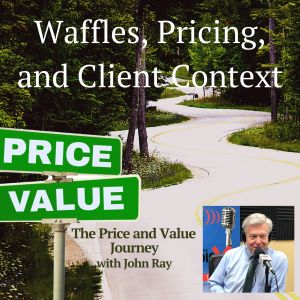
Prices are marketing signals. Prices send messages of quality, and sometimes prices send a signal you didn’t intend:  that your service is inferior in some way. A master woodworker’s story illustrates the point. The Price and Value Journey is presented by John Ray and produced by the North Fulton studio of Business RadioX®.

TRANSCRIPT

John Ray: [00:00:00] Hello. I’m John Ray on The Price and Value Journey. A few years ago, I gave a presentation to a group of business owners on pricing and specifically how pricing is the most important driver of revenue and profit growth in a business.

John Ray: [00:00:15] To understand pricing, it’s important to understand the value equation customers sort through as they evaluate a purchase. Regardless of whether they consciously realize it or not, clients weigh a comparison in their head. Does the value received from this product or service exceed the cost of the purchase? Now, that value could be tangible or intangible. Most often it’s a combination of both.

John Ray: [00:00:43] After my presentation, I received a comment from Hans Meyer. He’s a friend of mine who, at the time, was in the office products business. But on the side, Hans is a phenomenally talented wood craftsman. In fact, he does that work fulltime now that he’s retired. He makes a variety of wood decorative items, toys, puzzles, teaches other craftsmen, and exhibits at weekend trade shows.

John Ray: [00:01:12] Hans shared with me that he started making wood fret crosses. Now, wooden fret crosses can be extremely ornate and intricate. They’re beautiful works of art. Hans had made several large ones, which he had priced at $40 to 50 each. Despite their beauty, the crosses were just not selling. And in turn, this led to another problem, these crosses had been to eight or ten different craft shows and had not sold.

John Ray: [00:01:43] Well, finally, out of frustration at one show where, again, the crosses were not selling and not wanting to have to lug them back home yet again, Hans decided to mark them down and get rid of them. With pen in hand, he started changing prices. What are you doing? A voice called urgently from the next booth. It was a lady who was exhibiting her crafts next to Hans and she was curious.

John Ray: [00:02:10] Hans told her the saga of his crosses and how he wanted to mark them down to get rid of them. “No,” she replied emphatically, “do not do that. Absolutely not.” Hans was exasperated, he said, and he handed her the pen, “Okay then, you price them.” Well, she took the pen and she made new tags for the crosses, pricing them from $125 to 150 each. During that same show, Hans sold three crosses at the new higher prices to three different customers.

John Ray: [00:02:48] Hans now routinely sells these ornate crosses from $175 to 225 each. That’s about four times more than before his fellow exhibitor took that pen and in just a few short moments completely transformed the profitability of these products.

John Ray: [00:03:08] As business owners, we need to understand that our price is sometimes interpreted as a signal by customers. A signal of quality or a lack thereof. A readiness to discount or markdown may be interpreted by the client as an admission that the product or service really doesn’t have that much value after all. In such cases, discounts may not actually drive a sale. On the contrary, the signals sent by a discounted or low price may drive the client away and into the arms of another provider whose higher price signals better quality.

John Ray: [00:03:47] In the case of Hans and his decorative fret crosses, a higher price reinforced in the minds of buying clients what they came to the craft show to purchase, an intricately carved handmade item, handmade by a master craftsman. Hans’ original much lower price may have been interpreted by potential buyers as a signal these items were not of much quality and craftsmanship.

John Ray: [00:04:16] If you enjoy a craft beer or wine and you’re not really a connoisseur, think about how you order in a restaurant confronted by a list of beers and wines. Some of which you’ve never had before. Some of which you’ve never heard of. What’s your first impression of the $8 glass of craft beer you’ve never heard of compared to that $2 Budweiser draft? The former has to be good if it’s $8, right?

John Ray: [00:04:45] Now, you don’t have to imbibe to be subject to this phenomena. What about that delivered pizza from the national chain which you purchased with a discount you accidentally found online and which comes in a box with more coupons taped on top? How does your perception of the quality of that pizza compare in your mind to the more expensive version you get in a sit down Italian restaurant, which, not only doesn’t deliver, but doesn’t discount?

John Ray: [00:05:15] This dynamic is not just true in extremely subjective products like arts and crafts or food and drink. What’s your immediate perception of the experience, intellectual depth, advice, and service quality of the attorney advertising on a billboard for a $199 divorce versus an attorney who asks for a $10,000 retainer to begin the divorce process? Absent any other information, which attorney would you think offers the best quality service?

John Ray: [00:05:53] Understand that your price is a signal to potential buyers. Price your service with care. Those prices may be interpreted in ways you never considered and can reveal much more about your service than you can imagine.

John Ray: [00:06:10] I’m John Ray on the Price and Value Journey. Other episodes in this series can be found at pricevaluejourney.com or on your favorite podcast app.

John Ray: [00:06:21] I want to give a shoutout to Hans Meyer. If you’d like to see more of his work, go to hanspuzzles.com, that’s H-A-N-S-puzzles.com Hans is an outstanding woodworker who makes not only puzzles and fret crosses, but all manner of unique handcrafted wood products.

John Ray: [00:06:46] If you’d like to connect with me directly, you can send me an email, john@johnray.co. Thank you for joining me.


About The Price and Value Journey

The title of this show describes the journey all professional services providers are on:  building a services practice by seeking to convince the world of the value we offer, helping clients achieve the outcomes they desire and trying to do all that at pricing which reflects the value we deliver.

If you feel like you’re working too hard for too little money in your solo or small firm practice, this show is for you. Even if you’re reasonably happy with your practice, you’ll hear ways to improve both your bottom line as well as the mindset you bring to your business.

The show is produced by the North Fulton studio of Business RadioX® and can be found on all the major podcast apps. The complete show archive is here.

John Ray, Host of The Price and Value Journey

John Ray The Price and Value Journey
John Ray, Host of “The Price and Value Journey”

John Ray is the host of The Price and Value Journey.

John owns Ray Business Advisors, a business advisory practice. John’s services include advising solopreneur and small professional services firms on their pricing. John is passionate about the power of pricing for business owners, as changing pricing is the fastest way to change the profitability of a business. His clients are professionals who are selling their “grey matter,” such as attorneys, CPAs, accountants and bookkeepers, consultants, marketing professionals, and other professional services practitioners.

In his other business, John is a Studio Owner, Producer, and Show Host with Business RadioX®, and works with business owners who want to do their own podcast. As a veteran B2B services provider, John’s special sauce is coaching B2B professionals to use a podcast to build relationships in a non-salesy way which translate into revenue.

John is the host of North Fulton Business Radio, Minneapolis-St. Paul Business Radio, Nashville Business Radio, Alpharetta Tech Talk, and Business Leaders Radio. house shows which feature a wide range of business leaders and companies. John has hosted and/or produced over 1,100 podcast episodes.

Connect with John Ray:

Website | LinkedIn | Twitter

Business RadioX®:  LinkedIn | Twitter | Facebook | Instagram

Tagged With: John Ray, marketing, marketing signals, Price and Value Journey, prices, pricing, professional services, professional services providers, solopreneurs, The Price and Value Journey, value

Elizabeth Warren, Tower Roofing

March 25, 2022 by John Ray

Tower Roofing
North Fulton Business Radio
Elizabeth Warren, Tower Roofing
Loading
00:00 /
RSS Feed
Share
Link
Embed

Download file

Tower Roofing

Elizabeth Warren, Tower Roofing (North Fulton Business Radio, Episode 445)

Elizabeth Warren, Director of Business Development at Tower Roofing, talked with host John Ray about the services Tower Roofing offers. She explained when you might need to contact them, their methods of replacing and cleaning roofs, why you should never pressure wash your roof, and much more. North Fulton Business Radio is broadcast from the North Fulton studio of Business RadioX® inside Renasant Bank in Alpharetta.

Tower Roofing

Tower is a specialized commercial, industrial, and residential roofing contractor based in Marietta.

For the past 36 years, they have served our satisfied clients all over Atlanta and the surrounding counties and cities.

Being a leader in the Georgia roofing market since 1985 means we can provide you with the stability, strength, and quality you need. They are dedicated to working with you to implement a solution that meets your needs, from roof system installation to roof repair.

At Tower Roofing, they strive to provide only the best roofing products and services to our customers with an absolute commitment to customer service.

Company website | LinkedIn | Twitter | Facebook

Elizabeth Warren, Director of Business Development, Tower Roofing

Elizabeth Warren, Director of Business Development

After moving back to her home state of Georgia, Elizabeth is Tower’s Director of Business Development. She grew up in Columbus, Georgia, and moved herself to Manhattan to attend college. Elizabeth went to the Fashion Institute of Technology where she studied Fashion Business Management, International Trade Marketing, English, and Product Development.

In her free time, she enjoys being outside and baking!

LinkedIn

Questions and Topics in this Interview:

  • When to call Tower
  • When to replace a roof
  • How do you clean a roof?
  • Issues with gutters
  • Roof vents
  • Commercial roofs
  • The areas Tower serves

North Fulton Business Radio is hosted by John Ray and broadcast and produced from the North Fulton studio of Business RadioX® inside Renasant Bank in Alpharetta. You can find the full archive of shows by following this link. The show is available on all the major podcast apps, including Apple Podcasts, Spotify, Google, Amazon, iHeart Radio, Stitcher, TuneIn, and others.

RenasantBank


Renasant Bank has humble roots, starting in 1904 as a $100,000 bank in a Lee County, Mississippi, bakery. Since then, Renasant has grown to become one of the Southeast’s strongest financial institutions with over $13 billion in assets and more than 190 banking, lending, wealth management and financial services offices in Mississippi, Alabama, Tennessee, Georgia and Florida. All of Renasant’s success stems from each of their banker’s commitment to investing in their communities as a way of better understanding the people they serve. At Renasant Bank, they understand you because they work and live alongside you every day.


Special thanks to A&S Culinary Concepts for their support of this edition of North Fulton Business Radio. A&S Culinary Concepts, based in Johns Creek, is an award-winning culinary studio, celebrated for corporate catering, corporate team building, Big Green Egg Boot Camps, and private group events. They also provide oven-ready, cooked from scratch meals to go they call “Let Us Cook for You.” To see their menus and events, go to their website or call 678-336-9196.

Tagged With: attic ventilation, commercial roofing, gutters, North Fulton Business Radio, renasant bank, residential roofing, shingles, Tower Roofing

Experts Don’t Chase

March 25, 2022 by John Ray

Experts Don't Chase
North Fulton Studio
Experts Don't Chase
Loading
00:00 /
RSS Feed
Share
Link
Embed

Download file

Experts Don't Chase

Experts Don’t Chase

Experts don’t chase for a lot of reasons. One reason is that they’re too busy. The unsolicited pitches of a business and life coach prompts thoughts on expertise, chasing prospects, and the unintended signals some professional services providers send. The Price and Value Journey is presented by John Ray and produced by the North Fulton studio of Business RadioX®.

TRANSCRIPT

John Ray: [00:00:00] And hello. I’m John Ray on The Price and Value Journey. Dogs chase, experts don’t.

John Ray: [00:00:10] Sometime ago, a business and life coach connected with me on LinkedIn. Almost immediately, the automated private messages followed in a steady beat. My usual response to all this is simply to ignore. But the bots kept delivering the appeals, though, and they were progressively more urgent.

John Ray: [00:00:32] One note promises that her suggestions can help my business get back on solid ground. Never mind that she’s made no attempt to engage me in any personal way to find out exactly what I do, what’s going on with my business, what my needs are, and even what my favorite flavor of ice cream might be. Nothing.

John Ray: [00:00:55] In all these bots – yes, bots. Automated robot messages – she doesn’t offer me any insights that might help me in my business. Not even a pointer to the book she’s got for sale, an e-book, or even a blog post. Not even a pithy quote. Nothing.

John Ray: [00:01:16] Finally, in the last message I received, I got this, “I get it. You’re busy. But that doesn’t mean I’m giving up on you.” Good grief. That’s awesome. It’s great to know that I’ve got someone out there, someone who doesn’t know me from Adam’s house cat who’s not giving up on me.

John Ray: [00:01:38] Now, maybe you think I’m cranky for my critique, and maybe you think I have something against LinkedIn Sales Navigator or other similarly generation tools. But the tools and the technology aren’t the issue. The problem is how they are employed. These tools can be a godsend for professional services providers legitimately trying to expand their network. When used to chase people, though, with what amounts to spam, these tools devalue the brand you’re trying to build.

John Ray: [00:02:13] I’m thinking about this situation from the point of view of the coach, not me and the hundreds of other people she’s spamming on LinkedIn. Frankly, I feel a little bit sorry for her. She may be the best business and life coach one could ever hire, but that’s not the vibe she’s giving me. The signal she’s sending is that she has to chase people to get business. And that dents my perception of her abilities as a business coach.

John Ray: [00:02:41] If she’s so great, why does she need to chase me or anyone else with automated bots on LinkedIn? She’s not offering me even a glimpse into how she, out of the thousands of business coaches I could find on LinkedIn, might be able to help me with the particular problems that I have. She’s offering me no glimpses of her expertise, even though she clearly has some. Yes, I went to her website and poked around. All she’s doing is chasing.

John Ray: [00:03:10] That’s what dogs do, chase. Experts don’t chase. They’re too busy to chase. And let’s suppose she’s actually fortunate enough to shake out a few leads from this hunting she’s doing. If any of these leads turn into prospects, will this coach be able to command prices which reflect the value she delivers to clients? The chances are slim, I think, because she’s sending signals that she needs the business arguably worse than I or any of our other targets need her coaching. She’s fostering the perception, whether intended or not, that she badly needs the business.

John Ray: [00:03:54] And if you’re a coach who wants to receive prices commensurate with the value you offer, it’s a bottom line killer.

John Ray: [00:04:02] I’m John Ray on The Price and Value Journey. The show archive for this series can be found on your favorite podcast app or at pricevaluejourney.com. And if you’d like to connect with me directly, you can send an email to john@johnray.co. Thank you for joining me.


About The Price and Value Journey

The title of this show describes the journey all professional services providers are on:  building a services practice by seeking to convince the world of the value we offer, helping clients achieve the outcomes they desire and trying to do all that at pricing which reflects the value we deliver.

If you feel like you’re working too hard for too little money in your solo or small firm practice, this show is for you. Even if you’re reasonably happy with your practice, you’ll hear ways to improve both your bottom line as well as the mindset you bring to your business.

The show is produced by the North Fulton studio of Business RadioX® and can be found on all the major podcast apps. The complete show archive is here.

John Ray, Host of The Price and Value Journey

John Ray The Price and Value Journey
John Ray, Host of “The Price and Value Journey”

John Ray is the host of The Price and Value Journey.

John owns Ray Business Advisors, a business advisory practice. John’s services include advising solopreneur and small professional services firms on their pricing. John is passionate about the power of pricing for business owners, as changing pricing is the fastest way to change the profitability of a business. His clients are professionals who are selling their “grey matter,” such as attorneys, CPAs, accountants and bookkeepers, consultants, marketing professionals, and other professional services practitioners.

In his other business, John is a Studio Owner, Producer, and Show Host with Business RadioX®, and works with business owners who want to do their own podcast. As a veteran B2B services provider, John’s special sauce is coaching B2B professionals to use a podcast to build relationships in a non-salesy way which translate into revenue.

John is the host of North Fulton Business Radio, Minneapolis-St. Paul Business Radio, Nashville Business Radio, Alpharetta Tech Talk, and Business Leaders Radio. house shows which feature a wide range of business leaders and companies. John has hosted and/or produced over 1,100 podcast episodes.

Connect with John Ray:

Website | LinkedIn | Twitter

Business RadioX®:  LinkedIn | Twitter | Facebook | Instagram

Tagged With: Experts, John Ray, Price and Value Journey, pricing, professional services, professional services providers, prospects, solopreneurs, The Price and Value Journey, value

LIVE from WORKBENCHcon 2022: Tamara Robertson, Maker Science, and Nick Householder, Midnight Science Club

March 24, 2022 by John Ray

Midnight Science Club
North Fulton Studio
LIVE from WORKBENCHcon 2022: Tamara Robertson, Maker Science, and Nick Householder, Midnight Science Club
Loading
00:00 /
RSS Feed
Share
Link
Embed

Download file

Midnight Science Club

Organization Conversation LIVE from WORKBENCHcon 2022: Tamara Robertson, Maker Science, and Nick Householder, Midnight Science Club (Organization Conversation, Episode 9)

Nick Householder and Tamara Robertson, now co-collaborators on Midnight Science Club, joined host Richard Grove in the booth at WORKBENCHcon 2022. Nick and Tamara each describe how they each discovered their passions and followed them despite not seeing many role models, their advice to young people want to get into science and engineering, the value of failure, and much more. Organization Conversation is broadcast from the North Fulton studio of Business RadioX® inside Renasant Bank in Alpharetta.

Tamara Robertson, Maker Science

Tamara Robertson, Maker Science

Tamara Robertson was born and raised in a military family in Eastern, NC. As a small child, she had a very vivid imagination and a wish to explore the world around her. She very early on became an observer of humans in their natural elements which added to her storytelling ability. As a youth, she spent a large amount of time with her father watching Star Trek and tinkering in the garage – rebuilding engines, up – keeping the family cars and building / renovating homes.

She learned her love of machinery, as well as all things technical, from her time working with her dad.

With a sharp mind for detail and efficiency, Tamara was able to quickly excel in her career as a licensed Chemical & Biomolecular Engineer which afforded her the ability to truly see the world and gain experience in global tech transfers, process & facilities design, pandemic vaccine manufacturing, patented additive technology development, and product design for some of the top Fortune 500 companies. Tamara has found that she loves to utilize the design and beauty of the world around her to help create designs and tell stories.

Tamara resides in Los Angeles, CA where she continues to work as an Emmy nominated Executive Producer, Science Host, Engineering Consultant, SAG-AFTRA Actor and Wardrobe Designer. In her downtime, she volunteers as a board member for a number of STEM organizations across the US, utilizes Superhero Science to get kids excited about careers in STEM, and lends her Science and Maker skills to a number of non-profit organizations. She also enjoys scuba diving, backpacking, rock climbing, surfing, snowboarding, and spending time with her Shop Dog Dexter.

Connect with Tamara: Website | Instagram | Facebook | YouTube

Midnight Science Club

Midnight Science Club strives to make engaging, original science content. Our commitment to making science accessible has resulted in over 150K followers on TikTok, Instagram, and Facebook – and we’re just getting started!

From presentations at the Royal Institution of Great Britain to STEAM workshops in Saudi Arabia, and even live science demos at Cons and Festivals – Midnight Science Club delivers captivating live performances sure to delight and inspire any audience.

MythBusters, The Tonight Show, and MacGyver are just a few of the high-profile television programs that the team at Midnight Science Club has provided science consulting and science demonstration fabrication services for. They pride themselves on delivering captivating science that communicates complex concepts in a signature style that anyone can understand.

Website  | Facebook | Instagram | Twitter

Nick Householder, Midnight Science Club

Nick Householder, Midnight Science Club

Nick Householder is a co-host and lead builder on the Science Channel television show Street Science. It’s a fantastic team of people passionate about science and sharing the love of it with the world. He uses his aerospace engineering background and communication skills to share scientific concepts using examples anyone could understand. He also runs the Street Science build shop – designing the science demonstrations used for the show and leading an awesome team of builders in fabricating those demos.

​Nick’s experience designing and building science demonstrations for television goes beyond Street Science. ​Since October 2017 has has been a science consultant for The Tonight Show Starring Jimmy Fallon. ​He works with the team at NBC to design and build science demonstrations which resident science expert Kevin Delaney uses to entertain and educate the Tonight Show audience.

​Before his time in television, he spent five years working as a civilian in the U.S. Air Force, where he was a ‘Weapons Test Engineer’ – he designed, planned, and executed complex weapon tests. That experience gave him the skills needed to conduct large, dangerous science demonstrations in a safe and controlled way.

Nick attended Auburn University for both his Bachelor’s and Master’s degrees, both of which are in Aerospace Engineering.

Nick is always looking for new projects, so don’t hesitate to contact him if you think he’s right for the job!

Connect with Nick: Website | Instagram | Facebook | YouTube


About Organization Conversation

Organization Conversation features interviews with movers and shakers in storage and organization, from professional organizers to the creative and talented Brand Ambassadors who use Wall Control products every day. You’ll hear tips, tricks and how-tos for storage and organization, as well as receive first access to Wall Control promotions. We talk with our suppliers and partners to give you a look behind the scenes at how we operate, what makes our family-owned and operated brand tick, and some of the fun and interesting insights that go into making our business run. We love our guests, as they are engaging and entertaining with interesting experiences to share. By focusing on those guests and the amazing stories they tell, we hope you will be enriched and find your time listening to the Organization Conversation podcast as time well spent.

Organization Conversation is hosted by Richard Grove, and broadcast and produced from the North Fulton studio of Business RadioX® inside Renasant Bank in Alpharetta. You can find the full archive of shows by following this link. The show is available on all the major podcast apps, including Apple Podcasts, Spotify, Google, Amazon, iHeart Radio, and others.

About Richard Grove

Richard Grove, Host, Organization Conversation

Richard Grove‘s background is in engineering but what he enjoys most is brand building through relationships and creative marketing. Richard began his career with the Department of Defense as an engineer on the C-5 Galaxy Engineering Team based out of Warner Robins. While Richard found this experience both rewarding and fulfilling, he always knew deep down that he wanted to return to the small family business that originally triggered his interest in engineering.

Richard came to work for the family business, Dekalb Tool & Die, in 2008 as a Mechanical Engineer. At the time Wall Control was little more than a small ‘side hustle’ for Dekalb Tool & Die to try to produce some incremental income. There were no “Wall Control” employees, just a small warehouse with a single tool and die maker that would double as an “order fulfillment associate” on the occasion that the original WallControl.com website, which Richard’s grandmother built, pulled in an order.

In 2008, it became apparent that for the family business to survive they were going to have to produce their own branded product at scale to ensure jobs remained in-house and for the business to continue to move forward. Richard then turned his attention from tool and die to Wall Control to attempt this necessary pivot and his story with Wall Control began. Since that time, Richard has led Wall Control to significant growth while navigating two recessions.

Connect with Richard:

Instagram | Twitter | LinkedIn

About Wall Control

The Wall Control story began in 1968 in a small tool & die shop just outside Atlanta, Georgia. The first of three generations began their work in building a family-based US manufacturer with little more than hard work and the American Dream.

Over the past 50+ years, this family business has continued to grow and expand from what was once a small tool & die shop into an award-winning US manufacturer of products ranging from automobile components to satellite panels and now, the best wall-mounted tool storage system available today, Wall Control.

The Wall Control brand launched in 2003 and is a family-owned and operated business that not only produces a high-quality American Made product but sees the entire design, production, and distribution process happen under their own roof in Tucker, Georgia. Under that same roof, three generations of American Manufacturing are still hard at work creating the best tool storage products available today.

Connect with Wall Control:

Company website | Facebook | Instagram

Tagged With: learn from failure, Maker Science, Midnight Science Club, Nick Householder, Organization Conversation, Richard Grove, role models, Tamara Robertson, Wall Control, WORKBENCHcon 2022

Suicide Prevention: An Interview with Kristen Petillo, American Foundation for Suicide Prevention

March 24, 2022 by John Ray

Suicide Prevention
North Fulton Studio
Suicide Prevention: An Interview with Kristen Petillo, American Foundation for Suicide Prevention
Loading
00:00 /
RSS Feed
Share
Link
Embed

Download file

Suicide Prevention

Suicide Prevention: An Interview with Kristen Petillo, American Foundation for Suicide Prevention (Episode 72, To Your Health with Dr. Jim Morrow)

On this episode of To Your Health, Kristen Petillo, Area Director of the Georgia Chapter for the American Foundation for Suicide Prevention, joined Dr. Morrow to discuss suicide prevention. Ms. Petillo covered who is at risk, what the warning signs are, the mission of AFSP, their current initiatives, and much more. To Your Health is brought to you by Village Medical (formerly Morrow Family Medicine), which brings the care back to healthcare.

American Foundation for Suicide Prevention

Established in 1987, the American Foundation for Suicide Prevention (AFSP) is a voluntary health organization that gives those affected by suicide a nationwide community empowered by research, education, and advocacy to take action against this leading cause of death.

AFSP is dedicated to saving lives and bringing hope to those affected by suicide. Led by CEO Robert Gebbia and headquartered in New York, and with a public policy office in Washington, D.C., AFSP has local chapters in all 50 states with programs and events nationwide.

AFSP celebrates 30 years of service to the suicide prevention movement.

Company website | Facebook | Instagram | Twitter

Kristen Petillo, Area Director, Georgia Chapter, American Foundation for Suicide Prevention

Kristen Petillo, Area Director, Georgia Chapter, American Foundation for Suicide Prevention

Kristen is a former New Yorker with 20+ years in the health and human services/non-profit space.

Kristen enjoys connecting with community and creating opportunities to empower and uplift others.
When she is not representing AFSP, Kristen can be found spending time with her husband of 21 years and their son, Jack, a senior in High School. Together, they enjoy a life filled with family, friends, travel, and endurance events.

LinkedIn

About Morrow Family Medicine, A Member of Village Medical

Morrow Family Medicine, a Member of Village Medical, is an award-winning, state-of-the-art family practice with offices in Cumming and Milton, Georgia. The practice combines healthcare information technology with old-fashioned care to provide the type of care that many are in search of today. Two physicians, three physician assistants and two nurse practitioners are supported by a knowledgeable and friendly staff to make your visit to Morrow Family Medicine, A Member of Village Medical one that will remind you of the way healthcare should be.  At Morrow Family Medicine, a Member of Village Medical, we like to say we are “bringing the care back to healthcare!”  The practice has been named the “Best of Forsyth” in Family Medicine in all five years of the award, is a three-time consecutive winner of the “Best of North Atlanta” by readers of Appen Media, and the 2019 winner of “Best of Life” in North Fulton County.

Village Medical offers a comprehensive suite of primary care services including preventative care, treatment for illness and injury, and management of chronic conditions such as diabetes, congestive heart failure, chronic obstructive pulmonary disease (COPD) and kidney disease. Atlanta-area patients can learn more about the practice here.

Dr. Jim Morrow, Morrow Family Medicine, and Host of “To Your Health with Dr. Jim Morrow”

Covid-19 misconceptionsDr. Jim Morrow is the founder and CEO of Morrow Family Medicine. He has been a trailblazer and evangelist in the area of healthcare information technology, was named Physician IT Leader of the Year by HIMSS, a HIMSS Davies Award Winner, the Cumming-Forsyth Chamber of Commerce Steve Bloom Award Winner as Entrepreneur of the Year and he received a Phoenix Award as Community Leader of the Year from the Metro Atlanta Chamber of Commerce.  He is married to Peggie Morrow and together they founded the Forsyth BYOT Benefit, a charity in Forsyth County to support students in need of technology and devices. They have two Goldendoodles, a gaggle of grandchildren and enjoy life on and around Lake Lanier.

Facebook: https://www.facebook.com/MorrowFamMed/

LinkedIn: https://www.linkedin.com/company/7788088/admin/

Twitter: https://twitter.com/toyourhealthMD

The complete show archive of “To Your Health with Dr. Jim Morrow” addresses a wide range of health and wellness topics, and can be found at www.toyourhealthradio.com.

Tagged With: AFSP, American Foundation for Suicide Prevention, Dr. Jim Morrow, Kristen Petillo, Project 2025, Suicide, Suicide prevention, To Your Health, Village Medical

Decision Vision Episode 161: Should I Turn My Side Hustle into a Full-time Business? – An Interview with Natasha Tucker, Happy Hippie Gardening

March 24, 2022 by John Ray

Happy Hippie Gardening
Decision Vision
Decision Vision Episode 161: Should I Turn My Side Hustle into a Full-time Business? - An Interview with Natasha Tucker, Happy Hippie Gardening
Loading
00:00 /
RSS Feed
Share
Link
Embed

Download file

Happy Hippie Gardening

Decision Vision Episode 161: Should I Turn My Side Hustle into a Full-time Business? – An Interview with Natasha Tucker, Happy Hippie Gardening

Side hustles can add essential part-time income, but how and when should you transition that side gig into a full-time business? Natasha Tucker, President and CEO of Happy Hippie Gardening, found herself doing just that, as a few jobs on the side became a thriving landscape services business on word of mouth alone. She and Mike Blake discussed how it evolved for her, the decision to make it a business, the hurdles she faced, and much more. Decision Vision is presented by Brady Ware & Company and produced by the North Fulton studio of Business RadioX®.

Happy Hippie Gardening

Happy Hippie Gardening is a trusted landscape company operating in the Huntsville, AL metro market.

They offer residential and commercial landscape and maintenance services. Their hippies love weeds, but they do more than get dirty weeding flower beds.  They also add seasonal color, apply mulch, do shrub pruning, create stacked stone borders, and a lot more.

What they really do – “We Get Dirty So You Don’t Have To.”

Company website | Facebook | Instagram

Natasha Tucker, President and CEO, Happy Hippie Gardening

Natasha Tucker, President and CEO, Happy Hippie Gardening

Natasha is a relentless entrepreneur, daring businesswoman, loving mother, devoted wife, adoring daughter, caring granddaughter and a sometimes serious sister. In her many business adventures, she has successfully launched, acquired and/or owned multiple businesses including a coffee shop, children’s boutique and landscape company to name a few.

The daughter of an original 1960’s hippie and master gardener, Natasha has been working in flower beds, and getting dirty, since she was a girl. After years of maintaining her own flower beds, drawing from her childhood landscaping experiences, Natasha decided to help her hippie friends keep their flower beds looking beautiful too. After many months and much encouragement, she decided to turn her gardening side hustle into a legit business. So… on Valentine’s Day 2020 she launched Happy Hippie Gardening!

Her genuine desire and mission in business is to help others enjoy their landscapes, love their flower beds, and perhaps find a little peace and happiness. Natasha is your lovable suburban hippie who absolutely, positively loves to create, renew and maintain beauty, peace, and harmony in flower beds and landscapes. Peace & Love.

LinkedIn

Mike Blake, Brady Ware & Company

Mike Blake, Host of the “Decision Vision” podcast series

Michael Blake is the host of the Decision Vision podcast series and a Director of Brady Ware & Company. Mike specializes in the valuation of intellectual property-driven firms, such as software firms, aerospace firms, and professional services firms, most frequently in the capacity as a transaction advisor, helping clients obtain great outcomes from complex transaction opportunities. He is also a specialist in the appraisal of intellectual properties as stand-alone assets, such as software, trade secrets, and patents.

Mike has been a full-time business appraiser for 13 years with public accounting firms, boutique business appraisal firms, and an owner of his own firm. Prior to that, he spent 8 years in venture capital and investment banking, including transactions in the U.S., Israel, Russia, Ukraine, and Belarus.

LinkedIn | Facebook | Twitter | Instagram

Brady Ware & Company

Brady Ware & Company is a regional full-service accounting and advisory firm which helps businesses and entrepreneurs make visions a reality. Brady Ware services clients nationally from its offices in Alpharetta, GA; Columbus and Dayton, OH; and Richmond, IN. The firm is growth-minded, committed to the regions in which they operate, and most importantly, they make significant investments in their people and service offerings to meet the changing financial needs of those they are privileged to serve. The firm is dedicated to providing results that make a difference for its clients.

Decision Vision Podcast Series

Decision Vision is a podcast covering topics and issues facing small business owners and connecting them with solutions from leading experts. This series is presented by Brady Ware & Company. If you are a decision-maker for a small business, we’d love to hear from you. Contact us at decisionvision@bradyware.com and make sure to listen to every Thursday to the Decision Vision podcast.

Past episodes of Decision Vision can be found at decisionvisionpodcast.com. Decision Vision is produced by John Ray and the North Fulton studio of Business RadioX®.

Connect with Brady Ware & Company:

Website | LinkedIn | Facebook | Twitter | Instagram

TRANSCRIPT

Intro: [00:00:01] Welcome to Decision Vision, a podcast series focusing on critical business decisions. Brought to you by Brady Ware & Company. Brady Ware is a regional, full-service accounting and advisory firm that helps businesses and entrepreneurs make visions a reality.

Mike Blake: [00:00:21] Welcome to Decision Vision, a podcast giving you, the listener, clear vision to make great decisions. In each episode, we discuss the process of decision making on a different topic from the business owners’ or executives’ perspective. We aren’t necessarily telling you what to do, but we can put you in a position to make an informed decision on your own and understand when you might need help along the way.

Mike Blake: [00:00:44] My name is Mike Blake, and I’m your host for today’s program. I’m a director at Brady Ware & Company, a full-service accounting firm based in Dayton, Ohio, with offices in Dayton; Columbus, Ohio; Richmond, Indiana; and Alpharetta, Georgia. I am managing partner of the Strategic Valuation and Advisory Services Practice, which brings clarity to the most important strategic decisions that business owners and executives face by presenting them with factual evidence for such decisions. Brady Ware is sponsoring this podcast, which is being recorded in Atlanta per social distancing protocols.

Mike Blake: [00:01:16] If you would like to engage with me on social media with my Chart of the Day and other content, I’m on LinkedIn as myself and @unblakeable on Facebook, Twitter, Clubhouse, and Instagram. I also recently launched a new LinkedIn Group called Unblakeable’s Group That Doesn’t Suck, so please join that as well if you would like to engage. If you like this podcast, please subscribe on your favorite podcast aggregator and please consider leaving a review of the podcast as well.

Mike Blake: [00:01:42] So, today’s topic is, Should I turn my side hustle into a fulltime business? And I’ve been trying to find a guest for this topic for a while because I just run into so many people with side hustles. And, in fact, I would be willing to bet you if I actually looked at the data – I didn’t. I looked a little bit. I did a sneak peek.

Mike Blake: [00:02:04] When I first moved to Atlanta about 19 years ago, it seemed like every other person that I met had a side hustle of some kind. Now, back then, I was primarily in real estate. Because back then real estate was pretty much shooting fish in a barrel. It might be now, too, but don’t take my advice. I’m not a real estate guy. I’m not even very good at Monopoly. So, this is not the real estate investment show.

Mike Blake: [00:02:30] But it is interesting in how many people do seem to have a side hustle, and the statistics are supportive of that. According to Side Hustle Nation, 45 percent of working Americans have a side hustle and 20 percent of those bring in over $1,000 a month with those side hustles. Which is, for many households, $1,000 a month is a significant addition of income to a household.

Mike Blake: [00:03:01] And so, I’d be willing to bet many of you who are listening either have a side hustle, or are thinking of a side hustle, or have actually a business today that started off as a side hustle. So, I anticipate that this is going to be a topic of significant interest.

Mike Blake: [00:03:20] Now, I don’t have a side hustle. I can barely keep track of the one job that I have. But, fortunately, joining us today is somebody who’s done this successfully, and that is Natasha Tucker, from one of my favorite cities in the planet, Huntsville, Alabama. It is just one of the coolest places. It has really two of my favorite things. It has rockets and has German food. And those two things are actually related if you go back and sort of learn the history. But it is just a terrific place.

Mike Blake: [00:03:49] And Natasha is Founder and CEO of Happy Hippie Gardening. Happy Hippie Gardening is a trusted landscape company operating in the Huntsville, Alabama metro market. They offer residential and commercial landscape and maintenance services. Their hippies love weeds, but they do more than get dirty weeding flowerbeds. They also add seasonal color, apply mulch to shrub pruning, create stacked stone borders, and a lot more. Basically, anything that I don’t do. They get dirty so that you don’t have to.

Mike Blake: [00:04:20] Natasha is a relentless entrepreneur, daring businesswoman, loving mother, devoted wife, adoring daughter, caring granddaughter, and sometimes serious sister. In her many business adventures, she has successfully launched, acquired, and/or own multiple businesses, including a coffee shop, a children’s boutique, and landscape company to name a few. The daughter of an original 1960s hippie and master gardener, Natasha has been working in flower beds and getting dirty since she was a girl. Natasha Tucker, thank you for getting dirty with the Decision Vision podcast.

Natasha Tucker: [00:04:52] Yeah. Absolutely. Thank you so much for having me.

Mike Blake: [00:04:53] Sorry, it’s not that kind of podcast, but you get what I mean.

Natasha Tucker: [00:04:56] Hey, you know, we’ll try to keep it clean.

Mike Blake: [00:04:58] We will keep it clean. It has to be safe for work.

Natasha Tucker: [00:05:01] Exactly.

Mike Blake: [00:05:01] But thanks so much for coming on the program. And as I think I always am, but I say this in all sincerity, it’s a topic I’ve been wanting to do for a while, but haven’t felt the right person to do it. And then, your husband and I had just a conversation about entirely different topic and he had mentioned what you are into. I’m like, “Oh, I’ve got to get her on the podcast.” So, thanks so much for coming on.

Natasha Tucker: [00:05:27] Well, thank you. I’m so excited to be here.

Mike Blake: [00:05:29] So, I introed your business and kind of how you got into it, which is fascinating. So, what I’d like to do is I’d like to share with our listeners your origin story. Like, Spider-Man got bit by the radioactive spider and Superman was thrown off of his exploding planet. What’s the origin story of your business?

Natasha Tucker: [00:05:56] Well, it kind of started off with me trying to figure out what I wanted to do next. I’m kind of in a place at that time where we needed to get some extra income coming in. And I knew what I did not want to do. I did not want to go back into the service industry as far as like waitressing and things like that. I did not want to go back into the classroom. I don’t do well behind a desk.

Natasha Tucker: [00:06:30] So, it was it a big thought process. I felt stuck. And then, all of a sudden, it was the fall of 2019 and I had some friends ask, “Hey, you’re good at this. Can you please come and shred my shrubs and do some mulch? Because my lawn guys don’t want to do it.” And that was my initial little ping there that there might be a need. So, I did theirs, and then word got around, and I started doing more people’s flowerbeds.

Natasha Tucker: [00:07:05] And as that month, month-and-a-half, or fall went on, I realized this is a need that lawn guys are missing. I mean, they don’t want to have to stop and do the tedious. They want to be able to cut and go. And there’s a lot of people that don’t have the time to take care of their flowerbeds. So, that fall went by and I just kind of sat on it, because then, of course, through winter there wasn’t much then to do. So, I kind of sat on it for a little while. And as soon as the sun popped out in January and it felt warmer than normal, I started getting phone calls. And I was like, “Whoa. Okay.” So, it kind of went from there.

Mike Blake: [00:08:01] So, I have to ask and I’m just curious, you said you’re getting calls because the lawn guys wouldn’t do the shrubs and flowers and stuff. Is that a hierarchy? Do the lawn people feel like they’re too good to do that stuff? Is that the issue? Or is there something else at work?

Natasha Tucker: [00:08:20] I think that it’s more of the tedious part of it. They don’t want to get on their hands and knees and pull weeds. If you do get them to trim your shrubs, most of the time, they don’t even know what kind of shrubs they’re trimming. And when they leave, it looks like they’ve packed it to death with a chainsaw. And I’ve had quite a few people who have that happened to and it’s sad and mortifying.

Mike Blake: [00:08:51] I’ve had that happen too. I had my lawn guy do one of our shrubs exactly once, and it looked like my shrub was about to join the Marine Corps.

Natasha Tucker: [00:08:59] Exactly. Exactly. So, the attention to detail and the not minding taking the time to do it. And also one guy, you know, they charge – I don’t know what they charge there – anywhere from $50 to 75 a cut here. Well, they got to get in and out within 30, 45 minutes. You can’t be tedious and pay attention to detail with that amount of time that you’re being booked for. So, I think that’s basically why.

Mike Blake: [00:09:38] So, when you started this side hustle, did you work outside the home? And if so, what was that role?

Natasha Tucker: [00:09:47] I have done many. Especially 2018, 2019, I have had a couple of other little smaller jobs. Because I do have three children, and at the time, let me say, Isabela, my youngest, she was still, like, preschool age. So, I did not want fulltime then just because of schedule and kids. And at the time I did not have drivers yet. So, there was a lot of mommy taking around, and busing, and all that fun stuff.

Natasha Tucker: [00:10:28] So, right before I started with Hippie, I did have a fulltime desk job for a while. I realized that that was just not going to work with our schedules and with Rob’s schedule, so I did some retail work. I worked for one of my favorite stores. What else did I do? And then, I did try the waitressing thing again. I did it for many years and I realized, no, I’m just not doing that again.

Mike Blake: [00:11:03] So, at some point when this became a side hustle, not just sort of doing a person a favor, how many hours a week do you think you were doing that at first?

Natasha Tucker: [00:11:15] At first, maybe about ten. As I started getting more jobs, my dad would come and help me. So, that way I wasn’t spending five hours at one house necessarily. But it started off probably about ten hours a week to start with.

Mike Blake: [00:11:36] And is that something that you’re really embracing or did you have to kind of get dragged into it a little bit?

Natasha Tucker: [00:11:42] No. I actually fully embraced it. I love being outside and just having that freedom of I’m outside, I’m getting fresh air, I’m getting my exercise, and I’m getting paid to do it. And I could work with it when I needed to. I still had the flexibility at that point to still be the mommy bus. And so, all in all, it worked great.

Mike Blake: [00:12:18] So, when you started it, did you have any plans at that point to make this kind of a fulltime gig?

Natasha Tucker: [00:12:25] I really didn’t. I knew I loved it and I knew that it was working well for me. At the time, I did not expect for it to hit the fan, so to speak. And so, when it did that next spring in 2020, I was kind of blown away. And that’s when I was like, and even Rob being the business guy that he is, he was like, “We need to probably get your licensing and all that done and tax purposes,” so I can be legit.

Mike Blake: [00:13:08] Rob is your husband. For our listeners who haven’t met you guys, Rob is your husband.

Natasha Tucker: [00:13:11] Yes. So, he wanted me to be a legal hippie and make sure that I did things by the book as far as the business side goes. And it just kind of just happened, which worked for me because I loved it.

Mike Blake: [00:13:33] I think that’s one of the best ways to grow a business is have it organic – no pun intended. I tell people all the time that a business is like a Great Dane. And if you have to just sort of push and pull and it’s really hard to get the dog to move, then you probably don’t have the right dog. You probably don’t have the right business.

Mike Blake: [00:13:59] But on the other hand, if the Great Dane takes off down the sidewalk and nearly yanks your shoulder out of your socket and you’re running behind trying desperately to keep up with it, that’s the right business for you. That’s the market telling you that you’re really on to something.

Natasha Tucker: [00:14:15] Yes. Absolutely. And to see that the need was still there and it was greater and it grows. We’ve done very little as far as marketing. I started off with my Facebook Page. My husband, Rob, did the website. So, it was all done in-house and very manageable. And it’s all word of mouth as well. I love my people. That’s the other side of this business that I love. I love connecting with people and hearing them and saying, “Okay. This is what we want.” Even down to the colors that we pick, the style that they want. It’s individuality at its finest is your curb appeal. And so, it’s been a lot of fun. And I think that’s why I have grown so much, too, is if you enjoy what you’re doing, it shows.

Mike Blake: [00:15:22] Yeah. Yeah. I think that’s right. So, as you’re building this business or as you are trying to kind of lasso it, wrestle it to the ground – maybe that’s a better way to put it – did you have any doubts? Did you have any doubts about your ability to grow the business, run the business, be successful with it? Or did you kind of know just from day one, “Yeah. I got this”?

Natasha Tucker: [00:15:49] No. It’s a very scary ride. I think any time you’re doing something new and you are in a totally different ballgame than you’ve ever played, it can be super scary. We, all, as humans have that fear of failure kind of thing going, especially when you have your family depending, you have your customers, and your ego – let’s just be real. And so, it can be super terrifying, especially when you can’t control the weather. You can’t control supply and demand right now. There’s a lot of things that you can’t control as it is. So, being able to just keep pushing and try your best to stay levelheaded and keep the faith that, “Hey, it will work out”. Sometimes you just got to be a little patient. So, yeah, it can be terrifying.

Mike Blake: [00:16:54] So, how long did it take you from neighbors saying, “Hey, would you come help with our garden and, by the way, we’ll pay you” to getting to where you are now, where you’ve got it as an intentional, thriving business.

Natasha Tucker: [00:17:11] Well, I would say probably about four to five months. It was that fall of 2019 and then starting spring of 2020, it just kind of ran. It just took off and almost wanted to leave me behind. And, of course, spring of 2020 was when everything else hit the fan. And so, that was scary, I just started this in February and now the whole world is shutting down, which actually helped me a lot. Because I don’t work indoors. I work outdoors. People were working from home.

Natasha Tucker: [00:17:55] Especially here in Huntsville and Madison, most people were working from home. And they were forced to look at their flower beds. They were no longer doing the rat race in life and leaving and coming home at dark and not looking. Now, they’re sitting at their kitchen table with their computers looking out and going, “Oh, my God. What have I done to my yard? Or what have I not done?” And so, that actually spurred a huge push in my business. All of a sudden, like, it was a huge spike, which is great.

Natasha Tucker: [00:18:36] And then, the next year, 2021, it was stimulus checks. These little projects they’ve been wanting to do for forever, here you go. Now, they have the money for it. So, everything comes and goes and it ebbs and flows. But it always, always ends up evening out.

Mike Blake: [00:19:02] So, I’m curious, you’ve probably heard of this before. I often hear stories about somebody who cooks really well and then somebody will say, “You know what? You ought to open up your own restaurant.” And as often as not that person will say, “You know what? If I had to do it for a living, I wouldn’t like doing it anymore.” And I get that. I have hobbies. I’m into computers. I’m perfectly happy to spend a weekend fixing my own mistakes. But I would just blow my brains out if I had to make a living of fixing other people’s mistakes. So, I get that.

Natasha Tucker: [00:19:38] Yes.

Mike Blake: [00:19:39] And I’m curious, has now making what was a passionate hobby, one you had, really, from just being a little girl, how has turning that into a business impacted your passion for it, if at all?

Natasha Tucker: [00:19:53] If anything, it’s helped grow it because of the fact it is a constant learning thing. You know, there’s always something new to learn. There’s always different plants to learn. Every yard is different. Every customer is different. So, I think the difference is that, if it did become super repeat, like if I was just cutting grass and weeding and blowing and going, I would probably get bored to death. But the fact that every day is a different day, every plan that I draw up is different, I think the fact that it’s engaging me in that way, I still totally love it.

Mike Blake: [00:20:49] Now, if you’re willing, I’d like to talk about the impact on your family. Because your role economically has changed. Has that limited or changed the way that you fulfill your other roles as mother, wife, house manager, that sort of thing? And if so, has the family been supportive? How they had to adjust? How have you guys all had to adjust to now accommodate this thing that you’ve unleashed on the world with the gardening business?

Natasha Tucker: [00:21:19] Well, yes. As a wife and as a mother, let’s just say, don’t ever judge my house when you come in it. I try. I try. You know, me being gone now that the kids are even older – our eldest has graduated, my son drives, and we have a second grader – they’ve grown a little bit as well so that’s helped as far as they’re being self-reliant. Which is kind of sad, they don’t need mommy as much. But as far as I still do cook at least five nights out of the week. I do still try to make it to all the games and sports and things like that. That just means that mommy’s up until 1:00 a.m. every night.

Natasha Tucker: [00:22:20] And the balance is hard. I think that is probably the toughest part on me, is, finding the grace as a parent and as a small business owner with myself. Not beating myself up too hard for the little things. And so, my family has been great. This week is spring break, so my parents have our youngest. So, I’m all over the road and booked out this week. So, everyone has been very supportive. They’ve been my best cheerleaders.

Natasha Tucker: [00:22:59] And there’s just certain things that I had to let go of as far as my standards. No, my house isn’t perfectly clean. And, yes, there’s laundry. But I do make it a point to do my best as far as still being present. And I guess that means less sleep.

Mike Blake: [00:23:23] If you don’t mind my asking, how much sleep do you typically get a night?

Natasha Tucker: [00:23:27] Whew. Probably about five hours, maybe.

Mike Blake: [00:23:31] Okay. Okay. Okay. So, you’re really at it then. That’s a tough number. And I’m curious here, and we’ll get a little sociological, but that’s okay. We can do that here on the Decision Vision podcast. And that is that, I do think that that’s harder on women because of social media. And social media leads you to present the polished sort of market ready version of yourself. And that tends to impact women, I think, more than it impacts men in terms of making them feel badly about themselves or focusing on what they’re not doing as opposed to what they’re accomplishing. How do you react to that? Does that ring true for you?

Natasha Tucker: [00:24:19] It absolutely does. And, honestly, it’s a daily reminder that you have to give yourself. Stop allowing yourself to focus on that. Stop allowing yourself to be Negative Nancy on yourself. Look at what I did do today. You know, I brought in this much money today. I got my kids fed and out the door, at school, did jobs, did three estimates, went to a soccer game, and cooked dinner. In reality, that’s life.

Mike Blake: [00:25:03] That’s a full to-do list. You don’t have to apologize to anybody for that.

Natasha Tucker: [00:25:07] But, like you said, as women, we’re just kind of taught and expected by others, like you said, with social media and the way things are, that you’re supposed to get everything done in one day. And you’re supposed to keep things rolling, and the house clean, the dishes done. You’re supposed to still do the the feminine roles. And I am a woman working in a man’s world as well as business stuff. That’s been very interesting. At first, especially, I got a lot of looks. So, finding grace with yourself and always daily reminders of you are enough and own it. You can do this.

Mike Blake: [00:26:06] Yeah. Men have been slacking off for centuries, you know. So, let’s move over to more of the positive, and that is, you have this side hustle that’s now become a business. How has that impacted your household finances?

Natasha Tucker: [00:26:27] Oh, it’s dramatically impacted. It’s definitely carried us through quite a lot, especially the past two years. So, it’s been a huge blessing and it’s one of those things where it came at the absolute perfect time. Thank, God, for putting us in trouble.

Mike Blake: [00:26:59] So, did you have to invest any money in the business yourself when you started or could you just sort of bootstrap it?

Natasha Tucker: [00:27:08] I absolutely bootstrapped. When I first started up until – oh, wow – for a year, my poor Tahoe was loaded with all kinds of things from trimmers, and mulch, and bugs, to plants and dirt. Like, my poor Tahoe, it was embarrassingly bad. But it had to be. My work truck was all I had. I used tools out of my garage that I just had. If I needed something else, hopefully, I had a job that I would make profit on and go get it.

Natasha Tucker: [00:27:53] I know that my husband, Rob, thought I was crazy when I woke up one morning, it was April of 2020, and I got so tired of having to wait on people to make deliveries for me because I just had the Tahoe. So, there are things I couldn’t get, and I was like, “This is crazy.” I woke up and I said, “I’m going to go buy a trailer today.” He goes, “What?” I said, “I’m going to buy a trailer.” The fall of 2020, I woke up one day and I said, “That’s it. I’m getting a truck. Let’s go.”

Natasha Tucker: [00:28:26] But I had grown enough to that point where I could do that. I never borrowed money. I did not take on investments. It was all as I grew, everything else grew kind of thing.

Mike Blake: [00:28:44] It’s funny you say that. And I’m going to commiserate with you a little bit. You and I are in different fields, but I have my tools just as you have yours. And, you know, it’s funny, you do just sort of wake up one day and you say, “You know what? This just is not acceptable anymore. I’m going to go out and buy the right tool for the right job.” For me, I need a new computer because I was doing stuff that it would just take my old computer too long to do. Some of the models I do take ten hours to run through, so speed makes a big difference.

Mike Blake: [00:29:16] I woke up one day – because one was taking, like, 18 hours – I said, “You know what? There’s no numbers to run here. I’m just done doing this. I’m just going out and I’m buying a computer.” That’s all there is to it. And it’s refreshing to talk to somebody else that kind of had the same thing. It’s like I’m tired of being held back by my tools.

Natasha Tucker: [00:29:36] Yes. Yes. And the benefits that those new tools outweigh 1,000 percent what you’ve been dealing with. As long as you can do it. As long as you have the means to do it. And that’s part of being thirsty, I guess, and work smart and knowing that there’s going to come a time when you know that you’re going to have to just do it. And, thankfully, you’ll have the means to do it, if you’re thrifty.

Mike Blake: [00:30:09] It also shows that there’s a switch that flips, I think, that says I value my time now.

Natasha Tucker: [00:30:18] Yes.

Mike Blake: [00:30:19] It’s not like, “I’m buying this trailer or this truck, and then somebody is paying me right away thousands of dollars for me to go buy it.” You just know my time is too valuable to be waiting around on this stuff anymore. You know on the backend, it’s costing me money and my sanity not to do this.

Natasha Tucker: [00:30:39] Exactly. Absolutely. You know, when you do have your customers waiting on you, and you have a schedule that you’re trying to stay on, and you cannot count on other people to step up for you, especially when they have their own things going on in business or whatever. You can’t just expect people just to do it when you say do it. People, you give them always the benefit of the doubt. But when it just gets to where it is, taking up your time and money, let’s build up here.

Mike Blake: [00:31:25] What were some of the biggest challenges of converting from side hustle to full on business? If you can remember, what were some of the big hurdles for you that you had to overcome?

Natasha Tucker: [00:31:37] I think one of the biggest ones at first was the time management and the mental capacity. Because going back to everybody’s house is different, everybody’s needs or wants are different, the amount of brainpower that you have with thinking and thinking about these people. And if you have ten estimates lined up, each one the focus factor. The numbers factor of coming up with numbers for them. Then, you have to turn around and go be a mom and a wife.

Natasha Tucker: [00:32:20] So, it’s the compartmentalizing what needs to happen when. So, the time management and focus factor was probably the biggest hurdle, for me, getting thrown into a whirlwind that you knew was coming, but you just didn’t know how to fly in it.

Mike Blake: [00:32:48] So, that’s interesting, focus and time management. Were there any specific actions you took to develop those skills? Did you take courses, read books, podcasts? Or did you just learn it through the school of hard knocks and you learned what didn’t work and then tried something else?

Natasha Tucker: [00:33:09] That’s pretty much it.

Mike Blake: [00:33:10] Okay. That’s fine.

Natasha Tucker: [00:33:12] Okay. “So, that didn’t work out too well, so let’s shift here and let’s maneuver this a little bit. Because, you know, along with business, life changes as well. So, everything is constantly shifting and constantly moving. And so, half the time I just feel like I’m flying by the seat of my pants. But you have to be okay with that sometimes.

Mike Blake: [00:33:39] I get it. I need to take a picture of this. But on a table that you can’t see off camera here, there’s a bunch of stuff peeking out the bottom, a bunch of stuff I’ve thrown on the table is the workbook for David Allen’s Getting Things Done. And I can’t wait to take a picture of that because, obviously, I haven’t touched it. It’s literally on my to-do list to do the Getting Things Done Workbook.

Natasha Tucker: [00:34:07] Oh, my goodness. That’s great.

Mike Blake: [00:34:10] It’s just so meta. It’s going to make a fantastic photo when I put it out there. But there does come a point where you don’t have time to slow down and learn. You just sort of have to take the fruit as it’s thrown at you and try to juggle it as best you can. And, eventually, just learn to juggle.

Natasha Tucker: [00:34:28] Yes. Yes. And the more balls that get thrown in there, the quicker you get.

Mike Blake: [00:34:34] Yeah. That’s right.

Natasha Tucker: [00:34:35] I will say, too, I’ve never been a list person. And I can’t tell you how many calendars that I’ve thrown away in my life because I’m like, “I’m going to be one of those moms that writes everything down and I have my little schedule,” and that never worked up until now. I realized real quick that my schedule book is now my bible, because that was what kept me. If it’s written down, I can find it and I can remember. So, I did learn that part, too.

Mike Blake: [00:35:19] All right. So, as you’re making this transition, did you seek any outside advice?

Natasha Tucker: [00:35:29] Not really. I mean, Rob, my husband, is a huge business guy. So, anything that has to do with finances, money, the legal side of things, up to writing my little clauses at the bottom of my estimates, he was able to handle that. And there’s not really anybody else that I know or have heard of around here that does what I do. So, learning as far as different plants, different ways of doing things that, yes. Making good friends with nursery people and learning that way. But business side, thankfully Rob knows how to handle this stuff because that’s not my thing.

Mike Blake: [00:36:27] So, I’m curious, and feel free to not answer this almost unfair question. But I have to ask because I’m immensely curious. My wife and I have separate businesses. And they’re separate because if we tried to work in the same business together, it would either be the business than marriage, they would not both survive. I love her to death, 23 years married coming up on June, two children, all the works. She hasn’t changed the key on me yet when I left the house. But working together continues to be very hard for us. How do you guys work together? Does it work well or did you have to kind of break each other in? Or, frankly, did you have to break Rob in a little bit to get that going well?

Natasha Tucker: [00:37:12] I hadn’t break. It may have been kick him back out sometimes. What’s the word? He’s very driven and very hard focused on certain things. And I am very light spirited. I’m a total opposite. We’re complete opposite people. For a while, he did work with me daily, and it was great. And on some days, I do miss it. I do miss having him with me all the time. And then, other days I’m like, “Oh, thank goodness he’s back in an office because he does so much better there. That’s where he thrives.”

Mike Blake: [00:38:01] Okay. That’s fair.

Natasha Tucker: [00:38:02] Yeah. There were days. There were days.

Mike Blake: [00:38:08] Yeah. Well, look, my wife and I really struggle. We do a little bit, but not a lot. We’re better off sort of being in our corners and doing our thing. It doesn’t mean you have a bad marriage, but it just means that the compatibility required for a successful marriage is not the same as the compatibility required for a successful business partnership.

Natasha Tucker: [00:38:30] Exactly. Exactly.

Mike Blake: [00:38:36] What surprised you about this experience? What do you look back on? Or maybe think about now saying, “You know what? I didn’t expect this.”

Natasha Tucker: [00:38:46] Oh, gosh. I guess my biggest surprise when I look back, I’m like, “Oh, my goodness. I did that. Oh, my goodness. That happens. How in the world did we make it through? How did I even handle that?” Surprising myself, but then almost on a daily basis after a job, you turn around and you have that surprise of, “Wow.” Like, that’s one of the main reasons I continue to love this is you show up to a mess and, all of a sudden, you turn around and it’s gorgeous, and it’s beautiful, and people are happy, and you can be proud of yourself.

Natasha Tucker: [00:39:35] I did not realize when I first started because I wasn’t doing as much as I am now. I didn’t realize the sense of pride that I get. And the happiness of making other people happy, especially after you get to know them after bouncing back plans and getting to know people. That’s been my biggest surprise, is, I had no idea how happy it actually can make somebody when they do love what they do.

Mike Blake: [00:40:10] I’m talking with Natasha Tucker. And the topic is, Should I turn my side hustle into a fulltime business? We just have time for a few more questions. We got to, maybe, get you to bed at 12:45 rather than 1:00 a.m.. I certainly don’t want to be the reason you’re at that late. But what’s next for the business? What plans do you have for the business going forward?

Natasha Tucker: [00:40:37] Again, it’s the slow growth method now, because I haven’t taken on any capital per se. So, growing organically, right now I do have an assistant, which has helped keep my head a lot clearer. And I do have people that have been onboarded, so that helps a lot.

Natasha Tucker: [00:41:06] So, my ultimate goal is to be to where I can get another career going. I’m not going to say that I don’t want to be in the field working because I love it. But to where I can grow enough to where I can bounce between places a little bit more, because that makes it. And not be on the job site the whole time. But, again, I do love working outside and doing what I do and I love the people that I’ve brought on, so it’s just a lot of fun. So, get to where I can spread out and grow that way. Get a few more trucks out and go, I think that’s what’s next anyway.

Mike Blake: [00:41:56] Natasha, this has been a great conversation and I think our listeners will have learned a lot. I think they’ll just enjoy listening to the conversation, which is fine, too. It’s infotainment here on the Decision Vision podcast. But I’m sure there are questions we haven’t covered, and maybe they wish we would have done more in depth. If somebody wants to contact you about this question about turning their side hustle into a business and learn more from your expertise, can they contact you? And if so, what’s the best way to do that?

Natasha Tucker: [00:42:25] Absolutely. They can email me at natasha@happyhippiegardening.com. You can also message me through my Facebook page, Happy Hippie Gardening. And that’s probably the two direct routes that they’re absolutely welcome to email or message me.

Mike Blake: [00:42:49] That’s going to wrap it up for today’s program. I’d like to thank Natasha Tucker so much for sharing her expertise with us.

Mike Blake: [00:42:56] We’ll be exploring a new topic each week, so please tune in so that when you’re faced with your next business decision, you have clear vision when making it. If you enjoy these podcasts, please consider leaving a review with your favorite podcast aggregator. It helps people find us so that we can help them.

Mike Blake: [00:43:13] If you would like to engage with me on social media with my Chart of the Day and other content, I’m on LinkedIn as myself and @unblakeable on Facebook, Twitter, Clubhouse, and Instagram. Also, check out my new LinkedIn Group called Unblakeable’s Group That Doesn’t Suck. Once again, this is Mike Blake. Our sponsor is Brady Ware & Company. And this has been the Decision Vision podcast.


Tagged With: Brady Ware & Company, Decision Vision, entrepreneur, Happy Hippie Gardening, landscape services, Mike Blake, Natasha Tucker, side hustle

Workplace MVP: Soumaya Khalifa, Khalifa Consulting

March 24, 2022 by John Ray

Khalifa Consulting
Minneapolis St. Paul Studio
Workplace MVP: Soumaya Khalifa, Khalifa Consulting
Loading
00:00 /
RSS Feed
Share
Link
Embed

Download file

Khalifa Consulting

Workplace MVP: Soumaya Khalifa, Khalifa Consulting

On this episode of Workplace MVP, Soumaya Khalifa, President of Khalifa Consulting, joined Jamie Gassmann to discuss diversity, equity, and inclusion at the leadership level. Noting that diversity is now a given when hiring, Soumaya elaborated on the qualities an effective leader must have to be an inclusive leader. She and Jamie went on to discuss what diversity is, the impact when it’s missing, how leaders can uncover their unconscious bias, a culture of belonging, and much more. Workplace MVP is underwritten and presented by R3 Continuum and produced by the Minneapolis-St.Paul Studio of Business RadioX®.

Khalifa Consulting

Khalifa Consulting provides Fortune 100 companies, non-profit organizations, and governmental institutions with wide-ranging expertise and practical solutions to cross-cultural operations in the Arab world and the US.

Our team of top-level Diversity and Inclusion experts offers training and coaching services including Understanding the Diversity and Cultures of Arab Americans, Intercultural Communication, Managing a Cross-Cultural Team, Cultural Competency for Law Enforcement, and Keys to Success as a Woman Executive in the Arab World.

▪ For international business clients, we offer the specific cultural tools and information needed to successfully conduct business in the Arab World, including how to work within global/virtual teams, and crafting culturally appropriate videos and other media messages.

▪ For domestic and international business clients, we offer training workshops and individualized coaching to support diversity, equity, and inclusion initiatives.

▪ For US-based clients, we offer guidance and technical assistance on how to provide reasonable accommodations for their Muslim employees, by auditing current practices, making recommendations, and suggesting inclusive ways to support a positive work environment.

▪ For clients planning relocations to or from the Arab World, we offer general and specific direction for personal and family adjustment, practical shortcuts for managing new systems, and how-tos for everyday life.

▪ For our executive coaching clients, Khalifa Consulting offers personalized, ongoing, one-on-one high-level coaching to increase motivation, improve business skills and create work-life balance leading to thriving businesses and families.

Company website | LinkedIn | Facebook | Twitter

Soumaya Khalifa, President, Khalifa Consulting

Soumaya Khalifa, President, Khalifa Consulting

Soumaya Khalifa is the president of Khalifa Consulting, an Atlanta-based consulting firm specializing in intercultural coaching, consulting, and training. She is also an executive coach and teaches at Emory University Continuing education courses on Human Resources Management, Diversity, Equity and Inclusion, and Women in Leadership.

Soumaya is passionate about her work to build bridges of understanding and help leaders and organizations positively impact their employees and their bottom line.


LinkedIn

About Workplace MVP

Every day, around the world, organizations of all sizes face disruptive events and situations. Within those workplaces are everyday heroes in human resources, risk management, security, business continuity, and the C-suite. They don’t call themselves heroes though. On the contrary, they simply show up every day, laboring for the well-being of employees in their care, readying the workplace for and planning responses to disruption. This show, Workplace MVP, confers on these heroes the designation they deserve, Workplace MVP (Most Valuable Professionals), and gives them the forum to tell their story. As you hear their experiences, you will learn first-hand, real-life approaches to readying the workplace, responses to crisis situations, and overcoming challenges of disruption. Visit our show archive here.

Workplace MVP Host Jamie Gassmann

Jamie Gassmann, Host, “Workplace MVP”

In addition to serving as the host to the Workplace MVP podcast, Jamie Gassmann is the Director of Marketing at R3 Continuum (R3c). Collectively, she has more than fourteen years of marketing experience. Across her tenure, she has experience working in and with various industries including banking, real estate, retail, crisis management, insurance, business continuity, and more. She holds a Bachelor of Science Degree in Mass Communications with special interest in Advertising and Public Relations and a Master of Business Administration from Paseka School of Business, Minnesota State University.

TRANSCRIPT

Intro: [00:00:04] Broadcasting from the Business RadioX Studios, it’s time for Workplace MVP. Workplace MVP is brought to you by R3 Continuum, a global leader in workplace behavioral health and security solutions. Now, here’s your host, Jamie Gassman.

Jamie Gassmann: [00:00:25] Hi, everyone. Your host, Jamie Gassmann, here, and welcome to this episode of Workplace MVP. Diversity and inclusion is an area of focus for many senior leaders and H.R. executives. A great number of workplaces are re-examining their organization’s approach to ensuring diversity and inclusion and looking for how they can improve, build or implement new initiatives for their work environments. There are a lot of ways employers can take to building their diversity and inclusion program. But to aid in their ability to ensure their program is effective and successful, their efforts need to start at the top where they’re leaders embodying what is called inclusive leadership.

Jamie Gassmann: [00:01:08] As an inclusive leader, you are aware of your own biases and you are actively seeking out and considering different perspectives to inform your decision making and collaboration with others. These leaders are committed to ensuring all team members are treated equitably, feel a sense of belonging and value, and have the resources and support they need to achieve their full potential. How does an organization ensure they have inclusive leaders or how do their leaders learn to be inclusive if not already? Where does this fall within the process of establishing or reinventing an organization’s diversity and inclusion program?

Jamie Gassmann: [00:01:47] Well, joining us today to share her expertise and recommendations for workplaces looking to incorporate or reinvent their diversity and inclusion programs is workplace MVP and President and CEO of Khalifa Consulting, Soumaya Khalifa. Welcome to the show, Soumaya.

Soumaya Khalifa: [00:02:03] Thank you. It’s so wonderful to be with you today.

Jamie Gassmann: [00:02:07] Oh, we’re really happy to have you. So, I’d like to start out with you sharing with me your journey to becoming the President and CEO of Khalifa Consulting.

Soumaya Khalifa: [00:02:16] That is an incredible question. It has been a long road and it also has been a very unconventional journey. I earned my B.S. degree in Chemistry of all things and decided that I wanted to do something with people and not in labs. So, what I did is I pursued my MBA in human resources, worked in Corporate America for many years in the H.R. field, which I truly loved. Towards the end of that career in Corporate America, I was involved in a lot of diversity and inclusion work as well as organizational effectiveness, and it’s really amazing that the two really kind of complement each other. When I went out on my own, I wanted to bring all of my journey, all of my experiences to my clients. And so, that’s when I founded Khalifa Consulting, and it’s been about 12, 13 years now.

Jamie Gassmann: [00:03:01] Wow. So, talk to me a little bit about some of the work and the business that you do with Khalifa Consulting and helping your clients.

Soumaya Khalifa: [00:03:09] Khalifa Consulting is a boutique firm with a network of consultants covering the world. We specialize in executive coaching, intercultural and DEI training and consulting. I have a special interest in women and leadership and how to bring religion or faith into the DEI framework. We cater to large and mid-sized organizations and in the intercultural and DEI work, and also we do executive coaching for all sizes of organizations.

Jamie Gassmann: [00:03:41] Great. So, this topic we’re talking about is very near and dear to your heart. Share with me your opinion about workplaces having a diversity and inclusion program. Should they – is it – what’s the level of importance in making sure that they have something built-in?

Soumaya Khalifa: [00:03:59] Well, you know, diversity is a given because our population right here in the US has been diversifying over the last couple of decades. So, it is a given. If we are, as employers, looking for the best talent that there is out there, we will get diverse talent. Now, the real issue is how do we make our workplaces inviting enough for that talent, that top talent, to want to join us, but not only in joining us but to stay with us. So, inclusion needs to be very intentional. What does an employer have to do to attract and retain the talent that’s out there?

Soumaya Khalifa: [00:04:39] And, you know, it’s not only about talent. But if we have that talent, we are able to get into new markets. Because when we go into new markets, we have to understand them. And if we do have representation from them, that gives us an advantage, a competitive advantage to reach people in different markets. And, diversity is being invited to a party, and inclusion is being able to dance up the party. So, that’s the framework. So, diversity is a given, but what do we do with it in organization is the act and that is inclusion.

Jamie Gassmann: [00:05:19] Yeah. It’s such a great analogy. I’ve never heard it referred to that way, but it gives some context to how those two play together, basically. So, looking at that term inclusive, inclusive leader, you know, can you share from your expertise what that means? I know I gave a little brief definition of it at the beginning, but can you share from your perspective what that means?

Soumaya Khalifa: [00:05:43] Sure. In my opinion, an effective leader by default is an inclusive leader. And if we are to look at some of the characteristics of an inclusive leader, they have to have commitment to cultivate a diverse and inclusive workforce, and that takes really time and energy from them. And they have to believe in the business case for diversity and inclusion and how that is driving or will drive or will impact on the mission and vision of their organization.

Soumaya Khalifa: [00:05:43] They need to have courage. They need to have courage and not be afraid to challenge organizational attitudes and practices that yield homogeneity, even if their recommendations are politically or culturally unpopular within their organization. You know, they have to be very careful there.

Soumaya Khalifa: [00:06:34] They need to also display humility by acknowledging their own personal limitations and seeking contributions from others to overcome that. Some leaders, you know, as we all know, find it difficult to admit that they don’t have all the answers. So if they are, if they do have humility and reach out to others, that makes them better leaders. They need to be able to recognize that they have biases. We all do this. It’s just human nature. They need to work on identifying what their own biases are and learn ways to prevent them from influencing their talent decisions.

Soumaya Khalifa: [00:07:14] They want to also look at their policies, processes and structures to see if there are organizational biases that are undermining diversity and inclusion in their organization.

Soumaya Khalifa: [00:07:27] They have to be curious. They have to have an open mind and a passion for learning and a desire for their own exposure to different ideas. And, they have to also be culturally intelligent. By that, I mean that they have to be aware of their cultural preferences. When they are on autopilot, how do they act? What do they go to? But they also need to learn about the cultures of people that they work with, their team, their colleagues, and be able to identify if there are gaps and how can they bridge those gaps to be able to leverage the best from all their team members.

Soumaya Khalifa: [00:08:13] An inclusive leader needs to also be collaborative. They have to understand that collaboration is important for the success of their teams. And for them to be collaborative, they have to create a psychologically safe environment in which all individuals feel that they are empowered to express their opinions in the group. So, these are just some of the characteristics of an inclusive and, in my opinion, an effective leader.

Jamie Gassmann: [00:08:45] Great. And now, looking at those biases and thinking about diversity, just real quick, can you share with us when we hear the term diversity. I feel sometimes that can show up differently with different individuals. From your perspective, when you hear the term diversity, what does that include? What does that mean?

Jamie Gassmann: [00:09:07] Sure. Diversity, in my opinion, is everything that makes us different but also everything that makes us the same. So, a lot of organizations focus on race and on gender. And, within the US framework, that’s usually what is focused in on. But there are so many different layers of diversity that we need to look into if we are telling people bring your whole professional self to work in terms of, for instance, sexual orientation, in terms of religion, and many other different layers of diversity.

Soumaya Khalifa: [00:09:51] People on the outside might look the same, but when we start peeling off the different layers, there are differences amongst them. So, we need to treat diversity in the broadest sense. And, what’s really interesting is diversity, we need to look at the history of the nation that we’re looking at diversity at. We need to look at the social construct in it and many other things.

Soumaya Khalifa: [00:10:15] I was working with a client who works for a French company, and the French company’s diversity and inclusion philosophy is getting more women in and bringing more non-French people into their boards and into their leadership. So, that is how they define it in a French company. In a US company, that is defined a little bit differently. There’s more emphasis on race and on gender, of course.

Jamie Gassmann: [00:10:45] Interesting. So, looking at that inclusive leadership and looking at that work environment, why is it so important that you have inclusive leadership within that work environment? What are the consequences if you don’t? Or the impact?

Soumaya Khalifa: [00:11:00] The impact there is really huge. And some of it is a direct impact and some is an indirect impact. If the workplace is not inclusive, where employees don’t feel like they belong, if it is a hostile work environment, it’s not a friendly work environment, then the implications can be very enormous, anywhere from a turnover rate where people are not – don’t want to stay with the company or the organization. People can get depressed. The medical cost of the organization that they pick up on productivity goes down. People call out sick more often. Just a lot of negative consequences if we don’t have an inclusive environment in our workplaces.

Soumaya Khalifa: [00:11:55] I don’t feel like I belong. If I don’t feel like I belong and I could be myself, I don’t want to be there. I want to find somewhere else to go. And, I think with COVID-19 and if leaders were not intentional in diversity and inclusion because we went into more online and it was more difficult to provide that culture of inclusivity when we are online. So, leaders have to be even more intentional and organizations have to be more intentional to bring that inclusiveness culture into the workplace.

Jamie Gassmann: [00:12:31] Yeah. Interesting. I could imagine with the great resignation, if you will, if maybe some of that realization was coming through for some of those employees. Do you think that that had some contribution to it once they moved into this kind of remote work environment, feeling a little bit more isolated than before?

Soumaya Khalifa: [00:12:50] I do believe so. I do believe so. All our worlds really turned upside down. We did not think that we could work from home as much as we did, and we adapted to it. Everybody had an opportunity to pivot. And, as employees, they looked at their priorities and what’s important to them and decided is this the right organization for me to stay in, or do I look for something else where I’m happier? Because happiness is really important for individuals now.

Jamie Gassmann: [00:13:24] Yeah. Absolutely. And so, looking at a leader in a work environment, you know, how do they identify the biases that they have? How do they know they’ve got them? Like, what are some ways that they can help themselves to maybe identify ones that they might have that they weren’t even aware of? So, just we’d like to get some of your thoughts around that.

Soumaya Khalifa: [00:13:47] Well, thank you so much for the question. We all have biases and we have unconscious bias, whether – and they’re called unconscious because we don’t know about them and they could be really detrimental for us. If we don’t know about them, we can’t do anything about them.

Soumaya Khalifa: [00:14:02] So, your question of how do we find out. Well, there are so many different ways to find out. One quick way of doing it is for the individual leader to look at their circle of friends. Do they all look like them? Look at who they’re hiring. Do they all look like them? This is similar to me impact. And, you know, so that is looking in the mirror and seeing what world have I created around me.

Soumaya Khalifa: [00:14:33] I was involved with Leadership Atlanta and I went through that many years ago. And one of the things that came out of it is that we were challenged to look at our circle of friends. And many people from our class decided that, hey, I golf with all white guys or all black guys or whatever the race and gender happened to be. And they made a conscious decision that I need to diversify my circle of friends, circle of people that I go out with, circle people that I golf with, and that impacted them.

Soumaya Khalifa: [00:15:15] Now, another way to find out about our own cultural biases or unconscious biases, I’m sorry, is to ask a colleague or confidant. That would be a very sensitive conversation. But there needs to be a very high level of trust there.

Soumaya Khalifa: [00:15:32] There’s another way too and that is, there’s an online tool that is developed – that has been developed by Harvard University, and that’s an instrument to identify unconscious bias. And it’s free and it’s online. And, if one types implicit Harvard edu, then they will take that, take it to that website. And it’s really an amazing one. If you want to look at race or gender or religion or what have you, there are many different instruments there for people to identify what unconscious bias they might be playing.

Jamie Gassmann: [00:16:09] So, you kind of identified a couple of approaches that they can take by looking at their group of peers or that they’re spending a lot of their extra time with and look, you know, re-evaluating and identifying ways to kind of diversify that. But what are some other ways that they could overcome their bias, their unconscious bias, or even biases they know that they have and relearn a thinking, you know, that likely has been instilled in them from a really young age, because I think some of our biases that we have comes from how we grew up or how we, you know, life events that we’ve experienced. And so, how can one kind of relearn, if you will, how to look at people differently or how to kind of be more diverse or more inclusive?

Soumaya Khalifa: [00:17:00] Yeah. That is such a great question. And, you know, we pick up our unconscious biases as children at the dinner table, what is said at the dinner table. So, parents and grown-ups and leaders, we need to be watching what is said at the dinner table because the younger generations are picking up on the biases that we already have, spoken and unspoken. So, we don’t have to say much of anything and that’s picked up. Kids are very, very smart.

Soumaya Khalifa: [00:17:30] So, in terms of how do we get over that, I know that a client, he worked with very diverse background people. And one of the stories that he shared is they were talking about we don’t have, you know, we only have one Jewish person in the group. And to him, he looked and he said, “Who’s that?” And that Jewish person was somebody that he became friends with and he no longer saw him as Jewish. He was just Ed.

Soumaya Khalifa: [00:18:11] And so, that is how we can work around unconscious biases. First of all, identifying what unconscious bias we might have, and then be intentional in terms of expanding our experiences so that we have meaningful interactions with people from whatever background that we have the unconscious bias on. And then, when we see people as individuals, the stereotypes or the assumptions we have based on the group kind of falls out the way. And that is a very effective way to overcome our unconscious biases. But, again, it takes awareness. It takes intentionality, and it also takes a strong will of wanting to do it.

Jamie Gassmann: [00:18:56] Great. Great, great advice there. Because I imagine there’s people who are like, I don’t want to be seen as that person that’s not inclusive because they might feel internally that they are and maybe aren’t aware of what they can’t see. So, very interesting.

Soumaya Khalifa: [00:19:11] And, you know, more on that because that is a very important subject to think about. Again, unconscious, it’s not seen, it’s not felt. But knowing that the biases show up when we are in an ambiguous situation, such as if we don’t know about a person and we meet them, and all of a sudden we go to our stereotypes. So, we want to be able to minimize ambiguous situations. We you want to learn about all the situations we get into so we won’t be surprised. We won’t be able to surprise ourselves in a negative way when snap decisions need to be made right away, our hardwired stereotypes pop up. So, taking time to make decisions. And usually, it’s recommended that leaders make decisions early in the day when they have had a good night’s sleep and they’re less likely to make mental shortcuts.

Soumaya Khalifa: [00:20:09] And, you know, being able to push back against default assumptions when we put a stereotype in our mind that’s hardwired, you know, and I’m a short person. I love to give that example. If our stereotype in our mind is that short people are not very smart and we see a short person, then the way the stereotype works is that they are not very smart. And if that happens, if that person happens to be smart, then we push back through those stereotypes. Well, well, they’re the exception. They’re not really the rule.

Soumaya Khalifa: [00:20:44] So, we need, again, self-awareness to get over that. And then, being able to learn, learn and meet new people, be challenged and challenge our stereotypes and prejudices if they have gotten to that level.

Jamie Gassmann: [00:21:06] Yeah. Ask questions get to know people. Yeah. Be open to that. That’s kind of the approach that I like to take because I just love to hear people’s stories. So, which is why this show is so great because I get to hear so many leaders’ stories and expertise.

Jamie Gassmann: [00:21:19] So, real quick, we’re going to take a break and listen from our sponsor. So, Workplace MVP is sponsored by R3 Continuum. R3 Continuum is a global leader in empowering leaders to effectively support and help their employees thrive during disruptive times. Through their tailored workplace behavioral health support, disruption response and recovery, and violence mitigation solutions, they can help you create a work environment where your employees can feel psychologically and physically safe. To learn more, visit our r3c.com today.

Jamie Gassmann: [00:21:53] So, you mentioned in our previous conversation the importance of creating a culture of belonging within that work environment. Can you help kind of describe for our listeners what does a culture belonging look and feel like?

Soumaya Khalifa: [00:22:09] Sure. Belonging is a sense one gets that they are a valued member of an organization. They feel a sense of purpose. A sense of belonging brings meaning into our lives and all the circles. I mean, let’s face it, we spend more time at work than we spend with our family. And if we feel good about ourselves, good about the organizations that we work for, just think about how that’s going to impact us individually, as employees, as leaders, but also the organization.

Soumaya Khalifa: [00:22:44] So, there was a survey done in 2019 by an organization called BetterUp, and they found that workplace belonging can lead to a 56% increase in job performance. It can also lead to a 50% reduction in employee turnover. Workplace belonging can lead to 75% decrease in employee sick days. So, those numbers really give us the business case for why having a culture of belonging is very important. It adds to the bottom line.

Jamie Gassmann: [00:23:19] Wow. Sounds like – I mean, those are great statistics to show, you know, just by creating that environment that people want to be at and be a part of. Fantastic. So, looking at that, there was something when we talked before that really resonated with me in regards to religion and the symbolism around religion and certain holidays that are celebrated. And you and I were kind of discussing, in particular, the Christmas or Hanukkah and kind of that a lot of leaders have taken the approach of this broad messaging of happy holidays, and then removing certain symbolism like Christmas trees. And you talked about how not all your employees really want you to take that down, even if they don’t celebrate it.

Jamie Gassmann: [00:24:06] And so, the question I have is, you know, by taking and removing some of those symbolism, does it help to create that culture belonging, or what are some of your thoughts around how they can really handle those holiday seasons, you know, in an appropriate approach that allows all employees to feel like they belong and that their holidays are being celebrated.

Soumaya Khalifa: [00:24:32] I love that question. I super love that question. I am not in favor of somebody saying happy holidays. First of all, I am a Muslim. And, most of the time I don’t have a holiday around Christmas. And, for somebody to say happy holidays, it really doesn’t resonate with me. And that’s not only for Muslims, but you have Buddhists and you have Hindus, etc., who do not have a holiday around the holiday season.

Soumaya Khalifa: [00:25:02] I am not in favor of taking down the Christmas tree, but I am in favor of having an inclusive work environment that acknowledges and celebrates the religious holidays and traditions that are represented in the workforce. So, if we do have Jewish members, then Hanukkah, Passover, needs to be acknowledged. Holly, Ash Wednesday, Ramadan, and the list goes on. I want to be – I want to feel like I’m validated. By just saying happy holiday, I think it’s just a brush over and it alienates the Christians and it does not bring anybody into the fold.

Soumaya Khalifa: [00:25:44] But we want to be intentional. Again, we want to be knowing who’s in our workforce and what matters to them. If we have a calendar, let’s put it on there that Ramadan starts April 2nd. Ash Wednesdays on that date. Hanukkah is on that date. So, bring all those holidays, acknowledged people, validate people, and they feel like, hey, my workplace cares about me enough to wish me a Ramadan Mubarak or Happy Hanukkah or whatever the holidays.

Jamie Gassmann: [00:26:16] Yeah. Well, even to allow other employees to understand how each of those faiths practice their various holidays and what the symbolism and meanings are behind what they’re practicing so that people can learn.

Soumaya Khalifa: [00:26:30] Yes. And that’s the intention behind that. Because if I know – if I am – we have something called the iceberg. And the iceberg is where we say that what’s visible is what people see. But what’s below the waterline is what drives the visible attributes that we see.

Soumaya Khalifa: [00:26:50] So, if people know that my colleague’s religion is Muslim and when he takes or she takes a longer lunch hour on Friday, it’s because they have to go to prayer, or they’re not eating from April 2nd to May 2nd lunch and they leave early and we know it’s Ramadan. What is Ramadan like? What is Hanukkah like? What is the Passover and High Holy Days are like? Then, we get to know people at a deeper level and that goes hand-in-hand with belonging. I am accepted for who I am. I’m celebrated for who I am, and I am appreciated for who I am. And I don’t have to fit a mold to be able to be a validated person.

Jamie Gassmann: [00:27:40] Yeah. I love that. So, looking at that and looking at that validation of a person because obviously, you know, not feeling like you belong, not feeling validated can start to really impact somebody’s mental health and obviously ultimately their productivity. So, how does a workplace that’s not culturally belonging in your opinion, what do you see as the impact on that mental health and productivity of its employees?

Soumaya Khalifa: [00:28:08] There’s been a lot of research about that. And the outcome says – it was a 20-year research project. And it said that there’s increased depression of the employees, substance abuse, and health issues that kind of manifest themselves because of the stress and the pressure that they feel in that particular workplace. And, we know we’ve heard about people being disgruntled. We’ve heard people possibly committing suicide. We’ve heard people going postal. If the situation really gets out of hand and there’s a mental issue there, an employee could go back to the workplace and do horrific things, do it. So, it does have very negative implications.

Soumaya Khalifa: [00:29:00] But, you know, we’re talking about the employee and their mental health, which is really important. But the research also shows that the organizations are suffering as well. So, they’re suffering from decreased productivity, lower levels of employee commitment, increased turnover, and that doesn’t take into account the higher medical insurance premiums that the employer will be paying, the use of the employee assistance programs. So, it’s negative for all concerned, both the employees, leaders and the organization.

Jamie Gassmann: [00:29:38] Yeah. Absolutely. You know, it’s like when you want to bring your whole self to work because you’re passionate about the work that the company is doing, but yet you don’t feel like your whole self can be at work. You know, you want to – it’s like when you’re at work, it gets like you’re home away from home is kind of how I call it when you’re in the office because you spend so much of your day there. You want to feel like you’re welcome just like you are within your own home. So, I could see where that could have a huge impact on those individuals.

Soumaya Khalifa: [00:30:04] Absolutely.

Jamie Gassmann: [00:30:07] So, looking at cultural differences you shared previously that there are cultures that are relationship-oriented and then there’s cultures like the US that are very task-oriented. So, within our workplaces becoming more and more diverse, how does this show up? How does a leader strike that balance between allowing people to really congregate and socialize, you know, at the water cooler, if you will, when we get, you know, get that opportunity back to those days to really that task-oriented? How do they strike that balance?

Soumaya Khalifa: [00:30:39] Yeah. So, I want to share that I ran into a website that is a Ramsey County Minnesota website. And what struck me is that that website has been translated into languages that I had never heard of before. I mean, Somali, Hmood, Oromo, and Kara. All right. I had to Google each one of those languages to see where they’re spoken. So, this is not a hypothetical question. This is a true question that we need to be thinking about is we have people represented from all over the world working right here. Different cultures have different orientations. You mentioned that task-oriented cultures and the relationship-oriented cultures and they are on a spectrum.

Soumaya Khalifa: [00:31:36] So, the task-oriented culture is let’s get to work. We have a project to do. Let’s get down to what’s going to be done. What is it going to be done? Who’s going to be responsible? Where are the deliverables? And, relationships are really a second or third item that people will think about. Let’s just get the job done.

Soumaya Khalifa: [00:31:55] Now, the cultures that are relationship cultures and all those languages that I just named off, they are relationship cultures, which means that before I start doing work with you, I want to get to know you. I want to get to know about your family. I want to get to know where you went to school. What do you like to eat? Let’s go out to lunch together. Right?

Soumaya Khalifa: [00:32:15] So, if we have people who are on the opposite spectrums of that task orientation or relationship and we want them to work together, we need to be very, again, intentional. That word is very important for understanding who do we have in our teams. Come up with the team norms, identify what is a hybrid culture that will work for both the task-oriented people and the relationship-oriented people.

Soumaya Khalifa: [00:32:44] The task-oriented people, just an FYI, will look at the relationship people and say, “Gosh, they waste so much time. Why do they need to do all this small talk and drink tea or coffee? Let’s just get down to business.” The relationship people will look at the task people and say, “Oh, they’re just so rude and abrupt. They don’t even say hello and drink coffee with me.” So, that can be a real issue in terms of breakdown and communication. So, as leaders, we need to know who is on our team and how do we create a culture that would be understood and accepted by both.

Soumaya Khalifa: [00:33:20] When we look at a lot of data and research and looking at a homogeneous team versus a multicultural team and looking at when they are at their best and when they are very well managed, the multicultural team way outperforms the homogeneous team. So, it is a gift to have the diversity, but we have to manage it well to be able to leverage the results that we want to be able to achieve.

Jamie Gassmann: [00:33:55] Yeah. I find that there’s so much value in being able to build up some of those relationships. Even as a leader, you get to know people so differently. If you’re only focused on the day-to-day task, you’re not taking that time to get to know the people you’re working with. And so, when you think of that culture of belonging, it makes me think there’s benefit in trying to bring them closer to a balancing act. What are your thoughts around that and like how it contributes to that culture of belonging?

Soumaya Khalifa: [00:34:26] Yeah. One thing that I want to mention here is we are in a business to do business. So, let’s not lose sight of that. Right?

Jamie Gassmann: [00:34:35] Right.

Soumaya Khalifa: [00:34:35] And doing DEI is a very strong business case to do our business better. So, I don’t want us to just talk about DEI and not forget the bigger picture. We are doing DEI because of the bigger picture and we have to keep that very clear in front of our eyes. We are here to further and achieve the mission and vision of our organizations, and I’m a firm believer that DEI will help us achieve that.

Soumaya Khalifa: [00:35:04] So, let me give you an example and we touched upon that just a little bit earlier when we include religion and the DEI conversation. All right. We want to be able to leverage the organizational values and how they are very much aligned with our employee values. And they’re probably aligned in their religious beliefs values. So, when we say bring your religion into work, it does not mean that, hey, let’s bring everybody together and let’s argue about which faith tradition is the right tradition that’s going to get us to heaven or what have you. But it is to understand what’s below the waterline for our employees is to get to know them. It’s to be able to celebrate them, make them feel like they’re validated. So here is the way, as an example with DEI, when we bring faith tradition into work, the parameters that we need to build around it. There shouldn’t be a discussion about or proselytizing or what have you, but it’s about the person, about my teammate, about my leader, about everybody matters. And that part of them, which in many situations is a big part of who they are.

Jamie Gassmann: [00:36:25] Yeah. Absolutely. And there definitely is that you still have a business to run. So, I love that you brought that up and, you know, sharing that you’re focusing on the business needs while also focusing on your employee needs. So, how do you know when you’ve got it right? Like, is there a way for them to measure that? I mean, is it employee surveying? Is it pulling? Like, what can a leader do to know they’re striking that right balance and that right chord within that organization?

Soumaya Khalifa: [00:36:52] Well, yeah. Employee surveys are definitely something that many organizations look at and, you know, they’re done anonymously so people feel comfortable giving their true, honest opinions about the culture of the organization, about whether the culture has moved the needle to belonging or not.

Soumaya Khalifa: [00:37:15] There is something called the stay interview, like the exit interview but for people who do stay in the company, to get a read on how others perceive in the company. There are employee exit interviews, of course, but hopefully, we don’t get there. But if we do, then we want to understand why people left.

Soumaya Khalifa: [00:37:36] And one of my favorites is a very simple thing, and it’s just sitting down and speaking with employees and team members about how things are going. We look at performance management. A lot of organizations do at least that it’s done once a year, but we do ourselves a disservice when we do that. Managers and leaders need to have frequent check-ins with their employees to see how they’re doing, and hopefully, they have created a relationship with their employees where they’re open enough to share with them how things are going for them.

Soumaya Khalifa: [00:38:12] A leader should not wait very, very long time to have that conversation, but the more frequent the conversations are, the better off it is. So, it’s not rocket science. It’s communication, it’s caring, and it’s letting the employees know that there is a positive psychology within the organization and they can speak their mind.

Jamie Gassmann: [00:38:36] Yeah. Awesome. So, the leader is looking to evaluate, build or reinvent their diversity and inclusion program within their organization. What is your advice for how they should prioritize this initiative and where should they start?

Soumaya Khalifa: [00:38:51] Well, a couple of thoughts here is they need to be very clear on why they want to do that. They need to understand the business case for it. If an organization is doing DEI just to check the box, they need to rethink that. I believe that when just checking the box is done, it has very negative repercussions on the organization. And they can hire an outside consultant to assess the organization in terms of where they’re at with their DEI and collaborate.

Soumaya Khalifa: [00:39:30] If somebody brings in a consultant, it needs to be a collaboration. It’s not, “Here, consultant, take this. Let me know what I need to do.” It needs to be a collaboration. It needs to be a commitment of time and energy and resources and to understand that DEI is really a journey and not a destination. We don’t get there. It’s always work in progress. So, a lot of times people want to say, “Okay, we’ve arrived.” There’s no such thing. It’s always work in progress.

Jamie Gassmann: [00:40:02] Great. Well, I know I personally have learned a lot from you, and I so appreciate you being here on our episode. But if we have guests that want to hear more from you, or to get a hold of you, how can they do that?

Soumaya Khalifa: [00:40:17] I am on LinkedIn, Soumaya Khalifa. Our website is khalifa.consulting. So, K-H-A-L-I-F-A, dot consulting. Send us a message at info@khalifa.consulting, or call at 678-523-5080. I would love and appreciate hearing from you.

Jamie Gassmann: [00:40:40] Yeah. Wonderful. Well, thank you again so much for being on the show, Soumaya. It’s been such a great conversation. I truly appreciate you and all the work that you do.

Soumaya Khalifa: [00:40:48] Thank you so much. What a pleasure and honor to be with you.

Jamie Gassmann: [00:40:52] And we also want to thank our show sponsor, R3 Continuum, for supporting the Workplace MVP podcast. And to our listeners, thank you for tuning in. If you’ve not already done so, make sure to subscribe so you get our most recent episodes and other resources. You can also follow our show on LinkedIn, Facebook, and Twitter at Workplace MVP. If you are a workplace MVP or you know someone who is, we want to hear from you. Email us at info@workplace-mvp.com. Thank you all for joining us today and have a great rest of your day.


Tagged With: belonging, DEI, diversity, equity, executive coaching, inclusion, Jamie Gassmann, Khalifa Consulting, R3 Continuum, sense of belonging, Soumaya Khalifa, Workplace MVP

  • « Previous Page
  • 1
  • …
  • 144
  • 145
  • 146
  • 147
  • 148
  • …
  • 275
  • Next Page »

Business RadioX ® Network


Our Most Recent Episode

CONNECT WITH US

  • Email
  • Facebook
  • LinkedIn
  • Twitter
  • YouTube

Our Mission

We help local business leaders get the word out about the important work they’re doing to serve their market, their community, and their profession.

We support and celebrate business by sharing positive business stories that traditional media ignores. Some media leans left. Some media leans right. We lean business.

Sponsor a Show

Build Relationships and Grow Your Business. Click here for more details.

Partner With Us

Discover More Here

Terms and Conditions
Privacy Policy

Connect with us

Want to keep up with the latest in pro-business news across the network? Follow us on social media for the latest stories!
  • Email
  • Facebook
  • Google+
  • LinkedIn
  • Twitter
  • YouTube

Business RadioX® Headquarters
1000 Abernathy Rd. NE
Building 400, Suite L-10
Sandy Springs, GA 30328

© 2026 Business RadioX ® · Rainmaker Platform

BRXStudioCoversLA

Wait! Don’t Miss an Episode of LA Business Radio

BRXStudioCoversDENVER

Wait! Don’t Miss an Episode of Denver Business Radio

BRXStudioCoversPENSACOLA

Wait! Don’t Miss an Episode of Pensacola Business Radio

BRXStudioCoversBIRMINGHAM

Wait! Don’t Miss an Episode of Birmingham Business Radio

BRXStudioCoversTALLAHASSEE

Wait! Don’t Miss an Episode of Tallahassee Business Radio

BRXStudioCoversRALEIGH

Wait! Don’t Miss an Episode of Raleigh Business Radio

BRXStudioCoversRICHMONDNoWhite

Wait! Don’t Miss an Episode of Richmond Business Radio

BRXStudioCoversNASHVILLENoWhite

Wait! Don’t Miss an Episode of Nashville Business Radio

BRXStudioCoversDETROIT

Wait! Don’t Miss an Episode of Detroit Business Radio

BRXStudioCoversSTLOUIS

Wait! Don’t Miss an Episode of St. Louis Business Radio

BRXStudioCoversCOLUMBUS-small

Wait! Don’t Miss an Episode of Columbus Business Radio

Coachthecoach-08-08

Wait! Don’t Miss an Episode of Coach the Coach

BRXStudioCoversBAYAREA

Wait! Don’t Miss an Episode of Bay Area Business Radio

BRXStudioCoversCHICAGO

Wait! Don’t Miss an Episode of Chicago Business Radio

Wait! Don’t Miss an Episode of Atlanta Business Radio