Decision Vision Episode 119: Should I Return to In-Person Events? – An Interview with David Walens, Exploring, Inc.
Is it the right time to go back to in-person events? Is it the right time to schedule these events and how will they look? David Walens, CEO of Exploring, Inc. shared his observations and projections for in-person events with host Mike Blake. Decision Vision is presented by Brady Ware & Company.
Exploring, Inc.
Exploring is the parent company of several unique, trailblazing Atlanta-based companies.
Their companies span a range of industries, from the exhibit and event industry to hospitality, commercial, retail, architectural, automotive, museum, and other markets.
What each Exploring company has in common, however, is a ceaseless focus on discovering truly innovative solutions and value for clients. In fact, that focus is what they look for when adding new companies to the Exploring family.
Exploring Inc. employs almost 180 people and operates in three locations, including a 150,000 square foot fabrication facility, providing a uniquely wide scope of capabilities and supported by a highly experienced, versatile, and talented team of metal fabricators, sculptors, artists, carpenters, painters, and printers. The rapidly growing company was founded in 1999 and includes ID3 Group, Chisel 3D, Atlantis Waterjet, Brumark, Shelmarc Carpets, and CGI Graphics. Exploring, Inc. has been named to the Inc. 500/5000 Inc. Magazine’s annual list of Fastest-Growing Private Companies in America six times in 2009, 2010, 2011, 2014, 2016, and 2018.
Company website | LinkedIn | Facebook
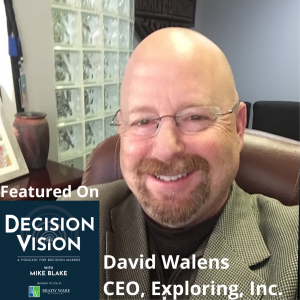
David Walens, CEO, Exploring, Inc.

Dave has over 30 years of experience in developing and growing businesses. His ability to think creatively and strategically and his unwavering commitment to customer service are true differentiators. He has extensive experience in exhibit design and construction, event fabrication, graphic production, flooring production, and project management. This experience, combined with in-depth industry knowledge and expertise enables Dave to assist companies in reaching their strategic marketing objectives as efficiently and as effectively as possible.
Dave has been CEO of Exploring, Inc. for 22 years. He has a degree from Kennesaw State University.
Mike Blake, Brady Ware & Company

Michael Blake is the host of the Decision Vision podcast series and a Director of Brady Ware & Company. Mike specializes in the valuation of intellectual property-driven firms, such as software firms, aerospace firms, and professional services firms, most frequently in the capacity as a transaction advisor, helping clients obtain great outcomes from complex transaction opportunities. He is also a specialist in the appraisal of intellectual properties as stand-alone assets, such as software, trade secrets, and patents.
Mike has been a full-time business appraiser for 13 years with public accounting firms, boutique business appraisal firms, and an owner of his own firm. Prior to that, he spent 8 years in venture capital and investment banking, including transactions in the U.S., Israel, Russia, Ukraine, and Belarus.
Brady Ware & Company
Brady Ware & Company is a regional full-service accounting and advisory firm which helps businesses and entrepreneurs make visions a reality. Brady Ware services clients nationally from its offices in Alpharetta, GA; Columbus and Dayton, OH; and Richmond, IN. The firm is growth-minded, committed to the regions in which they operate, and most importantly, they make significant investments in their people and service offerings to meet the changing financial needs of those they are privileged to serve. The firm is dedicated to providing results that make a difference for its clients.
Decision Vision Podcast Series
Decision Vision is a podcast covering topics and issues facing small business owners and connecting them with solutions from leading experts. This series is presented by Brady Ware & Company. If you are a decision-maker for a small business, we’d love to hear from you. Contact us at decisionvision@bradyware.com and make sure to listen to every Thursday to the Decision Vision podcast.
Past episodes of Decision Vision can be found at decisionvisionpodcast.com. Decision Vision is produced and broadcast by the North Fulton studio of Business RadioX®.
Connect with Brady Ware & Company:
Website | LinkedIn | Facebook | Twitter | Instagram
TRANSCRIPT
Intro: [00:00:02] Welcome to Decision Vision, a podcast series focusing on critical business decisions. Brought to you by Brady Ware & Company. Brady Ware is a regional full service accounting and advisory firm that helps businesses and entrepreneurs make visions a reality.
Mike Blake: [00:00:21] Welcome to Decision Vision, a podcast giving you, the listener, clear vision to make great decisions. In each episode, we discuss the process of decision making on a different topic from the business owners’ or executives’ perspective. We aren’t necessarily telling you what to do, but we can put you in a position to make an informed decision on your own and understand when you might need help along the way.
Mike Blake: [00:00:40] My name is Mike Blake, and I’m your host for today’s program. I’m a director at Brady Ware & Company, a full service accounting firm based in Dayton, Ohio, with offices in Dayton; Columbus, Ohio; Richmond, Indiana; and Alpharetta, Georgia. Brady Ware is sponsoring this podcast, which is being recorded in Atlanta per social distancing protocols. If you would like to engage with me on social media with my Chart of the Day and other content, I’m on LinkedIn as myself and @unblakeable on Facebook, Twitter, Clubhouse, and Instagram. If you like this podcast, please subscribe on your favorite podcast aggregator, and please consider leaving a review of the podcast as well.
Mike Blake: [00:01:15] So, today’s topic is, Should I go back to in-person events? And as we record this show just prior to Memorial Day, we are in what I like to call the trans-pandemic period, where we’re not in the throes of the pandemic hell that we found ourselves in six months ago or in the process of becoming vaccinated. It’s an open question whether or not we’re going to hit the 70 percent vaccination rate that the presidential administration has told us is required to achieve herd immunity. And I’m no epidemiologist. I have no clue if we’re going to get that. But just sort of taking straw polls, I think, we’re probably in the fall just short of that. So be it.
Mike Blake: [00:01:56] But whether we’re vaccinated or not or we reach that vaccination level or not, the floodgates are clearly opening. We’ve had enough. Even introverts like me are stepping out more and are willing to take a little bit more risk than we were willing to take 6 to 12 months ago. And almost, like it or not, things are going back to normal. In fact, at this point, probably the biggest obstacle of things to returning to events – at least trying to sort of daily life, I’ll put it that way. Because events, I think, are a different story – but return to daily life, I think, is simply finding enough people that want to actually work the jobs that are necessary to make those things happen.
Mike Blake: [00:02:37] And, again, I’m not going to enter into that discussion. But we are going to have a podcast on a related topic soon, Should I change careers? Because I think a lot of people have been prompted by the pandemic experience to rethink what it is they want to do with their professional lives and their personal lives. And our relationship with work, I think, for many of us, has forever changed. But, again, that’s getting ahead of ourselves. We have a very good topic in front of us today.
Mike Blake: [00:03:08] You know, opportunities are now opening up left and right. I know that professional events, sporting events are going to, if not full attendance capacity, certainly close to it. I think in my original hometown of Boston, when the Bruins and Celtics continue to play, hopefully the Celtics will just end their season. Bruins are miserable. Well, when the Bruins and Celtics continue their play, they’re going to be in front of something like 85 percent capacity crowds. Fenway Park is going to something similar. I haven’t paid attention to what’s going on in Atlanta, but I think it’s following a similar path. So, we’re going back to this stuff. People are going back to restaurants. I’m seeing in my email box more announcements for in-person events.
Mike Blake: [00:03:57] It’s starting to happen, although I think timidly. And I think the question now begs the asking. Should we be going back to in-person live events? I don’t mean that from a perspective, should we as a society go back to that. That’s not what this podcast is for. And, frankly, I’m not qualified to answer that question and nobody’s asked it of me, so I’m not going to answer it. But I suspect that many individuals are weighing now, is it the right time to go back to these events? Is it the right time to sponsor these events again, host these events? Will people come? Are they going to look exactly like they looked, say, in October of 2019? Are they going to look different? Are we going to have more virtual events? When we talk about hybrid events, what on earth does a hybrid event mean? Is a hybrid event even feasible?
Mike Blake: [00:04:55] And so, you know, right now I frankly cannot think of a more timely topic that is on most business people’s minds. Again, whether we’re an event producer – and Brady Ware just had a a fairly large event, virtual, for nonprofits. And I understand it was very successful, but it was virtual. But, you know, other events now are going to be in-person. And what does that look like?
Mike Blake: [00:05:20] And I’ll kind of end the monologue here with this, is that, according to meetings outlook, the 2021 winter edition, 49 percent of event planners and 42 percent of event suppliers expect in-person event activity to return to pre-pandemic levels by 2022. So, whether your glass is half full or empty, that means that over half of people in that industry expect 2022 to still be down for pre-pandemic levels. And the report was silent on when or if the industry may indeed return to pre-pandemic levels. It may not even be necessarily a desirable thing to do that, at least on a micro basis.
Mike Blake: [00:06:03] So, coming on to talk about this is my friend, Dave Walens, who is President of Exploring, Inc. The parent company of several unique trailblazing Atlanta-based companies supporting the event trade show experiential entertainment and flooring industries. He is also the current president and grand poobah of an organization – which I’ve been involved for several years and is really one of the few organizations I have time for and make time for – CEO NetWeavers. And we’ve had a couple of guests on who have been part of that group as well. So, they account for a big part of the guest quota that we’ve had with this podcast over the last two years.
Mike Blake: [00:06:39] Dave has over 30 years of experience in developing and growing businesses. His ability to think creatively and strategically and his unwavering commitment to customer service are a true differentiator. He has extensive experience in exhibit design and construction, event fabrication, graphic production, flooring production, and project management. This experience, combined with in-depth industry knowledge and expertise enables Dave to assist companies in reaching their strategic marketing objectives as efficiently and as effectively as possible.
Mike Blake: [00:07:07] Exploring Inc. employs almost 180 people and operates in three locations, including a 150,000 thousand square foot fabrication facility, providing uniquely wide scope of capabilities and supported by highly experienced, versatile, and talented team of metal fabricators, sculptors, artists, carpenters, painters, and printers. The rapidly growing company was founded in 1999 and includes ID3 Group, Chisel 3D, Atlantis Waterjet, Brumark, Shelmarc Carpets, and CGI Graphics. Exploring has been named to the Inc. 500/5000 Inc. Magazine’s annual list of Fastest Growing Private Companies in America six times in 2009, 2010, 2011, 2014, 2016, and 2018. Dave Walens, welcome to the program.
Dave Walens: [00:07:51] Well, thank you, Michael, in probably the longest intro ever.
Mike Blake: [00:07:55] Well, I talk fast. I’m at least old enough to remember the FedEx fast talking guy. I remember him so I can learn how to talk like him. But, you know, maybe it’s a long introduction, but I think it’s a worthwhile introduction because I think it establishes your expertise in the space. And, you know, our listeners don’t have time to listen to amateurs. There are plenty of podcasts that already do that. We need to listen experts and you’re one of those. So, again, thank you for being generous with your time and coming on today.
Dave Walens: [00:08:23] You bet, Mike. And thanks for having me, man.
Mike Blake: [00:08:25] So, we talked about what your company does. I’m sure you’re going to kind of sprinkle that over the course of the discussion. So, I’m going to kind of cut right to the chase. I mean, 2020 must have been an absolute brutal year for you guys. And if I’m right or if I’m even half right, I’d love to know how you guys survived it.
Dave Walens: [00:08:48] Well, great question to start out with. As a great entrepreneur that I think I am, I actually got even better during the pandemic because I learned how to run a company with no sales. That’s pretty impressive.
Mike Blake: [00:09:01] Yeah. I didn’t know that could be done.
Dave Walens: [00:09:03] Neither did I. So, frankly, it was a very, very difficult year. 2020 shut down the convention industry. Obviously, the event industry. We were the first industry to close. And, frankly, we’re going to be the last industry probably to open as trade shows aren’t really officially opening even yet. But we have survived it and we survived it for several key reasons.
Dave Walens: [00:09:27] One is, really, the mental fortitude that you have to have as an entrepreneur and changing to meet current needs. And that really was the core of our whole company and our employees is, really, that mindset. And we’ve just had a great team that came together and did whatever it takes to find paths to get through this thing. And we’ve done some very, very creative and unique ways to get through it. And I couldn’t be more proud of my executive management team and my management team to make it happen.
Dave Walens: [00:09:53] And, fortunately, we were really busy and the industry was super busy in the first quarter of ’20. And because of that, it helped us get to some benchmarks throughout the year to where we had cash flow to help us get through some of the worst times until PPP kicked in. So, to be very specific, if it wasn’t for that, this industry, the trade show industry and event industry, may not have survived. Not like it’s going to be.
Mike Blake: [00:10:19] So, you know, now we’re here. As I said, we’re here at the end of May, trans-pandemic period. What are you hearing? What are you sensing? What are you seeing in terms of the public’s interest in going back to live events right now?
Dave Walens: [00:10:34] First of all, I would look for facts in the marketplace that indicate what’s the appetite for folks to go back to live events. And, fortunately, we’re right here in Atlanta where we’re watching Van Gogh open up last week. And, fortunately, our ID3 Group was the builder of Van Gogh, so we got to partake in this. Actually, they’re sold out until August already. They’ve sold over 200,000 tickets and hard to find them. And attendance has been outstanding. So, those are the facts that I look for. So, every event that I have seen or witnessed has seen tremendous participation. That’s an awesome sign.
Mike Blake: [00:11:17] Now, what about among the event planners and sponsors and hosts, are they equally chomping at the bit to kind of get back to this thing?
Dave Walens: [00:11:29] Yeah. I think they are. We’re seeing it because many of them switched to stay connected to their customers. The event producers, if you will, the ones who own the show, want to make sure that their customer base was able to see their customers so they went to virtual events. And doing these virtual events was great. But it was just one element. And there was a real missing component of that interaction. And I think that’s the outcome of the virtual events, it connected a lot of people but, frankly, lost that human touch, that interpersonal touch that we really crave. So, when the opportunity started to come back, I think these event producers were clamoring to get back face-to-face and they found ways to do it.
Mike Blake: [00:12:15] And I’m curious, I rattled off a statistic before we started the formal interview. But it seems like more people in your industry now think that this year and maybe next year are going to be transition years. And maybe 2023, if we go back to the normal or if we achieve the new normal, that’s going to be the timeline. Do you share that opinion or do you differ from that?
Dave Walens: [00:12:41] I think I differ just a little bit from that, Mike. What I’m seeing is choppiness through the summer. As trade shows start to open, they’re opening up very conservatively with expectations. I mean, you’ve got to remember, many of these shows have canceled. And what’s happening is they’re rescheduling for summer, that typically were in the winter or even the spring. As they move to different parts of the year, attendance is going to be lower. They’re going to be spottier. You’re not going to have the back to back shows. They’re going to be smaller. I’m sure all that’s going to take place. But they are opening and they are committing to go face-to-face.
Dave Walens: [00:13:14] What that means is, I think, we’re really going to see things come back fourth quarter. So, summer will be choppy. Third quarter will start to build up. But a good stake in the ground is CES, which is opening in January, which is typical of where it always is open. And that is the largest trade show in our country. And I think that’s the one that I’m looking at most closely to be an indicator of where things are to come. So, if we get back fourth quarter, then 2022 should be a very, very good year.
Mike Blake: [00:13:41] I did not know that CES was the largest trade show in the country. I mean, I knew it was big, but I had no idea that it was the largest. And I agree that probably will be a very good barometer, especially because with CES, that’s actually a trade show that has the kind of content that actually is more easy to deliver virtually than others. You don’t necessarily have to have people in a room to show a demo of a video game, for example. So, if people are coming back in droves, then I agree with you that that is going to be the leading indicator.
Dave Walens: [00:14:16] Yeah. And I think CES is going to be well-attended this year, I think people cancelled last year. So, think about all the technology changes that have happened over this past year. This is the debut of the show. And I think people haven’t been able to go to Las Vegas. There’s a lot of new things in Las Vegas, including the convention center. So, there’s a lot of compelling reasons why people are going to want to travel. I know the dangers and the health issues, but I think they’re going to be overcome by the protocols that are being done by these shows that are being very careful. And I think they’re going to really have a great attendance. And if that happens, I think it’s going to pave the way for a very good 2022.
Mike Blake: [00:14:54] So, when I start going back to live events – and I’m pretty sure that’s going to happen this year for me, even if I’m on the conservative side – am I going to see something different? How are those events are going to look different when I walk in as opposed to what I remember being involved in back in ’19?
Dave Walens: [00:15:13] You know, I think they’re going to be different. I think people are going to look at them a little bit more conservatively, strategically. And I also think you’re going to see a lot of hybrid and live combined. So, one thing we learned about the hybrid event is we’re able to touch more people. So, we could actually communicate to a lot of people at a company because they’re obviously not paying the travel expense. However, when you’re able to do these live events, I think it’s like a combination of those two things happening, where content will be available to you even after that show, long after that show for a majority of people.
Dave Walens: [00:15:45] Which means the way that we communicate on the show floor will absolutely change. And I think things don’t necessarily have to be as large and as complicated and perhaps as complex. And I think there’ll be more storytelling being done and brand building than there will be just showing up to say, “I’m coming to this trade show. I’m going to show my products.”
Mike Blake: [00:16:07] And I think that’s a good thing. You know, as somebody who does his fair share of public speaking in some format or another, the one thing that I’ve long regretted and have never found a good solution for was to solve the perishability problem. I take the time to put a presentation together. I think I do a pretty good job. And then, it’s just gone. It perishes instantly. And you haven’t seen me in some of these things. I mean, I’ve tried so many contraptions and setups and weird things to try to capture what I do, you know, with an iPad or an iPhone or something. And it’s been both cumbersome and just bad outcome.
Mike Blake: [00:16:52] I think that as a content provider, one, I will appreciate if there’s sort of a default setting where there’s going to be something to capture my content that can live on. And that, to me, also says that it’s an opportunity to scale the business model because you don’t have to just serve the people that are out there on site. Am I crazy or have I gotten a bunch of stuff wrong in that sense?
Dave Walens: [00:17:14] No. You got a lot of things right in that sense, Mike. I mean, that’s exactly what you’re going to do. And that’s why you’re going to look at these trade shows and events just differently, because you could touch your customer in different ways and it lives on. So, you think about now capturing all your presentations in your live presentations in a way that has a lifespan that is endless. So, yeah, you really can look at how you approach this much differently.
Dave Walens: [00:17:41] And, frankly, how you justify it. I mean, it’s an investment of your time and your money, and that’s the other part of it. The return on your investment is going to be even wider and probably more effective. So, you’re going to want to go to maybe more events than you ever thought about, or more trade shows, or do more public speaking because you’re able to monetize that even better.
Mike Blake: [00:18:00] So, let’s look at this from the corporate side. You know, I’m a partner in a CPA firm, which means, you know, we’re really good accounting dollars. The jury is still out. We’re really good at making them, but we’re certainly very good at counting them. And, you know, there’s an argument that I’m sure some people are making or some businesses are making. I’m not necessarily making it, but it’s being made, I’m sure. Look, we got what we needed to get out of 2020, mostly education for our people. It was a lot less expensive. They didn’t have to be out of the office. They didn’t have to pay for travel. They didn’t have the time disruption of travel. You know, what have we missed and we need to get back by being forced into an all virtual environment? What’s waiting for us on the other side?
Dave Walens: [00:18:56] And I think that all goes back to human interaction and really being able to get to know people and get to understand people at different level than doing it over Zoom. You can never really achieve that. In fact, I would suggest people are really moving more to fatigue on Zoom. And they are truly finding it as a good experience and a positive experience. So, I do think it’s just another tool. And what is missing is just that human interaction. It’s just needed. Flat out needed.
Dave Walens: [00:19:26] And I will go on the record right now telling you that, if you’re not traveling to see your customers today because, frankly, some customers won’t let you come see them. But the second your competitor goes and flies and meets a customer face-to-face and you don’t, you tell me how fast you’re going to jump on a plane to go meet with your customer face-to-face. It’s the cycle. It’s going to happen.
Mike Blake: [00:19:51] So. I think I know the answer to this question, but I don’t want to assume. So, are hybrid events, in your mind, are they going to be a transitional step or is that going to be kind of part of the new normal? The new outgrowth is that there’s a role for digital play in these things and they’re just going to ride shotgun with one another.
Dave Walens: [00:20:12] I’m glad you said the word digital this time than virtual. From our industry as designers and producers of experiences and trade shows, we’re really turning into content producers and storytellers. And as content developers, we have to understand that market now better than anything to help brands achieve their goals. So, this is just one element. And what we’ve learned through content development now has a lot of legs. I mean, we could create movies around the content we’re building or, you know, video podcasts, whatever we want to do. But we better be good at that as well as building physical structure. So, if we’re going to help the brand the best way, then we have to know all elements of this marketplace.
Mike Blake: [00:21:01] And it’s interesting, I hadn’t thought of that. But I think I completely agree with that, that the core competencies, I would imagine, and people of your industry – participants in your industry, I think are going to need to evolve. From what I have seen – again, I haven’t worked in your industry behind the scenes of your industry is that, there are people on the physical events and then there are the people that do the audio, video, take the footage and whatnot, but they’re almost sort of parallel.
Mike Blake: [00:21:38] From my observation, you only talk to each other when you need to make sure you’re not stepping each other’s extension cord, basically. Or not going to screw up their WiFi, basically. I imagine that in the operational model, that’s no longer the case. You either have to be able to closely collaborate with each other or maybe you even just own those capabilities all in-house.
Dave Walens: [00:21:55] Yeah. Absolutely. But I’ll take that maybe even a little step higher, Mike, and go back to the customer. So, the customer is the one that we really got to focus on. And when a customer has got complications between going through virtual or digital content and physical content, really, what it is, is helping the brand achieve what it’s doing. And it lives in the hands of the customer.
Dave Walens: [00:22:17] As we learn more about it, it goes back to the fact that as designers and builders of environments, we may not have known much about graphics in the early days. We had to learn. We didn’t print them ourselves at the time, now we do. But we needed to know about it as well as a printer did, whether it be LED, whether it be whatever content that we’re dealing with, we have to know it.
Dave Walens: [00:22:38] In this case, we’re really helping the brand achieve its goals. That’s really what’s happened. And that lives in the hands of the customer. So, knowing how to work and manage that content is the important part in executing it. Not every one of these exhibit companies are going to be experts in content management. But they’re going to have resources at their fingertips so a customer has to go to one place rather than two. And that is a big time saver for a customer.
Mike Blake: [00:23:01] I’m curious in terms of what it’s going to take to put events together. I infer from what you’re telling me, they’re going to be more complex because the customer is asking you to do more, whether directly or indirectly. Are events going to be more expensive to put on? Or maybe they might be less expensive initially because fewer people are going to attend them. I can see an argument. Maybe there’s no impact whatsoever. I’m curious, just in terms of the cost structure, are events going to be more expensive to put on and, therefore, by extension to attend?
Dave Walens: [00:23:34] I have a feeling they’re going to be more expensive, to be honest with you. I’m starting to watch some of the data out there. The way that you participate in the show, there are some rates that are proposed by – in our industry called – the general contractor. And those rates are paid for by the exhibitors. And we’re already seeing those costs escalate a little bit surprisingly. But I think they’re anticipating smaller spaces initially. So, they have to generate revenue so their costs are a bit higher. We’ll see what happens in the long run. But I think you’re going to see an escalation in that.
Dave Walens: [00:24:09] And, of course, then you’ve got ruggedized issues and you’ve got supply chain issues that are driving up costs. So, for us as builders, we work a lot in wood. You know what’s happened with wood prices over this past year. They’ve gone up over 300 percent. And just about all raw materials have gone up. So, I think you are going to see an increase in cost. However, I think it’s going to be offset by the return that you get. And that’s where I think this industry, frankly, from my side of the table, suppliers to an exhibitor, that we have an opportunity of resetting to doing all the things that we were doing wrong, to now do them right. And eliminate cost overruns and things that were in the way before that we can now find ways to justify it and bring our value. So, that’s the opportunity.
Mike Blake: [00:24:56] So, I’m glad you brought that up, because this gets into really, frankly, one of the questions I was most looking forward to asking you, which was, from the pandemic experience – and I’d love you to think about this as broadly as possible, because I think there could be a very broad answer that will bring some insightful things to the fore – what in your mind have you – or if you want to be broader, you guys in your industry – learned from the pandemic? And how are some of those things learned going to be evident in the events that you produce and we’re going to start to attend later this year and forward?
Dave Walens: [00:25:36] Well, one thing that I think our industry learned by being truly shut down is that overhead will destroy you. And our industry is based on large spaces to accommodate building large exhibits. So, we all have a very big footprint to do what we do. You heard I’ve got 150,000 square foot facility, one of them just to do the work that we do. Building overhead will be a change in the minds of these business owners from here on out. That they’re going to have to find alternative ways not to build overhead.
Dave Walens: [00:26:12] And I think that then changes the model for them to look to be more marketing based. Go back to the content marketing base, working with brands and a marketing solution. Then, actually making the actual physical components that they could strategically work with others to build them. And let them really work with the brands to make sure they’re done right. So, I think there will be a reset in this industry of getting smaller, leaner, smarter about the things that we do because we’ve experienced the worst.
Mike Blake: [00:26:42] And it sounds like – and please correct me if I’m putting words in your mouth – the way I distill what you just said is, in a way, getting back to basics. What is the core value of what you actually deliver? And maybe building an exhibit, although a nice thing that you can offer, maybe that isn’t necessarily core to the value. Is that fair to say? Or am I going too far?
Dave Walens: [00:27:04] No. I think that’s a bit fair to say. I mean, I think where we used to differentiate by how we built something, you know, I built it better than you built it. Today, it’s about the outcome of the piece that we build. How is that story being told in your lobby, in your event, at your trade show? The outcome of that is the most important part. There’s no concern if I made it out of one material or another anymore as long as it looks like what you wanted it to look like. But if the story is told right, that’s the power of that execution and there’s the value. And that’s what we need to focus on.
Mike Blake: [00:27:37] So, it’s not necessarily about how you build it, but really why you built it.
Dave Walens: [00:27:41] That’s right. That’s exactly right.
Mike Blake: [00:27:43] And I like that. I think that’s a lesson that actually can be taken beyond just your industry, right? Going back and taking a step back, why are we doing this? Why does the customer want it? And then, that can help you rethink, is this the right or the necessary path to get there?
Mike Blake: [00:28:02] So, you answered the question one way in terms of how you run your business, which is great, is instructive. But I’m also curious, are there any lessons that you learned in terms of actually executing the event itself? Anything that you or others you think have learned from the pandemic that are going to impact simply the way that you execute on what you already do?
Dave Walens: [00:28:26] So, my seat is a little bit different, so we’re a supplier to those designers and builders of environments. So, I work with design build firms, event marketing companies, architects. So, yes, every one of those folks are approaching this much differently. And even we are about how we look at building an environment. And, you know, cost is a big issue now. So, we’re having to figure out creative ways to meet a need and finding new techniques and new materials to actually achieve what the design intent is.
Dave Walens: [00:29:00] But I will say this, the entire economy is moving to an experiential economy. People want to have a story told. And they want to know the brand has a message to them when they go and do it. And that’s the biggest piece of all. And we’re finding and we’re seeing that happen across the country right now with some very unique things that are opening up. Van Gogh is one of them, and I doubt that. But Meow Wolf is another one you may be familiar with. They’re out in New Mexico, they just opened up in Las Vegas. It’s a grocery shopping tour of the experiential type. It’s really an art exhibition more so than anything else.
Dave Walens: [00:29:33] You’re seeing a lot of these shows that are coming to fruition and it’s all about just telling the story. Malls are changing, that’s a good example of that as well. What’s happening inside of malls? With Animal Planet as an exhibition opening inside a mall. All sorts of things that really are taking what traditionally would be just standard graphic on a wall and really telling a whole story.
Mike Blake: [00:29:59] Is there any concern in your industry that some segment of the population is just not going to come back to live events? And I’m sure there’s a number, I just don’t know how big that is. In your mind, is that something that’s of concern to you that some people are just never coming back because they’ve just been so impacted almost to a PTSD level of the pandemic? Or do you think that’s just not going to be enough to move the needle for your industry?
Dave Walens: [00:30:32] No. That’s a huge concern, to be honest, Mike. Not so much individuals themselves because I don’t think there’ll be enough to move the needle. But when you have Google and Facebook and Apple telling their employees not to go to a show or we don’t want you to go to a show, that is devastating. Or we don’t think we need to do it, not because of even health issues, but the pandemic has showed them we could figure out other paths since we couldn’t do the events and go to trade shows, we’ll find an alternative way to do it. That’s very concerning. And, also, it’s also the opportunity. Because they’ll never not touch their customer. They will be face-to-face with their customer at some point. It may not look like a trade show or an event like we’re used to, but they’ll find that out.
Mike Blake: [00:31:18] Yeah. I think that’s right. You know, with things like these disruptions, it’s rare that the thing that’s disrupted goes away. It often is forced to adopt a different model. Even right now, taxis have not gone away with Uber and Lyft, but they have changed what they do and they’ve changed their value proposition.
Mike Blake: [00:31:41] I’m going to put on my amateur lawyer’s hat now. What could possibly go wrong with that? But, you know, I do wonder kind of about liability. And I wonder if this conversation has come up with you or in your circles at all. And interestingly enough, as I was preparing for this podcast, I read an article yesterday that the WWE folks, the folks that put on the “totally real wrestling matches” are making their attendees sign a waiver form that if they get sick by being in an event that, you know, you can’t come back and sue them. Is that a concern? And is that something that folks in your industry are taking a look at?
Dave Walens: [00:32:23] Absolutely. Look, liability, in my opinion and that’s my own personal opinion, is the reason that it’s taken so long for live events to come back. And I have been fortunate enough in my industry, I early on jumped on to really trying to help my industry and partnered virtually with two of our biggest players in the industry, Czarnowski and George P. Johnson. And we started what is called Live for Life, where we pull together people in our industry to help solve the temporary hospital issue.
Dave Walens: [00:32:56] We’re all shut down. We didn’t have any work at hand and we turned all of our attention to helping our communities. And so, what better workforce than obviously our trade show world that was used to making these temporary environments. And all of that became the liability issue at every turning point. And because of that, also, we got a privilege to sit in the forefront as things developed and how we were going to get over that liability. So, the protocols that were put in place with GBAC, which is a certification in the cleaning of these environments. And every single convention center or most convention centers have been certified through this GBAC.
Dave Walens: [00:33:38] Or putting in infrared and thermometers at locations and how we were going to have apps that actually trace people through an environment, making sure they were safe to go in. A program called Clear To Go – which in fact, my nephew developed the software to that – so that you tested at home, you came to an environment, you check in, you check out. All these protocols are put in place to minimize liability. It will never eliminate liability. And I haven’t seen it yet eliminate liability. But that is the biggest concern.
Mike Blake: [00:34:12] Yeah. You know, liability is sort of a particular part of the American way of life, right? So, you know, it’s just going to be ever present. That’s just the way that our society is now constructed. And there’s nothing you or I really can do to stop that. All we can do is try to work around it.
Dave Walens: [00:34:34] None of us want to be sued, and that’s really what this comes down to.
Mike Blake: [00:34:38] That’s exactly right.
Dave Walens: [00:34:39] This is a business and you were playing attorney, so I know that’s where you were going with it. But for us, as a company, we can’t afford to have that happen. And that’s the problem. It’s not that someone’s going to get sick. That, I don’t think is the issue. People are going to get sick. But it’s not going to be put in and be sued because you were allowed to be on the show floor or an event or a live event. That’s the problem.
Mike Blake: [00:35:03] So, I want to bring up another part of the value proposition of live events I’d like to get your reaction to it. This doesn’t get talked about a lot, but I think it’s more important. I think it doesn’t get talked about a lot because it’s not as polished and corporate from an outside perspective. But the reality is that, being able to send certain people to events is a form of compensation. And it’s a form of professional recognition. And I’ll use the word boondoggle. You may not, that’s fine. I don’t expect you to.
Mike Blake: [00:35:46] But the simple fact of the matter is that, a traditional way that companies have shown their appreciation for certain employees to retain them, to give them sort of non-compensation compensation is, “Hey, there’s this trade show in Vegas. Why don’t you go for this weekend and take your wife and so forth and we’ll write it off. You come back with some business cards, that’s great.” You know, I do think that’s also something that needs to come back. And if companies are thinking they can chip out and stop and sort of try to put an end to or discontinue that practice, they’re going to find out the hard way. They’re going to lose some very key people, because that is a consideration. That is a way that you make employees feel appreciated.
Dave Walens: [00:36:29] Absolutely. And no doubt about it and good point. I mean, that’s strategic, I mean, it’s cheaper to bring your sales team together and put them to good work at a trade show than it is to have a separate sales meeting. So, doing it around a trade show makes a lot of sense and the perk of doing that. So, I agree with you.
Dave Walens: [00:36:48] But I’ve actually seen that firsthand, Mike, through not a trade show, but at our industry event which was in San Antonio in December of this year. And interestingly enough, I was really surprised to see how many people showed up in our industry, in a very small industry, who were shut down. I’ll remind you of that, we were not working. And we still had over 100 people to show up at that meeting. That was a testament to that exact statement. They came out because they felt they needed to and it was part of the perk, just part of their core makeup, and they just made it happen. And it was surprising.
Mike Blake: [00:37:24] Yeah. And, look, there’s nothing wrong with that, right? As long as at least in the business you understand the decision that you’re making. I think that’s fine if businesses want to do that. But it’s interesting that I don’t see it talked about a lot, as if people don’t know that that goes on, which is kind of interesting. But, again, I do think a company that thinks they can cut out this kind of commerce travel, just on that basis alone, is making a mistake because a competitor that is sending people to those events are going to look a lot more attractive in terms of being an employer.
Mike Blake: [00:38:05] So, my impression, based on what I read is that, while we are working our way through the pandemic and I think most of us feel more secure doing things we did not feel secure doing some time ago, we’re still concerned about flare ups. There seems to be a new strain of the month and whatnot. And we don’t know what the vaccination scenario is. And it seems pretty clear that, at least in the United States, we’re not going to have these vaccination passports. There’s no way a conservative Supreme Court is going to approve that. Either that or other than that, I just don’t know politics.
Mike Blake: [00:38:45] But, you know, flare ups can kind of happen. I think something that could kill a conference forever is to, all of a sudden, be another one of these infection vectors. We hear about the wedding in Maine, or the funeral in Georgia, or something, or the biotech conference in Boston. That was the big one that actually launched this whole thing in North America. You don’t want to be that conference. That is the infection vector. Because I don’t know that as a conference, you could ever recover from that. In your mind, how do you just protect against being complacent that, you know, we see the light at the end of the tunnel, but we’re not through the tunnel yet.
Dave Walens: [00:39:32] Well, instead of the word complacent, I would put the word confident rather. I really do. And I think everybody, just like you, will find when they feel comfortable and confident to start traveling and going to these events, whether they’re local or whether you’re going to have to jump on a plane and go. Let’s be honest, if we follow the science, it’s confusing. If we follow the politicians, it’s confusing. If we try even to follow the facts, it’s confusing. So, it’s our own facts and our own mind that we have to make up what’s justifiable.
Dave Walens: [00:40:09] I’m an entrepreneur. I take risks every day. Way bigger risks just working and driving and the things that I do that I just didn’t feel the risk that I would take in certain environments make it uncomfortable for me. I justified it. Does it make it right or wrong? No. It’s just what I was able to handle.
Mike Blake: [00:40:28] It’s right for you.
Dave Walens: [00:40:30] Right. And that’s what I tell people, “If you have the confidence.” You know, I read a report yesterday that said, if you had coronavirus, you have the antibodies. Although we’ve been told it may only last three months. Now, they’re coming out saying it’s actually better than the vaccine and it’s for your lifetime. You never have to have a vaccine and have to go through it again. Who’s to know until it happens again? Until we get sick again? But we can’t stop living. And that’s just where my line is drawn. And I feel like if I could build enough confidence where people will take it a little bit of a risk, then maybe it’s worth it. But it’s all about individual choice. And that’s the beauty of where we’re at. I let people see for themselves what feels comfortable for them.
Mike Blake: [00:41:17] We’re talking with Dave Walens, CEO of Exploring Inc. And the topic is, Should I go back to in-person events? A couple more questions I’d like to cover before we let you go and start planning and keep planning those events that you’re working on. But one question I’m curious about is the international angle. International travel is much slower to recover, for good or ill that’s just the way it is. Europe says they might open to U.S. traffic sometime this summer. But they haven’t committed to that. Frankly, I have not followed what the U.S. stands on. I haven’t heard any definitive word from the Biden Administration.
Mike Blake: [00:41:58] Is that putting a damper on events right now? Are there plans or maybe some live events that have traditionally been international in nature and may be duplicated and localized? What’s the strategy or response to that? Or even to your mind, is there a strategy or response to that?
Dave Walens: [00:42:13] No. There absolutely is a strategy around that. And, yes, it is having an impact on attendance and exhibitors. And, frankly, I think the owners of these shows are having to work around that and find what’s the best way to approach the show, which means they may go smaller. That’s where we go back to how are they going to survive? Well, maybe they take less square footage and commit to that, knowing that a percentage of their exhibitors and attendees are international.
Dave Walens: [00:42:41] And, no, they shouldn’t plan for it. I mean, you’re an accountant, it’s kind of that zero based projection. And we’re going to plan for zero. And if we get any, we’ll incrementally benefit from it. If they’re planning to have them come, they’re going to be sorely missed because they probably won’t be showing up. And so, we’ll see perhaps some or fourth, and that’s where I say fourth quarter by the time it really wraps in. And it’ll be a gradual increase so we’ll see it coming. But if you’re not planning for them not to show up, you’re making a mistake, in my opinion.
Mike Blake: [00:43:11] So, one thing I was thinking about – and I could be completely off base, so if I’m wrong, you’ll tell me – it seems to me that events are part of or at least adjacent to the hospitality industry. And their struggles in terms of just finding people to staff are well-known and well-documented. I’m curious if your industry is facing similar challenges. And if so, how are those challenges going to be felt at events and your ability to to put them on?
Dave Walens: [00:43:43] Probably the number one issue for our industry right now.
Mike Blake: [00:43:46] So, I guess strike. Good.
Dave Walens: [00:43:48] Thanks for the question. In all honesty, if you really think about this, our industry is primarily made up of entrepreneurs, business owners. And most of them are owner operators. And the only way they survive this pandemic is by getting back to the basics of a handful of people, perhaps just themselves or one other person. So, their workforce has been decimated. And our employees were furloughed and laid off. And as I said, our industry still is not open. We’re at 10 percent. Restaurants never hit this level. Our workforce is absolutely been crushed. Our skilled labor has gone. Our project managers, our sales teams, gone. There’s no one to sell to unless they moved in to new areas like virtual events. But for the most part, it’s all going to have to be built back, which is going to take a toll.
Dave Walens: [00:44:40] I think we’re all projecting issues to happen because of that. On the show floor, hard to get people and hard to get enough people to fill the demand that’s starting to happen. And we’re seeing that specifically on projects that we’ve actually closed up outside of the trade show world. But some traveling exhibits, some permanent installations, and hospitality projects that we’re working on. And it’s just going to be a challenge getting back a workforce, especially a skilled base, high talent, the carpenters and the welders. They’ve all found work in the housing industry, which has exploded, or construction overall.
Mike Blake: [00:45:18] So, Dave, this has been a great conversation. And, you know, as an aside for the listener’s benefit, this conversation sort of has an interesting side dynamic, in that, Dave and I serve on the board of CEO NetWeavers. He’s the executive – not the executive director. He’s the president and I’m the head of the Events and Speakers Committee. And so, we’re going to be having a conversation internally in our board in the next couple of weeks about moving to in-person events as well. As it happens sort of lays the groundwork. But I say that for the benefit of our listeners, because this is an actual conversation that’s going on in an organization that he and I are both stewards of at the moment. And it just goes to underline the real practicality of it.
Mike Blake: [00:46:05] You know, Dave, you’ve got a lot of information. We couldn’t cover everything in one hour. We never do. But if somebody wants to ask you about information, you know, about attending events, hosting them, sponsoring them, participating in some way, can they do that? If they want to ask you something we didn’t talk about, say, want to go in more depth. And if so, what’s the best way to do that?
Dave Walens: [00:46:26] Absolutely, Mike. Good or bad, I’m always available. I would suggest emailing me. And, Mike, I got to clarify one thing for you. You have called me Walens the entire conversation, and COVID has caused that, because it’s actually Walens. But every single one of them, from friends to family, have called me Walens. Don’t ask me why for 2020. But it is actually dwalens@exploring.com is my email address, that’s D-W-A-L-E-N-S@exploring.com. Instagram, it’s drwalens. And you’re welcome to follow me or any of our companies, exploring.com is our main website for the parent company. You can get to all our brands through that and you see other things that we’re producing. So, I’m very accessible and I welcome you to connect at any time. I’d be happy to share more.
Mike Blake: [00:47:19] All right. Well, there you have it. There’s Dave Walens, who has been the victim of the COVID long A. But I would like to thank Dave so much for joining us and sharing his expertise with us today.
Mike Blake: [00:47:29] We’ll be exploring a new topic each week, so please tune in so that when you’re faced with your next business decision, you have clear vision when making it. If you enjoy these podcasts, please consider leaving a review with your favorite podcast aggregator. It helps people find us so that we can help them. If you like to engage with me on social media with my Chart of the Day and other content, I’m on LinkedIn as myself and @unblakeable on Facebook, Twitter, Clubhouse, and Instagram. Once again, this is Mike Blake. Our sponsor is Brady Ware & Company. And this has been the Decision Vision podcast.