Business RadioX ®

  • Home
  • Business RadioX ® Communities
    • Southeast
      • Alabama
        • Birmingham
      • Florida
        • Orlando
        • Pensacola
        • South Florida
        • Tampa
        • Tallahassee
      • Georgia
        • Atlanta
        • Cherokee
        • Forsyth
        • Greater Perimeter
        • Gwinnett
        • North Fulton
        • North Georgia
        • Northeast Georgia
        • Rome
        • Savannah
      • Louisiana
        • New Orleans
      • North Carolina
        • Charlotte
        • Raleigh
      • Tennessee
        • Chattanooga
        • Nashville
      • Virginia
        • Richmond
    • South Central
      • Arkansas
        • Northwest Arkansas
    • Midwest
      • Illinois
        • Chicago
      • Michigan
        • Detroit
      • Minnesota
        • Minneapolis St. Paul
      • Missouri
        • St. Louis
      • Ohio
        • Cleveland
        • Columbus
        • Dayton
    • Southwest
      • Arizona
        • Phoenix
        • Tucson
        • Valley
      • Texas
        • Austin
        • Dallas
        • Houston
    • West
      • California
        • Bay Area
        • LA
        • Pasadena
      • Colorado
        • Denver
      • Hawaii
        • Oahu
  • FAQs
  • About Us
    • Our Mission
    • Our Audience
    • Why It Works
    • What People Are Saying
    • BRX in the News
  • Resources
    • BRX Pro Tips
    • B2B Marketing: The 4Rs
    • High Velocity Selling Habits
    • Why Most B2B Media Strategies Fail
    • 9 Reasons To Sponsor A Business RadioX ® Show
  • Partner With Us
  • Veteran Business RadioX ®

Alpharetta Tech Talk: Matthew Thomas, City of Alpharetta

November 16, 2019 by John Ray

Alpharetta Tech Talk
Alpharetta Tech Talk: Matthew Thomas, City of Alpharetta
Loading
00:00 /
RSS Feed
Share
Link
Embed

Download file

“Alpharetta Tech Talk” Host John Ray and City of Alpharetta Economic Development Manager Matthew Thomas

“Alpharetta Tech Talk,” Episode 3:  Matthew Thomas, City of Alpharetta

Matthew Thomas, Economic Development Manager of the City of Alpharetta, joins “Alpharetta Tech Talk” to discuss the roots of Alpharetta’s thriving technology sector. “Alpharetta Tech Talk” is hosted by John Ray and broadcast from the North Fulton Business RadioX® studio inside Renasant Bank in Alpharetta.

Matthew Thomas, City of Alpharetta Economic Development

Matthew Thomas

Matthew Thomas is the Economic Development Manager for the City of Alpharetta.

There’s a reason why more than 640 technology-based businesses have made their home in Alpharetta, and it’s not just the nice houses and great weather. The city’s fiber-optic network is the most extensive and redundant in the Southeast, and they work closely with state and local economic development agencies to provide tax credits and incentives to complement any brand of business. Some of the biggest and most recognized names in the tech industry are thriving in Alpharetta. With more than 20 million square feet of office space, there’s plenty of room in the neighborhood for you next expansion.

The City of Alpharetta has been recognized nationally in a variety of awards and rankings, including Best Small City to Start Business (Entrepreneur.com), Best Atlanta Suburb (Movoto), Top 25 Best Places to Move (Forbes), 7th Friendliest City (Forbes), and 6th Fastest Growing City (U.S. Census, 2012).

For more information, go to GrowAlpharetta.com, or call 678-297-6024.

About “Alpharetta Tech Talk”

“Alpharetta Tech Talk” is the radio show/podcast home of the burgeoning technology sector in Alpharetta and the surrounding GA 400, North Fulton, Roswell, Johns Creek, and South Forsyth area. We feature startup entrepreneurs, executives of larger enterprise companies, and other key technology players from a region with over 900 technology companies.  “Alpharetta Tech Talk” is hosted by John Ray and originates from the North Fulton Business RadioX® studio inside Renasant Bank in Alpharetta.


“Alpharetta Tech Talk” is broadcast from the North Fulton studio of Business RadioX®, located inside Renasant Bank in Alpharetta. Renasant Bank has humble roots, starting in 1904 as a $100,000 bank in a Lee County, Mississippi, bakery. Since then, Renasant has grown to become one of the Southeast’s strongest financial institutions with approximately $12.9 billion in assets and more than 190 banking, lending, wealth management and financial services offices in Mississippi, Alabama, Tennessee, Georgia and Florida. All of Renasant’s success stems from each of their banker’s commitment to investing in their communities as a way of better understanding the people they serve. At Renasant Bank, they understand you because they work and live alongside you.

Tagged With: economic development, economic development in Alpharetta, eSports, FinTech, GA 400 technology, Matt Thomas, Matthew Thomas, North Fulton technology, Tech Alpharetta, Tech in Alpharetta, tech talk, technology GA 400, technology in Alpharetta, technology in Johns Creek, technology in North Fulton

Inspiring Women, Episode 15: Being Politically Savvy

November 16, 2019 by John Ray

Inspiring Women with Betty Collins album cover
Inspiring Women PodCast with Betty Collins
Inspiring Women, Episode 15: Being Politically Savvy
Loading
00:00 /
RSS Feed
Share
Link
Embed

Download file

Inspiring Women with Betty Collins album cover

Being Politically Savvy

How do you successfully navigate office politics? On this edition of “Inspiring Women,” host Betty Collins discusses the skills needed to be politically savvy. “Inspiring Women” is presented by Brady Ware & Company.

Betty Collins, CPA, Brady Ware & Company and Host of the “Inspiring Women” Podcast

Betty Collins, Brady Ware & Company

Betty Collins is the Office Lead for Brady Ware’s Columbus office and a Shareholder in the firm. Betty joined Brady Ware & Company in 2012 through a merger with Nipps, Brown, Collins & Associates. She started her career in public accounting in 1988. Betty is co-leader of the Long Term Care service team, which helps providers of services to Individuals with Intellectual and Developmental Disabilities and nursing centers establish effective operational models that also maximize available funding. She consults with other small businesses, helping them prosper with advice on general operations management, cash flow optimization, and tax minimization strategies.

In addition, Betty serves on the Board of Directors for Brady Ware and Company. She leads Brady Ware’s Women’s Initiative, a program designed to empower female employees, allowing them to tap into unique resources and unleash their full potential.  Betty helps her colleagues create a work/life balance while inspiring them to set and reach personal and professional goals. The Women’s Initiative promotes women-to-women business relationships for clients and holds an annual conference that supports women business owners, women leaders, and other women who want to succeed. Betty actively participates in women-oriented conferences through speaking engagements and board activity.

Betty is a member of the National Association of Women Business Owners (NAWBO) and she is the President-elect for the Columbus Chapter. Brady Ware also partners with the Women’s Small Business Accelerator (WSBA), an organization designed to help female business owners develop and implement a strong business strategy through education and mentorship, and Betty participates in their mentor match program. She is passionate about WSBA because she believes in their acceleration program and matching women with the right advisors to help them achieve their business ownership goals. Betty supports the WSBA and NAWBO because these organizations deliver resources that help other women-owned and managed businesses thrive.

Betty is a graduate of Mount Vernon Nazarene College, a member of the American Institute of Certified Public Accountants, and a member of the Ohio Society of Certified Public Accountants. Betty is also the Board Chairwoman for the Gahanna Area Chamber of Commerce, and she serves on the Board of the Community Improvement Corporation of Gahanna as Treasurer.

“Inspiring Women” Podcast Series

“Inspiring Women” is THE podcast that advances women toward economic, social and political achievement. The show is hosted by Betty Collins, CPA, and presented by Brady Ware and Company. Brady Ware is committed to empowering women to go their distance in the workplace and at home. Other episodes of “Inspiring Women” can be found here.

Show Transcript

[00:00:01] So today I’ve chosen kind of an interesting topic. Maybe when you hear the title, you’ll understand politically savvy. Oh, yes. Politics. You know, today it’s always had a negative tone. But in today’s environment. Wow. Just not good, right? But, you know, if you take politics in in politically correct or just say politically savvy, maybe I’ll get you to listen. Politically savvy. The why and the how. I will tell you, is it really necessary? Because some people really don’t like that idea of that. I’m going to say a firm. Yes. If you truly want to get where you want to go, you’ve got a you’ve got to learn the art of being politically savvy. So let me set the stage. The term politics is based on words, Polly, and ticks. Poly meaning many and ticks, meaning blood-sucking parasites, totally fits in today’s environment, right? It’s why we don’t like it maybe I don’t know. But whenever people’s priority, their values and their interests come together, chances are some type of politicking is going to take place. So where are your priorities right now? Can you easily define those values? Hopefully it should be quick, you know. What are your interests? So, yeah, you know, it’s necessary if you’re going to make sure that those priorities, values and interests are really going to become reality. Being politically savvy just might have to be in order.

[00:01:36] But no matter where, you know, your office, family, maybe you maybe you volunteer a nonprofit, you’re involved in your local community, talk about politics or politics, politicking. It’s just inevitable. And they involve intentional acts to you and by you to influence and enhance, you know, protect those priorities and those values and interests. So we’re going to talk about today. So, yeah, it’s necessary to be politically savvy to have as the best desired outcomes that you’re looking for. I think the major intention of office politics is about. It’s about positioning yourself. It’s about vested rights that can be dangerous, maybe resources and careers, influence and power. And when all those things are done the right way, it can be really amai amazing. And when it’s done the wrong way with wrong motives, though, it can be pretty dangerous. So be careful when you’re talking in wanting to position yourself, investing yourself and tapping into resources, advancing your career, which can all lead to some good influence and power. Political savvy is the only way to go and it’s a positive connotation. Necessary, my opinion totally the true secret to being politically savvy is that it’s a secret skill. To be successful if the best it’s the best trader ability you have that’s just kind of natural and and you don’t talk about being politically savvy and nobody talks about it.

[00:03:07] e-justice. It’s who you. It’s it’s who you are. It’s how you can can work the room and work the situation to do what you need to do. Navigating an office or, you know, an organization, even your own household. You know, you got to get comfortable with and then duty, you know, those unknowns. Right? You’ve got to get comfortable with some alliances. Not everyone is easy to align with and be authentic with. That’s why you got to be political savvy. By the way, you know, the thing that we don’t really see a lot in today’s politics is, is those things that people are trying to come together with. But with practice, you know, you can decipher what is often unspeakable and not easy. If you decide the right course of action and just a side note, authenticity is not telling the truth without spilling every single. Your gut every single time. That’s not an authenticity. But truth always wins and it doesn’t have to be dramatic. So as we talk about political competence today and being politically savvy. Really, political competence is the ability to understand what you can and cannot control. You’ve got to know when you take action. And you’ve got to figure out who’s going to resist your agenda.

[00:04:25] I remember it being in a class once for CPE and it was a long, long time ago in my career and she was such a dynamic speaker. If you can imagine, all of us really love talking about managing compilations. OK. Not an exciting subject, but she or I never have forgotten this for her. She said Always figure out who’s going to resist what you want to do when you’re managing. Always figure out and be prepared for it because it will happen. So I’ve always remember that advice from this woman. I couldn’t tell you who it is on compilations of how exciting. You have to know who’s on your side. Absolutely. You know, there is that saying out there, keep your friends close, keep your enemies closer. So there’s some truth in that. But you really do have to know who’s on your side, who’s in that circle that will help you through it. And then you have to know about how to navigate through that, the map, the political terrain where you are to get others on your side. So, you know, I’ve said a lot of things that you probably already knew, but being politically savvy is really, you know, for me, I’ve got to make sure that if I’m going to get what I want or I’m going to get what I think the organization needs or do what’s best and align my values and all those things, I’ve just got to learn this skill set. So how do I do that? I’m going to give you some Howse today. Here’s the number one think before you speak. Let me say that again. Think before you speak. You know, to be truly politically skilled. You’ve got to have some impulse control even over this past weekend. I had a situation where I got a a face book message, p_m_, whatever it’s called.

[00:06:01] And it was a very I could have taken that message a hundred ways, but I stepped back and said, nope, I’m going to think about this and try to not hash it over all weekend. But before I speak, I’m going to take my time. It kind of paid off because when I actually had the conversation and step back and wait for a real conversation, not text, it turned into something different.

[00:06:24] So you need to choose your organizational battles wisely. You know, those conversations that size things up before you decide how you’re going to present to others. You have to consider whether or not to voice a thought or a feeling. And timing is everything. Have you ever seen someone try to get something done because they’re passionate. They want to do it. They’re ready. They’re prepared. It’s just not the right time because the person maybe or the situation they’re trying to change. It’s not time. It’s not a good time. You’ve got to think before you speak and you’ve got to think there’s going to be a time when I can do this.

[00:06:58] You have to consider that your communication of yourself, your ideas, your opinions, sometimes look back and see where you said something. And in that prior time, it worked and learned from that. Probably it was the circumstance and the timing that made it work.

[00:07:17] The result that you can have can be pretty ideal if you wait and think before you speak. And chances are you’re probably not going to go off and be real rogue or this situation goes rogue. And you definitely are politicking at that point, but the results are likely be more positive when you think before you speak. Especially when it’s not something simple, especially when it’s something that could be controversial or it could go either way in. So be careful too. You got to manage up to some point. When you are savvy, you must be able to skillfully communicate with the layers above you.

[00:07:52] What does layers mean then? Sound very fun, does it? But it’s your boss, the supervisor. Sometimes I’m referring to even higher up decision makers. Your boss might not be the decision maker, but then you have to look at that layer and say, boy, if I go to his boss or her boss, is that going to be good? So you’ve got to figure out how to manage up to a point. I was just in a meeting where there were two people with the same position and they both had such different approaches. They both managed up, but two to one really did it to the wrong person and one did it to the right person and that person who knew skillfully enough to go, Hey. Think before you say say it, well, that person was making such more headway than the other person over here thinking, I’ve chosen the right person, I’m going to work the room over here and I’m going to. I’m gonna be savvy on this side on the right person to be savvy with. So you have to think about those things.

[00:08:48] Also, political skill involves maintaining good relationships with people, though, in the entire organization. Nearly as good as that team around you. We always hear that.

[00:08:57] So I’m not saying put all your all your energy and your resource in layers above you, because if you don’t have the layer below you, that makes it all work as well. You may end up neglecting that entire team around you. So, you know, when you’re trying to be politically savvy, trying to work through your family organization, your church, your community office, your careers. Think before you speak and manage up to a point. Make sure everyone around you that’s involved is treated well, because those people may they may one day rise up above you. You never know. You have to practice influence. How do you do that? I mean, what does that really mean? Because my next podcast is on influence and becoming that so effective influencers. They build strong interpersonal communication and relationships and they have good rapport with other people. When you are skilled, politically, politically savvy, people are comfortable with those interpersonal communications and skillsets that can be somebody that’s very intimate setting. It can be something that’s one on one. But you have to practice that influence. There’s a really good saying that sometimes influences like a savings account. The more you don’t draw out, the more you have.

[00:10:13] So sometimes throwing influence around doesn’t help you. I really got to witness somebody who’s very good at influence and being politically savvy and having really good impact. And that would be Caroline Warley. She’s an attorney in Columbus, Ohio. She has helped tremendous amounts of women’s organizations start from scratch, get them going. And what she really does well with those things is she connects people to the right people because she is a very connected person. She practices her influence. But you don’t even know it. You know, she’s bringing those people in and she’s she’s making sure that they are connected to the right thing for the greater good, not for Caroline morally necessarily. It’s okay that sometimes it’s for Caroline Worthy. Right. But she practices that influence in all kinds of situations and areas in her life. People who practice influence, they tend to have some good judgment about when they assert themselves and that results in cooperative relationships around them. So skilled influences are not always overly political. They just know how to play the game. Don’t you hate that? But it’s true. There are people out there who really know how to do that.

[00:11:26] Number four, this could be an entire podcast. Hone your power of perception. Don’t you love the person in the room that has no, I dieser just. They think they do, but they don’t. So I love number four. What a statement. Really, it’s an action or trait that is key to being skillfully politically savvy. You have to understand that.

[00:11:52] That when you can know what’s going on and be perceptive, there is power in that can, that’s an entire podcast. One day I was in a meeting and room full of great people and I walk in and they said, Here’s your meeting. I sat down and. And I’m pretty personable. So I start talking to everyone because, you know, I think I am in the right meeting. I have no idea that I’m completely in the wrong meeting until I realized and I said out loud, I’m in the wrong meeting.

[00:12:23] Everybody laughed because there’s a dozen people, but they were very entertained. But it didn’t dawn on me till probably three to five minutes into this meeting. I had no idea I was in the wrong meeting, too. I really then started seeing these people had no clue. I’m hitting out my cards to everybody. The funny part of that story was two years later, somebody hired me from that meeting because I handled it so well. Wish them all a good day. Walked out of there completely humiliated, but I laughed all the way out the door.

[00:12:51] So having the ability to understand now, that was a funny situation, obviously, but people who can hone in and have that perception have some. There’s power in it. And you understand you’ve got to. It’s a skill. This is really a natural characteristic in somebody. I think it’s a hard skill to learn. If you can’t see it, you just can’t. And so if you really have that problem where you’re not being able to work a room, well, get someone to help you with that. You’ve got to know who is around you and what this what the circumstances is. But it really is part of being really good savvy. That’s for sure. You got to learn to network. There’s networking and then there’s networking. Right. Actually, my friend Betty Clark at CPM Media says all the time there’s networking and then there’s connecting. So I could go to lunch three times a day. Sometimes I feel like I have or there’s really where you’re connecting with somebody. And so when you’re being savvy, if you are a person who helps small business, but you are meeting with big time, the large client, middle market bankers, that’s that’s networking. It’s not connecting. So you have to learn the difference a little bit and get in there. And of course, it’s not who you are. It’s who you know. That’s just a fact in life. Effective networking goes well beyond passing out your business cards and smoothing. You know, people who possess a strong networking ability, they build friendships and they see that going to be beneficial for both of you. It’s not about networking with a big name. So you can say you networking the big name. What can you do for them and what can they do for you? Skilled networkers know when to call on others and they’re willing to reciprocate.

[00:14:41] There has to be benefit between the two. The relationships have to benefit. Otherwise, it truly is just having lunch. It’s not networking connecting. So you have to invest in them and they will invest in you. Those are just various things that you can do to get that good politically savvy people are. They think before they speak. They manage up to they manage up to a point, but then they practice influence, they hone the power of perception and then they learn to network. Those are things that you have to take those five subject matters and dive into where you don’t have strength. But really, those who demonstrate political intelligence, they probably have a basic strategy. Of course, I’m a CPA and I’m a practical person. So strategy is great. I love it. If it sits down, if it’s in a book that sits on a shelf, it doesn’t really mean anything.

[00:15:33] So when I talk about they demonstrate political intelligence, they’re actually doing something with this strategy. But these are the things that they do. They partner with their boss. Unless you have a unique and irreplaceable knowledge or skill, which very few people do, actually your boss has much more power than you do. Probably your manager has much more access to those key decision makers. So it’s better to have a boss as a cheerleader than as an adversary. And again, I go back to managing up and you find those relationships. If you really want to get to the CEO of a company or a vice president level. You’re probably not going to find that by partnering with the accounts payable clerk of the company. You know, you’ve got to understand partnering with whether it’s a customer or a prospect or in your own company, partner with the boss. The person who’s up. The person who is the decision person. But at the same time, you’ve got to be a team, a 360 team player, which, you know, what does that really mean? I think it means it’s full circle. You must have a wide network of relationships with in your organization. Missy Heimer, who is a director at Brady, where when she first came to Brady, where which is probably 13, 14 years ago, she was a staff accountant. She kind of had started her career later in life.

[00:16:46] But she was very adamant of wanting to be a director and own a company one day. And one of the people gave her great advice. Young, you know, when she became a senior, she started seeing things happen. Get to know every director of Brady where and not just in the office you work in, but in other offices, because one day you’re in need, all those relationships around you. And so, you know, when it came time to vote for her to be a director, she knew everybody shouldn’t work for them necessarily. She she didn’t have that much interaction, but she definitely had this full circle. And on top of that, she made sure all the managers around staff, everyone, she was a kind of a hub centralized person. The other reason had to be a 360 team player and know kind of everyone within your organization. I mean, our Columbus office has 30 people in it. The more you know and have relationships in and work those rooms, guess what? You’re going a better understand what’s going on in the Columbus office. You’re going to know the things that are happening. And you won’t be maybe surprised then when you get those circles in those teams all collaborating. You can do anything. And that’s part of being politically savvy for sure. Then you have to understand the power map. Organizations are pop power hierarchies, right. And from time to time, those things shift.

[00:18:08] So you might have had the relationship with this person for ever and ever thinking that would hold you there. Well, what happens when that person goes? I learned this early on in my career as I was, you know, trying to know more and more people. And I loved one of my partners, which was with the payroll company. And this person gave me a lot of business and I gave them a lot of business. It was great until all the sudden three into three years. Guess what? They go on to something else, like selling medical something. Well, I had no other contacts at that point to refer to me or me refer to them. And so you have to kind of understand that at sometimes, no, that’s not a hierarchy person, but everywhere you have to. I if I would have known his boss, the boss would’ve probably brought me out one of his better reps if I wouldn’t. You know, CEOs come and go, accountants come and go. And you’re in. Really, you’re working for the owner of the company, not the CFO. You have to make sure that your understanding that power map of who has the influence, where you are and where you want to be and making sure that you will always leverage that things could change. So I’ve got to be able to change along with it.

[00:19:16] Then you have to practice subtle self-promotion. That would not be Betty Collins. I tell people on my podcast all the time. And really, if I don’t mean why wouldn’t I promote that? I mean, I work hard at it. It takes time to do. I was at a lunch and we were with a table, people we didn’t know. And so we’re going around introducing ourselves.

[00:19:38] And so one of the women said, oh, ah. I asked her, actually, I said, so how do you like being in the Narva organization? And she goes, Oh, I love it. And so the person next to her said, Oh, you’re with norvo. And I said, Yeah, you know, I’m on the board and I’m involved. And everyone started laughing at the table that was with me. They said, she’s the president of norvo. I don’t know why she’s not telling you that. And they all kind of laughed about it, you know. But the person I was across the table from actually was a really great connection. And so now I have kind of something she’s going to remember buying. I gave her my card and we talked. I could have just said, yeah, I’m very involved. I love the organization and so much so that I’m on the board and I’m the president right now, blah, blah, blah. And go on into those things. So sometimes you have to do those things and we don’t always do that well. Of course, there are those people that do it way too often and it’s very annoying.

[00:20:29] So politically savvy people can share their information, but chances are they’re going to self-promote and no-one’s. It’s not going to be obnoxious. People are gonna be good with it. OK. Here’s one. And you’ll go, why did you put this in here? Connect with the power people. Well, the big decisions about your career, you know, your company or even in the community will be made by people who endorse you. It’s just true. I mean, it can actually other day with someone because I was a link. She’s a LinkedIn friend. You know, we run in circles, but I’ve never done a business with her until she. She. Person who was trying to get her business said, well, we have a common person that I know. And can you call her? And she will give me a reference. I’m not going to tell her that I’m calling. And she said, we made this connection. And these were pretty high up. Well, I we consider high a powerful people. I up now having. Thank you for giving me a good reference. And by the way, here’s a client for you, because now I learn more about you and the person who I’d really like to get declined that she knows. Now, we had a great conversation about just business in general vs. other things that that I usually talk with her about. So those decision-maker people who endorse you.

[00:21:49] People who will make you happen. That was just a simple thing. But in the case of your company, maybe it’s your boss, you know, in your business, maybe it’s getting to that bigger client or smaller ones. You know, I’d rather have 10 big clients than 100 smaller ones. It depends on what you do. But in your community, you know, it’s one thing to note city council members. It’s another thing to know the mayor. You’re probably going to get a lot more done when you know the mayor. You may not know the mayor to, you know, council, though. So you have to look at both of those politically savvy people. Enjoy talking to folks who have the power, of course. It’s not like sucking up and using their coattails to drag along, but the people who are endorsed, you know, they’re going to help you be politically savvy. Again, remember memory, I started this podcast. I said you don’t really want to be seen as politically savvy. Just wanted to have it be happening. And then you got to commit to the business of the day that you do the passion that you’re doing, the organization that you’re in. Nobody likes an apathetic attitude. No one has ever press with, well, you know, I like the commercial that’s out right now where they say, yeah, my French is just okay. And of course, they interpret French as completely wrong.

[00:22:56] So if you want decision makers to think well of you, you need to be pretty interested and excited in what you do and false cheer will get you. So it will only get you so far. So you have to have some politically savvy. You really got to have the why and the what so that the what is simple in your life. But you’ve got to be committed to whatever it is you’re trying to politically savvy navigate through. So knowing the rules of this unwritten, invisible world politically savviness that no one wants to talk about because no one wants to say they’re political. It will help you gain recognition. It will help you get promotion in. It will get you where you probably want to go. Here’s some other things where you can think of. I’m going to be politically savvy, not sleazy. Right. You find the geek gatekeepers. Keep your eyes and ears open. Who are the real people of influence? Who do you need to get to? Who’s going to really make the difference? Often it’s just like any game you need to connect with the person who shuffles the cards. You have to be careful in that, too, because you can’t just try to get to the top first. I had a very interesting person in my my district ran for mayor. Anybody can run for mayor, but the person had never been on council.

[00:24:04] They’d never even been in the chamber. They had never been in CVB volunteering throughout the city. It was really kind of strange. So politically savvy, you know, when we’re talking about a find the gatekeeper. Sometimes you got a fine before you get there. You got to listen. Listed the coffeemaker. Gossip is a bad thing, right? It’s hard. It should be anyways. But tidbits of information sometimes can get you right to the right person. So sometimes just again, listening, kind of when I talked in the beginning of think before you speak. Right. Know when to be quiet. Tom Cruise is the perfect example of this in Jerry Maguire. So in the beginning, he has this epiphany, right? He writes this big story. Right. He goes in and gives everybody the story. And the whole place is quiet and within, you know, an hour of entering that office. Guess what? He was walking out of that office, had a really lot of good things to say and passion that he wanted to do and influence and change. But, man, he just didn’t know when to be quiet. Really blew it as far as I was concerned. And then building strategic alliances. You know, it’s not all about numbers. It’s not about how many people like you on Facebook. It really is probably gathering up your own board of directors.

[00:25:17] That is about your agenda. Whatever it is to politically savvy, savvy, navigate through. That’s better than well, I know all these people now and you don’t really know them. And they’re liking something good for you.

[00:25:30] And then trust your instincts. You know, learn what pushes your buttons and do it. Do something about it. Navigating office politics means getting comfortable with that ambiguity, the unknowns, alliances and authenticity, I talked about that at first and with practice you can decipher was often pretty unspeakable and decide the right course of action. So gonna end with this statement to be human is to be political. Inspired people help you build the right required skills to navigate, navigate politically in organization. And so make sure that as you start this venture of I’m going to become politically savvy, take hard. Get the transcript, because I just gave you a ton of information about trying to navigate through through being politically savvy, it’s not easy to do, but it’s necessary in the world you live in, probably. I’m Betty Collins. Thanks for listening today.

Tagged With: CPa, CPA firm, Dayton accounting, Dayton business advisory, Dayton CPA, Dayton CPA firm, Influencers, Inspiring Women, Inspiring Women podcast, organizational culture, perception, politically savvy, politics, power hierarchies, power map, woman owned business, women entrepreneurs, Women in Business, women-owned businesses

To Your Health With Dr. Jim Morrow: Episode 20, Infections and Antibiotic Resistance

November 15, 2019 by John Ray

North Fulton Studio
North Fulton Studio
To Your Health With Dr. Jim Morrow: Episode 20, Infections and Antibiotic Resistance
Loading
00:00 /
RSS Feed
Share
Link
Embed

Download file

To Your Health With Dr. Jim Morrow: Episode 20, Infections and Antibiotic Resistance

In this edition of “To Your Health with Dr. Jim Morrow,” Dr. Morrow discusses infections, germ-resistant bacteria, antibiotic resistance, and how you should protect yourself and your family. “To Your Health” is brought to you by Morrow Family Medicine, which brings the CARE  back to healthcare.

About Morrow Family Medicine and Dr. Jim Morrow

Morrow Family Medicine is an award-winning, state-of-the-art family practice with offices in Cumming and Milton, Georgia. The practice combines healthcare information technology with old-fashioned care to provide the type of care that many are in search of today. Two physicians, three physician assistants and two nurse practitioners are supported by a knowledgeable and friendly staff to make your visit to Morrow Family Medicine one that will remind you of the way healthcare should be.  At Morrow Family Medicine, we like to say we are “bringing the care back to healthcare!”  Morrow Family Medicine has been named the “Best of Forsyth” in Family Medicine in all five years of the award, is a three-time consecutive winner of the “Best of North Atlanta” by readers of Appen Media, and the 2019 winner of “Best of Life” in North Fulton County.

Dr. Jim Morrow, Morrow Family Medicine, and Host of “To Your Health With Dr. Jim Morrow”

Dr. Jim Morrow, Morrow Family Medicine, and Host of “To Your Health With Dr. Jim Morrow”

Dr. Jim Morrow is the founder and CEO of Morrow Family Medicine. He has been a trailblazer and evangelist in the area of healthcare information technology, was named Physician IT Leader of the Year by HIMSS, a HIMSS Davies Award Winner, the Cumming-Forsyth Chamber of Commerce Steve Bloom Award Winner as Entrepreneur of the Year and he received a Phoenix Award as Community Leader of the Year from the Metro Atlanta Chamber of Commerce.  He is married to Peggie Morrow and together they founded the Forsyth BYOT Benefit, a charity in Forsyth County to support students in need of technology and devices. They have two Goldendoodles, a gaggle of grandchildren and enjoy life on and around Lake Lanier.

Facebook: https://www.facebook.com/MorrowFamMed/

LinkedIn: https://www.linkedin.com/company/7788088/admin/

Twitter: https://twitter.com/toyourhealthMD

Dr. Morrow’s Show Notes

Antibiotic Resistance 

  • Antibiotic resistance is one of the most serious public health problems in the United States and threatens to return us to the time when simple infections were often fatal.
  • Antibiotic resistance is a national priority, and the U.S. government has taken ambitious steps to fight this threat.
    • For example, it established a  National Strategy and an accompanying National Action Plan.
  • Federal agencies are working together to:
    • Respond to new and ongoing public health threats
    • Strengthen detection of resistance
    • Enhance efforts to slow the emergence and spread of resistance
    • Improve antibiotic use and reporting
    • Advance development of rapid diagnostics
    • Enhance infection control measures
    • Accelerate research on new antibiotics and antibiotic alternatives
  • CDC is working to improve antibiotic prescribing and use in human health care, and educate patients about the importance of appropriate use.
  • When we optimize how we use and prescribe these drugs, we protect patients from harm and combat antibiotic resistance.
  • Antibiotic resistance has the potential to affect people at any stage of life, as well as the healthcare, veterinary, and agriculture industries, making it one of the world’s most urgent public health problems.
  • Each year in the U.S., at least 2 million people are infected with antibiotic-resistant bacteria, and at least 23,000 people die as a result.
  • No one can completely avoid the risk of resistant infections, but some people are at greater risk than others (for example, people with chronic illnesses). If antibiotics lose their effectiveness, then we lose the ability to treat infections and control public health threats.
  • Many medical advances are dependent on the ability to fight infections using antibiotics, including joint replacements, organ transplants, cancer therapy, and treatment of chronic diseases like diabetes, asthma, and rheumatoid arthritis.

Brief History of Resistance and Antibiotics

  • Penicillin, the first commercialized antibiotic, was discovered in 1928 by Alexander Fleming.
    • Ever since, there has been discovery and acknowledgement of resistance alongside the discovery of new antibiotics.
    • In fact, germs will always look for ways to survive and resist new drugs.
    • More and more, germs are sharing their resistance with one another, making it harder for us to keep up.

Germ Defense Strategies

  • To survive, germs are constantly finding new defense strategies, called “resistance mechanisms,” to avoid the effects of antibiotics.
    • Bacteria develop resistance mechanisms by using instructions provided by their DNA.
    • Often, resistance genes are found within plasmids, small pieces of DNA that carry genetic instructions from one germ to another.
    • This means that some bacteria can share their DNA and make other germs become resistant.

What Can You Do?

  • Ask Questions and Speak Up
    • Talk to your healthcare providers about questions or worries you have.
    • For example, at a doctor’s office:
      • What can I do to prevent infections?
      • What do I need to know about the antibiotics you’re prescribing?
    • At a healthcare facility, like a hospital or nursing home:
      • What do you do to prevent infections?
      • What test will be done to make sure I’m getting the right antibiotic?
      • What are you doing to prevent a drug-resistant or  difficile(life-threatening diarrhea) infection?
      • Do I still need my medical device (for example, catheter)?
    • Also ask your healthcare provider about cleaning their hands before touching you, such as:
      • “Would you mind cleaning your hands before you examine me?”
      • “I’m worried about germs. Will you please clean your hands once more before you start my treatment?”
    • Clean Your Hands
      • Regular hand cleaning is one of the best ways to remove germs, avoid getting sick, and prevent spreading germs.
    • Recognize Early Symptoms of Infection
      • Tell your doctor if you think you have an infection, or if your infection is not getting better or is getting worse. Some infections, like skin infections, appear as redness, pain, or drainage at an IV catheter site or surgery site. Symptoms of a  difficileinfection include severe diarrhea, loss of appetite, abdominal pain/tenderness, and nausea. Often these symptoms come with a fever.
    • Remember Pets Share Germs
      • Sometimes animals, including pets, carry germs that can make people sick.
      • Wash your hands thoroughly with soap and water after:
      • Touching animals or anywhere animals live
      • Handling pet food
      • Cleaning up after pets or livestock
    • Sepsis is a medical emergency.
      • Sepsis is the body’s life-threatening response to an infection.
      • Visit Get Ahead of Sepsis for more information on how you can protect yourself.
    • What is resistant—my body or the germ?
      • Antibiotic resistance does not mean our body is resistant to antibiotics; it means that the bacteria or fungus are resistant to the antibiotics designed to kill them.
    • Get Vaccinated
      • Vaccination is one of the best ways to prevent illnesses.
      • Every year, thousands of Americans get sick from diseases that could be prevented by vaccines.
      • Talk to your child’s healthcare provider about recommended vaccines, and learn more about vaccines recommended for all ages.
    • Prepare Food Safely
      • Bacteria in food can make you sick, and these infections can be caused by drug-resistant germs.
      • Learn about food safety and follow four simple steps at home—clean, separate, cook, and chill—to help protect you and your family from foodborne infections.
    • Protect Yourself from Gonorrhea
      • Gonorrhea, a common sexually transmitted disease (STD), is becoming harder to treat due to increasing drug resistance.
      • If you are diagnosed with gonorrhea and your symptoms continue for more than a few days after receiving treatment, then return to a healthcare provider to be checked again.

Urgent Threats:

  • Clostridioides difficile
    • Type: Bacteria
    • Also known as: C. difficile or C. diff, previously Clostridium difficile
    • difficile causes life-threatening diarrhea and colitis (an inflammation of the colon), mostly in people who have had both recent medical care and antibiotics
    • Infections per year: 500,000*
    • Deaths per year: 15,000*
  • Carbapenem-resistant Enterobacteriaceae (CRE)
    • Type: Bacteria
    • Also known as: Nightmare bacteria
    • Some Enterobacteriaceae (a family of germs) are resistant to nearly all antibiotics, including carbapenems, which are often considered the antibiotics of last resort
    • Drug-resistant infections per year: 9,000
    • Deaths per year: 600
  • Drug-resistant Neisseria gonorrhoeae
    • Type: Bacteria
    • gonorrhoeae causes the sexually transmitted disease gonorrhea, and has progressively developed resistance to the antibiotic drugs prescribed to treat it
    • Infections per year: 246,000

Here are seven facts you should know to be antibiotics aware:

  • Antibiotics save lives.
    • When a patient needs antibiotics, the benefits outweigh the risks of side effects or antibiotic resistance.
  • Antibiotics aren’t always the answer.
  • Antibiotics do not work on viruses, such as colds and flu, or runny noses, even if the mucus is thick, yellow or green.
  • Antibiotics are only needed for treating certain infections caused by bacteria.
  • An antibiotic will not make you feel better if you have a virus.
    • Respiratory viruses usually go away in a week or two without treatment.
    • Ask your doctor about the best way to feel better while your body fights off the virus.
  • Taking antibiotics creates resistant bacteria.
    • Antibiotic resistance occurs when bacteria develop the ability to defeat the drugs designed to kill them.
    • Each year in the United States, at least 2 million peopleget infected with antibiotic-resistant bacteria.
      • At least 23,000 peopledie as a result.
    • If you need antibiotics, take them exactly as prescribed.
      • Talk with your doctor if you have any questions about your antibiotics, or if you develop any side effects, especially diarrhea, since that could be a difficile (c. diff) infection which needs to be treated right away.

Information courtesy of www.cdc.gov

Tagged With: Cumming doctor, Cumming family care, Cumming family doctor, Cumming family medicine, Cumming family physician, Cumming family practice, Cumming md, Cumming physician, Dr. Jim Morrow, infections, Milton doctor, Milton family care, Milton family doctor, Milton family medicine, Milton family physician, Milton family practice, Milton md, Milton physician, Morrow Family Medicine, sepsis, sinus infections, vaccinations

ProfitSense with Bill McDermott, Episode 2: Melanie Millner, The Design Atelier, and Kasey Gartner, Northwestern Mutual

November 15, 2019 by John Ray

North Fulton Studio
North Fulton Studio
ProfitSense with Bill McDermott, Episode 2: Melanie Millner, The Design Atelier, and Kasey Gartner, Northwestern Mutual
Loading
00:00 /
RSS Feed
Share
Link
Embed

Download file

Melanie Millner, Bill McDermott, Kasey Gartner

ProfitSense with Bill McDermott, Episode 2: Melanie Millner, The Design Atelier, and Kasey Gartner, Northwestern Mutual

On episode 2 of “ProfitSense with Bill McDermott,” Melanie Millner, founding principal and owner of  The Design Atelier discusses the value of a professional interior designer with unique vision. Wealth management advisor Kasey Gartner of Northwestern Mutual brings her expertise in financial planning, and much more with host Bill McDermott. “ProfitSense with Bill McDermott” is broadcast from the North Fulton Studio of Business RadioX® inside Renasant Bank in Alpharetta.

Melanie Millner, The Design Atelier

Melanie Millner

Award-winning interior designer Melanie Millner is founding principal and owner of  The Design Atelier.  Her team at the luxury interior design firm is committed to delivering exceptional spaces. They value architecture and the details that make each project unique. With a vision for spaces and lifestyles, they strive to exceed client expectations.

For more information visit The Design Atelier website. You can reach Melanie by email or phone, 404-365-8662. Also connect with Melanie on LinkedIn.


Kasey Gartner, Northwestern Mutual

Kasey Gartner

As a wealth management advisor at Northwestern Mutual, Kasey Gartner understands that people often don’t take the time they should to properly plan for their financial futures. Life can be hectic – careers, family, friends and hobbies often leave little time to address some of life’s most important needs – like creating a solid financial plan. Kasey makes it her goal to help busy professionals craft a plan that most effectively and efficiently allows them to reach their financial goals, while protecting what’s most important to them. Helping clients address these critical areas and experience life knowing a financial plan is in place, continues to be the most rewarding aspect of Kasey’s career.

Her expertise includes business continuation planning, life insurance planning, investment strategies, disability income planning, education funding, executive business planning and more.

For more information visit Kasey Gartner’s website. You can reach Kasey by email or phone, 404-841-5013. Also connect with Kasey on LinkedIn and Facebook.

About Your Host, Bill McDermott

Bill McDermott

Bill McDermott is Founder and CEO of McDermott Financial Solutions. After over three decades working for both national and community banks, Bill uses his expert knowledge to assist closely held companies with improving profitability, growing their business and finding financing. Bill is passionate about educating business owners about pertinent topics in the banking and finance arena.

He currently serves as Treasurer for the Atlanta Executive Forum and has held previous positions as board member for the Kennesaw State University Entrepreneurship Center and Gwinnett Habitat for Humanity and Treasurer for CEO NetWeavers. Bill is a graduate of Wake Forest University and he and his wife, Martha have called Atlanta home for over 40 years. Outside of work, Bill enjoys golf, traveling and gardening.

Connect with Bill on LinkedIn and Twitter and follow McDermott Financial Solutions on LinkedIn.

Tagged With: curated design, diversifying wealth, Entrepreneurs, financial advisor, financial planning, insurance planning, interior decorating, interior design, Investment Planning, Kasey Gartner, life insurance planning, Melanie Millner, North Fulton Business Radio, North Fulton Studio, Northwestern Mutual, Professional Design, professional interior designer, ProfitSense, ProfitSense with Bill McDermott, space planning, The Design Atelier, Wealth Management Advisor, wealth planning

Decision Vision Episode 40: Should I Align My Business with a Cause? – An Interview with Mollye Rhea, For Momentum

November 15, 2019 by John Ray

Decision Vision
Decision Vision
Decision Vision Episode 40: Should I Align My Business with a Cause? - An Interview with Mollye Rhea, For Momentum
Loading
00:00 /
RSS Feed
Share
Link
Embed

Download file

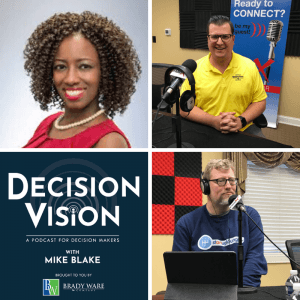
Mike Blake and Mollye Rhea

Decision Vision Episode 40: Should I Align My Business with a Cause? – An Interview with Mollye Rhea, For Momentum

Does cause marketing really help my business? What factors should I consider in selecting a cause to align with? Answers to these questions and much more come from Mollye Rhea, For Momentum, on this edition of “Decision Vision.” Mike Blake is the host of “Decision Vision,” presented by Brady Ware & Company.

Mollye Rhea, For Momentum

For Momentum unites companies and brands with nonprofits in a way that benefits both organizations. Benefits include enhanced visibility, high-touch relationships with employees, customers and donors and significant social impact. Within the industry, this is referred to broadly as corporate social responsibility (CSR) or more concisely as cause marketing. At For Momentum®, they call these carefully designed partnerships strategic cause alliances.

Mollye Rhea

Founded in 2003 by corporate marketing and nonprofit executive Mollye Rhea, For Momentum has emerged as a leading cause marketing agency that helps companies and nonprofits prosper through partnership. Corporate Responsibility Magazine has recognized For Momentum as one of the top five cause marketing firms in the United States. Their work has been featured in the books Cause Marketing for Dummies and Corporate Social Responsibility: Doing the Most Good for Your Company and Your Cause as well as in numerous other industry publications.

While many factors set For Momentum apart from other cause marketing firms, these are the top five unique selling points (USPs) mentioned most often by their clients and industry experts. For Momentum is 100 percent focused on strategic cause alliances versus offering cause marketing as one service among many public relations, marketing and advertising options.

For Momentum’s accomplished cause marketing consultants possess a deep understanding of national/local dynamics—both corporate HQ/franchise and national nonprofit/chapter affiliate relationships.

For Momentum maintains a hiring criterion that each staff member has experience in both nonprofit and corporate environments, which equips them to provide valuable “translator” skills. Experience on both sides of the table allows them to link shared values and mutual challenges cohesively and meaningfully, leading to strategic, integrated cause marketing programs that achieve nonprofit mission objectives while delivering marketing, sales and PR benefits to the corporation.

No other cause marketing agency offers For Momentum’s proven system of identifying partnership prospects, conducting partner outreach and negotiating corporate partnerships. They customize each strategy and cultivate each pipeline for the specific client or project. With For Momentum, you won’t find cookie cutter plans, stale templates or impersonal outreach using the same tired list of prospects.

For Momentum provides a fresh, outsider perspective to help clients realize strategic priorities and adds a depth of experience and actionable plans that enable agencies, companies and nonprofits to meet their goals more quickly and efficiently.

For more information and to access resources mentioned in the show, go to the For Momentum website.

Michael Blake, Brady Ware & Company

Mike Blake, Host of “Decision Vision”

Michael Blake is Host of the “Decision Vision” podcast series and a Director of Brady Ware & Company. Mike specializes in the valuation of intellectual property-driven firms, such as software firms, aerospace firms and professional services firms, most frequently in the capacity as a transaction advisor, helping clients obtain great outcomes from complex transaction opportunities. He is also a specialist in the appraisal of intellectual properties as stand-alone assets, such as software, trade secrets, and patents.

Mike has been a full-time business appraiser for 13 years with public accounting firms, boutique business appraisal firms, and an owner of his own firm. Prior to that, he spent 8 years in venture capital and investment banking, including transactions in the U.S., Israel, Russia, Ukraine, and Belarus.

Brady Ware & Company

Brady Ware & Company is a regional full-service accounting and advisory firm which helps businesses and entrepreneurs make visions a reality. Brady Ware services clients nationally from its offices in Alpharetta, GA; Columbus and Dayton, OH; and Richmond, IN. The firm is growth minded, committed to the regions in which they operate, and most importantly, they make significant investments in their people and service offerings to meet the changing financial needs of those they are privileged to serve. The firm is dedicated to providing results that make a difference for its clients.

Decision Vision Podcast Series

“Decision Vision” is a podcast covering topics and issues facing small business owners and connecting them with solutions from leading experts. This series is presented by Brady Ware & Company. If you are a decision maker for a small business, we’d love to hear from you. Contact us at decisionvision@bradyware.com and make sure to listen to every Thursday to the “Decision Vision” podcast. Past episodes of “Decision Vision” can be found here. “Decision Vision” is produced and broadcast by the North Fulton studio of Business RadioX®.

Visit Brady Ware & Company on social media:

LinkedIn:  https://www.linkedin.com/company/brady-ware/

Facebook: https://www.facebook.com/bradywareCPAs/

Twitter: https://twitter.com/BradyWare

Instagram: https://www.instagram.com/bradywarecompany/

Show Transcript

Intro: [00:00:02] Welcome to Decision Vision, a podcast series focusing on critical business decisions brought to you by Brady Ware & Company. Brady Ware is a regional full-service accounting and advisory firm that helps businesses and entrepreneurs make visions a reality.

Michael Blake: [00:00:20] And welcome to the Decision Vision, a podcast giving you, the listener, clear vision to make great decisions. In each episode, we discuss the process of decision making on a different topic, rather than making recommendations because everyone’s circumstances are different. We talk to subject matter experts about how they would recommend thinking about that decision. My name is Mike Blake and I’m your host for today’s program.

Michael Blake: [00:00:41] I’m a Director at Brady Ware & Company, a full-service accounting firm based in Dayton, Ohio, with offices in Dayton; Columbus, Ohio; Richmond, Indiana; and Alpharetta, Georgia, which is where we are recording today. Brady Ware is sponsoring this podcast. If you like this podcast, please subscribe on your favorite podcast aggregator and please also consider leaving a review of the podcast as well.

Michael Blake: [00:01:02] So, our topic today is should my business align with a cause? And I was brought to thinking about this topic because it was in the late last year, early this year, I think it was late last year, you know, I observed Nike pretty much going all in with the Colin Kaepernick scenario with the NFL. And I’m not going to comment specifically on that matter, but I did make an observation on social media that, it struck me that if I were a shareholder of Nike, I would at least like to know in advance if a company in which I was invested was going to take a polarizing or potentially polarizing position like that.

Michael Blake: [00:01:52] And I think I was kind of motivated in that viewpoint by the fact that there was a pretty demonstrative response by what turned out to be a very small minority of customers. I know that the massive response is everything from burning shoes to tearing up sweatshirts and wherever it is else that Nike sells. And, you know, quite frankly, most people who looked at that on social media said, “Blake, you’re dead wrong.” And I said, “We’ll see.”.

Michael Blake: [00:02:28] And you know, to a couple of my friends’ credit, they actually went out and bought Nike stock. So I got to give them credit, they put their money where their mouth was. And, well, you can see the history for yourself. Nike is still around. They are doing fantastically. Their stock has never been at a higher level, I believe. I think they had one of their best years ever in terms of return on that stock.

Michael Blake: [00:02:51] And clearly, I was wrong about that. And I owned up on that on social media. Imagine that, somebody saying they were wrong on social media. But, you know, the facts are the facts. And as Bill Gates likes to say, “Success is a lousy teacher.” So I had a great teacher in failure there. But it led me to sort of think about, you know, what goes into the process of a Nike when they decide that they’re going to support, in their case, a polarizing cause?

Michael Blake: [00:03:18] Not all causes are polarizing. There are many cause we can all get behind, whether it’s the United States Olympic movement, whether it is fighting cancer, whether it is stopping human trafficking, right? Not every single cause that people believe in is a polarizing one. But nevertheless, there is also a viewpoint, and Warren Buffet, I think, would agree with us because he’s written about this, that, you know, it’s really not company’s business to engage in causes at all, that business should be in the business of generating return for its shareholders.

Michael Blake: [00:03:51] And if shareholders then want to take their returns and use that to support a cause, then they should do that. And that’s how the economics should work. And again, I’m not going to necessarily debate that directly, but I want to put that out there that that is a widely held view by a person who’s been pretty successful at this whole business thing. And so, that kind of sets the stage as a platform for today’s discussion, because my bringing this on social media showed me very clearly that there’s, you know, something more that I can understand.

Michael Blake: [00:04:22] And many of you who are in business may be thinking the same thing about, you know, is there an opportunity for me to align with a cause, an organization of some kind? Is that the right thing to do? How do I kind of figure that out? And I’m not qualified to talk about that, but I have somebody here in the studio who is very qualified to talk about that. And joining us today is Mollye Rhea, founder and president of For Momentum, a cause marketing agency here in Atlanta.

Michael Blake: [00:04:54] When Mollye founded For Momentum in 2003, she recognized that she was leading one of very few agencies that specialized in cause marketing. I think that’s still true today. Since then, as cause-related marketing and corporate social responsibility have grown to a $2.6-billion industry, For Momentum has grown into one of the leading cause marketing firms in the United States. And they’re doing fantastic.

Michael Blake: [00:05:18] Through work in nonprofit development, brand marketing, and cause marketing, Mollye has acquired a unique 360-degree perspective of what fosters success and strategic cause partnerships. In her over 25 years in the field, she has created and executed cause engagement and marketing programs, strategic fundraising campaigns and organizational development strategies with dozens of nonprofit organizations and hundreds of brands, including the American Cancer Society, Boys & Girls Clubs of America, Habitat for Humanity, International—InterContinental Hotels Group, Lane Bryant, and Novartis to name a few.

Michael Blake: [00:05:53] She is a graduate of the Leadership Atlanta Class of 2012. And by the way, that’s the second best class ever. You had to be an insider of Leadership Atlanta to get that joke, but I was class of 2014. And I did not know that about you. She sits on a bunch of nonprofit boards and holds a bachelor’s degree in economics and psychology from William & Mary. Mollye, thanks so much for coming on the program.

Mollye Rhea: [00:06:18] Well, thanks so much for having me, Michael. I’m excited to be here. And wow, what a provocative promotion you started the discussion with.

Michael Blake: [00:06:26] Well, yeah, you know, you got to do something attention-grabbing to get attention on social media, right?

Mollye Rhea: [00:06:31] Right.

Michael Blake: [00:06:32] And what’s nice about that is that I learned something and it made me think more about this topic. So, thanks for coming in to talk. I don’t think I’m the only person that’s thinking about this question, right? The fact that you have the thriving business you have, I think, is Exhibit A that this is a topic that’s of a lot of interests, but it’s not a cut and dried one. So, why don’t we dive into it? So, what I like to do with a podcast is to sort of set our vocabulary. When we talk about cause marketing, what does that mean?

Mollye Rhea: [00:07:05] Well, I’m really glad you started with that, because so many people, in my experience, come to that term with a different point of view. And so, I think it’s really important to lay that groundwork right from the get go. So, I’ve been doing this type of work for a very, very long time. And back in the olden days, it was called corporate relations or something like that. And it’s really the practice by which a company is supporting a nonprofit as a part of their business practices.

Mollye Rhea: [00:07:35] And I really encourage the listeners today to take a more open-minded viewpoint to realize that that can bring many different—that can come to life in many different ways. So, some of the terminology that you hear, you know, bandied about, you know, corporate relations, community relations, cause marketing, strategic philanthropy. But these days, a really popular term, which kind of plays off of the story you told is social impact marketing. And so, companies today are looking to really engage in generating impact into our society as a side part of their business, but as a primary part of their business as well.

Mollye Rhea: [00:08:18] So, some people think of cause marketing as, you know, I’m going to buy this bottle of water and 10 cents is going to go to a charity. That is one type of cause marketing. It’s a very specific type called commercial co-venture. And we can talk about that more later. But also, different types of cause marketing, I would argue, would be, you know, the Nike program that you talked about. Other campaigns, even in employee engagement these days, in terms of really getting your employees involved in making a difference on a social issue. So, it’s a very broad landscape that we’re talking about.

Michael Blake: [00:08:54] So a question comes up, and I apologize, I’m going off the script right away, but I think it’s—I just got to get your answer on this, because I think it’s so interesting. You know, in recent months, we’ve seen a number of companies pull back in terms of their willingness to sell firearms and firearm ammunition supplies, and so forth. Is that a kind of cause marketing in your mind?

Mollye Rhea: [00:09:21] In my mind, yes.

Michael Blake: [00:09:22] Okay.

Mollye Rhea: [00:09:22] I mean, I put those into the same landscape.

Michael Blake: [00:09:27] Okay.

Mollye Rhea: [00:09:27] Right? So, again, cause marketing itself might be one term within this landscape, but it’s the most commonly used term.

Michael Blake: [00:09:35] Okay.

Mollye Rhea: [00:09:35] So, I think, in fact, I was going to bring up that example based on what you said, you know, about the Colin Kaepernick Nike campaign. You know, there are a variety of societal issues where companies are starting to make a difference through their business decisions, whether to sell something. There’s a local firm called Kabbage that makes business loans and they will no longer loan to anybody who’s in ammunitions-

Michael Blake: [00:10:01] Oh, really? Okay.

Mollye Rhea: [00:10:03] … type of business.

Michael Blake: [00:10:03] Okay.

Mollye Rhea: [00:10:04] So, there’s things like that. So, I think those sorts of deep integrated business decisions are more of the recent trend we’re seeing in this landscape, but you do have to be very careful. And I want to say that I think that we can continue to use this Nike example as a grounding case study, if you will. They did lose a segment of their customers. You know, their overall numbers went up, but there was a segment, just like there was a strong segment who spoke out against it and burned-

Michael Blake: [00:10:34] Yeah.

Mollye Rhea: [00:10:35] … things. And then, there was, you know, on the other end, strong, you know, affiliation with it. You have to really understand your customer base and not make those decisions based on your personal opinions, but really take into account the community that you serve if you want to make sure that you aren’t having that, you know, the tail wag the dog, so to speak, you know.

Michael Blake: [00:10:57] Yeah. And that’s a great point that I think we’re going to get back to. But it does it does bear emphasizing that, you know, cause marketing for its own sake may or may not be a great thing, but it sounds like an integral part of that notion is make sure you understand who your target market is, right?

Mollye Rhea: [00:11:15] Right.

Michael Blake: [00:11:16] And it may not be necessarily the target market that I, as a CEO or board or a decision maker, chief marketing officer, thinks as the right cause, right?

Mollye Rhea: [00:11:25] Mm hmm. That’s right.

Michael Blake: [00:11:26] So, again, using the Nike sort of the platform for this discussion, there was some risk there, I think. That turned out well for Nike, great for them, right? But, you know, because of that risk, why should a company consider taking that risk in embarking on a cause marketing campaign?

Mollye Rhea: [00:11:47] Yeah. And you know what? I think I want to interject here a different example, because I don’t want the listener to think of that as the guiding light of an example-

Michael Blake: [00:11:57] Yeah, please.

Mollye Rhea: [00:11:57] … because it’s an extreme example.

Michael Blake: [00:11:59] Yeah, please.

Mollye Rhea: [00:12:00] So, you know, there are many, many ways that companies can support nonprofit’s, you know, strict sponsorship of events or activities, things like that. They can get behind a campaign that is going to raise funds or awareness for an issue that isn’t controversial. And it doesn’t change their business model, but it’s more of a programmatic way that they can support. So, let’s talk about some of those more standardized types of campaigns, because I don’t want the listener to be frightened that, oh, it’s got to be this big extreme-

Michael Blake: [00:12:33] Yeah, good.

Mollye Rhea: [00:12:33] … you know, thing. So, let’s talk about the business benefits of a company supporting a social impact or a nonprofit mission. You know, either space. Often, they’re very interlinked. There are clear and documented benefits to a company for this type of marketing behavior. And they are things like increased sales, heightened PR, heightened awareness of the company and positive awareness of a company. So, there are a lot of great business benefits. But what I also want listeners to know is that, you know, in the trends in this space, an increasingly important target audience is your employee base. Because today our unemployment rates are very, very low.

Mollye Rhea: [00:13:21] The cost of finding a good candidate and retaining a good employee are real cost that we have to be very careful about. And there’s a mounting amount of evidence that cause marketing or a company’s support of the local community is a positive differentiator for job selection. And that when employees join a company that they feel is doing good things in the community, they’re more likely to be engaged and they’re more likely to stay employed with that company. So, why should a company consider cause marketing? Lots of different reasons. It could be PR, it could be HR.

Michael Blake: [00:13:58] You know, and I want to underscore that point as well. You know, marketing, when many of us think of marketing, frankly, myself included, we think about an outward message, right? How do we get more customers? How do we get the customers we have to love us more, buy more from us, and so forth. But you’re right, there is a marketing element internally, right, to make your employees and your associates feel great about where they are. Because at the end of the day, raising salaries can only take you so far.

Mollye Rhea: [00:14:30] That’s right. Yeah. You know, part of the overall compensation package is psychic income, right? And so, you want to feel good about the work you’re doing and you want to feel good about the company that you’re working for. And this is becoming—you know, we hear a lot about millennials, you know, we’re starting to hear now more statistics from the Gen Z population.

Michael Blake: [00:14:51] Yeah.

Mollye Rhea: [00:14:53] But these younger cohorts are absolutely motivated by community impact. And so, you know, it’s becoming more and more important as companies want to attract those younger talent.

Michael Blake: [00:15:07] And that’s been something of an adaptation for Gen X’ers like myself, right? The Gen X’ers are the, I think, last of the kind of the old school workforce where just put your head down, getting your hours, do your thing, and, you know, get in and get out. And that’s an adaptation outlook that my generation has had to change, right? Because if we try to treat our workforce in a Gen X way, we’re not going to have a workforce very long or at least not one with which we’re very happy.

Mollye Rhea: [00:15:44] Mm hmm. I think that’s right.

Michael Blake: [00:15:45] So, it sounds like you’ve segued again very nicely into the next question, which is it sounds like there’s evidence that cause marketing does have a positive impact on company performance.

Mollye Rhea: [00:15:55] Absolutely. You know, there are an increasing number of studies out there. The most common are from an agency called Cone, C-O-N-E. And if readers are interested, you can certainly Google that and you will find all sorts of different studies on this topic. But I like to cite more resources than just the primary one, because I think sometimes we can get into a rut or a routine and I think their work is fantastic. I’m not dissing that at all.

Michael Blake: [00:16:23] Right.

Mollye Rhea: [00:16:24] I follow that. But, you know, we’ve been able to find many, many other sources of information that point to the validity of this notion. I also want to point out that there are increasing numbers of corporate associations focused on this topic. One of those is the Committee to Encourage Corporate Philanthropy, CECP. And they are a group of CEOs of large organizations that very much track the benefits of this type of investment, because this is not just a, you know, flash in the pan idea.

Mollye Rhea: [00:16:59] This is something they realized they have to pay a lot of attention to. And according to CECP, 87 percent of companies are now measuring and tracking societal outcomes and using that data to inform their program development. And 80 percent of those same corporate leaders think that, they believe, it is enhancing customer loyalty and 89 percent of them feel that it’s enhancing collective purpose amongst their employees.

Mollye Rhea: [00:17:27] So, those are just some of the types of statistics. I could go on and on. I don’t want to do that because probably, a lot of your listeners are driving. And I don’t want them to fall asleep. But, you know, on our website, at For Momentum, we have a variety of resources. We compile this type of research all the time because we’re in it, you know, 365. So, free downloadable tidbits are there if your listeners want to go and download those.

Michael Blake: [00:17:53] Well, yeah, perfect. It’s all about data nowadays. So, let’s shift gears in a little bit. So, let’s say that one of those driving listeners now is saying, “You know what, this cause marketing thing is something I ought to pay more attention to.” I think the next obvious question to my mind is, is my company a good fit for it, right? Is there a profile of a company that has a good or a best fit for cause marketing as opposed to maybe a company that isn’t as good with that?

Mollye Rhea: [00:18:22] Yes and no. I mean, I think that there are some companies that, you know, have an easier footprint into the community. So, like a retailer, you know, where they can really, you know, engage, “Would you like to add a dollar? Would you like to make a donation and get a bounce back coupon?” Things like that. They have a natural affinity. But what I like to say is that when you, whoever you are as a company, are looking at putting your toe in the water on this, think about what companies—or what nonprofits, rather, what social impact mission is going to advance your business and what is the right footprint for you.

Mollye Rhea: [00:18:59] So, if I am a local company based in Atlanta, Georgia and my footprint is 100 percent Atlanta, Georgia, I probably want to pick a comparative nonprofit that impacts that same geographic space. So, you know, I need to find someone who’s like-minded, like-sized, you know, and find the right match for me. So, I’m not, as my company is not going to compete with what Nike is doing.

Michael Blake: [00:19:28] Right.

Mollye Rhea: [00:19:29] Because I don’t have the same profile or footprint.

Michael Blake: [00:19:31] Right.

Mollye Rhea: [00:19:33] So, I really think it can be any type of company, but with the right connection to a cause that makes sense. And another thing I want to point out about that is that sometimes, companies fall into a natural rut, where they just want to pick something that they care about individually. So, you know, I’m going to support, you know, something that matters to me individually, but it has no tie to their brand, whatsoever.

Mollye Rhea: [00:19:58] That’s confusing to the consumer and confusing to the employees, frankly, because it needs to be a charitable choice that matches, I call it, the three-second rule. It’s like, “Oh, I understand why this restaurant is supporting hunger issues because they’re both about food”, you know, or something basic like that. But that can really enhance the validity of the campaign when there’s a natural fit between the brands.

Michael Blake: [00:20:23] It’s almost like a joke. The second you have to explain it, you’re done.

Mollye Rhea: [00:20:26] Right.

Michael Blake: [00:20:27] Right? The joke is just never going to have the impact.

Mollye Rhea: [00:20:30] That’s right.

Michael Blake: [00:20:31] So, one thing that kind of strikes me about cause marketing is that you’re trying to find a partner. You need a partner, probably, in some constraints. I guess you could have a completely unidirectional cause marketing campaign, but I don’t think that’s what you’re all about. What is the role of the partner, the nonprofit or philanthropic partner in the cause marketing relationship?

Mollye Rhea: [00:20:56] Yeah. So, actually, I want to go back and talk about what you’ve just said.

Michael Blake: [00:20:59] Okay.

Mollye Rhea: [00:21:00] Which is that, you know, it doesn’t make sense for it to be unidirectional, but in fact, that is one of the trends we’re seeing, which I am really sad about. You know, I think there are a lot of companies that have decided to do their own—they’ve picked their own issue and they’re going to create their own solution to it. You know, and some companies can do that. I mean, they have enough wherewithal to really, you know, go in there.

Mollye Rhea: [00:21:25] I’m a big proponent that if there is a nonprofit that is working in that issue space, find a way to work with them because it does help to bring multiple voices to an issue and not later get maybe accused of self-dealing or, you know, something that’s self-serving. There are many, many benefits that the nonprofit can bring to the partnership table. And you have to have a really robust business discussion about that. So, it’s really important to find a partner who is going to match your business objectives.

Mollye Rhea: [00:22:02] So, for example, the nonprofit partner brings, first of all, an expertise into the issue space that you are wanting to address. They live in this space 24/7, so they should be bringing some special expertise. With that comes connections with stakeholders and opinion leaders in the space. They bring a level of awareness, a level of authenticity. They can bring marketing benefits. They have followers and they may have social media following or they may have, you know, donors, constituents. So, they do have their own audience that they can bring to the marketing equation.

Michael Blake: [00:22:39] You know, that unilateral element brings to mind something that just came up in the news. Apple just announced they’re going to put, I think, $2 billion into building housing in Silicon Valley because California has a massive housing problem. Basically, their own employees cannot afford to live in the state.

Mollye Rhea: [00:22:57] Right.

Michael Blake: [00:22:58] Facebook is doing something similar. And what struck me about that was, you know, I don’t know that necessarily building houses is the answer. And I hope—it wasn’t clear from what I read that they’re partnering with anybody. But, you know, perhaps, they should be. I certainly hope that they are, because Apple is not in the multi-family real estate business, as far as I’m aware, right? And simply building houses may not be the issue, right?

Michael Blake: [00:23:28] In my view, I think the issue is most likely zoning or something of that nature that prevents homes from being built where they ought to be built. And it would be interesting to see how the Apple initiative unfolds, right? Because they’re clearly targeting a cause somewhat self-serving. But that’s okay, because there is a collateral good that’s coming out of it. But it would be interesting to see if that winds up being part of a partnership or not. Right now, it’s not clear.

Mollye Rhea: [00:23:55] Yeah. And I don’t know because I haven’t studied that particular topic. But I do know of many nonprofit players that could be excellent in that space. You know, I think it’s called Community Enterprise Partners that we did some work with few years ago, whose mission is to talk about the fact with the increasing amounts of rent in key cities and how people can’t afford to live in the places where we need them to.

Mollye Rhea: [00:24:19] So, they obviously are working in this space 24/7 and at least could bring thought leadership to that process. So, that’s a great example, Michael, where I hope that whatever the issue is, I think it’s imperative that companies look to others in the space to see what they can learn before they go running down a path, you know, without all the information available.

Michael Blake: [00:24:42] So, let’s say we go through some process, we identified that nonprofit partner, you know, what are some of the typical contributions a nonprofit partner makes to that relationship?

Mollye Rhea: [00:24:53] So, again, it depends on the nature of the relationship. It can be extremely directed. It could be that the company is funding a specific project of the nonprofit and they are literally delivering, you know, the project. But many times, nonprofits can bring—you know, as I was saying earlier, people are aware of the nonprofits, so they’re bringing awareness to the topic. They are bringing constituency. They are bringing, you know, increase. I’ll give you an example. So, one of our clients is Habitat for Humanity, and they do a program called Home is the Key. And they’re a variety of corporate partners that engage in that campaign.

Mollye Rhea: [00:25:35] And in that case, what Habitat is bringing to it is, you know, obviously, the expertise on the issue. But they are also bringing celebrities to the floor, right? So, the Property Brothers are celebrity spokespeople for this event. They are investing in a big PR campaign that then the companies receive the spotlight of as a part of that initiative. So, instead of building the whole program from scratch on the corporate shoulders, the corporate can engage in a program that the nonprofit is bringing to the marketplace. And they are tremendous amounts of marketing and sales benefits, you know.

Michael Blake: [00:26:11] Okay. So, often, the nonprofit brings their own infrastructure-

Mollye Rhea: [00:26:15] Yes.

Michael Blake: [00:26:15] … basically. And the benefit there is, yeah, you could do it unilaterally, but why are we reinventing the wheel, right?

Mollye Rhea: [00:26:21] Right.

Michael Blake: [00:26:22] And especially in that case, you know, they’ve got celebrities, which, you know, most companies want to line with and so forth. And it sounds like—and I appreciate that it sort of depends. You know, it could be as simple also as simply using, you know, doing co-branding logos, trademarks, things of that nature.

Mollye Rhea: [00:26:41] Absolutely.

Michael Blake: [00:26:41] So, as I understand it, there’s really a sort of a whole spectrum of the sky’s the limit. And of course, another function of that is going to be, you know, how big the nonprofit itself is, right?

Mollye Rhea: [00:26:50] Yes.

Michael Blake: [00:26:50] The united way can do more than, say, you know, the local Chamblee chapter of St. Vincent de Paul, which is a thrift store that, you know, helps people in poverty in the Chamblee area.

Mollye Rhea: [00:27:04] Yeah, but that’s a good example of if I am a company based in Chamblee, you know-

Michael Blake: [00:27:10] Yeah.

Mollye Rhea: [00:27:10] … St. Vincent de Paul is gonna be more attractive to me-

Michael Blake: [00:27:12] Yeah.

Mollye Rhea: [00:27:13] … because there is an authentic connection between my business and that nonprofit’s mission. So, just to kind of tie that back to what I was saying earlier about, you know, finding the right partner, don’t forget those local ones-

Michael Blake: [00:27:27] Yeah.

Mollye Rhea: [00:27:27] … if you’re a local company.

Michael Blake: [00:27:27] Is it hard to mix the for profit and nonprofit cultures? Are there any issues with them sort of having being able to talk the same language? Because there are probably cases where their goals are not 100 percent aligned all the time.

Mollye Rhea: [00:27:43] Yes, absolutely. 100 percent of the time, they are not 100 percent aligned.

Michael Blake: [00:27:48] Okay.

Mollye Rhea: [00:27:49] I can tell you that. They may come together for a common objective in, you know, a particular program or initiative. But it’s very important to take into account the respective needs of each of the partners and their business realities, their business resource mixes, their stakeholders and who they’re reporting to. I would say that you could make the same argument in any business to business relationship building. Whenever you bring two partners together, they’re going to have different goals and different missions. But I will say the nonprofit environment is more starkly different from a corporate environment, you know, just given the fact that it’s a nonprofit.

Mollye Rhea: [00:28:28] However, where you can really bridge that gap is by having very straightforward communication and collaborative planning and really authentic clear conversations. So, you know, Business A wants this set of benefits and the nonprofit needs be able to say, this is what I can do and this is what I can’t. And some of those are regulatory-related. You know, like, for example, a nonprofit can’t overly promote a corporate entity or it becomes unrelated business income tax. There are implications for EBIT. So, you know, the company needs to respect the nonprofit’s, you know, boundaries and vice versa.

Michael Blake: [00:29:08] Okay. And to that end, I believe that some companies will actually create a role inside the company for somebody to be their, in effect, cause marketing ambassador, their person that represents the company for the nonprofits with whom they cooperate. And I suspect that model can work well because then, that person is fluent in both languages, basically, if you will. Is that a necessity in your mind? Is that best practices? Can you live without it? Can you talk a little bit about, you know, how important that role is?

Mollye Rhea: [00:29:43] Yeah. So, I don’t think it needs to be someone’s full time job, but there needs to be someone who’s put in charge, if you will, of managing the relationships. And so, I guess I want to answer this in a couple of different way. So, it doesn’t have to be—you know, I don’t want to dissuade companies that can’t afford a full-time position because you can certainly do this. You can have effective partnerships without it being a full-time role.

Mollye Rhea: [00:30:08] In fact, some of the largest companies that we work with as customers only have a couple of people and they’re doing billions of dollars, sometimes, of good. So, you don’t have to have a full-time person to get engaged in cause. The other thing I want to say is that we’ve been doing a piece of research. We’ve now completed our third cycle of this research with corporate partnership decision makers. And, you know, in the trends and in the way that the landscape changes, there came a time where there was this individual who was responsible. And what we’re seeing now is that that’s not the case, that it’s actually a shared responsibility across many different departments.

Mollye Rhea: [00:30:50] And so, we asked the question in our research, who from your corporate structure is involved in the decision making? And we found marketing, PR, HR, Community Relations, C-suite and sometimes, a special committee. So, I think that the company needs to make those decisions about where the most natural fits are and don’t work in a silo. Recognize that you need to engage counterparts from all those departments that I just mentioned in your planning process or you will end up with a silo, and that’s not good.

Michael Blake: [00:31:24] Okay. So, I want to switch gears a little bit. What are some trends you’re seeing out there that are, for lack of a better term, hot in terms of cause marketing? What are some emerging things that a lot of companies are looking to do? Whether it’s practices, nature of the cause themselves. What are you seeing out there?

Mollye Rhea: [00:31:40] So, let’s go back to your first topic of the morning, which was the, you know, Colin Kaepernick, you know, taking on a social issue. That is a trend. It’s not for everyone. It’s for a select few of brands that have an avant-garde element to their brand personality. But increasingly, we are seeing some companies taking this very strong stance on a particular social impact issue. So, that is a trend. And we actually have some resources on that, if anyone’s interested. But sort of to the more broad-based approach, actually, a trend is that the United Nations came out with some sustainable development goals. And I think it was 18 different areas of impact, where, you know, United Nations members from around the globe identified 18 common areas that any country needs to be sustainable.

Mollye Rhea: [00:32:34] So, poverty, education, hunger, water, you know, et cetera, and health. And what I’m seeing is an increasing trend as that companies are identifying from these sustainable business goals, development goals from the United Nations, they’re identifying we’re going to impact, you know, area 2, 8, and 12, whatever their numbers are that they pick. And companies are starting to speak in lingo, in that lingo of, “Well, in, you know, goal 12, we’re making this, you know, headway, this much headway. So, it’s a way of really working collaboratively across different corporate segments towards mutually beneficial goals. Does that make sense?

Michael Blake: [00:33:19] Yeah.

Mollye Rhea: [00:33:19] And so, that’s a trend. And then, the other trend that I want to highlight sort of as a top three trend is the increasing incidence of digital. So, as our society becomes more and more digitally focused, we are seeing lots more partnership activations in the digital realm.

Michael Blake: [00:33:39] Okay. And actually, to that end, is there a risk to defy, embark on cause marketing? And, you know, I’m not doing it yet. Is there a risk of it being somehow disruptive to my existing conventional marketing efforts? I imagine there must be some integration issues because I think that’s the expertise that you lend. So, if that is true, can you talk about kind of what some of those challenges might be?

Mollye Rhea: [00:34:08] So, how cause could be disruptive to the rest of your business plan?

Michael Blake: [00:34:12] Yeah, or, you know, cause marketing is a different kind of marketing, just like digital marketing has become disruptive to more conventional analog methods, right? I guess I’m posing a hypothesis that cause marketing has the potential to be similarly disruptive because I think the way you have to go about, the skill sets required, the stakeholders are different, right? And so, I guess my question is, is it fair to characterize this cause marketing as somewhat disruptive? And if so, is that something that needs to be actively thought about, managed by a company that is thinking of pursuing it?

Mollye Rhea: [00:34:52] So, I guess where this takes my mindset, Michael, is to think about, you know, all good things in moderation, right? So, if you were to abandon, if a company was to abandon some of their traditional marketing methods toward strictly cause, I think they could lose themselves, frankly, in it, because they need to—it needs to be a piece of your overall communications or employment objectives, not the only thing you do.

Mollye Rhea: [00:35:22] So, that’s something that I think you have to like integrate it into a bigger plan as opposed to, like, for instance, if a company suddenly went 100 percent digital and forgot all their other kinds of marketing, those repercussions will be clear. I think anybody can understand that analogy. So, I’m saying the same thing would happen if you went too top-heavy in cause. And maybe I’m honestly just a little too close to it, but I don’t see it as a risk, in general.

Michael Blake: [00:35:53] Yeah.

Mollye Rhea: [00:35:53] Here’s another example of where it could be risky. It could’ve been risky with Nike. You know, if they don’t understand their audience or if they choose a cause activity that doesn’t resonate with their target audience. That could become disruptive because they’ve suddenly changed their brand personality, probably unintentionally.

Michael Blake: [00:36:15] Right. And another example, we’ve talked about Nike, but Gillette with their “Me too” ad about a-year-and-a-half ago, right? That had some ramifications as well. In some cases, somewhat stronger, I think.

Mollye Rhea: [00:36:26] If you’re thinking of the ad where it was like the gentleman that they were trying to encourage men to be, it wasn’t “Me too.”

Michael Blake: [00:36:37] Well, but they sort of aligned—okay, you’re the marketing expert.

Mollye Rhea: [00:36:42] Yeah.

Michael Blake: [00:36:42] I’m not. I’ve heard it referred to as that.

Mollye Rhea: [00:36:44] Yeah.

Michael Blake: [00:36:45] So if it’s not, then I stand corrected. But I’m referring to the ad where they try to redefine a sense of what it means to be a man.

Mollye Rhea: [00:36:54] Right.

Michael Blake: [00:36:55] Which is a different relationship with women, which is a different relationship with other men, which is different relationships with people who are vulnerable. And I think that—is that a fair characterization?

Mollye Rhea: [00:37:06] Well, you know, it’s interesting. I think that your perception of it is a great example of where it can get dangerous, right?

Michael Blake: [00:37:11] Okay.

Mollye Rhea: [00:37:12] Because the campaign, in its essence, was designed supposedly to educate men to make more responsible choices that consider other people’s feelings more, like, you know, the way they raise their sons or the way that they talk to women or whatever. That is a great example of a campaign that had a really positive and negative reaction in the marketplace. I think they’ve—I haven’t seen it lately, so I don’t know if they’ve withdrawn or gone back to the drawing board or exactly where they stand on that, but I don’t think they expected that big of a reaction on the negative side.

Michael Blake: [00:37:51] Right.

Mollye Rhea: [00:37:52] So, that’s a good example of really needing to understand your target audience. And if a portion of your target audience resonates with that, you know, that could be a strategic decision. It could have been a mistake. And I don’t know because I wasn’t involved. And so, I don’t know the inner workings.

Michael Blake: [00:38:09] Right.

Mollye Rhea: [00:38:10] But I’ll give you another example and I don’t feel comfortable saying who it is because it was a business-to-business conversation.

Michael Blake: [00:38:16] Yeah.

Mollye Rhea: [00:38:17] But it was a, again, company that targets men and they had decided to, in their own way, try to redefine how men relate to their emotions. This was, you know, the stance that this brand took was, “We’re going to teach men that it’s okay to be in touch with their emotions.” And they did some, you know, post-campaign research and their audience didn’t like it. Like, “Don’t tell me how I’m supposed to feel.” So, you really do need to understand your audience. And especially if you’re going for something that’s provocative or brand changing, potentially could have people have a different perception of your brand, those are good examples of where it can be very disruptive. So, what could they have done differently? They could have picked a—those are also cases where there was no cause. There was no nonprofit partner. They’re just stating like, you know-

Michael Blake: [00:39:15] I hadn’t thought about that. Yeah, that sounds exactly right.

Mollye Rhea: [00:39:18] So, if they wanted to generate something, maybe that would have been a good time to find a partner that has a mission that they could say we’re supporting their mission, not we are changing who we are.

Michael Blake: [00:39:29] Interesting. Okay. And to that point about picking partners, I would imagine not all partners are created equal, right? And even if you identify with the partner’s potential cause, they may not be the right partner for you, right?

Mollye Rhea: [00:39:46] That’s true.

Michael Blake: [00:39:48] And sometimes, there can be a size mismatch. You know, an interesting story, you know, one cause I paid some attention to is Lou Gehrig’s disease research, ALS Society—ALS Association. And, you know, as everybody knows, it had the ice bucket campaign, which I did, and boy, ice water’s cold.

Mollye Rhea: [00:40:12] Yeah.

Michael Blake: [00:40:13] But an interesting thing about that was that all of a sudden, the ALS Association of America came into a windfall, about $130 million. They just did not have the infrastructure-

Mollye Rhea: [00:40:23] Right.

Michael Blake: [00:40:25] … to manage that kind of cash, right? Their organization had to completely reorient to make sure that that money was used well, right, and wisely. Can that be an issue in the cause marketing space, too? Maybe there’s a size mismatch or just fundamental characteristics of certain nonprofits that may not make it a good partner, even if you agree with the cause?

Mollye Rhea: [00:40:49] Yeah. So, I just want to go back just to clarify for a moment about the wonderful, fabulous ice bucket challenge phenomenon.

Michael Blake: [00:40:56] Yeah.

Mollye Rhea: [00:40:58] That was not cause marketing.

Michael Blake: [00:40:59] I understand.

Mollye Rhea: [00:40:59] Okay, okay. I just want to make sure your listeners understand that that is an example of a movement that caught wind. And I think every nonprofit in the world dreams of having that problem-

Michael Blake: [00:41:11] True.

Mollye Rhea: [00:41:12] … of creating that magic in a bottle, you know, where they can create something. Another beautiful example of something that was a game changer was cystic fibrosis.

Michael Blake: [00:41:22] Yeah.

Mollye Rhea: [00:41:22] So, they literally invested in research and the research paid off. And so, they became a part-owner of a pharmaceutical product that serves cystic fibrosis. I might not be getting this 100 percent right.

Michael Blake: [00:41:37] I think that sounds right. I’ve read that.

Mollye Rhea: [00:41:39] And it created just a tremendous amount of income. So, I think it’s incumbent on the nonprofit board to be prepared with, “This is our plan and this is our plan if we grow this much and this is our plan if we grow that much”, you know, so that they are strategically staying aligned to their mission and bringing that to life. In terms of a cause program that just has taken off and changes the direction, I think—I can’t think of a real example.

Mollye Rhea: [00:42:07] But I can tell you that, you know, if the nonprofit or if the message of the campaign was focused on a tiny issue and then, you had too much funding and you couldn’t spend all that on the issue, I think it’s really important to make sure that the focus area is broad enough that you’re not going to get into that topic. So, it gives me the chance to say this, many times companies decide that they want to create impact on a particular subset of a bigger issue. And sometimes, it’s better just to help the broader issue and not get so singularly focused on this small little piece.

Michael Blake: [00:42:45] Sure. Yeah. Because even if, say, Coca-Cola decided there is hook of the firehose and dumped, you know, $10 million into that St. Vincent de Paul charity in Chamblee, right? They’d be overwhelmed.

Mollye Rhea: [00:42:58] Right.

Michael Blake: [00:42:58] Most likely. And it wouldn’t work very well for everybody. So-

Mollye Rhea: [00:43:02] Right.

Michael Blake: [00:43:02] … you know, pick not just the cause, there’s a bullet point I want to kind of tease out, I think we’re doing that, is that picking the partner for a match is just as important as picking the cause. Is that fair?

Mollye Rhea: [00:43:14] Picking the partner that is delivering into the mission space that you’re interested in?

Michael Blake: [00:43:21] Correct. That’s right.

Mollye Rhea: [00:43:21] Yes. Yes, I do agree with that. And an example that I wanted to share, you know, when you think about that, so let’s say that your organization, you know, one that many of us know is breast cancer, right?

Michael Blake: [00:43:33] Yeah.

Mollye Rhea: [00:43:33] So, lots of people want to support breast cancer. And, you know, you really need to do homework on your nonprofit partner because, you know, there’s one breast cancer organization that works, let’s say, on funding research. And there’s a different breast cancer organization whose mission is to serve people who currently are dealing with breast cancer and make it easier for them, make it—help them get to their doctor’s appointments or things like that. And yet, a third breast cancer organization is all about prevention messaging and warning signs and things like that. So, really look at what it is you’re trying to accomplish within the mission space and make sure that you’re finding the right partner who will help you with that particular goal.

Michael Blake: [00:44:11] All right.

Mollye Rhea: [00:44:12] Not all nonprofits focus on exactly the same things.

Michael Blake: [00:44:15] Yeah.

Mollye Rhea: [00:44:16] Even if they’re all about, say, breast cancer.

Michael Blake: [00:44:18] Yeah, that’s true. I mean, many of them are new ones and that the cause itself is so big that there are subsectors of that cause and effect.

Mollye Rhea: [00:44:26] That’s right.

Michael Blake: [00:44:27] Well, Mollye, we’re running out of time but this has been great, I’ve learned a lot. And if I’ve learned a lot, I’m confident at least some of our listeners have learned something. So, thank you for doing this. There’s a lot more we could talk about. I’ve only gotten through about half the questions I want to talk about today, but that’s a good thing. How can people contact you if they want to find out more about this and explore maybe this for their own business, their own nonprofit?

Mollye Rhea: [00:44:52] Okay, great. Well, so, you know, I have been working in this space for a very, very long time, so I’m hyper interested in it. And as a part of our return to the community, we conduct research every year into different factors of how to bring a cause partnership to life, what sorts of benefits can you seek and things like that. So, I would hope that some of your listeners might find it of interest to go to our website, to our resource page and download some of our free resources.

Mollye Rhea: [00:45:20] So, that’s For Momentum, formomentum.com/resources. If you have specific questions for us, there’s a Contact Us page. We’d love to hear from you. Be more than happy to help direct you to resources or point—answer questions, things like that. That’s just a part of our giving it back to the industry practices kind of things. But I do want to shout out to a couple of others in the cause landscape that I think produce excellent resources for the listeners. So Engage for Good is the association of people in this profession. And they do a fantastic job of constantly bringing, you know, information to light.

Mollye Rhea: [00:46:00] They have research resources, they have free webinars, they have newsletters for free that listeners can sign up for. And a third one that I would mention is a newsletter called Selfish Giving. And it’s produced by a guy out of Boston named Joe Waters, who’s a pal of mine. And he is really funny. And so, most of his, you know, articles have some entertainment flair to them as well, but really, really great examples. And he tends to focus a lot on small companies. So, you know, some of your listeners, if they’re not the Nikes of the world, but they’re a more moderate-sized company, they might find Joe’s content very realistic.

Michael Blake: [00:46:37] Very good. All right. Well, that’s going to wrap it up for today’s program. I’d like to thank Mollye Rhea so much for joining us and sharing her expertise with us. We’ll be exploring a new topic each week, so please tune in so that when you’re faced with your next business decision, you have clear vision when making it. If you enjoy these podcasts, please consider leaving a review with your favorite podcast aggregator. It helps people find us so that we can help them. Once again, this is Mike Blake. Our sponsor is Brady Ware & Company, and this has been the Decision Vision podcast.

Tagged With: CPa, CPA firm, Dayton accounting, Dayton business advisory, Dayton CPA, Dayton CPA firm, Decision Vision, Employee Engagement, employee retention, Enterprise Community Partners, Facebook, For Momentum, Gen X, Habitat for Humanity, Michael Blake, Mike Blake, millennials, Mollye Rhea, Nike, Non-Profits, social impact, St. Vincent de Paul, sustainable development, United Nations

Sue and Craig Derene, Franchise Connect Pro, and Sherry Heyl, Amplified Concepts

November 12, 2019 by John Ray

North Fulton Business Radio
Sue and Craig Derene, Franchise Connect Pro, and Sherry Heyl, Amplified Concepts
Loading
00:00 /
RSS Feed
Share
Link
Embed

Download file

John Ray, Sherry Heyl, Sue and Craig Derene

North Fulton Business Radio, Episode 176: Sue and Craig Derene, Franchise Connect Pro, and Sherry Heyl, Amplified Concepts

Choosing and buying a franchise and working with marketing freelaancers were just two of the topics discussed on this edition of “North Fulton Business Radio” as Sue and Craig Derene, Franchise Connect Pro, and Sherry Heyl, Amplified Concepts, joined the show. “North Fulton Business Radio” is hosted by John Ray and is broadcast from inside Renasant Bank in Alpharetta.

Sue and Craig Derene, Franchise Connect Pro

Craig and Sue Derene

Sue and Craig Derene are owners of  Franchise Connect Pro, a full service franchise consulting and development firm with extensive experience in the industry. Their consultation process is a proven method of helping others identify and research successful franchise opportunities for clients and their target markets.

With over 4,400 franchise concepts available in the United States alone searching for the right franchise can be a daunting task. In addition, not all franchises are created equally and even the top rated franchises are not always the best fit for all individuals. Franchise Connect Pro takes a close look at client goals, experience, strengths, weaknesses, desired lifestyle and more to help them find the opportunities that present a realistic opportunity for long term success and happiness. The business team of professionals has decades of experience in franchising.

To learn more, go to the Franchise Connect Pro website, email Craig directly, or call 770-366-0715.

Sherry Heyl, Amplified Concepts

Sherry Heyl

Sherry Heyl is a marketing consultant and owner of Amplified Concepts, a freelancer collaborative bringing together talent and resources to meet client needs no matter the size of the project by offering the resources of an agency model.

Sherry started Amplified Concepts in 2016 with the help of a team of freelancers that she had been working with for several years. They worked together to create a model that enables freelancers to scale their business and collaborate. Members are marketing and technology professionals with niche expertise and experience working in a variety of industries.

To learn more, go to the Amplified Concepts website, email Sherry, or call directly, 404-386-9801.

North Fulton Business Radio” is broadcast from the North Fulton studio of Business RadioX®, located inside Renasant Bank in Alpharetta. Renasant Bank has humble roots, starting in 1904 as a $100,000 bank in a Lee County, Mississippi, bakery. Since then, Renasant has grown to become one of the Southeast’s strongest financial institutions with approximately $12.9 billion in assets and more than 190 banking, lending, wealth management and financial services offices in Mississippi, Alabama, Tennessee, Georgia and Florida. All of Renasant’s success stems from each of their banker’s commitment to investing in their communities as a way of better understanding the people they serve. At Renasant Bank, they understand you because they work and live alongside you every day.

Tagged With: corporate refugee, Craig Derene, Encore career, entrepreneur, FDD, Franchise Connect Pro, Franchise consultants, Franchise Disclosure Document, Franchise industry, Franchise periods, Franchise Services, Franchisee, Franchisor, Franserv, Freelance Collaborative, home based franchises, home-based business, marketing consultant, North Fulton Business Radio, North Fulton Studio, serial entrepreneur, Sherry Heyl

Family Business Radio, Episode 4: Valencia and Ozzie Giles, Lawrenceville-Suwanee School of Music, Melissa Gunderson, Morsels by Melissa, and Bonnie Mauldin, The Mauldin Group

November 12, 2019 by John Ray

Family Business Radio
Family Business Radio, Episode 4: Valencia and Ozzie Giles, Lawrenceville-Suwanee School of Music, Melissa Gunderson, Morsels by Melissa, and Bonnie Mauldin, The Mauldin Group
Loading
00:00 /
RSS Feed
Share
Link
Embed

Download file

Anthony Chen, Bonnie Mauldin, Melissa Gunderson, Valencia Giles, and Ozzie Giles

Family Business Radio, Episode 4:  Valencia and Ozzie Giles, Lawrenceville-Suwanee School of Music, Melissa Gunderson, Morsels by Melissa, and Bonnie Mauldin, The Mauldin Group

On this episode of “Family Business Radio,” host Anthony Chen welcomes Valencia and Ozzie Giles, owners of Lawrenceville-Suwanee School of Music, Melissa Gunderson, chef and owner of Morsels by Melissa, and Bonnie Mauldin, founder of The Mauldin Group. “Family Business Radio” is broadcast from the North Fulton Studio of Business RadioX® inside Renasant Bank in Alpharetta.

Valencia and Ozzie Giles, Lawrenceville-Suwanee School of Music

Valencia and Ozzie Giles

Valencia and Ozzie Giles own Lawrenceville-Suwanee School of Music, a top award-winning music school in Gwinnett County where instructors teach instrument lessons to over 650 students, ages 3 to adult, from the U.S. and abroad. Lessons include voice, piano, guitar, bass guitar, ukulele, violin, viola, drums, clarinet, flute, greek instruments and more.  More than 40 instructors teach classes in Early Childhood Music Development, Special Needs, Music Theory, and Art, all under one roof.

Valencia’s love of music took root when her father gave her a piano at age 7. The music school director graduated from Alabama A&M University with a double major in flute and piano. She is a member of the Music Teachers National Association.

Ozzie, who has a Bachelor of Science degree in Special Needs Education, and a Master’s in Counseling and Ministry, works with students with special needs.

The couple highlights how Lawerenceville-Suwanee School of Music provides loving structure and support to help students not only succeed in music, but in life down the road.

For more information visit the Lawerenceville-Suwanee School of Music website. Valencia Giles can be reached by email, or call 678-376-9800.

Melissa Gunderson, Morsels by Melissa

Melissa Gunderson

Melissa Gunderson is chef and owner of Morsels by Melissa where she provides full range menu items to clients including specialty cakes and sweets. Melissa’s expertise includes the planning and implementation of corporate and private parties and events, as well as wedding receptions and intimate dinners.

At a young age Melissa loved to cook and sing. She turned down culinary school to pursue a career in opera. As a “Full Lyric Soprano” she sang professionally for 10 years. While singing full time, she honed her cooking skills in New York City with some of the top caterers there. In the end, Melissa decided cooking was her true joy in life and decided to jump into the culinary world full time.

Melissa started her culinary career in New York City. In 1996, she worked as a private chef for Four Star Chef Works and The Pavilion Agency while catering for private clients of her own. In 2000, Melissa decided to move back to Atlanta, her hometown.

Melissa started as an event chef for Bold American upon her arrival in Atlanta. She also worked with Proof of the Pudding as catering manager/party chef and The Epicurean as sous chef. While working with these premiere catering companies, she began to build her own clientele, eventually starting her own catering company, Morsels by Melissa.

For more information visit the Morsels by Melissa website. Melissa Gunderson can be reached by email,  or call 678-357-2349.

Bonnie Mauldin, The Mauldin Group

Bonnie Mauldin

Bonnie Mauldin is founder of The Mauldin Group. Her agency specializes in serving small businesses with professional web design, internet marketing and business development training. Services also include social media management, Search Engine Optimization, Linkedin profile makeover, Pay-Per-Click Management and more. Her mission is to help companies become more profitable and expand their brand to new heights.

The Mauldin Group is ranked as a Top 10 SEO and PPC Agency in Atlanta by Expertise.com.

Bonnie serves on the Marketing Council at Gwinnett Technical College and as a Diplomat with the Greater North Fulton Chamber of Commerce. Bonnie was named Business Person of Excellence this year, and has won Business of the Year by the Forsyth Chamber of Commerce.

She is dedicated to helping entrepreneurs become more profitable and expand their brand to new heights.

For more information visit The Mauldin Group website. Bonnie Mauldin can be reached by email, or call 678-846-2306.

Anthony Chen, Host of “Family Business Radio”

Anthony Chen

This show is sponsored and brought to you by Anthony Chen with Lighthouse Financial Network. Securities and advisory services offered through Royal Alliance Associates, Inc. (RAA), member FINRA/SIPC. RAA is separately owned and other entities and/or marketing names, products or services referenced here are independent of RAA. The main office address is 575 Broadhollow Rd. Melville, NY 11747. You can reach Anthony at 631-465-9090 ext 5075 or by email at anthonychen@lfnllc.com.

Anthony Chen started his career in financial services with MetLife in Buffalo, NY in 2008. Born and raised in Elmhurst, Queens, he considers himself a full-blooded New Yorker while now enjoying his Atlanta, GA home. Specializing in family businesses and their owners, Anthony works to protect what is most important to them. From preserving to creating wealth, Anthony partners with CPAs and attorneys to help address all of the concerns and help clients achieve their goals. By using a combination of financial products ranging from life, disability, and long term care insurance to many investment options through Royal Alliance. Anthony looks to be the eyes and ears for his client’s financial foundation. In his spare time, Anthony is an avid long-distance runner.

Tagged With: cook and sing, culinary, Family Business Radio, Freezer meals, full service catering, Go-to meals, Homey meals, Lawrenceville-Suwanee School of Music, Linkedin makeover, marketing consultant, Melissa Gunderson, Morsels by Melissa, North Fulton Business Radio, North Fulton Studio, Opera singer/Chef, Ozzie Giles, pay per click marketing, PPC, Private Chef, Proof of the Pudding Chef, recipes, search engine optimization, SEO, social media management, Southern Comfort Foods, Thanksgiving Menu, The Mauldin Group, top caterers, Unique food dishes, Valencia Giles, web design

Decision Vision Episode 39: Should I Write a Book? – An Interview with Bea Wray, Michael Levin Writing Company

November 7, 2019 by John Ray

Decision Vision
Decision Vision
Decision Vision Episode 39: Should I Write a Book? – An Interview with Bea Wray, Michael Levin Writing Company
Loading
00:00 /
RSS Feed
Share
Link
Embed

Download file

Mike Blake and Bea Wray

Decision Vision Episode 39:  Should I Write a Book? – An Interview with Bea Wray, Michael Levin Writing Company

Are books still relevant? How do I get a book out of my head and down on paper? Should I self-publish? The answers to these questions and much more come from this interview with Bea Wray, Michael Levin Writing Company, “Decision Vision” is hosted by Mike Blake and presented by Brady Ware & Company.

Bea Wray, Michael Levin Writing Company

Bea Wray

An innovation expert, Bea Wray helps thought leaders share their stories, passions and knowledge as they invent, launch, and promote new products. As the former Chair of the Entrepreneurship Practice Group at Advantage Media Group, ForbesBooks, Bea further leveraged the wisdom and experience of these innovators through branding, visibility, and marketing efforts substantiated by the ForbesBooks brand name.

Bea is an innovator herself.  She successfully built and eventually sold SourceHarbor Inc.  Along the way, she expanded the company to serve thousands of clients internationally, and has consulted with hundreds of startups. Bea served as the Executive Director of The Creative Coast, a regional non-profit building the innovation economy in Savannah, Georgia where she hosted TEDxCreative Coast and the innovation conference known as GeekEnd. Her years of energy and effort are an immediate benefit to entrepreneurs across 26 countries and throughout the United States.

Bea’s upcoming book, titled What Harvard Taught Me, But My Kids Made Me Learn, is expected to arrive late in 2019. She is looking forward to sharing how her experiences as a mother of three taught her how to negotiate, communicate, and adapt in the business world.

Bea holds an MBA with Distinction from Harvard Business School, is a summa cum laude graduate of Emory University, and is one of South Carolina’s prestigious Liberty Fellows of the Aspen Global Leadership Network. She is a frequent keynote speaker on innovation, entrepreneurship and business growth, and an inspiring contributor to various publications, including Entrepreneur.com, The Grindstone, and The Savannah Morning News.

Michael Blake, Brady Ware & Company

Mike Blake, Host of “Decision Vision”

Michael Blake is Host of the “Decision Vision” podcast series and a Director of Brady Ware & Company. Mike specializes in the valuation of intellectual property-driven firms, such as software firms, aerospace firms and professional services firms, most frequently in the capacity as a transaction advisor, helping clients obtain great outcomes from complex transaction opportunities. He is also a specialist in the appraisal of intellectual properties as stand-alone assets, such as software, trade secrets, and patents.

Mike has been a full-time business appraiser for 13 years with public accounting firms, boutique business appraisal firms, and an owner of his own firm. Prior to that, he spent 8 years in venture capital and investment banking, including transactions in the U.S., Israel, Russia, Ukraine, and Belarus.

Brady Ware & Company

Brady Ware & Company is a regional full-service accounting and advisory firm which helps businesses and entrepreneurs make visions a reality. Brady Ware services clients nationally from its offices in Alpharetta, GA; Columbus and Dayton, OH; and Richmond, IN. The firm is growth minded, committed to the regions in which they operate, and most importantly, they make significant investments in their people and service offerings to meet the changing financial needs of those they are privileged to serve. The firm is dedicated to providing results that make a difference for its clients.

Decision Vision Podcast Series

“Decision Vision” is a podcast covering topics and issues facing small business owners and connecting them with solutions from leading experts. This series is presented by Brady Ware & Company. If you are a decision maker for a small business, we’d love to hear from you. Contact us at decisionvision@bradyware.com and make sure to listen to every Thursday to the “Decision Vision” podcast. Past episodes of “Decision Vision” can be found here. “Decision Vision” is produced and broadcast by the North Fulton studio of Business RadioX®.

Visit Brady Ware & Company on social media:

LinkedIn:  https://www.linkedin.com/company/brady-ware/

Facebook: https://www.facebook.com/bradywareCPAs/

Twitter: https://twitter.com/BradyWare

Instagram: https://www.instagram.com/bradywarecompany/

Show Transcript

Intro: [00:00:02] Welcome to Decision Vision, a podcast series focusing on critical business decisions, brought to you by Brady Ware & Company. Brady Ware is a regional, full-service accounting advisory that helps businesses and entrepreneurs make visions a reality.

Michael Blake: [00:00:20] And welcome to Decision Vision, a podcast giving you, the listener, clear vision to make great decisions. In each episode, we discuss the process of decision making on a different topic. Rather than making recommendations because everyone’s circumstances are different, we talk to subject matter experts about how they would recommend thinking about that decision.

Michael Blake: [00:00:38] My name is Mike Blake and I’m your host for today’s program. I’m a director at Brady Ware & Company, a full-service accounting firm based in Dayton, Ohio, with offices in Dayton; Columbus, Ohio; Richmond, Indiana; and Alpharetta, Georgia, which is where we’re recording today. Brady Ware is sponsoring this podcast. If you like this podcast, please subscribe in your favorite podcast aggregator. And please, also, consider leaving a review the of podcast as well.

Michael Blake: [00:01:02] Our topic today is, should I write a book? And this is a topic that is near and dear to my heart because books have become, in some respect, easier to write and circulate than ever before. And I do sort of have this secret desire to get about five or six books out, which surprises a lot of people because they’re a surprise and I learned I could read. But in point of fact, I think that there’s a voice in there that wants to put things down on either dead tree paper or virtual paper.

Michael Blake: [00:01:38] And I think a lot of people are thinking about that as well. And it may be people who are like me that are in the services area that wish to establish and reaffirm our reputations as subject matter experts to the market. It may be people that have an artistic bent and this is, you know, a book is in effect their canvas for self-expression. Or it could be somebody that simply feels like they have a story to tell or a lesson to teach. And a book is their way of of getting that lesson out to the world. That’s sort of their contribution to society. And we all know this proliferation of books out there under various names. They could be books, they could be e-books, they could be something else.

Michael Blake: [00:02:27] And, you know, I think that, you know, as we record today in 2019, this is a topic that really wouldn’t have even mattered 20 years ago. You know, the notion that somebody would just somehow write a book was a much larger undertaking because of the way the industry was structured, because of the way technology worked or didn’t work. And it’s just another one of those signs of the times that technology is enabling us all to put a voice out there in a way that, for good or bad, we simply were not able to.

Michael Blake: [00:03:06] And joining us today is my pal Bea Wray, who is with Michael Levin Writing Company with the awesome tag line, their books make their clients happy, famous, trusted and rich. You have a story to tell, a business case to make, a family history, to capture, your book as the ultimate leave behind on sales calls. And I agree with that. The best way to record the culture of the enterprise you’ve built and your legacy for your family.

Michael Blake: [00:03:31] Bea herself is an innovation expert. And she and I know each other from back in the days when Startup Lounge was active in Savannah, Georgia, and she was the director of—executive director of our partner organization Creative Coast there. And now she’s helping thought leaders share their stories, passions and knowledge as they invent, launch and promote new products. As the former chair of the Entrepreneurship Practice Group and Advantage Media Group, Forbes Books, Bea further leverage the wisdom and experience of those innovators through branding, visibility, marketing efforts substantiated by the Forbes Books brand name.

Michael Blake: [00:04:08] Bea is an innovator herself. She successfully built and eventually sold Source Harbor Incorporated. Along the way, she expanded that company to serve thousands of clients internationally and has consulted with hundreds of startups. She serves as the executive director of the Creative Coast, a regional nonprofit building the innovation community in Savannah, Georgia. By the way, one of those awesome cities anywhere. If you don’t—if you’ve never been there, go. If I can ever afford to retire there, that is where I’m going. She hosted TEDxCreative Coast and the Innovation Conference known as GeekEnd.

Michael Blake: [00:04:40] Her years of energy and effort are an immediate benefit to entrepreneurs across 26 countries and throughout the United States. She holds an MBA with Distinction from Harvard Business School and a summa cum laude graduate of Emory University and a bunch of other good things. And last but not least, I mean, we’ll get to this one. She has written her own book or is in the fit—in the process of putting her own finishing touches on that book. What Harvard taught me but my kids made me learn, which is expected to arrive in 2019. And I know she’s looking forward to sharing how her experiences as a mother of three taught her how to negotiate, communicate and adapt in the business world. And I think there’s a lot that I’m going to learn from that, too, as a father of two who I think already can negotiate better than I can. Bea Wray, thank you so much for being on the program.

Bea Wray: [00:05:30] I’m so happy to be here, Mike. This is wonderful.

Michael Blake: [00:05:33] So, let’s sort of get down to it. You know, normally I start these podcasts with a definition because we’re talking about a fairly technical topic. But I’m just going to go on a limb here and say everybody knows what a book is. So, why would I want to write a book? You know, I don’t have time to even read all the books that I would like to read. Why am I going to take that time and write one instead?

Bea Wray: [00:05:57] Well, the main reason is to—that people want to be known, loved, and trusted and businesses want to hire people that they know love and trust. And more and more businesses are deeper in whomever they’re working with. Whether it’s your accounting firm, your lawyer, even your orthodontist. You know, I helped an orthodontist write a book because he explains that the impact of straightening teeth on a child’s sleep and what was happening in sleep and the ability for that child to do better in school. So, I thought, orthodontia was all about just keeping your smile pretty. Well, it turns out that the fact that this doctor spends more time understanding the numerous impacts, he wrote a book about it.

Bea Wray: [00:06:53] And so, I guess what I’m trying to say is, you introduced the podcast, which was excellent by, you know, this was not something you could have done 20 years ago because technology was different and the distribution was different. That’s very true. I would argue that in addition, the knowledge base was different. And so, one of the reasons fewer and fewer people publish with a traditional publisher is because we are not all reading the same book. You just said yourself, there’s 10 or 12 books you would love to read. Those are probably not the 10 or 12 that are on my list.

Bea Wray: [00:07:35] It’s that we want more specific stories, more connected to our lives. I want to know not what is the most popular book in the country, but I want to relate to someone who’s more like me, who has insights about things that I need. And so, one of the reasons you might write a book is because you have a unique and special experience and perspective that can help some people, thousands of people, tens of thousands of people. Maybe not a few billion people. And yet helping thousands of people is actually a really great thing to do, and sharing your own thoughts in that way is a great endeavor.

Michael Blake: [00:08:23] So, you touched on something that I think I want to jump to, because if you’re—if you really haven’t looked at this and if you’re a people of a certain age such as myself, you think, oh, I need a book, I then need to, I guess, find a way for John Wiley and Sons or McGraw-Hill or, you know, somebody else that’s going to pick this thing up, is that necessarily the case anymore? Is that gateway or that barrier to entry still important?

Bea Wray: [00:08:55] It is not. And I’m a big fan of both of those companies. And working with a traditional publisher can be great and it might not work for you at all. And I have had the privilege of working with hundreds of authors. And what I find is that that industry continues to consolidate and to minimize in such a way that the services one would have gotten in the past, like marketing services are smaller and fewer. And so, it may not be a great experience if you, one, go down that route even if you’re successful. Then the distribution of the book may not be what you’re hoping for.

Bea Wray: [00:09:39] What also can happen is, you know, they’re in the business of selling books. Not in the business of selling you or your company or your idea, which can be great as long as your incentives are aligned with what you want with your book. And so, if they’re not aligned, what can happen is a very specific methodology that maybe it’s something you go over in your consulting practice. It’s a way you use as a business card. It’s what you start talking about and bringing people to your company. Make it watered down in the book that’s trying to be sold to a million people. And so, right off the get go, just the book you envision in your head, depending on what level of control you want, it may be better to self-publish or a hybrid publish than going the traditional route because you lose a lot of control. There’s a lot of talk about how you lose money. You get 40 cents on the book versus $10 on each book sold. But a big problem is, are you actually putting out there the book that is in your heart and mind and soul?

Michael Blake: [00:10:50] And you know, you touched on something there that I want to kind of break from the script a little bit and drill into because I think that’s an important point. You know, the business model of bookselling and the life model of the author may not very—may not be in alignment, right, to sell a book. If you’re going to really do it the way McGraw-Hill put on a bestseller list, that kind of becomes your job, doesn’t it? And maybe you don’t want that to become your job.

Bea Wray: [00:11:18] Absolutely. That’s exactly right. And you know, you mentioned me and my own book. And I’ll just use this as a very specific example. Is—I write not exclusively to women, but sometimes to women, because I’m a mom and I am a woman and I’m a business person. And what I have found is that, we as women, choose to belittle our own experiences in the home and outside of the corporate world, even though they’re very, very relevant to learning about how to deal with people and learning how to negotiate and all those things you said earlier. I never speak from a platform of corporations to conferences or in my book as a victim, or about those bad men who don’t treat me well enough, because that’s not something I think about.

Bea Wray: [00:12:14] However, there is a huge market for that. There is a lot—after the #MeTooMovement, there’s a lot of energy and there’s—I have actually been approached by traditional publishers, write the book in this way because there is a market for, if only men would pay a dollar and a dollar to men and women and the gender pay gap and all this whole language that—those are important factors and there are important things to fight for. But I’m going to fight it from the perspective I know which is I’m going to get better at raising my hand. I’m going to get better at taking risks. I’m going to be better at stepping forward. Not about saying I’m a victim.

Bea Wray: [00:12:55] And the point I’m trying to make here is I have personally been approached, hey, if you change your book to say something that wasn’t in your heart, mind and soul, we can sell it. That’s not been my personal choice. And I know 30 other people who’ve made a similar choice to me because what was more—if you’re going to go through the effort of writing a book, it is a long journey and it sticks with you a long time, my encouragement is make it a book you want it to be.

Michael Blake: [00:13:22] And you know, I would think the thing about a book even by today, it—still, if you compare it to other forms of communication, media, it—a book still has a permanency to it that even a blog doesn’t, a YouTube video, or a Facebook post, whatever, an Instagram, whatever it’s called, a gram, I don’t know. I’m not on histogram, you know, tweet, whatever. A book is still different in that regard, isn’t it, that once it’s out there, either on on dead tree paper or a virtual paper, at some point, I think most people would would have a need to be proud of that out there, because if you’re not, it ain’t going away.

Bea Wray: [00:14:08] Correct. And it is all about—I mean, I love that the word author is part of authority. It is all about establishing your authority. So, be clear on what authority you want to be establishing. Be clear on who you are on that paper because this is where you have your chance to shape it.

Michael Blake: [00:14:30] So, let’s do a close eye role play here. But what I’m really doing is I’m getting free consulting and other guys are giving you a podcast interview opportunity. But I’ve got a book and I’ve got several books in my head that I think I want to write. Do I just start writing? Do I do the Snoopy cartoon thing where I’m on my doghouse, the typewriter and say it was a dark and stormy night? Or how do you—what are the first steps toward that goal?

Bea Wray: [00:15:00] Well, that’s a great question. And you certainly can. Most people start to at least have an outline and a set. The kind of questions you’re thinking is, what is the book I want to write and for whom? And then why? I do recommend being I won’t say selfish but a little bit. Like know your purpose for writing the book because that will help you define your audience and your use. And it will certainly keep you motivated.

Bea Wray: [00:15:34] So, I’ve worked with people who are writing a book because they just hope that one of their grand kids will read it someday, that they don’t want to die without their story somewhere written down. And that’s what they’re going to do. Maybe it will get published in a place and all those people around the world will read it but it was really just about a legacy. That’s a great reason. I’ve helped people write books because their need is to drive business to their company. Now, those kinds of people may be selling $40 gene. Usually, they’re selling a complicated relational relationship kind of product. So, $150,000 on average. Way that leads to consulting, whether it’s for manufacturing or setting up of insurance captive or whatever, where their wisdom and knowledge and the sense to be trusted is so critical. You can’t have that across in a phone call. They want their ideas out and they want to be trusted. And that’s their way that they attract people to their company.

Bea Wray: [00:16:45] Some people want to launch a speaking career. Some people—so, understanding your why. I think it is really, really important before you go too far in writing your book. And then there’s the how. What I will say is I learned over time that the average entrepreneur take around three years to write his or her own book. And unfortunately, fewer than 40 percent of the entrepreneurs to start out on that personal endeavor finish. And that’s why people like the Michael Levin Writing Company exist, is people who are running their own company have—there’s so much at stake every two hours that they spend just writing, not working in the company. And so, it’s constantly the battle that’s most urgent thing and the book never gets done. And so, it becomes a very costly endeavor just an opportunity cost.

Michael Blake: [00:17:54] So, you know, you said another thing. You’re going to make us rip off the script, which is great, because I can do that with you because you’re smarter than I am, empirically. And that is that you say something that kind of runs against what a lot of us, I think almost everybody, is taught and as a hardwired way, which is cater to your audience, cater to your audience, cater to your audience. And while I think you’re acknowledging kind of the existence of the audience, at the end of the day, if you’re going to produce a book that you’re going to feel is worthwhile at the end, it’s really about what you want. It sounds like, correct me if I’m wrong, but what I’m hearing is that it’s really about what you want to put out there to the world. And then if people buy it, buy into and engage cause they’re great. But that’s just kind of the way that it’s got to go.

Bea Wray: [00:18:48] Yes. I mean, one of the first questions we ask people is who is this book for? And what are you going to do for them? And so, in why are they going to do what you want them to do? It may be that they—you want to motivate them to take better care of their health. Great. It may be that you want them to call you to take better care of their health. We don’t know. But one of the very first questions is who are you writing for? So, I do care about the audience.

Bea Wray: [00:19:21] But before that, you have an idea for the book. It really needs to be your idea that’s deep in your heart and your passion connected to the life that you are ready to lead as an author. And so, whether that’s a business person who has a book, whether that is a speaker who has a book, or whether that I’m a grandparent, I’m leaving a legacy that has a book. This book is becoming a part of who you are and you have to have a reason for wanting to write it. And that will help define your audience. And then you can start tailoring to that audience and you have to or otherwise it won’t be a good book. But I—what I don’t recommend is go out, survey the world, and see what book is missing.

Michael Blake: [00:20:12] Interesting, because I’ve actually heard exactly that advice given many times. So tell me more about that. Why? Why is that a bad idea?

Bea Wray: [00:20:23] Because we don’t live in—because, well, we’re going to think I’m an old fuddy duddy, but because we don’t want beaver cleaver on T.V. anymore is basically the reason. And let me explain that. So 40 years ago, you watch, you consume video television, the same—you and every other neighbor were watching the same thing as there were three channel. And we all watched the same thing. We consume information in a certain way. And my guess is you didn’t watch that last night. Am I right?

Michael Blake: [00:20:59] Yeah.

Bea Wray: [00:20:59] And you didn’t watch even the same thing as everyone on your street. And if you’re like most of America, you don’t even watch everything that was the same even if people in your home. So not only is it not consistent. Three options down the street. Most of us watching the same thing and talking about it. And as the water cooler the next day, we are self-selecting and sometimes is independently created content like YouTube videos, TedX Talk, and so on and so forth. So the way we consume information is so totally different than the way it was years ago. At that time, publishing of individual books had certain channels. We need so many mysteries, we need so many adventure stories, we need so many biographies. And we don’t have a recent biography of Abe Lincoln for 10-year-old. We needed to fill that.

Bea Wray: [00:21:56] That is not the way information is consumed today. It’s quite the opposite. We create whether video content or written content as a way of connecting with people. Who do we want to connect with? Is it based on our faith? Is it based on our geography? Is it based on our clients? And so, I want to write a book that helps me be who I want to be and connect with the people I want to connect with. I have a—I have an e-mail today from a friend who went to Harvard Business School who wrote a book about parenting and leveraging Harvard Business School, very, very similar in some ways as my book and not at all similar. And it will be used in the same way. But we became friends because our books were similar. But never did she think, oh, gosh, you’re writing on that topic, I can’t. Or did I think you’re writing on that topic, I can’t.

Michael Blake: [00:23:01] Yeah. And to some extent, right, it probably kind of reaffirms a factor you may be on to something.

Bea Wray: [00:23:07] Yes.

Michael Blake: [00:23:08] If one person, other person thinks it’s worth writing that book, that would tell me there’s 10,000 people that think it’s reading that book.

Bea Wray: [00:23:18] Exactly. But it wouldn’t be the case if there were only one spot on the network or only one spot in the McGraw-Hill sells for this type of book. But that’s not the way books are distributed, written especially today.

Michael Blake: [00:23:36] So—and this actually—this does circle back then to a question I actually had prepared to ask for today, which is, you know, given all of the media that bombards us and is available, you know, I mean, are books on their way out or are books still a real thing?

Bea Wray: [00:23:58] That’s so interesting because many times you also in this podcast talked about, you know, a paper book or an online book. And I believe that not only are books very much relevant today. Funny, I’m looking at a bookshelf right now suddenly filled with books. But I think paper books are still very relevant, even though I’m an audible fan. I listen to books often. And the reason is because they are a way of connecting with people.

Bea Wray: [00:24:30] So more and more people are writing books, more and more people are writing books to connect with their audience. It may not be a billion people. It may not even be 300,000 people. But writing a book—well, take the guy, for example, whose client is $150,000 every time he gets a client. This gentleman wrote a book, put it in the hands of fewer than a thousand people, and his business increased by $5 million in the first year because it didn’t take many people to learn, to know, love, and trust him. Does that make sense?

Michael Blake: [00:25:15] It does. And by the way, as an aside, I have stolen that phrase because I’m familiar with the phrase no like and trust. No love and trust is so much better. So kudos to you.

Bea Wray: [00:25:26] Well, thank you.

Michael Blake: [00:25:26] And if you hear lots of other people that are using that, it’s because I stole it from you and told everybody they can have it.

Bea Wray: [00:25:33] I appreciate that. I was told one time that, you know, the first time you borrow, you give credit. The second time, you know, oh, I was talking and so-and-so said. The next time you say, so and so taught me to say. The third time you forget about so-and-so altogether and you just know it.

Michael Blake: [00:25:52] That’s right. And by the fourth time, it just came to me one day. I don’t know where. But you’re welcome to borrow it if you want.

Bea Wray: [00:26:01] There you go.

Michael Blake: [00:26:01] Yeah. So I do think, you know, there is still some—there is still a mystique around a book. In spite of all the other media that, you know, compete for attention, I give books a lot because I recommend that people read a book and then to guilt them into reading and I’ll often buy it for them and send it to them. So they’ll at least lie to me the next time they see me and say they read it. But, you know, it is a very powerful calling card.

Michael Blake: [00:26:32] And I’ll share my own story. So years ago, I co-authored a book called Entrepreneurship Back to Basics, and it’s one long out of print. But I remember, I was applying for a job and they asked me for a writing sample. I say, okay, if I send you a copy of my book, right, just sort of hear a pin drop at the interview at that point. An extreme case, but still an anecdote of the impact that a book could make.

Bea Wray: [00:27:00] Totally fabulous. And you know, a lot of time it’s okay if someone doesn’t read the whole book. But one of the most powerful sales talk is to say, you know, hey, Michael, it was great to speak with you today. I really appreciated the questions you had on my marketing strategy. Please turn to page 26 in the book that I’ve enclosed.

Michael Blake: [00:27:23] Yeah. And of course, then there’s if you want the benefit of reading the book and I haven’t actually read it, you can just hire me.

Bea Wray: [00:27:31] Precisely.

Michael Blake: [00:27:34] So let’s say we’re well along the way to a book being written or maybe it’s even written. Is it as hard to get a book picked up by Amazon and distributed to Kindle or iBooks or something like that? Is it hard at all or can anybody just sort of do it? How, you know, what’s your assessment of that electronic distribution medium in terms of making it harder or easier to actually get a book out there?

Bea Wray: [00:28:01] Well, I think anybody can do it. Most people need help with how. So certainly making sure the book is a great quality. You know, you do want an excellent manuscript, well-written, but that’s not enough. You definitely have to have someone who’s helping you do the layout, make it look excellent. Pull out images and illustrations and even font type and book jackets. All of that matters.

Bea Wray: [00:28:30] And so, I’ve never met someone who can do all of that him or herself. You know, that usually takes a team who can get that done. And that’s where, you know, hybrid publisher and that’s where, you know, our company helps people find that right team at the Michael Levin Writing Company so that—because what people don’t want to do is finally get this book out of themselves. Finally have this manuscript and then say, now what, and still run into all of the hurdles that they were experiencing before, you know, they took the steps to get the book actually done. That said, you know, Amazon will put a book up, and so you don’t have to go to McGraw-Hill to have—to be a published author. And you still get—and you get to retain much more of the profits of the book, which is excellent.

Bea Wray: [00:29:27] But there’s still a science around how do you get it in the very category? How do you get the ISBN number? How do you make sure that it becomes an Amazon best-seller because Amazon does a great job of creating certain categories. And there’s a system around making sure enough people are voting for you at the time so that you can be a best-seller. And so, there—it’s not that hard. You just, you know—my husband will kill me for saying this. I don’t even change my oil in my car because I don’t know how to do that, right.

Michael Blake: [00:30:03] Right.

Bea Wray: [00:30:03] He does and he knows how to take the radiator out, too. And if he doesn’t, he’ll learn on YouTube. That’s not me. So my philosophy is get the people who are excellent at doing these things for you so that you can feel comfortable and go do the things that you’re excellent at.

Michael Blake: [00:30:25] So you mentioned in passing that assuming the book is finished at all, that it would take an entrepreneur roughly three years to complete a book. Is that reflective of best practices or is that reflective more of that? There have been a bunch of fits and starts and mistakes and restarts. And that’s not really an efficient path. And if you do it kind of the Bea Wray way that it doesn’t necessarily take a full presidential cycle to do that.

Bea Wray: [00:30:55] Now, I think the best practice is 90 to 120 days.

Michael Blake: [00:31:00] So good. Yeah. Because I’m not nearly that patient if I’m going to write my book. So, let’s walk through that. If you’re talking to somebody and they’re serious about writing a book, what—how does that time typically get allocated? Do somebody take 90 days off to write the book and they go to a, you know, a Nepalese monastery where they’re not going to be disturbed? Or do they take one or two days a week or they just sort of locked themselves in an office and do that? Or is it, you know, the method where somebody gets up at 4:00 in the morning and the first two and a half hours a day, they write? How does that typically work?

Bea Wray: [00:31:38] So, what I have experienced in the last few years, both with the Michael Levin Writing Company and the ghostwriting company and when I ran the Forbes book is that they realize they want to buy their—what they’re really doing as CEO of a company is buying his or her own time. They’re saying, I don’t want to delay fits and starts because there’s something about our brains that actually gets ourselves in the way of writing our own book because we want to be perfect. And writing is an imperfect endeavor. We have to get it out and then it needs to be edited and changed and moved around.

Bea Wray: [00:32:18] And so, most people who have not been trained as writers and have 10 years of history as a writer with things that are not emotionally connected to themselves, are not going to be the best at writing their own book. They’re going to be the best at speaking their own books. And so, what they typically do is say, I want to hire a partner to help me with this book. And then, the first thing that happens is there’s a 90-minute phone call where there’s a conversation about who’s the audience, why are you doing the book, and let’s work through what is the book, meaning the outline of the book in the book plan.

Bea Wray: [00:33:00] And then usually the writers will go back and take probably six to eight hours with that 90 minute, listening to it, just writing it, re-listening to it, reshaping it, understanding, doing some research and then deliver back. Sometimes a 10 to 12 fixed, detailed outline, sometimes with holes. This is the way I see the book. Here’s where I sit these stories. What do you think? And so, now we’re working off of a book plan. And from that book plan, sometimes weekly phone calls are scheduled, sometimes every other week, depending on the schedule of the book and whether there is sort of a launch of that. But we need this book to be done by X date. What are we aiming for in order to hopefully get the 90 to 120 days.

Bea Wray: [00:33:51] And oftentimes, the entire book is interviewed. And then the writer goes away and delivers factious the first three chapters, never the whole book. That’s too much to digest for the author. So, the ghostwriter will deliver back the first two or three chapters, are we—did I get the voice right? Are we on the right path? That’s the time to iterate and decide how to shape the next two-thirds of the book. And within 90 days, an excellent ghostwriter, ghostwriting team should be able to deliver to a CEO his or her book written in his or her voice about his or her story.

Michael Blake: [00:34:40] And so, you know, kind of working through that process. And it certainly makes sense to me if you’re retaining a ghostwriter. You know, you’re surely buying back that time. And by the way, I’ve got to assume being a ghostwriter is extremely hard because writing to capture someone else’s voice has—I know is excruciatingly difficult because I’ve tried to work with ghostwriters in just small articles. And it’s never worked very well. And I think it’s something that’s very hard to do. Meaning that if you find somebody like you guys that can do it, you know, that is a precious commodity.

Bea Wray: [00:35:23] I think so. I can’t not do it. So, let me be clear. But the Michael Levin Writing Company has written over 700 books in 25 years. And I’ve been tracking for the last five years, and what I find is there are people who can do it. And interestingly, I spent enough time with them that these actual ghostwriters will say it’s easier for me to write your books than my own because all of those emotional things like that are those blocks that get ourselves in the way, get in our, we put in our own way don’t happen.

Bea Wray: [00:36:07] But it is one reason why the calls are cheap recorded, is there’s a lot of time spent getting that voice correct. Getting even that like (inaudible) of stories correct.

Michael Blake: [00:36:22] So, you touched on something I think is an important definitional point and that is editing and proofreading. I don’t think those are necessarily the same thing. And if you agree with that, can you explain to our audience what the differences between those two steps?

Bea Wray: [00:36:39] Yeah. So, anything—you know, they’re closely related, but editing is this—is a little more thorough and has a little more power. So, there’s ghostwriting. There’s really an overseeing. So, Michael Levin actually does all the book planned and he does the overseeing as a whole company. But there’s dozens of ghostwriters who are very carefully, closely match specifically to the author, but they’re never going to do their editing themselves. And so, then, there’s an overall editor who’s paying attention to tying the written work back to the author,b Back to the transcripts, back to the plan.

Bea Wray: [00:37:24] And then the proofreading is more the very final, you know, fork it out the door.

Michael Blake: [00:37:35] Right. Make sure there are no glaring errors and so forth, as opposed to high level kind of structure elements, I’m guessing.

Bea Wray: [00:37:41] Exactly.

Michael Blake: [00:37:42] Okay.

Bea Wray: [00:37:42] Editing can be—proofreading is making sure what they’re perfect. Editing is making sure we have everything we need there and identifying what’s not there.

Michael Blake: [00:37:57] Yeah. Okay. So, we’ve touched on this next question a little bit, but I don’t want to skim over because I do think it’s important. What’s your opinion of e-books?

Bea Wray: [00:38:11] Well, I think a lot of people that have them need to have them. Personally as a parent driving me crazy that my kids almost only read e-books because they read them on their phone and then there goes the text message, it’s like an invitation for a distraction. So, I don’t think they’re going away but there is a lot lost. I also don’t think—I’m positive they’re not replacing paper books where you can highlight and send and give as a gift and wrap up in a way. That cannot be done as effectively in an e-book.

Michael Blake: [00:38:55] And in terms of impact on a reader, do you think there’s a difference? Do you think that maybe readers look at e-books—and I want to make a distinction. I don’t necessarily mean a formal analog book that also happens to have a Kindle variant, but I’m more referring to kind of the promotional e-books that you see out there and they’re often called an e-book and maybe they’re not even worthy of the name. They should be called something else. But, you know, maybe they’re 15, maybe they’re 50 or 80, 90 pages to be considered almost too short a book to publish in paper format. But you see kind of that genre of book that appears in a digital format. You know what I’m talking about?

Bea Wray: [00:39:36] Yeah, I know exactly what you’re talking about. And, you know, there are certain things that are seen to be shared and they are sort of too short that would never make it as a book that also has an electronic version. I hear what you’re saying. So, I tell people that some of those out, it’s definitely not my specialty and I don’t personally have a big desire, so I don’t know that I have enough experience to say, you know, to have an opinion about them. It makes sense to me that sometimes people have a shorter message to give and a 50 page e-book will get it done.

Michael Blake: [00:40:20] Okay. So, now, I’m curious on your view, and I think our listeners are curious, and it’s an off—it’s an awkward, almost insipid question, but I think it has to be asked and that is, you know, how easy or hard is it to actually produce a book that people are willing to pay for? And, you know, for most people, is that even a realistic or desirable goal?

Bea Wray: [00:40:55] Well, I think that the hardest part is digging deep in your heart. So, I’ve been involved with the publishing of hundreds of books and every one of them has met that bar. They are—some people are paying for them. What I’m not sure is that enough people are paying—the author is getting a million dollars. So, I am not a fan of published—I never say to someone go write a book, you’ll be a millionaire because it’s selling—making money, selling books is hard work. So, it depends. You know, you’re not going to get very far if your book is of bad quality and you can’t find some market who will pay for it.

Bea Wray: [00:41:48] Oftentimes, the way to get to that is you might give it away to other people, but it has to be excellent quality, has to have an excellent work, has to have a brief title, has to know the audience but that’s a big leap from, you know, I sold books at the back of a conference to I became a millionaire selling books. And I say a million dollars because it’s really not worth your time and effort. Probably you’re gonna get a $200,000 but there are easier ways to make a living.

Bea Wray: [00:42:22] And so, that is really hard. And I don’t think it’s about the quality of the book at that point. I think it’s about the quality and the dedication of your marketing and how many—did you run here to get on the radio station? And how many public speaking engagements are you doing and how did you work your way onto The Today Show?

Michael Blake: [00:42:45] So, it’s about the business of the book?

Bea Wray: [00:42:46] Most people don’t want to do all of that work because they don’t need to, that their book is making them a million dollars because it’s tied to a business that they’re doing or it’s tied to some other reason. So, they don’t go through the effort to get on The Today Show.

Michael Blake: [00:43:01] Right. And plus, I mean, it sounds like—I mean, that process, if you want your book itself to be that kind of income generator, the book itself becomes a business and it requires a substantial investment. You know, I don’t think you just sort of write at info@todayshownbc.com, whatever their domain is. Hey, can I come on. I’d really like you to interview me. You know that in itself is a huge financial investment.

Bea Wray: [00:43:27] I used to help software companies sell their software. And what we always said was no matter how great it is, you can’t just cut a hole in the side of the building and hope that people start driving up like Burger King.

Michael Blake: [00:43:40] Darn it.

Bea Wray: [00:43:42] It’s true with books.

Michael Blake: [00:43:44] So, we’re running out of time. Before we do, if it’s okay with you, I’d like to shift gears to your own upcoming book. It’s going to be released later this year. Are you self-publishing that or is that going for a formal publishing house?

Bea Wray: [00:43:57] I am actually self-publishing that and I’m really excited about it. We’re finally getting into the homestretch here.

Michael Blake: [00:44:05] And if it’s not a major state secret, what is the voice of that book and what is the idea that you just had to get out of yourself and into that book?

Bea Wray: [00:44:18] Thank you. So, I had the privilege. I called the company and I had the privilege of taking about six years off of corporate work to raise my children. And I actually did so on a (inaudible) island in South Carolina. Daufuskie Island. So basically it’s exactly next to heaven and it was a perfect experience. But when I went back to work, which was at the Creative Coast, which you’ve already mentioned, I’m terrified. Did I have any skills? What can I do? How could I help them? Could I even find a job? And it was even way worse when I did because then I thought of all the ways I would fail because I had been at home with my children for six years.

Bea Wray: [00:45:00] And what amazed me is I had floods of thank you note. Thank you for that introduction to the venture capitalist. Thank you for this great event that you put on. Thank you for the strategic consulting. And I kept wondering, what were we doing that was helping these people? And then I kept wondering specifically, where did I personally get this skill to help these 300 plus companies? And over and over and over, the answer to that last question was not that I got this skill because I had attended the Harvard Business School. It wasn’t that I got this skill because I had decades of experience as an entrepreneur. Over and over again, the ability that I had to connect people, make people feel comfortable at an event, set out a vision for where we were going I received because I was raising children. So I want to talk about it.

Michael Blake: [00:46:00] And what what is the—is there one lesson that stands out as to the most important or the most obvious that your children taught you?

Bea Wray: [00:46:16] There isn’t one. Well, there’s dozens of them. But I think the main—the overarching lesson is that business is done with people. So people skills matter. So a great way to get people feel—hone your people skills is to try to raise them in your home.

Michael Blake: [00:46:37] Very good.

Bea Wray: [00:46:38] The one to do I have that I hope people walk away with is we, both men and women, belittle on our LinkedIn profile anything to do with parenting. We treat it as like a black mark, especially people who have taken time off. We try to cover it up from our professional experience. And my invitation is to consider not feeling that. And if you consider saying, you know, here’s who I am as a whole person. It’s basically Sheryl Sandberg said, hey, your corporate—your career path is not a corporate ladder. It’s not linear. It’s a jungle gym. And what I’m trying to do with this book is to validate that parenting is a reasonable spot on that corporate jungle gym.

Michael Blake: [00:47:33] Well, I am going to hit you up for a signed copy of that book. I can certainly see where that would fit because you’re right, there’s not just people skills. I think, you know, modern parenting involves tremendous time management requirements. I think obviously there’s economics that are involved. There’s conflict resolution. There’s so many things that actually can take from that. I’ve never thought about that. But the more you talk about it, the more inherent sense it makes to me. So, like I said, I’m going to hit you up for an autographed copy of the book.

Bea Wray: [00:48:10] I can’t wait.

Michael Blake: [00:48:11] So we need to wrap up. I think this is the longest podcast we’ve actually done and this is number 37 or 38, something like that. So I’m not sure if congratulations are in order or not, but it is what it is. If people want to contact you about writing a book or or maybe just figuring out where, you know, what lessons their children should be teaching them, how can they best contact you?

Bea Wray: [00:48:36] So, my personal e-mail is bea, is my name. B like boy, @beawray.com.

Michael Blake: [00:48:47] Okay. And that’s gonna do it for today’s program. I’d like to thank Bea Wray so much for joining us and sharing her expertise with us. We’ll be exploring a new topic each week. So, please tune in, so that when you’re facing your next business decision, you have clear vision when making it. If you enjoy these podcasts, please consider leaving a review with your favorite podcast aggregator. It helps people find us, so that we can help them. Once again, this is Mike Blake. Our sponsor is Brady Ware & Company. And this has been the Decision Vision podcast.

Tagged With: connecting with an audience, CPa, CPA firm, Dayton accounting, Dayton business advisory, Dayton CPA, Dayton CPA firm, Decision Vision, Michael Blake, Mike Blake, Parenting, personal brand, personal branding

Pam Balentine, Viking CPA Group, and Anna Clapper, Deep Blue Aquatics

November 5, 2019 by John Ray

North Fulton Business Radio
Pam Balentine, Viking CPA Group, and Anna Clapper, Deep Blue Aquatics
Loading
00:00 /
RSS Feed
Share
Link
Embed

Download file

John Ray, Pam Balentine, and Anna Clapper

North Fulton Business Radio, Episode 175: Pam Balentine, Viking CPA Group, and Anna Clapper, Deep Blue Aquatics

A small business “CPA with a personality” and a professional mermaid for your next corporate event were featured on this edition of “North Fulton Business Radio” as Pam Balentine, Viking CPA Group, and Anna Clapper, Deep Blue Aquatics, joined the show. “North Fulton Business Radio” is hosted by John Ray and is broadcast from inside Renasant Bank in Alpharetta.

Pam Balentine, Viking CPA Group

Pam Balentine

Pam Balentine is founder of Viking CPA Group, which services small to mid-size business owners, assisting them with tax, accounting, and consulting needs. She prides herself on being a value add to her clients and forming relationships. Pam helps clients understand their business numbers and how to use them to make key growth decisions. She assists clients with strategies to incorporate operations and processes with financials to ensure a low risk, effective, and efficient business.

Pam earned bachelor and master’s degrees in accounting from Michigan State University, and started her career at the prestigious EY in the Detroit office. She continued her career in auditing at various Fortune 500 companies. While working in internal audit, Pam started Viking CPA Group in March of 2013. She is a former adjunct accounting professor at Kennesaw State University. Pam describes herself as the CPA with personality.

To learn more, go to the Viking CPA Group website, email Pam directly, or call 404-850-0326.

Anna Clapper, Deep Blue Aquatics

Anna Clapper

Anna Clapper is a professional aquatic performer and owner of Deep Blue Aquatics in Columbia, SC. She has made appearances at events all across the Southeast. She not only provides exceptional mermaid and aquatic performance entertainment, but also offers personalized dive instruction, aquatic safety workshops, and life-saving certification courses upon request. She has nearly 15 years of diving experience and is a PADI Open Water Scuba Instructor. As a PADI Master Freediver and Freediving Instructor, Anna has a recorded breath hold of over three and a half minutes. She can safely perform in open water and confined water environments using both breath hold diving and surface supply scuba systems. Anna has more than 20 years of training in a variety of dance styles, making her a skilled underwater model and performer.

In addition to diving, Anna is a published scientist. She works closely with local organizations as an advocate for conservation and STEM education. In her spare time, Anna is also a volunteer diver at the South Carolina Aquarium (in her human form). And, as you might have guessed, her favorite sea creatures are jellyfish.

To learn more, go to the Deep Blue Aquatics website, email Anna directly, or call 843-289-0033.

North Fulton Business Radio” is broadcast from the North Fulton studio of Business RadioX®, located inside Renasant Bank in Alpharetta. Renasant Bank has humble roots, starting in 1904 as a $100,000 bank in a Lee County, Mississippi, bakery. Since then, Renasant has grown to become one of the Southeast’s strongest financial institutions with approximately $12.9 billion in assets and more than 190 banking, lending, wealth management and financial services offices in Mississippi, Alabama, Tennessee, Georgia and Florida. All of Renasant’s success stems from each of their banker’s commitment to investing in their communities as a way of better understanding the people they serve. At Renasant Bank, they understand you because they work and live alongside you every day.
Tagged With: CPa, CPA firm, Dive industry, dive instructor, free diving certifications, freediver, freediving, internal audit, life-saving certifications, lifeguard, mid-size business owners, Open water certifications, outsourced accounting services, PADI Master, Pam Ballentine, performance aquarium, Professional Association of Dive Instructors, Professional Mermaid, Revenue and Profit, scuba certifications, scuba instructor, scuba systems, sea creatures, small business clients, small business owners, STEM education, tax needs, tax preparation, traveling performance aquarium, underwater model, Viking CPA Group, virtual cfo services, water safety instructor

  • « Previous Page
  • 1
  • …
  • 252
  • 253
  • 254
  • 255
  • 256
  • …
  • 275
  • Next Page »

Business RadioX ® Network


Our Most Recent Episode

CONNECT WITH US

  • Email
  • Facebook
  • LinkedIn
  • Twitter
  • YouTube

Our Mission

We help local business leaders get the word out about the important work they’re doing to serve their market, their community, and their profession.

We support and celebrate business by sharing positive business stories that traditional media ignores. Some media leans left. Some media leans right. We lean business.

Sponsor a Show

Build Relationships and Grow Your Business. Click here for more details.

Partner With Us

Discover More Here

Terms and Conditions
Privacy Policy

Connect with us

Want to keep up with the latest in pro-business news across the network? Follow us on social media for the latest stories!
  • Email
  • Facebook
  • Google+
  • LinkedIn
  • Twitter
  • YouTube

Business RadioX® Headquarters
1000 Abernathy Rd. NE
Building 400, Suite L-10
Sandy Springs, GA 30328

© 2025 Business RadioX ® · Rainmaker Platform

BRXStudioCoversLA

Wait! Don’t Miss an Episode of LA Business Radio

BRXStudioCoversDENVER

Wait! Don’t Miss an Episode of Denver Business Radio

BRXStudioCoversPENSACOLA

Wait! Don’t Miss an Episode of Pensacola Business Radio

BRXStudioCoversBIRMINGHAM

Wait! Don’t Miss an Episode of Birmingham Business Radio

BRXStudioCoversTALLAHASSEE

Wait! Don’t Miss an Episode of Tallahassee Business Radio

BRXStudioCoversRALEIGH

Wait! Don’t Miss an Episode of Raleigh Business Radio

BRXStudioCoversRICHMONDNoWhite

Wait! Don’t Miss an Episode of Richmond Business Radio

BRXStudioCoversNASHVILLENoWhite

Wait! Don’t Miss an Episode of Nashville Business Radio

BRXStudioCoversDETROIT

Wait! Don’t Miss an Episode of Detroit Business Radio

BRXStudioCoversSTLOUIS

Wait! Don’t Miss an Episode of St. Louis Business Radio

BRXStudioCoversCOLUMBUS-small

Wait! Don’t Miss an Episode of Columbus Business Radio

Coachthecoach-08-08

Wait! Don’t Miss an Episode of Coach the Coach

BRXStudioCoversBAYAREA

Wait! Don’t Miss an Episode of Bay Area Business Radio

BRXStudioCoversCHICAGO

Wait! Don’t Miss an Episode of Chicago Business Radio

Wait! Don’t Miss an Episode of Atlanta Business Radio