Business RadioX ®

  • Home
  • Business RadioX ® Communities
    • Southeast
      • Alabama
        • Birmingham
      • Florida
        • Orlando
        • Pensacola
        • South Florida
        • Tampa
        • Tallahassee
      • Georgia
        • Atlanta
        • Cherokee
        • Forsyth
        • Greater Perimeter
        • Gwinnett
        • North Fulton
        • North Georgia
        • Northeast Georgia
        • Rome
        • Savannah
      • Louisiana
        • New Orleans
      • North Carolina
        • Charlotte
        • Raleigh
      • Tennessee
        • Chattanooga
        • Nashville
      • Virginia
        • Richmond
    • South Central
      • Arkansas
        • Northwest Arkansas
    • Midwest
      • Illinois
        • Chicago
      • Michigan
        • Detroit
      • Minnesota
        • Minneapolis St. Paul
      • Missouri
        • St. Louis
      • Ohio
        • Cleveland
        • Columbus
        • Dayton
    • Southwest
      • Arizona
        • Phoenix
        • Tucson
        • Valley
      • Texas
        • Austin
        • Dallas
        • Houston
    • West
      • California
        • Bay Area
        • LA
        • Pasadena
      • Colorado
        • Denver
      • Hawaii
        • Oahu
  • FAQs
  • About Us
    • Our Mission
    • Our Audience
    • Why It Works
    • What People Are Saying
    • BRX in the News
  • Resources
    • BRX Pro Tips
    • B2B Marketing: The 4Rs
    • High Velocity Selling Habits
    • Why Most B2B Media Strategies Fail
    • 9 Reasons To Sponsor A Business RadioX ® Show
  • Partner With Us
  • Veteran Business RadioX ®

Ramping up to attend the WBEC-West 21st Annual Procurement and Awards Conference with Missy Kelly

September 10, 2024 by angishields

WIM-Missy-Kelly-Feature
Women in Motion
Ramping up to attend the WBEC-West 21st Annual Procurement and Awards Conference with Missy Kelly
Loading
00:00 /
RSS Feed
Share
Link
Embed

Download file

In this episode of Women in Motion, Lee Kantor interviews Missy Kelly, co-founder and CEO of CatTongue Grips. Missy shares her entrepreneurial journey, detailing the creation of her non-abrasive, non-slip products designed to prevent items from slipping. She discusses the challenges of product development, the importance of networking within the women-owned business community, and the value of the WBEC-West certification. Missy also highlights the benefits of attending conferences for networking and growth opportunities, offering tips for success and emphasizing the significance of building long-term relationships in business.
Missy-KellyMissy Kelly  is an accomplished entrepreneur, business leader, and community advocate. She is widely recognized as the co-founder and CEO of CatTongue Grips, a global leader in providing non-abrasive, non-slip products that prevent items, people, animals and cargo from slipping, sliding, spilling or dropping. Under her leadership, CatTongue Grips has become the go-to brand for high-performance non-slip products, serving customers across a diverse range of industries.

In addition to her work at CatTongue Grips, Missy is also a Visionary for Pinnacle Global Network, where she leads quarterly mastermind sessions to help business owners scale their companies. Her passion for helping other entrepreneurs succeed is also evident in her roles as the 2023 Chair of the Utah Forum for WBEC-West, 2023 WBENC National Forum member and serving as a mentor for the 2023 WBENC College Accelerator program.

Missy’s commitment to her community extends beyond her professional work. She serves on the Dean’s Advisory Board for the College of Arts and Sciences at the University of Colorado, Boulder, as well as the Board of Trustees at the Winter Sports School of Park City. She is also newly serving on the Board of Directors for the MECA Project, a non-profit organization that addresses mental health in teens.

Despite her busy schedule, Missy finds inspiration in the people she helps and the incredible entrepreneurs she encounters. She lives in Park City, Utah, with her husband, Matt, and their two teenagers and two dogs. In her spare time, Missy enjoys practicing yoga and exploring the outdoors through hiking and skiing. Her motto, “live life, love hard, and do epic sh*t,” is a testament to her unyielding spirit and dedication to making a positive impact on the world around her.

Connect with Missy on LinkedIn.

Music Provided by M PATH MUSIC

Transcript-iconThis transcript is machine transcribed by Sonix


TRANSCRIPT

Intro: Broadcasting live from the Business RadioX Studios, it’s time for Women In Motion. Brought to you by WBEC-West. Join forces. Succeed together. Now, here’s your host.

Lee Kantor: Lee Kantor here, another episode of Women In Motion and this is going to be a good one. But before we get started, it’s important to recognize our sponsor, WBEC-West. Without them, we couldn’t be sharing these important stories. Today on Women In Motion, we have Missy Kelly, who is the Co-Founder and CEO of CatTongue Grips. Welcome.

Missy Kelly: Thank you. I’m so happy to be here.

Lee Kantor: Well, I’m so excited to learn about CatTongue Grips. Can you tell us a little bit about what you do?

Missy Kelly: Yes. So, CatTongue Grips is the world’s leader in providing non-abrasive, non-slip products that prevent items, people, animals, cargo from slipping, sliding, spilling, or dropping. So, we like to say we maximize safety for people and facilities and improve day-to-day living.

Lee Kantor: So, there has to be a story. Can you tell us about the genesis of this idea? How did this come about?

Missy Kelly: Of course, yes. So, it happened in 2015 when my husband walked into a Verizon store to upgrade his phone, and he just noticed how slippery the back of the phone was. And he made a comment to the salesperson, she tried to sell him insurance. And not wanting another bill, the light bulb went off and he went to a nearby skateboard store, literally cut out skateboard grip tape, and slapped it on the back of his phone.

Missy Kelly: And later on I said to him, “What do you have going on here? This feels like a cat tongue and it’s going to scratch every surface of the house. You can’t have it.” And so, he challenged me to find something like it. We couldn’t. So, we decided to make it, and sourced a manufacturer, went through about 18 months and ten prototypes before we launched our first product, which was the phone grip.

Missy Kelly: But then, customers saying, “Hey, can I use this under furniture? Can I cut it and use it on slippery tools?” We ended up putting our material, which we saw that was the true value, on a roll so that the customer can do anything that they desire with it to help them prevent items from slipping and sliding, for themselves in bathtubs, showers. And now we have companies using the product in their warehouses or manufacturing facilities for safety. And we’re even now selling into the U.S. Navy.

Lee Kantor: So, had you ever developed a product like this before? Because that seems like it has its own learning curve just doing that.

Missy Kelly: Yeah. Exactly. You know, I like to say we are building the plane as we fly it. No, we’ve never developed a product. It’s definitely been a topsy-turvy entrepreneurial road. However, all the different doors that have opened opportunities, it’s stepping through and walking into it, and just being open to what’s on the other side.

Lee Kantor: So, any advice for other people who have maybe an idea for a product like this? I mean, obviously not like this, but just a product in general. What is kind of some of the basic things you do to just get started to see if you can even make it come to life as a prototype?

Missy Kelly: Right. Well, first of all, it’s finding a manufacturer. So, for us, it was finding a manufacturer that could produce material for us. And that in itself took time, energy, research. And I believe for us, it’s always been that belief in there is a need that if my husband has this issue, other people do too. And then, just being open. Because, you know, we started as a phone grip, and now our products have been to space. So, it’s being open to what the market is calling for. And we say we’re a customer-driven company, and that certainly has been true of designing and developing products that the customer desires.

Lee Kantor: Now, when you’re at kind of the beginning stages and it’s an idea and I’d like this thing to do with this thing, how do you know who are the good guys, and who you can trust, and who that you might be opening up a can of worms by revealing this? Was that any of an issue for you?

Missy Kelly: You know, I feel that it could have been if we really let the mindset go that way. It kind of sounds a little Huey Dewey in that sense. But, I mean, our manufacturer we trusted from the get go. There’s a great synergy. And is it possible that it could have gone the other way? One hundred percent. But I’m very thankful that we’ve built relationships over the last – gosh – now seven years, and fortunately, it’s worked out for us.

Lee Kantor: Now, when it came to finding that trustworthy manufacturer, was that just using your network and networking, or did you just go Google manufacturers?

Missy Kelly: Hello Google. Yeah, really finding who was in the space for non-slip products, and going through, and finding, and chatting, and researching, and then having a meeting. And that meeting went really well and they had never seen anything like it and hadn’t been asked to make something like it, so it ended up being that, you know, they they got their scientists on it to make us a product. And here we are.

Lee Kantor: It’s an amazing story.

Missy Kelly: Thank you. Thank you.

Lee Kantor: Now, can you share a little bit about why it was important for you to become part of the WBEC-West community?

Missy Kelly: Well, I knew from the beginning that being a woman-owned business would be important for us. And in the sense of that also is my husband and I started the company, however he was still working his other job too. So, for me, I knew I would be running it. And I actually had a good friend who was part of WBENC who told us that you should really look into being a woman-owned company. And I’m so glad I followed her advice, because truly having that WBENC certification has just been instrumental to the growth of our business.

Lee Kantor: In what way?

Missy Kelly: Just having, for one, the opportunity to connect with supplier diversity professionals that are your advocate behind the scenes with the larger corporations. It’s how we were able to get into Walmart, to get into Lowe’s, QVC. Companies are looking for diverse-owned businesses. It’s part of many of their mandates. I mean, it doesn’t get you in the door, but it gets you a seat at the table to be considered, and you and the product or the service has to stand on their own two feet and deliver.

Lee Kantor: Now, one of the benefits of being part of the community is taking advantage of events like the WBEC-West 21st Annual Procurement Conference coming up in Nevada in September 17th through 19th. Have you been to any of these conferences before?

Missy Kelly: I sure have. I haven’t missed one of them since we started our company, except for COVID when there wasn’t one at least in person. So, I love them. I think they’re a great opportunity to network, to meet with supplier diversity professionals, and to really get insight into the world of supplier diversity, but also how it can help your business.

Lee Kantor: Now, is there anything you’ve learned over the years, like compared to the first time you attended one of these, which I’m sure was kind of overwhelming the very first time, but now you’re a veteran, is there some do’s and don’ts when it comes to getting the most out of these conferences?

Missy Kelly: Well, I think with anything, it’s what you put in, you’re going to get out. And, you know, is it putting yourself out there to walk up to a group of women you’ve never met before and introduce yourself? One hundred percent. But that’s something you have to do at conferences and you never know the relationships that can come out of them. Some of my dear friends in business have come from WBENC conferences and even the relationships I’ve built with the supplier diversity professionals. I always like to say that the WBENC certification is not a guarantee. It’s a marathon. It’s not a sprint. It’s a relationship business. So, attending the conferences and being there so they can put a name with the face is integral to your success using your WBENC certification.

Lee Kantor: Now, are there any things that are happening at the conference that are must do’s for you?

Missy Kelly: Gosh. I love it all. I mean, last year I remember, there was a guacamole making and tequila tasting, which was super fun, or learning how to make the perfect margarita, maybe that was it with the guacamole. That’s really fun. Dr. Pamela and Jaymee Lomax do such a great job, and the whole WBEC-West team, of creating really innovative, fun experiences for the WBEs to interact with the supplier diversity professionals have fun and start to build those relationships.

Lee Kantor: Now, what about some advice when it comes to those more formal, like, matchmaker, roundtable, those kind of things, where you’re in front of the people that can make a difference in your business? Is there some tips in that area?

Missy Kelly: There’s definitely an etiquette to that, especially when it’s not just a one-on-one where there’s more than one of you at the table. And I feel that being a good listener, having someone be the timekeeper so that everyone gets that fair few minutes that they can with the corporate is important.

Missy Kelly: But, also, as I mentioned, being that listener, you never know, yes, you may be trying to get that relationship started with the corporate to do business, but there may be a WBE at that table that you could potentially be doing business with as well. So, just being open to all of the different opportunities that present themselves at the conference.

Lee Kantor: Do you find that a mistake some people make, maybe the new people, are that they kind of are too hungry for the sale instead, like you said, for the long run in building the relationship where the sale will come down the road, maybe not this minute?

Missy Kelly: Exactly, 100 percent. You never know. But I do feel that way, if you can go into the conference with a go giver attitude of not really what’s in it for me, but how I can support others, then I find that it’s just going to come back to you a hundred fold.

Lee Kantor: Now, you mentioned some of the relationships you’ve made over the years, is there any memorable moments for you in previous conferences?

Missy Kelly: For me, I was asked to serve on a panel that was a manufacturing panel. Gosh, that may have been my first one. And it’s a big honor for me and, you know, stepping out of my comfort zone and saying yes, and just having an incredible rapport with both the moderator – whom I still know. He’s a supplier diversity professional – as well as the other WBEs. And the more you’re seen and the more you engage, the more that the supplier diversity professionals will recognize you and remember you. So, for me, I think 2019 was my first conference, it’s been super gratifying to now be able to go into the room or sit at a table, not only know other WBEs, but actually have relationships and friendships with the supplier diversity professionals.

Missy Kelly: So, when I think back to my first conference, I went into it with just not having any expectations, but having fun and, of course, getting my name and the product out there, and I succeeded with that. And they also do opportunities to be able to pitch, and I believe they’re doing that this year. But, you know, just saying yes to all of the opportunities, knowing that everyone is in your same boat and having fun, making the relationships, and knowing that these relationships, even if business doesn’t come out of a specific relationship at that moment, hope that eventually it will in time.

Lee Kantor: Yeah. Having that kind of longer term view of all this, I think, is very healthy and helpful and helps manage the expectations that you’re not there to make a sale today, but build a relationship today that could lead to a sale tomorrow.

Missy Kelly: Right. And going in and doing your homework, I think, is really important too. You can go on to the WBEC-West site and look at all of the corporations that are WBEC-West corporate sponsors, and then knowing that supplier diversity professionals are going to be there. And even going so far as finding out who those people are, and maybe the ones that could synergy with your own company or could use your service. So, being prepared, and that especially goes for any matchmaker as well, is, sitting at the table knowing that you have something to offer rather than sitting at the table and figuring out, “Oh. Maybe this corporate isn’t one that is a good fit.” So, being prepared, I think, is really key.

Lee Kantor: Absolutely. And doing your homework, like you’re saying, and invest the time in other things, not just kind of those business-y things, but like you said, the guacamole making and the fun stuff is where you’re building relationships with other folks that might turn into partners down the road.

Missy Kelly: One hundred percent. And if that is one thing, as I mentioned, it’s fun. There’s a lot of fun, innovative, really just cool ways to connect to the other WBEs as well as to the corporations.

Lee Kantor: Well, Missy, if somebody wants to learn more about Cat Tongue Grips, where should they go?

Missy Kelly: At cattonguegrips.com. You can also reach out to me on LinkedIn, Missy Kelly. I’m on LinkedIn as well. And just wishing you all luck and remembering it’s that marathon and not the sprint, and hope to see you there.

Lee Kantor: And see you at the conference, which will be at the Westin Lake Las Vegas Resort and Spa in Henderson, Nevada, September 17th through 19th. It’s going to be a great event. It’s going to be where everybody can amplify your success and, hopefully, we’ll see you all there. Thank you again, Missy, for sharing your story. You’re doing such important work and we appreciate you.

Missy Kelly: Thank you. I appreciate you having me on.

Lee Kantor: All right. This is Lee Kantor. We’ll see you all next time on Women In Motion.


Tagged With: CatTongue Grips, WBEC-West 21st Annual Procurement and Awards Conference

Corporate Prospective on the upcoming WBEC-West 21st Annual Procurement and Awards Conference and Why Participate in Matchmakers!

August 23, 2024 by angishields

WIM-Erika-Castro-Feature
Women in Motion
Corporate Prospective on the upcoming WBEC-West 21st Annual Procurement and Awards Conference and Why Participate in Matchmakers!
Loading
00:00 /
RSS Feed
Share
Link
Embed

Download file

In this episode of Women in Motion, host Lee Kantor is joined by Erika Castro from Salt River Project (SRP) about the crucial role of women in corporate procurement and supplier diversity. Erika emphasizes the importance of building relationships with women business owners, effective networking, and preparation for events. She highlights SRP’s commitment to community engagement and collaboration with women-owned businesses.

The episode also previews an upcoming procurement conference organized by WBEC-West, stressing the value of face-to-face interactions and proactive networking for business growth. Erika provides practical advice on articulating value, seeking feedback, and maintaining connections.

Erika-CastroErika Castro is the Supplier Diversity and Supplier Management Manager at SRP Salt River Project.

SRP is a community-based, not-for-profit organization providing reliable, affordable and sustainable water and energy to more than 2 million people in central Arizona.

Follow the Salt River Project on LinkedIn, Facebook, X and Instagram.

Music Provided by M PATH MUSIC

Transcript-iconThis transcript is machine transcribed by Sonix


TRANSCRIPT

Intro: Broadcasting live from the Business RadioX Studios, it’s time for Women In Motion. Brought to you by WBEC-West. Join forces. Succeed together. Now, here’s your host.

Lee Kantor: Lee Kantor here, another episode of Women In Motion and this is going to be a good one. But before we get started, it’s important to recognize our sponsor, WBEC-West. Without them, we couldn’t be sharing these important stories. Today on Women In Motion, we have Erika Castro with the Salt River Project. Welcome.

Erika Castro: Thank you. Thank you for having me.

Lee Kantor: I am so excited to learn what you’re up to. Please share a little bit about Salt River Project. How are you serving folks?

Erika Castro: So, Salt River Project, also known as SRP, is an Arizona company. It’s a public water and power utility with over two million customers here in the Valley. And the Valley, we kind of refer to like the Phoenix metropolitan area. But, yeah, water and power utility, that’s what we do. That’s our bread and butter.

Lee Kantor: Now, what’s your background? Have you always been in that line of work?

Erika Castro: Yeah. So, I actually have been with the utility for I’m going on 16 years, so definitely have enjoyed being in the utility space. And my background is in corporate philanthropy, but most recently within our supply chain area working in supplier diversity.

Lee Kantor: Now, you are one of the corporate representatives at WBEC-West. Can you talk a little bit about why it’s important for your firm to be a member of WBEC-West and to be a corporate rep?

Erika Castro: Yeah. So, SRP has been in the Valley for over 100 years. And SRP’s establishment was actually established pre-statehood, so it’s really important for SRP to just really be engaged with the community, and more importantly, with the business community because, obviously, SRP can’t do all of the things that we do if we don’t partner with suppliers that can get us the services and good to be able to provide reliable, affordable power and water.

Lee Kantor: So, when WBEC-West has an event, like they are having in Henderson coming up September 17th through 19th, their 21st Annual Procurement Conference, how do you kind of attack that? Is that a must attend event for you and your team? Can you talk a little bit about how you kind of get the most from the corporate side of the table?

Erika Castro: Yeah, absolutely. So, I’m also a proud member of WBEC-West and I truly believe in its mission of advocating, supporting women business owners, and ensuring that they have the opportunities necessary to compete for sustaining contracts and opportunities. And so, for SRP, really, it’s an imperative. Like I mentioned, we are not able to do the great work that we do at the utility if it wasn’t for many of our women business owners. And so, in this case, it’s really important for us to be there.

Erika Castro: WBEC-West is our regional partner for WBENC, and not only are they just an amazing team – so I am going to brag on the team – but secondly, they’re very intentional with everything that they do. And that means a lot for SRP because we know that when women business owners are competing for contracts, they’re ready. They’re ready and they’re well-prepared, and they’re winning contracts.

Erika Castro: So, like I said, for us it’s really important to be there. It’s an imperative for us to be there. So, we are planning on attending with several members of our procurement team, which is super exciting because we always like developing the connections with our women business owners, but women business owners, also – we call them WBEs – they’re super excited to meet our procurement folks. And so, just making those connections, I think is really important because at the end of the day, we’re kind of the funnel and the advocate for women business owners and the utility. But procurement, who knows about the projects, those folks are the ones that is really important for WBEs to meet, so we’re really excited to go with a team of folks to the WBEC-West conference.

Erika Castro: And you asked a great question, Lee, about just preparing, and so we do prepare in advance for the conference to make sure that if there’s anything upcoming that we need, that we’re looking for those things at the conference.

Lee Kantor: So, we talk a lot on this show with WBEs, but we don’t talk a lot with the corporates, so I’m just trying to give the WBEs a little insight into how the corporates prepare, and how you’re kind of getting the team ready, and how they’re kind of gathering the information that’s important to them so that the WBEs have an idea of maybe how to kind of anticipate some things so they’re better prepared. So, can you share a little bit about, you know, when you’re in a meeting with the procurement folks and you’re saying, “Okay, this conference is September 17th through 19th, here’s the game plan. Here’s the best way to kind of get the most out of it.”

Erika Castro: Yeah. So, we kind of approach it from the perspective that each one of our procurement individuals that will be attending, they kind of have their area of responsibility. So, someone may be very specific that all they do is, you know, IT support, someone else may just do, let’s say, marketing and communications and environmental support. But once we kind of have this conversation with our procurement individuals, we kind of go at it from the perspective that you are representing our entire supply chain at SRP. So, really, the goal is to ensure that we are talking to everyone else and we’re kind of getting a feeler out there for everyone else in procurement of what is needed or what are the big things that are kind of coming down the pipeline where we may need additional sources of WBEs.

Erika Castro: And so, that’s really kind of how we approach it. We have a discussion and we kind of just survey, survey all of our peers on what they need. So, in that way, when we go to the conference, we know the types of things that we need. And obviously for the types of things that we don’t need, I always tell this to anyone that I meet, whether it’s at SRP or not, is that it’s so important, I think, to always give some positive feedback to WBEs, because, one, they look to you for that experience from the corporate perspective.

Erika Castro: So, although there may not be opportunities in business, it’s so important to make sure that you’re giving them feedback and that you’re giving them some honest, good feedback that they can take back for other potential relationships for them or other potential opportunities. Because the last thing that I want is, you know, to have our team prepare and go into this conference making everyone believe that everyone’s going to do business with SRP tomorrow, and that’s just not really the reality.

Erika Castro: So, one, it’s kind of just knowing what it is that we need going into it. But two, if we know that there’s not a fit, still making sure that we’re, one, accessible – and that is one thing that I’m really proud of at SRP is that we have a great team – and you can be assured that if you reach out to anyone from our team, they’re going to get back to you. And oftentimes, I think there’s a lot of folks that are reaching out to procurement and supplier diversity, and I think just the fact that there’s not a lot of resources in those departments, it just takes a little bit longer maybe to get back to someone. We have a great team and we have a strong team, so that’s one thing that we really pride ourselves with is that we love to provide feedback just in the true essence of helping develop one another.

Lee Kantor: And it sounds like relationship part of this is very important. You don’t want this to be transactional. You don’t want it to be like, I sell widgets. I don’t need widgets. Buy. You want it to be more human to human.

Erika Castro: I mean, one of the things that I always talk about is, you know, the relationship part should always come first. And even when we talk about matchmaking, whenever a WBE and a corporate gets into a matchmaker, I really don’t like being in a space where it’s just like you get someone’s 30-second pitch, and then you don’t really learn anything about that person. I want to get to know you. And I know that for anyone that has gotten a contract, really, they say people do business with who they trust, and so, for me, I think definitely it’s developing those relationships.

Erika Castro: And I know that a lot of folks would agree with that. It’s developing the relationships, the work comes after. Because kind of what I mentioned, even if there’s not an opportunity immediately, if I’m in conversation with someone internally, or even externally because there’s a huge network of us folks that talk outside, so it’s other corporate representatives talking to other corporates, and even if we can’t use them, if we’ve developed this relationship with a certain individual, a WBE, we’re more likely to recommend them. “Oh, you know what? We haven’t been able to use this person but, man, they would be great.” And so, yeah, absolutely, relationship building I think is the number one that I would say coming in here and really trying to develop that and just being yourself.

Lee Kantor: Now, I’m glad you brought up this matchmaking event that’s going to happen there and sharing a little bit about how you prepare your team to kind of go into that event. Is there some kind of do’s and don’ts? You know, like these are red flags. These are green flags. Are there things that you can share with the WBE? Like you mentioned one, I want to know a little bit about you as a human, not just your elevator pitch. But can you share a little bit about things that you like and don’t like?

Erika Castro: Yeah. I mean, I really appreciate when we can come into a conversation and when a WBE will ask for feedback. There is one event in particular that I attended where I heard a pitch of a company, and this is a great example of kind of being open to feedback is that this company kind of talked about they were in the painting industry and they talked a lot about doing business with a certain segment and government work and a ton of government work. And it sounded like a lot of their work really was focusing on in this particular segment of homebuilders.

Erika Castro: And so, you know, one of the things that I proposed to her after that conversation is, “Well, have you thought about procurement with large corporations because the type of work that you do -” and it was a specialty type of painting “- if you’ve seen any of these large corporations, they have beautiful facilities, have you not thought about getting into procurement with large corporates?” And she hadn’t thought about that.

Erika Castro: So, going back to your question, I think one of the things that I really appreciate as always that I’d like to recommend in any sort of matchmaker, you’re always seeking out either advice or just open to any feedback. I think that’s always a great thing. And I guess things that you want to stay away from is, one, obviously, I think in any matchmaker setting, you have limited time. And so, the last thing that you want is to take up the entire conversation. If there’s five people in the table and you’re going on for now three minutes, it’s not being mindful, I guess, of the other folks at the table. So, I think just kind of having the awareness of how much time do you have, how many people do you have, and not kind of overtaking that conversation because I think that could be perceived negatively.

Erika Castro: So, that’s what I would recommend that we definitely be mindful of others, but, two, also be open to the feedback and suggestions of whoever’s there, not just from a corporate standpoint, but I think there’s a lot of great feedback and suggestions that can be made from other WBEs. Because you might have a WBE there that’s been in business for 20 plus years and someone that’s just starting out, and I think there’s a lot of great feedback and advice that can come from someone that has a seasoned business or an experienced business.

Lee Kantor: Right. And there’s a lot of synergies that might be just waiting there if you’re kind of open to that. Now, when it comes to working with your company, how important is kind of doing the homework and research and really understanding? Because if you’re a WBE and you can’t go to every single corporate matchmaking, you can’t go with everybody, so you’ve got to pick a handful, is it important for you to hear some of the kind of key words and some of the hints that maybe they have done some homework and that they have kind of at least understand some of our pain points and some of the opportunities within our organization?

Erika Castro: I mean, especially being in the utility space with a lot of our upcoming initiatives and our renewable initiatives, I think there’s a lot of value to be had and someone just making sure that they’re prepared. And I always think this way, if there’s a corporation and we know what we’re looking for going into it, I think the same concept could be made for a WBE that they come prepared to the conference knowing which corporations they would like to target, because, like you mentioned, you may not get face time with everyone that maybe you’d like.

Erika Castro: So, understanding, let’s say, that if a utility was in my area of focus, that if I haven’t talked to one of the utilities, that I will make it a point after the fact to connect with them or to reach out. And I always think that it’s also important to note that, one, yes, doing your homework, but, two, if you maybe haven’t done your homework because maybe you just haven’t looked at this company, maybe it’s someone that’s out of state, a company that’s out of state, I think it’s understanding, you know, come with some questions like what kind of questions can you ask the company that’s going to help them solve their needs, and what types of maybe new innovative things are happening where maybe you could help solve a problem for them.

Erika Castro: And so, absolutely doing your homework, but then also having a plan going into it because I think sometimes, especially with some of the conferences and the amount of people, it can be a little overwhelming for WBEs. And so, if they come prepared, they know that they kind of have a plan in place. And if they meet additional corporate’s along the way, well, that’s just a cherry on the top.

Lee Kantor: Right, that’s the bonus. Now, is there any advice you can share when it comes to maybe following up and networking with folks that, like you mentioned, you’re going to see some of them at this matchmaker event, but you’re going to just see some of them, maybe you’ll go and attend one of their speaking events or maybe you’ll run into them at lunch, how would you kind of navigate the networking part of this with the corporates because we respect your time and we don’t want to be so forward that we assume that you’re going to make time for me. How would you do that from a networking standpoint in order for me to maximize my best chances of interacting with you and, maybe at some future point, doing business?

Erika Castro: Yeah, I mean, I think it’s important to always lean in. I know this is kind of maybe a played out term, but I always say just lean in. And even if you can’t have a five minute conversation because, to your point, people are busy and they may be talking to others, just introduce yourself. Make it a point to introduce yourself and maybe provide a business card and ask them for theirs so that you can kindly follow up after.

Erika Castro: And the other thing, I think, is just making sure that you clearly articulate what it is that you do in any sort of follow up. Whether you do get a chance to talk to folks on site or whether you’re following up, it’s just being able to clearly articulate that, because I think many times you hear of companies that they kind of say, “Oh. Well, I do X services?” And you’re like, “Okay. Well, what about X services?” So, I always like to ask for examples, “Well, give me an example of something that you’ve done.” And if they have examples for me for the utility space, “Well, do you have examples specific to the utility space?” If they do, great. If they don’t, then I just ask for an example, period, because I think that can kind of help me figure out, “Okay. Yeah. Then, that would be a great person to introduce to X person internally.”

Erika Castro: Because our job really is to be the connector and the conduit between the WBEs and our internal businesses. And so, I think just making sure that you’re being seen, and if you know that there’s three corporate representatives there, make sure that at least touch base with one of them. And if there’s only one, then obviously you want to try to at least get them to give you their card or follow up. But definitely if there’s more than one, then make sure that you at least touch base and make a connection with at least one of the corporate reps.

Lee Kantor: Now, for you, this event in the past, has there been a story you can share, a memorable moment from a previous conference that you would like to share that maybe you made a connection or you helped somebody or something that you remember.

Erika Castro: Yeah. So, last year, we had a WBE that attended in the construction space, and they hadn’t been as connected with WBEC-West in a little while, and they were so thankful and appreciative that, one, we invited them to join us – and they’re an existing supplier – and two, that they were able to make all these additional connections, because one of the things that I know WBEC-West is big on and I always talk about is that this network is such a supportive network. Women help build each other. And although, you may not be able to do business with maybe a corporation, there’s probably another WBE that you can team up with or subcontract for.

Erika Castro: So, in this case, the company that I was mentioning, it’s ensuring that we were introducing them to a lot of other women, one, that they could mentor because this business has been in business for a while. And two, that they could have also kind of this network of people that they could then team up with or partner with on future projects. And so, coming out of there, this WBE was just super excited and very appreciative. And we have just seen their business flourish and grow not just with SRP but as a business. And I do think that a lot of that is a direct result of continuing to be engaged in events like this.

Erika Castro: You know, especially out here in Arizona, there’s a lot of growth, especially in the construction space. So, if there’s anything in that area, then it’s also kind of just knowing what area you live in and what are kind of the hot areas that are growing and developing, and how can I potentially work with the business like that to get future opportunities.

Lee Kantor: And this event is an opportunity for you to get in front of corporates that can really make a difference in your business. I mean, this to me is a must attend event. If you’re involved in the community and you’re a member, I think it’s super important to invest the time to attend here because meeting face-to-face with these people like yourself, it can be a game changing account if you can land a Salt River Project account for some of these WBEs. So, I wouldn’t sleep on this opportunity. I think this is a must attend event this September 17th through 19th. I mean, how often do people get a chance to meet with you and your team face-to-face like this? It’s probably not that frequently.

Erika Castro: I mean, there’s a few times a year, and then also the fact that I mentioned that we’re bringing folks in procurement. Oftentimes, myself and maybe someone else on the team gets to attend, but we’re not part of the procurement team that’s actually making the decisions with the internal client. That’s why I think this is just so important because, one, you have a team of folks that are going to be there. And then, two, I just think that just professional growth, who doesn’t want that? Who doesn’t want the professional and business growth?

Erika Castro: I think a lot of things that you may learn at an event like this could also help propel your business to the next level. And I think oftentimes we think, you know, I’m going to come out of here and I’m going to get a contract. And I think if you walk out of there and you made X amount of connections, you kind of have to make a goal for yourself and you come out with those connections. And you came out with all these additional learnings that can help you grow your business, I mean, that’s a win, because we all know that a contract won’t happen overnight.

Erika Castro: And so, I think, one, it’s just making that first introduction. And then, secondly, is that there’s just so many other opportunities for personal growth and development, both on a personal level and also at a professional level through your business.

Lee Kantor: And the dates again for this event is September 17th through 19th. It’s in Henderson, Nevada. You can go to wbec-west.com to learn more. This is the 21st Annual Procurement Conference. I think it’s a must attend event if you’re a WBE and you’re already investing in the community, take this next step and learn from your peers in person, meet them face-to-face, get in front of a bunch of corporates that can help your business get to a new level. I think that you should really attend this event. What do you think, Erika?

Erika Castro: I say it’s a great investment, like I said, in yourself and in your business, so I agree with you. As many people that can sign up and register, like you said, it’s just having access, and we all talk about having access to opportunities, this is it.

Lee Kantor: Yeah. This is where it happens. So, Erika, if somebody wants to connect with you and learn more about Salt River Project, what’s the website there.

Erika Castro: So, you can find us at srp.net/supplierdiversity. That will take you to our site, one, to where you can register to be a prospective supplier to SRP, and then two, it does have all of our forms of communication. It has our phone number, our email. And then, it also has just some other additional fun things that we’ve been doing, like tracking our economic impact in our community, so that’s on there as well. And I’ll say the website again, it’s srp.net/supplierdiversity.

Lee Kantor: Well, Erika, thank you so much for sharing your story today. You’re doing such important work and we appreciate you.

Erika Castro: Thank you.

Lee Kantor: All right. This is Lee Kantor. We’ll see you all next time on Women In Motion.
 

Tagged With: Salt River Project, WBEC-West 21st Annual Procurement and Awards Conference

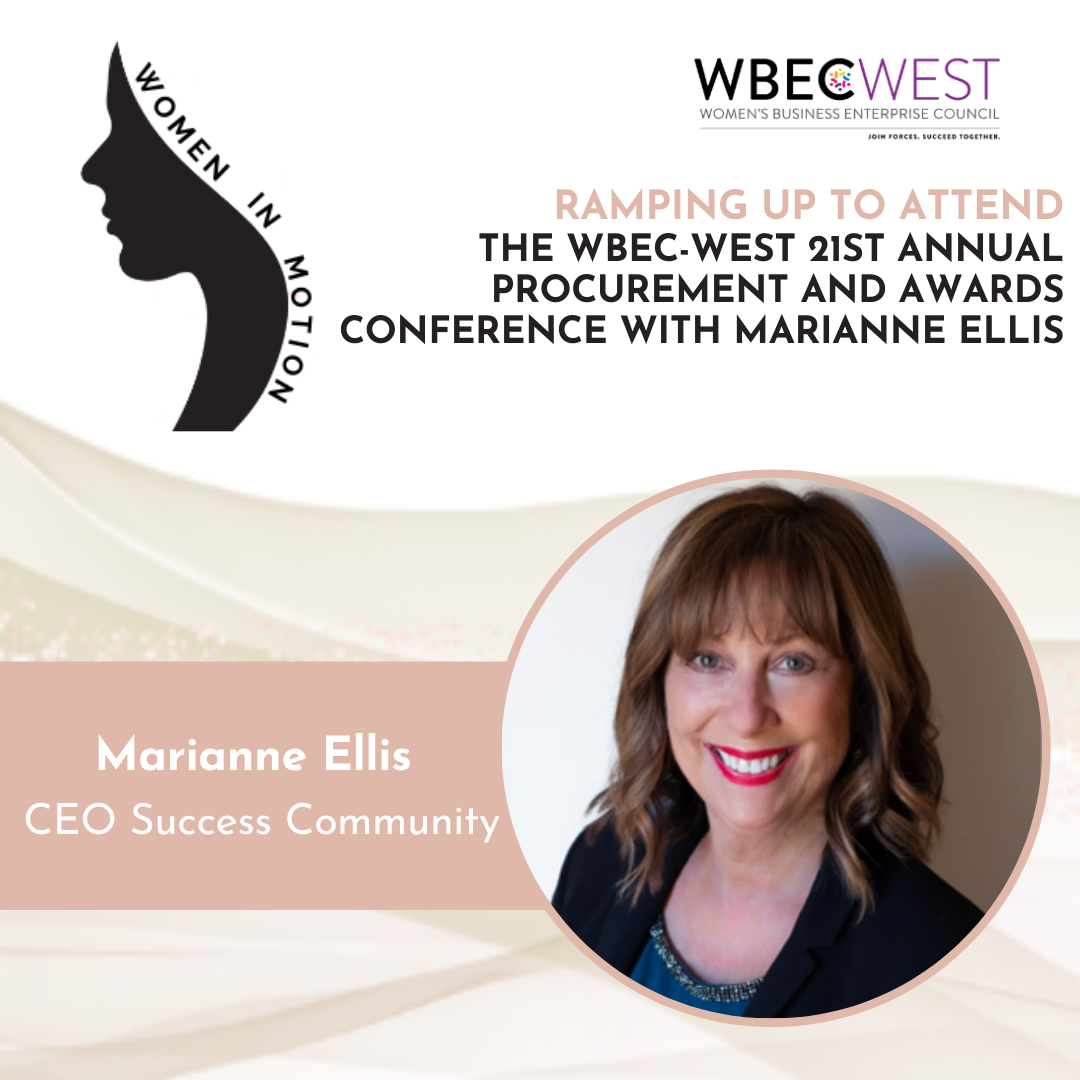
Ramping up to attend the WBEC-West 21st Annual Procurement and Awards Conference with Marianne Ellis

August 14, 2024 by angishields

WIM-Marianne-Ellis-Feature
Women in Motion
Ramping up to attend the WBEC-West 21st Annual Procurement and Awards Conference with Marianne Ellis
Loading
00:00 /
RSS Feed
Share
Link
Embed

Download file

In this episode of Women in Motion, host Lee Kantor interviews Marianne Ellis, CEO of the CEO Success Community. They discuss the significance of building a supportive community for women and diversity-owned businesses aiming for corporate contracts with Fortune 500 companies. Marianne shares insights about her organization and offers practical tips for attendees of the upcoming 21st Annual Procurement Conference in Las Vegas. Key advice includes thorough preparation, effective networking, and strategic follow-up.

Marianne-EllisMarianne Ellis is the CEO/Co-Founder of CEO Success Community–the source for Women & Diversity Owned Businesses seeking Corporate Contracts with Fortune 500 companies.

Our mission is to show CEOs the fastest path to increased revenue and growth. We are a CEO Community membership offering the following business tracks: Get To The Buyer, RFP/Proposal To The Win, Business Innovation, Sales Accelerator, Pivot Your Business, Virtual Conference Maximizer, Business Succession Planning and more.

We are proud to have coached thousands of Diversity CEOs. Major Corporations hire us to coach their Rising Suppliers like SCE, PG&E, and CDW. Diversity Associations WBENC, WBEC-West, WBEC-Pacific, and NAWBO count on us to run their signature workshops sponsored by Capital One, Mass Mutual, Bank of America, UPS, T-Mobile, Walmart, Accenture, and more.

CEO Success Community was built on a successful sales practice that averaged more than $100 million in new billing growth in less than 18 months. We have both sell-side and buy-side procurement experience running Fortune 500 RFPs. Our CEO programs have been featured in the 2023 Billion Dollar Roundtable (BDR) Economic Global Impact Report.

Marianne is an Amazon #1 Best Selling Co-Author of Women In Business Leading The Way and a Member of the Television Academy—annually attending The Emmys. She is an LA Times Inspirational Women of the Year Nominee, Two-Time Winner WBE Advocate of the Year, Community Impact Award and on the WBENC National Host Committee WBENC Nashville 2023. She was featured as a sought-after speaker.

Connect with Marianne on LinkedIn.

Music Provided by M PATH MUSIC

Transcript-iconThis transcript is machine transcribed by Sonix


TRANSCRIPT

Intro: Broadcasting live from the Business RadioX Studios, it’s time for Women in Motion. Brought to you by WBEC-West. Join forces. Succeed together. Now, here’s your host.

Lee Kantor: Lee Kantor here. Another episode of Women in Motion and this is going to be a good one. But before we get started, it’s important to recognize our sponsor, WBEC-West. Without them, we couldn’t be sharing these important stories. Today on Women in Motion, we have Marianne Ellis with CEO Success Community. Welcome.

Marianne Ellis: Hi, Lee, great to be back.

Lee Kantor: Well, I am so excited to get caught up. For those who aren’t familiar, can you share a little bit about CEO Success Community? How are you serving folks?

Marianne Ellis: Well, the way I like to say how we serve folks is we are the source for women and diversity-owned businesses seeking corporate contracts with Fortune 500 companies, which is why it’s perfect that we’re going to talk today about this upcoming September conference.

Marianne Ellis: Our mission, Lee, is to show CEOs the fastest path to increase revenue and growth and through RFPs and corporate contracting, that is a huge way to double and triple your company. We work both for corporations like Southern California Edison, PG&E, and CDW, putting programs together for diverse business owners. I can talk more about that later.

Marianne Ellis: And we also have a CEO Success Community where we have our CEOs work together to grow their business in a mastermind. And also we have about ten intellectual property workshops that have been very successful. And recently we were written up in the billion-dollar roundtable. So, big honor for us in 2024.

Lee Kantor: Now, any advice for other entrepreneurs out there that would like to build a community like you’ve been able to build? Like, is there some kind of things that are must-haves, nice to haves? Like, how would you go about building a community from scratch if you had to?

Marianne Ellis: It’s interesting. How to build a community from scratch, mine really happened organically and it all happened at WBENC West. So WBENC West has a wonderful program called the Platinum Supplier Program. I’m in year ten as a lead coach working with Jaymee Lomax, who is amazing. She’s the VP of WBENC West. Did the program for multiple years. It’s helping diversity-business owners, specifically women, get their capability statement ready.

Marianne Ellis: Capability statement is a like a resume for your business when you’re talking to corporations. And there’s a standard format, and we have a five-week program where we get the women, newly certified women business owners, ready with their capability statement. The story goes, after about two or three years of doing this or when the program ended, Lee, the CEO, said, “Marianne, can we keep working with you?” And I said, “Well, we don’t have a program for that right now.” And they said, “Well, could you create a community where we met monthly, got some more coaching advice since you, you know, were in a $16 billion spend procurement team? You know how the buyers feel. Can we keep working with you?” And here I am seven years later, Lee.

Lee Kantor: So, is that kind of at the heart of it? You have to be useful. You have to have some kind of organic reason for everybody to get together, that it’s a kind of a win-win around.

Marianne Ellis: I think when you think about affinity clubs, you know, whether you’re involved with your college, you know, after you graduate, whether you’re involved with certain charities or different causes that are important to you, it really has to do with being in a community of like-minded individuals and having things in common.

Marianne Ellis: So, what the CEOs and CEO success community have in common is they want to grow their business through RFP and corporate contracting. Some of them do do what we call WBE business owner to business owner contracting. But primarily it’s about RFP and corporate contracting. So they’re all, you know, also trying to run their business. So it’s staffing, it’s insurance, it’s process and procedures. It’s sales and marketing. They all have the same needs. We have a CEO group that’s been meeting on Tuesdays since the very beginning twice a month.

Lee Kantor: So, now if somebody wants to learn more about your community, what’s the best way to get a hold of you or check it out?

Marianne Ellis: I would say go on ceosuccesscommunity.com, like all good websites. Like, I try to do as I coach, make sure that, you know, you check out our website, look at our different programs and there’s a way to respond also on the website.

Lee Kantor: Now, we’re also here to talk about the upcoming 21st Annual Procurement Conference in Vegas in September. What is your take on that? How have you experienced this conference in the past?

Marianne Ellis: Well, first of all, I want to do a shoutout to anybody that’s listening that is a platinum supplier graduate. When you sign up for the conference, please check the box: yes, I’m a PSP graduate.

Marianne Ellis: I am so excited. Now, that we are post-COVID, WBENC West, so that’s Dr. Pamela Williamson and Jaymee Lomax have brought back the in-person platinum supplier showcase. So about 10 or 12 lucky business owners are going to be able to go in front of MGM, Chase, Disney, you know, Amgen, Amazon, and present their company. And what a fantastic opportunity.

Marianne Ellis: So, number one, I want to do a shoutout to the PSP graduates. Make sure that you register for the conference. It’s September 17th to 19th. We’re saying it’s in Vegas, but it’s really at the Westin Lake in Henderson so we’re not on the strip, and it’s going to be the 21st annual conference, and it’s going to be amazing. There’s going to be matchmakers, there’s going to be roundtables, there’s going to be cornhole playing with corporations. So if you haven’t registered for the conference, make sure you do so before it gets closed out and full up.

Lee Kantor: Now, the theme this year is amplify your success. Do you have any tips for conferencegoers when it comes to amplifying their success?

Marianne Ellis: Absolutely. I do a program right now that is sponsored by CDW. They are amazing WBENC Corporation. I think they’re a Fortune – they’re within the Fortune 40. And I take 15 business owners to the conference. So this is definitely my sweet spot. And to anyone that’s listening, I wanted to give you what I call my six top tips.

Lee Kantor: So I’ll go as long as you want, Lee, and then feel free to interrupt me. I would say tip number one, read the WBENC West Conference website three times and look for prospect names and conference opportunities. I’ll give you some hints if you’re listening. There’s a lunch on Wednesday where WBEs, business owners, can have an expo table. Now, unlike nationals, this is only going to be the WBE, the women business owners, are going to be tabling, and the corporations are going to have an opportunity to stop by your table. And you can also invite them. So if you look at the website and you check that on sign up, that’s important.

Marianne Ellis: Number two, there is a breakfast Thursday morning, a pitch competition. So, get your 60-second pitch ready and you’re going to pitch at the table. And then you’ve got to win your table. And then you go up on stage. And when you go up on stage, you’ll again have a chance to pitch your business.

Marianne Ellis: Also, when you read the conference website very carefully, which is tip number one, you’ll see that Amazon is listing their sourcing opportunities, but you’ve got to apply by August 19th, so don’t miss that.

Marianne Ellis: Two more things. WBENC West and Jaymee Lomax are having pre-conference training on August 9th and August 27th. Plus, you can sign up for the cornhole competition. You want to do that. It was a lot of fun when WBENC did this before and you get partnered with corporations.

Marianne Ellis: So, tip number one, Lee, read the conference website. Look at the prospect names, and the corporations that are going to be there. I also have the list of all the corporations that I saw on the sponsorship page that I can share with our listeners. As well as if you look at the pitch competition, they list their name and their company name. So, you can learn so much by – don’t give the website short shrift. Make sure that you read it three times. That’s tip number one out of six. Back to you, Lee.

Lee Kantor: And this is one of those things where, sure, it’s in Vegas, sure, you’re going to be at a nice hotel and resort, but you have to do some pre-work if you want to wring out the most value. Right? You wouldn’t just show up here and think like, oh, I’ll just figure it out when I get there. How hard could it be?

Marianne Ellis: So, okay, you are teeing me up perfectly, Lee. So tip number two, if you’re new at this, target three to five businesses. If you’re experienced, target eight to ten. What do I mean by that?

Marianne Ellis: So, when I talk about targets – this is going to surprise some of your listeners. The first thing you should do is thank your current clients. When I was at an event last week, that was a real fun one in Newport that WBENC West did. We got to network on a boat. The first thing I did was thank my current clients, Southern California Edison. So, shoutout to Gloria and William. They were there. So, that’s number one. Find out which of your current clients are going and put them on your list.

Marianne Ellis: Number two, you want to think about new business. So when you think about targeting new business, you want to look at the corporation category. Like, what industry are you an expert in? Are you an expert in utility, banking, pharma? And then put them on the list.

Marianne Ellis: And then I also say when you pick your three to five, definitely do your homework, what’s important to that corporation and how can you be of service and help. Do they have some new construction happening? Do they have a new product launch? What role can you play and how are you better than their current incumbent?

Marianne Ellis: There is a third group when you make your targeting list, I want to remind you. Don’t forget to thank the WBENC West team. So, definitely you don’t need to include them in your 3 to 5, or 8 to 10. But I would definitely make sure to connect with them.

Marianne Ellis: And I also say take a look at the sponsor page. So again, if you’re listening, here’s the sponsors I saw: MGM, Chase, Aflac, SoCal Gas, SRP, Disney, Banner Health, SCE, Sony, Blue Cross, Blue Shield, ASU, Amazon, Intel, Amgen, Caesars, Metropolitan Water Bank of America. So are any of those corporations ones that you have experienced with their industry, or are they current clients that you should check in with? Definitely, do your homework before you come to the conference so that you have your conference offer. Or what is it that your company can do to help that corporation? So tip number two, make sure to target your top 3 to 5 targets if you’re new at conferencing, or 8 to 10 if you’re experienced, and be conference ready.

Lee Kantor: Now, we’re talking obviously a lot about the conference and how to kind of get the most value from it. How do you handle the follow-up after the conference? You go to the conference, you have your list, you go through, you meet these people. How are you kind of elegantly following up with the folks you met throughout the year? Because you don’t want an event like this that you put this much time, energy, and resource in to just be that event. Like, you don’t want it to end there. You need kind of the relationships to kind of build over time. So how were you kind of doing follow-up where you’re staying top of mind?

Marianne Ellis: I’m so glad you asked that question because 50% of those that attend the September conference in Vegas for WBENC West will do absolutely nothing. According to the National Sales Association, over 50% of people that go to conferences or in sales never follow up, and it can take 5 to 12 meaningful interactions to win a relationship with a corporation to get in there for an RFP invitation.

Marianne Ellis: So, what I recommend is that you have your follow-up ready before you go so that all you have to do is fine-tune it once you learn more about the company, either in your one-on-one conversation or if they’re presenting at all at conference. So, that was going to be my suggestion number five. So we got through two.

Marianne Ellis: I’ll go down to number five, which is, be ready with outreach before you go. So you want to send out emails, LinkedIn messaging before you go to conference with those connections that you have that you know they’re going to be there and you want to up your posting on LinkedIn. That’s pre.

Marianne Ellis: During, you want to reach out to them to connect for coffee or a drink or a meal.

Marianne Ellis: And then post, you want to request a 15-minute introductory follow-up. Or if they specifically asked for something, you can follow up with that, but I would have this all pre-written before you go to conference. So in terms of outreach, I always say be ready with your drip five-plus program. And it has everything to do with pre, during, and post-outreach.

Lee Kantor: And like you said, you can get like 80-90% of that done before the conference. Like, you could be working on that today.

Marianne Ellis: You’ll be exhausted. There was actually a very impressive diversity-business owner. We were at a conference. I was talking to a corporation. They had asked for something and she emailed it that day right back. And when I looked at, because they shared with me what they had received in my mind but I didn’t say it out loud, a lot of that was pre-written. So, absolutely, you know what your company does best and how you help your current clients, be ready to express that when you go back and talk to the companies you just met.

Lee Kantor: Now, is WBEC-West doing anything to help, maybe before the conference to get ready? Is there going to be any type of education to help prepare a conferencegoer, you know, to help them kind of get the most out of it? Is there any webinars or anything like that?

Marianne Ellis: Absolutely. Jaymee Lomax is going to have her amazing pre-conference training on August 9th and August 27th. I want to tell you, I am uber-experienced and I have already signed up for 08/09 and 08/27 for her conference training because each conference brings something new and it’s really important that you listen to part one and part two. And just again, it’s about a month prior to the conference, so you still have plenty of time to take what you learn and apply it for your company.

Lee Kantor: Now, you mentioned you’re a veteran and you’ve been to, you know, more than one of these things in the past. Are there any highlights or anything memorable about any of the conferences in the past you’d like to share?

Marianne Ellis: I have a couple of quick stories because it’s their success stories, and we always love success stories. So, when we were in Denver, which was the last national conference, one of the business owners had really highlighted their keywords, which is so important in corporate contracting. Keywords is like, that’s the menu, that’s what they’re sourcing and shopping. And she had highlighted her keywords, and I was physically standing there when the corporate said, “I am sourcing that. You do that. Let’s sit down. I want to talk to you about an upcoming RFP.”

Marianne Ellis: Wow! She didn’t even have to do a 15-minute introduction. Her keywords did that. And I know that WBENC-West has a monthly keyword training. I would definitely recommend that you check that out on their website, which is wbec-west.com. If you go into the calendar, they monthly talk about keywords.

Marianne Ellis: A second great story is a business owner had really prepared themselves, and they were able to show to a corporation a problem on their website, which they could fix immediately for them, and they immediately got a purchase order. It was amazing. This corporation was so grateful. And they said, “You know, we have all these suppliers and you’re not even one of them. And you spot and you saw a problem on our website.” And rather than just pointing out the problem, they quickly had the solution and they immediately got a purchase order for that. Wow!

Marianne Ellis: Now, most of the time, as we like to remind everybody, it can take 18 to 24 months to get a contract with a corporation going through the RFP process. But they also have discretionary spend. Many corporations, Lee, can – they can do a purchase order for under 50,000. Some corporations it’s even higher. And they – again, if you’re what you do, your service is below their threshold, they could even pay you on a credit card. It’s called the p-card.

Marianne Ellis: So, sometimes that magic happens where you get invited to an RFP right at the conference. Or the even rarer one is you get a purchase order right at the conference. But I have seen it with my own eyes happen.

Lee Kantor: And it’s one of those things that those weren’t just random, pure luck. I mean, there was a lot of preparation that allowed them to be lucky at the right time.

Marianne Ellis: What do they say? It’s like hard work is how luck happens. Both of these business owners, both women, had worked very, very hard. And the woman who had worked on the keyword, she had really fine-tuned them. So the minute that these corporations saw her keywords, they were like, yep, that’s what I need. Or nope, that’s not what I need. And the other business owner, she was a very experienced conferencegoer so she went to that 8 to 10 level of preparation. And the corporation that, you know, she had taken a look at these 8 to 10 corporations and were looking for any flaws or problems. Her area was website, Ux/UI.

Lee Kantor: Now, you’ve mentioned so many things that are obviously valuable to growing a person’s business. But part of this conference is kind of building relationships and nurturing existing relationships. Are there things that you’re going to be doing or looking forward to maybe that aren’t the hardcore business stuff but it’s more the fun, friendly build rapport and build and deepen relationship stuff that you’re looking forward to?

Marianne Ellis: I think you have the right spirit, Lee. Absolutely. I always say in my area of must-do’s, yes, we all need to have a conference checklist, and we can talk about that in a minute. But I think the most important thing you need to pack before you go to the September conference in Vegas, you need to pack the right attitude. And what I mean by that is this is not the hard sell time. Nobody likes to be hustled. You don’t like to be hard sold when you walk into a store or you meet people.

Marianne Ellis: So, this is really relationship building, getting to know people as human beings because we all are human beings, having a lot of respect. So, I always say relationship and respect come before revenue. If you put revenue first and you don’t build that relationship and respect, it’s never going to happen. I also think what’s really important besides, you know, having a conference checklist and packing the right attitude, I also think you need to live in the moment.

Marianne Ellis: And that’s one of my favorite parts, is I can plan and plan and plan and so can the CEOs I work with but opportunity will find you if you are open. If you have your head in your playbook or your head in your phone or your head in your notes, a terrific opportunity could pass right by you. My favorite story in that area was they had meet and greets at one conference, and there was this one corporation sitting all by themselves because everybody rushes, you know, to the, you know, the Amazon table or the Disney table.

Marianne Ellis: But they were sitting all by themselves and one business owner said, you know what? I’m not going to rush where the crowds are. I’m going to go to this individual person and create a relationship. They now have a contract with that corporation. They got the full one-on-one time with this company. So, sometimes it’s good to go where others are not. Sometimes it’s good to say hello to somebody standing by themselves. You have an opportunity to have a one-on-one. And it’s also great to make relationships with other business owners. And that’s your network.

Marianne Ellis: Jaymee Lomax is famous for her saying, HASU, which is hook a sister up. So all the time, if I meet a corporation, I ask them what they’re sourcing. I just recently did that when I was in Newport, and I heard that one company is looking for electricians and people who can do more, you know, residential, commercial repairs. So, I’m going to look into the business owners I know and refer them.

Marianne Ellis: So, yeah, I think you have to – that’s to me the spontaneous – sort of spontaneous things that happen. And that’s a really big part of having all the preparation but living in the moment.

Lee Kantor: And that’s what’s so magical about these in-person conferences. It’s hard to duplicate that virtually. And so when you have the opportunity to be in-person and meet face-to-face with folks you might have been on a Zoom with, it really becomes magical. And you can really accelerate relationships in this environment.

Marianne Ellis: I would also – to the listeners if anyone gets to Vegas and starts to panic or gets confused, I think we, you know, come by my table. Just take a break and come by my – I’m in a table. I have a CEO Success Community table. Just come by and say, you know, or if you have a question or if there’s something I can do to help you, you know, just know that there’s a lot of us that have been doing this for a while and we’re always willing to help other business owners.

Lee Kantor: Now, you mentioned this checklist. Do you got any checklist information to share?

Marianne Ellis: So in terms of the checklist, I’ll go through a couple of things that I would like everyone to keep in mind that they should have prepared. First thing is business cards. And make sure your business cards have plenty of white space so the corporates can write notes. Don’t have those cards that you can’t write on or all-colored front and back. But, you know, we do want to be more sustainable. We do want to be digital. So I always say bring a digital card and a hard, you know, regular card.

Marianne Ellis: Capability statements. I think it’s good to bring a few – they may not want to walk away with it, but at least it can anchor a conversation. QR code is another thing that a lot of corporations like. Again, if you’re doing your table, you want to bring whatever signage you need for your table or giveaways.

Marianne Ellis: I also think on that checklist, you want to make sure that you pack comfortable shoes and clothes that you’ve worn before. Don’t run out and buy new stuff. Make sure it’s comfortable.

Marianne Ellis: You’re using your phone a lot during the day, so bring a battery. And, you know, some people are more on their phone versus notepad.

Marianne Ellis: You definitely want to check your website and your LinkedIn before you go. And matter of fact, you may want to announce on LinkedIn that you’re going to be there because there’ll be a lot, a lot of other business owners there. But also think about your email signature.

Marianne Ellis: I also think on your checklist, it’s good to have a group, kind of a gang, that maybe you’re in a group chat so you don’t feel like you’re all alone. We talked about your homework on your top, whether you’re doing 3 to 5 if you’re new prospects, or 8 to 10 if you’re experienced. I think those are the big things.

Marianne Ellis: And then, like Lee and I talked about earlier, you know, get that prospect outreach program ready. So when you get back, you can just change a few things and then follow up. So, that would be my checklist.

Lee Kantor: Yeah. And a great place to start is the WBEC-West website. That’s W-B-E-C, hypen, W-E-ST, dot com. Go there. You can sign up for those webinars, which I think are really important, and that’s going to be happening, you know, several weeks before the event so it’s important to kind of just dip your toe in and just start to meet some of the folks that are going to be there and that can be helpful.

Marianne Ellis: I also think that messaging is really important, Lee. So I do want to remind everybody, take a look at the messaging on your website.

Lee Kantor: And then, so, the messaging and the website, and then you mentioned the email signature in any way you’re communicating probably on social media as well. Right?

Marianne Ellis: To really get a Word document and introduce yourself in 20 words. That’s about 10 seconds and that’s about all you can hear if you’re online. And then if you’re doing an expo table, I’d have a 30-second introduction, which is about 75 words.

Marianne Ellis: So, I also think there is a preparation. And then I would practice. Practice with your family, practice with your employees, practice with your friends. Make sure that once you socially introduce yourself, you’re someone that they’d like to continue to talk to, not run away.

Marianne Ellis: And, for the expo table, or if you get a longer period of time with the corporation, you know, what is your 30-second introduction? Your elevator pitch, if you know what I mean. So, I think messaging is important, and I think being short to the point and succinct.

Lee Kantor: Yeah, absolutely. And, Marianne, thank you so much for sharing your wisdom today. It’s so important for folks. If someone wants to connect with you, one more time, your website for SEO Success Community.

Marianne Ellis: It’s www.ceosuccesscommunity.com. And I’ll also be there, helping with Jaymee Lomax with the platinum supplier in-person showcase. So, yeah, year ten working for WBENC West in this area is such a joy. And again, if I can help anyone, please come and seek me out at the conference. And hopefully, I’ll see you at the training on August 9th and August 27th.

Marianne Ellis: My last fast piece of advice, my iPhone is my secret weapon at the conference, so come by my table and ask me about that.

Lee Kantor: All right. Well, Marianne, thank you so much for sharing your story and for all those tips. You’re doing such important work and we appreciate you.

Marianne Ellis: Thank you. And thank you to WBENC West. We owe so much to WBENC West, Dr. Pamela Anderson – Dr. Pamela Williamson – I love that – Jaymee Lomax, as well as Tera Jenkins. We also have Heather who’s on board, and Ella, I mean, Maria. There’s a whole great team behind WBENC West and we really appreciate all of them. So, thank you.

Lee Kantor: All right. This is Lee Kantor. We’ll see you all next time on Women in Motion.


Tagged With: CEO Success Community, WBEC-West 21st Annual Procurement and Awards Conference

Business RadioX ® Network


Our Most Recent Episode

CONNECT WITH US

  • Email
  • Facebook
  • LinkedIn
  • Twitter
  • YouTube

Our Mission

We help local business leaders get the word out about the important work they’re doing to serve their market, their community, and their profession.

We support and celebrate business by sharing positive business stories that traditional media ignores. Some media leans left. Some media leans right. We lean business.

Sponsor a Show

Build Relationships and Grow Your Business. Click here for more details.

Partner With Us

Discover More Here

Terms and Conditions
Privacy Policy

Connect with us

Want to keep up with the latest in pro-business news across the network? Follow us on social media for the latest stories!
  • Email
  • Facebook
  • Google+
  • LinkedIn
  • Twitter
  • YouTube

Business RadioX® Headquarters
1000 Abernathy Rd. NE
Building 400, Suite L-10
Sandy Springs, GA 30328

© 2025 Business RadioX ® · Rainmaker Platform

BRXStudioCoversLA

Wait! Don’t Miss an Episode of LA Business Radio

BRXStudioCoversDENVER

Wait! Don’t Miss an Episode of Denver Business Radio

BRXStudioCoversPENSACOLA

Wait! Don’t Miss an Episode of Pensacola Business Radio

BRXStudioCoversBIRMINGHAM

Wait! Don’t Miss an Episode of Birmingham Business Radio

BRXStudioCoversTALLAHASSEE

Wait! Don’t Miss an Episode of Tallahassee Business Radio

BRXStudioCoversRALEIGH

Wait! Don’t Miss an Episode of Raleigh Business Radio

BRXStudioCoversRICHMONDNoWhite

Wait! Don’t Miss an Episode of Richmond Business Radio

BRXStudioCoversNASHVILLENoWhite

Wait! Don’t Miss an Episode of Nashville Business Radio

BRXStudioCoversDETROIT

Wait! Don’t Miss an Episode of Detroit Business Radio

BRXStudioCoversSTLOUIS

Wait! Don’t Miss an Episode of St. Louis Business Radio

BRXStudioCoversCOLUMBUS-small

Wait! Don’t Miss an Episode of Columbus Business Radio

Coachthecoach-08-08

Wait! Don’t Miss an Episode of Coach the Coach

BRXStudioCoversBAYAREA

Wait! Don’t Miss an Episode of Bay Area Business Radio

BRXStudioCoversCHICAGO

Wait! Don’t Miss an Episode of Chicago Business Radio

Wait! Don’t Miss an Episode of Atlanta Business Radio